Life services, 208 answers from Kuaishou
A nail salon with 4 chairs and 4 nail technicians. It takes 1 hour for a solid - color manicure and 2 hours for a manicure with rhinestones. Assuming it operates for 12 hours a day, the daily reception limit of this salon can be clearly calculated. It's just that specific number, no more, no less.
On May 15th, at the Chengdu Science Fiction Museum, Liu Xiao, the person - in - charge of the Kuaishou Life Services Division, started his speech on stage with this arithmetic problem. There were hundreds of merchants, agents, and partners sitting in the audience, coming from dozens of industries such as driving schools, dental clinics, electric vehicle stores, legal consultations, and household maintenance. Most of them probably wouldn't use the term "marginal effect" to describe their situation, but everyone knows one thing: I can only receive so many customers a day. I can't take one more, and if I take one less, I'll lose money.

This is the most fundamental difference between life services and e - commerce. E - commerce can have explosive orders, achieve scale, and spread costs with more SKUs. However, for a nail salon, a driving school, or a dental clinic, the ceiling of the business is locked by three variables: "people × time × space".
Liu Xiao put it more concisely: "The essence of life services is to sell people's time - space inventory."
And the inventory has an upper limit. So what the platform can do is not to help merchants "sell more", but to help them earn more within the limited inventory. Either improve efficiency to increase profits or reduce costs to cut expenses. There is no third way.
"Hello, I'm glad to serve you" is the theme of this conference and also the most common opening line in the service industry. This ordinary sentence might be the key to understanding Kuaishou's organizational structure adjustment and the establishment of the new Life Services Division.
The Majority Passively Migrating Online
Manicures may take a long time and are not very typical. Let's take men's haircuts as an example.
The price of a common community barbershop is around dozens of yuan. After deducting rent, utilities, shampoo costs, and the assistant's salary, the daily profit may only be three or four hundred yuan.
This is still an ideal situation. If it's rainy or extremely hot or cold, the customer flow will be further affected. If you are the owner of one of these barbershops, you must have considered "going online" either passively or actively in the past two years.
You registered an account on a content platform and also listed your shop on a group - buying app. "The customer acquisition cost is low on content platforms." You tried it. You asked your assistant to hold the phone and film haircuts, added a popular piece of music, and posted it. The video got a good view count, but no one came to your shop because of it. Among the three thousand people who watched the video, some might be in Shanghai and some in Guangzhou.
Some shop owners who want to invite influencers to visit and promote their shops are completely in the dark. As for group - buying, it's not very friendly to small - profit community shops.
There are nearly 25 million enterprises in the entire life services field, and they have been wavering between these two dilemmas in the past five years.
The group - buying platform is a passive waiting model. Users actively search when they have a need, and shops can only get a position through group - buying price wars. The content platform model is an active reach model. Short - videos are pushed in front of users, but most of the people who see them have no demand for the shop. They are "consuming your content" but not "consuming your services".
According to Yu Daxi, the person - in - charge of small and medium - sized merchant operations, these merchants are like "one - man armies". The boss serves as the decision - maker, marketer, content producer, customer service, and accountant all at once. They look after the shop during the day and edit videos at night. Few can understand the advertising back - end.
The problem is not that merchants don't work hard. It's that the measurement dimensions in the life services field previously were not focused on the merchants. In the past few years, the competition focus among platforms was on GMV and the number of merchants: who signed more shops, who sold more coupons, and whose verification data looked better. But GMV measures the platform, not the merchants. There is a long way between selling coupons and in - store verification. Not to mention industries like real estate, education, and law that generate "leads" rather than direct transactions.
Especially on content platforms. Just because someone watches food - related live - streams every day doesn't mean they want to go out for a meal today. Just because someone watches hair - cutting videos with great interest doesn't mean they want a haircut this week. Competing for coupons and view counts on content platforms attracts people interested in the content, but there is a wide gap between content interest and consumption willingness.
Kuaishou clearly noticed this. This year, it set "serving the service industry" as the direction of the division. The division changed from "Local Life" to "Life Services", which essentially means a shift in the underlying logic. It no longer focuses on group - buying coupons and GMV but turns to leads and user management.
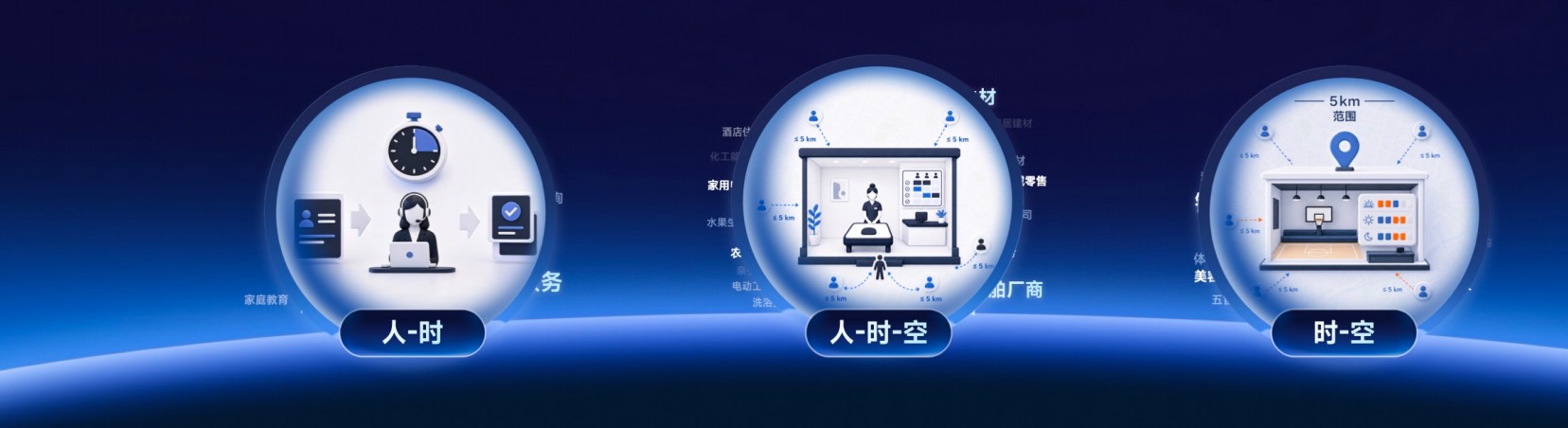
Put simply, it means helping you find the people who will actually enter your shop.
What this change means to the merchants sitting in the audience may only be gradually understood when they open their mobile back - ends. But at least, the barbershop owner has finally received a long - awaited signal: the platform no longer forces him to issue coupons but tries to find people within a 3 - kilometer radius who want a haircut in the next few days and can accept a price of 60 yuan.
There may not be many such people. But for a shop that can only receive dozens of customers a day, it doesn't need many, just enough.
AI, Products, and Solutions: How Does Kuaishou Solve the Problem?
So, how to find those "right people"?
This is the core question that the entire conference is actually answering. Kuaishou has developed a large number of large - scale models, AI tools, advertising systems, and crowd - matching algorithms in the back - end, but merchants at the front - end can hardly feel them. One of the core purposes of this conference is to make the black - box system transparent so that merchants know what's going on inside the engine.

Let's go back to that barbershop. The owner wants to acquire customers online but doesn't want to issue coupons or compete for video view counts. He just wants people nearby who want a haircut to know his shop. The problem is that it's normal for a person to get a haircut about 10 times a year. How can we know that he "wants a haircut in the next few days"?
Can we rely on his browsing history, likes, and collections on the platform? These data can hardly capture such detailed consumption intentions.
Kuaishou took a different approach. Instead of looking at what content users passively consume, it captures their active behaviors - what they ask in the comment section, what they say in the live - stream, and what keywords they search for.
The moment a person types "men's haircut" in the search box, his consumption intention is clearer than after watching 100 haircut videos. Based on these active signals, Kuaishou launched the "Crowd Exploration Agent" this year. It first understands what service the merchant provides, how much it's worth, and who it's suitable for, then identifies real intentions from users' active signals, and automatically completes the matching within the constraints of the budget and geographical scope. According to the test data shown on - site, the ability to attract high - intention users in the legal industry increased by 4 times, and the intention reach rate in the medical industry increased by 31%.
For that barbershop owner, this can be simplified into one sentence: The platform helps you find people nearby who want a haircut and pushes your information to them. Customers come not because it's cheap but because they need your service right now.
This is the first - level requirement: finding people. What about after finding them and even completing the transaction?
Sun Bo, the person - in - charge of transaction products, said, "Transaction is not the end but the starting point of business operation." From the platform's perspective, if it only optimizes immediate transactions, it can only help merchants sell teeth - cleaning coupons. The distance between helping you sell goods and helping you do business is much farther than many people think.
Take a dental chain with a more complex business scenario as an example. A dental clinic usually offers two types of services: low - price promotional packages and high - profit orthodontic and tooth - implanting solutions.
In the past, when advertising on the platform, these two types of products were put into the same advertising system for bidding. The system sorted them by immediate transaction amount. The order - placing rate of a 30 - yuan teeth - cleaning service crushed that of an 8000 - yuan orthodontic service, and all the traffic was tilted towards teeth - cleaning. You kept selling teeth - cleaning coupons, but the system didn't see or care whether these people actually came to the clinic or upgraded to orthodontic services.
Moreover, the conversion process of a dental clinic is not completed in one step. A user may take several days or even weeks from seeing a teeth - cleaning video, sending a private message for consultation, visiting the clinic for a diagnosis, to finally getting orthodontic treatment. This is not something that can be solved by just "placing an order". It requires "dialogue", multiple - round, continuous, and trust - building dialogue.
Kuaishou spent five months last year to establish a second link: private - message - based business operation. Group - buying solves immediate transactions, and private messages solve business that requires communication.
Kuaishou announced a set of data on - site. In 2025, the commercial consumption of the private - message link on the entire platform increased by 233%, and the lead generation increased by 237%. On this basis, the intelligent advertising product "Zhipintui" for transaction advertising separates promotional products from regular - price products. Promotional products are not measured by immediate transaction amount. The system evaluates the real business value by looking back at the subsequent in - store rate, upgrade rate, and regular - price conversion rate. Regular - price products follow a precise - matching route and are mainly promoted in scenarios with strong signals such as searches.
The example of the dental chain actually exists. After adjusting the strategy, its order volume in the content field increased by 262%, and in the search field, it increased by 117%. The order volume in one quarter was almost equal to that of the whole last year.
Finding people, receiving them, and completing the business require the platform to upgrade its capabilities. But for most small and medium - sized business owners, there is a more fundamental and pressing problem: they can't even take the first step.
Owners of mobile - phone repair shops, household - service providers, cake shops... may know they need to transform online, but they don't know how to shoot videos, do live - streams, or place ads. They may not even figure out what their selling points are.
Yu Daxi shared an interesting detail on - site. The AI product "Qingsong Robot" announced at the conference can sense this confusion. When you move your mouse back and forth three times, it will start to assist the merchant. In a situation where the merchant doesn't know what to choose at this stage of the industry, it will "help you make a choice".
Behind this small interaction - design idea is actually a microcosm of the solutions Kuaishou has created based on AI technology.
Correspondingly, a variety of capabilities and product matrices were launched at this conference:
- If you don't know how to shoot videos, the Pineapple Video Factory can help you. The back - end product - selection model determines which products are easy to sell. The video agent analyzes the shot language of popular videos on the platform and then fills in your product information to generate videos in batches. A competition mechanism allows multiple versions to compete, and the winning version will be used for enhanced learning.
- If you're afraid to appear in live - streams, the Digital Human 4.0 can replace you. Kuaishou even provides emotion - control and "dialect - Mandarin" capabilities to make the digital human more realistic.
- If you don't understand the advertising back - end, you can use the "Worry - free Advertising" service. Just set the budget, duration, and advertising slogan, and the system will do everything automatically. If the lead generation target is not met after the advertising, compensation will be provided. The more advanced "Dialogue - based Advertising" can even automatically generate an advertising plan as long as you state the budget and expected results.
These tools solve different pain points but aim at the same thing: making tasks that used to require a professional team doable by one person.
It must be recognized that the life services industry is not just "one" industry. At least on Kuaishou, it is a combination of 208 secondary sub - industries. From catering to driving schools, from dental clinics to stadium reservations, from legal consultations to electric vehicle stores, the cost structure, customer - acquisition path, and business operation mode of each industry are completely different. Trying to solve all problems with one set of solutions is doomed to fail here.

This is also the original intention of Kuaishou to continuously refine the industry category division and form a team of hundreds of optimization specialists to provide one - on - one services. By deeply understanding different industries, based on AI technology and the product matrix, truly customized personalized solutions for each industry can be developed.
The number 208 itself is a statement of attitude. It means that Kuaishou has chosen a very challenging path. Instead of being a unified traffic - distribution platform, it tries to become the infrastructure of the life services industry.
Who Is Changing, Who Is Still on the Sidelines
Merchants don't need to be experts in the platform. The platform should be an expert for the merchants.
Several merchant cases at the conference formed a sharp contrast. On one side is Jike Electric. Its parent company, CF Moto, is a listed company on the Shanghai Stock Exchange, with four global R & D centers and six manufacturing bases. Jike has accumulated nearly 90 million people on Kuaishou, with a payment GMV exceeding 200 million yuan, a sales growth rate of 1633%, and a 1562% month - on - month increase in AIGC live - stream sessions. They jointly created the "Riding Diary" IP and a micro - variety show about motorcycle trips with Kuaishou, with a global exposure of 2.2 billion. They have brand influence, a professional team, and the budget to create a content matrix and cooperate with top - tier influencers. They can easily make use of the platform's tools.
On the other side is Han Jianhua, the owner of a driving school in Shenyang. It's a small and medium - sized driving school that abandoned offline recruitment and focused on online operations. With the help of AI customer service and video tools, its performance doubled. But the only keyword he repeatedly mentioned at the conference was "cost". "We