Buying following NVIDIA is the most "profitable" money-making strategy in the AI era.
All along, Buffett's Berkshire has been regarded as the "Bible" in the investment world.
But in the era of AI, it might be time to replace this icon.
At the end of last year, NVIDIA heavily invested in Intel, Synopsys, Nokia, CoreWeave, and Nebius all at once.
As a result, these holdings have almost all skyrocketed this year.
Intel has soared by 195% this year, Nebius has risen by 162.6%, and Nokia has increased by 115.6%. Even CoreWeave, which has the "smallest" increase, has risen by about 50% this year.
This means that if you simply and crudely bought 20% of each of these 5 companies at that time, as of now, the combined return has reached as high as 106%, far outperforming the Nasdaq.
And this is just in the past half - year.
If we look further back in time, since 2024, NVIDIA has completed 7 investment exits, among which 5 were profitable and 3 directly doubled in value.
This win - rate and money - making speed can no longer be explained by ordinary industrial investments. To some extent, NVIDIA is becoming more and more like the "super dealer" in the AI world.
In the AI era, there is no better strategy than following Huang Renxun's investments.
01 Seven Exits, Three Doubled
If you take a close look at NVIDIA's investments in the secondary market in the past two years, you'll find something quite astonishing:
Not only does NVIDIA itself rise in value, but even the stocks it has invested in have started to skyrocket collectively.
Since 2024, NVIDIA has held shares in 12 US - listed companies in total, and 7 of them have completed the exit process.
Among these exit cases, 5 achieved profitability, and 3 had a return rate of more than double.
The three most remarkable cases are SoundHound AI, Serve Robotics, and Applied Digital.
The most astonishing one is Serve Robotics.
What this company does is actually "sidewalk delivery robots" - a seemingly niche field. But NVIDIA got involved early on.
It's worth mentioning that this investment was not made by NVIDIA in the secondary market, but came from earlier SPACs, private placements, and convertible bonds.
In the second quarter of 2024, when it first appeared in NVIDIA's 13F filing, NVIDIA held about 3.727 million shares, with a market value of only $7.268 million, corresponding to a share price of about $1.95.
Just half a year later, by the end of 2024 when NVIDIA exited, the share price of Serve Robotics had risen to $14.37.
That is to say, this initial holding of less than $8 million had swelled to about $53.56 million when exiting.
In just half a year, the book value increased by more than 6 times.
If you were just an ordinary retail investor, buying in the third quarter of 2024 and selling by the end of 2024, you could also have made at least about 1 time your investment.
Another more classic case is Applied Digital.
In September 2024, NVIDIA participated in its $160 million private placement financing at a cost of only $3.24 per share.
It then held the shares until the third quarter of 2025 and completed the liquidation in the fourth quarter.
Calculated based on the exit window, NVIDIA's initial investment of about $25 million eventually swelled to about $177 million.
With one investment, the floating profit was about $152 million, another myth with a return close to 6 times!
As for SoundHound AI, it's more like the most classic emotional performance of a "NVIDIA concept stock".
As of Q1 2024, NVIDIA held about 1.73 million shares of SoundHound AI. At that time, the share price was $5.89, and the market value at the end of the quarter was about $10.195 million.
By the end of 2024, when NVIDIA completed the exit, the share price of SoundHound AI had risen to $19.84. Based on the holding cost, NVIDIA made more than 2 times its investment.
In addition, NVIDIA even made a fortune in ARM's IPO.
The IPO issue price of ARM was $51, and NVIDIA held 1.96 million shares. Based on this price, NVIDIA's initial holding cost was about $100 million.
Although it reduced some of its holdings midway, the market value of the remaining position had reached about $156 million by the last disclosure.
Conservatively estimated, NVIDIA made at least 1 time its investment in ARM.
Of course, NVIDIA is not "always on target".
For example, it invested $50 million in Recursion Pharmaceuticals in 2023. But by Q3 2025, when the last holding was disclosed, the market value was only about $37.6 million. It then liquidated the position in Q4 2025.
That is to say, this investment ultimately lost about $12.39 million, with a return rate of about - 24.8%.
02 Three Doubled This Year, Floating Profit of $17.8 Billion
Since last year, NVIDIA has been making more and more aggressive bets.
In terms of the total scale, the amount of NVIDIA's disclosed US stock holdings has rapidly increased from about $333 million in the first quarter of 2024 to about $13.105 billion in the fourth quarter of 2025.
In two years, it has almost increased by 40 times.
Now its core holdings are Intel, Synopsys, Nokia, CoreWeave, and Nebius.
The most remarkable one is Intel.
NVIDIA currently holds about $7.925 billion worth of Intel shares, accounting for more than 60% of its entire holdings.
The second - largest holding is Synopsys, a giant in chip design software, worth about $2.265 billion. The third is CoreWeave, an AI cloud company, worth about $1.739 billion.
Even more astonishing is that almost all of these holdings have skyrocketed this year.
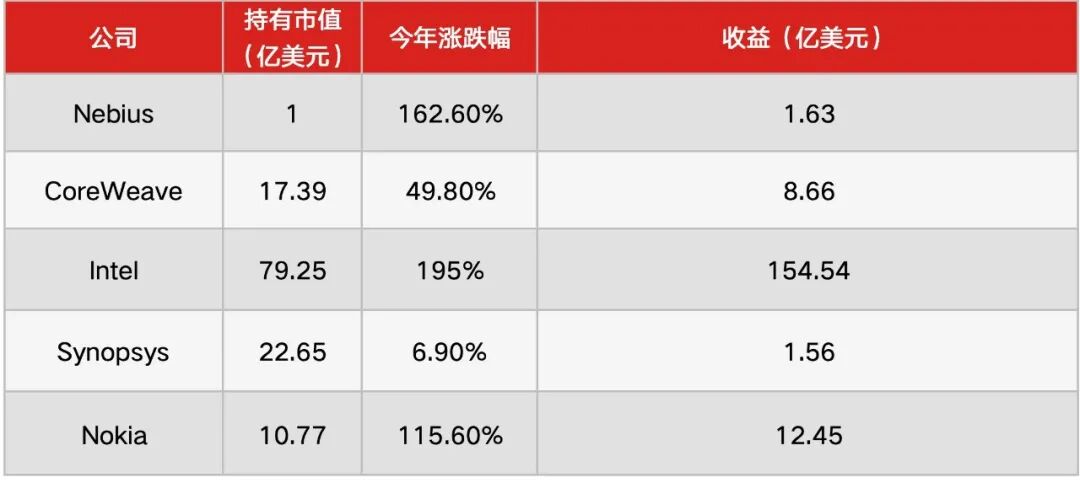
Intel has soared by 195% this year, Nebius has risen by 162.6%, and Nokia has also increased by 115.6%. Even CoreWeave, which has a "smaller" increase, has risen by about 50% this year.
If we simply make a static calculation based on the year - end holdings without considering intermediate increases or decreases, NVIDIA's floating profit from these 5 stocks alone has already approached $17.8 billion this year.
Among them, Intel alone contributed about $15.4 billion.
This year, NVIDIA has continued to increase its positions crazily, focusing on two directions: AI cloud and optical interconnection.
In January 2026, NVIDIA invested an additional about $2 billion in CoreWeave at $87.2 per share. In March, it invested about $2 billion in Nebius through private placement prepaid warrants.
In addition to continuing to increase its investment in the AI cloud, NVIDIA has also carried out a larger - scale layout in the "optical interconnection" direction this year.
As of now, NVIDIA has cumulatively invested more than $7 billion in the optical communication industry chain, basically covering the entire chain from "light source devices - optical chips - optical fibers/encapsulation". The specific companies include:
Invested $2 billion in Lumentum
Invested $2 billion in Coherent
Signed an investment agreement of up to $3.2 billion with Corning
Meanwhile, NVIDIA has also continued to strengthen its AI infrastructure ecosystem.
On March 31, 2026, NVIDIA announced an investment of $2 billion in Marvell and will cooperate in areas such as NVLink Fusion, customized XPU, silicon photonics, and AI - RAN.
Judging from the results, the money - making effect of following NVIDIA's investments is still quite astonishing.
Taking the opening price on the day NVIDIA announced the investment as the starting point, to date, Marvell Technology has risen by 83.5%, approaching a doubling. Coherent and Lumentum have also risen by 39.1% and 30.7% respectively.
Only Corning, which just announced the cooperation recently, has only risen by 1.3% so far.
This is the charm of NVIDIA's investments.
03 Conclusion
Why does following NVIDIA's investments always make money?
Because in this era, Huang Renxun is not only a tool - seller, but also a gold - mine explorer, and even the rule - maker of the game.
When NVIDIA invests in a company, it is not only injecting capital, but also injecting computing power, orders, and industry endorsement.
Every move of NVIDIA is to build a moat for its huge computing - power empire. And the skyrocketing stock prices in the secondary market are just a by - product of this "ecosystem empowerment".
In the past, value investors followed Buffett to look at cash flows and moats. But in the AI era where computing power equals power, perhaps the best investment strategy is to see where NVIDIA's money is flowing.
After all, at the gambling table, following the dealer's bets is always the strategy with the highest win - rate.
This article is from the WeChat official account "Silicon - based Observation Pro", author: Silicon - based Jun. Republished by 36Kr with permission.