Structural Transformation in Satellite Communications: Growth Driven by Technology, Geopolitics, and Business
Recently, the well - known consulting firm Boston Consulting Group released the report "The Future Growth Path of Satellite Communication Connectivity", pointing out that the global satellite communication industry is in the midst of a structural transformation. This transformation is reshaping the industry's economic model, geopolitical landscape, and user experience. Currently, commercial space has become a popular track in China. As a typical area of commercial space, the commercialization potential of satellite communication has begun to be unleashed, bringing considerable revenue to relevant participants.
What prominent characteristics is satellite communication presenting?
In the report of Boston Consulting Group, by analyzing the driving forces of the transformation of satellite communication connectivity, the future growth path, and the competitive landscape, the most prominent characteristics of the current global satellite communication field can be found.
First, from the perspective of the driving forces behind satellite communication, Boston Consulting Group believes that the structural transformation in this field is driven by three major forces, mainly including:
One is the drive of technological transformation. Due to the continuous progress of technologies such as reusable rockets, satellite mass - production capabilities, and inter - satellite links, the cost and communication delay of low - Earth orbit (LEO) satellites have been significantly reduced, thus expanding the application scenarios of LEO constellations. This has enabled LEO to dominate and, to a certain extent, compete with terrestrial communication.
Two is the influence of geopolitical factors. The Russia - Ukraine war has significantly accelerated the militarization of commercial space services, making it a key part of modern hybrid warfare. For this reason, Europe has launched the 11 - billion - euro IRIS2 program, Canada supports the Lightspeed project, and Germany is advancing Satcom BW Stage 4. Sovereign communication capabilities have risen to a national strategic necessity.
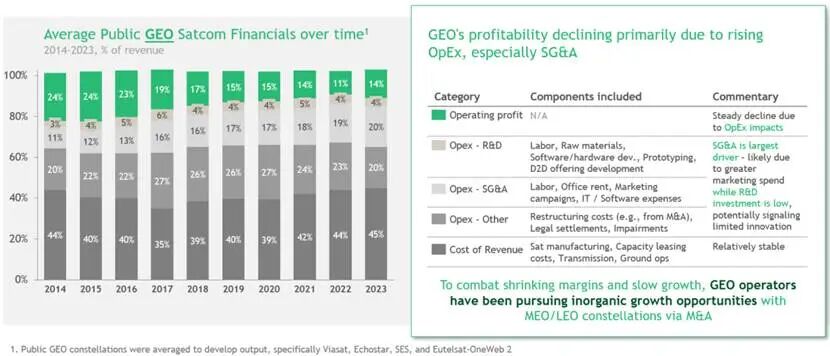
Three is the impact of intensified competition. Vertically integrated LEO operators have reshaped the cost structure, leading to a decline in the profit margins of traditional geostationary orbit (GEO) operators, who are facing weak revenue growth and integration risks. For example, through vertical integration, SpaceX covers the entire chain of satellite development, launch, terminals, and services, with costs and efficiency far exceeding those of traditional GEO operators. From 2019 to 2024, the total shareholder return of GEO operators declined by about 20% over five years, and the operating profit margins of most operators fell below 20%. The industry has entered a stage of survival of the fittest. The following figure shows the continuous decline of GEO operating profits in the past few years.
Second, the incremental value in the future satellite communication field will mainly come from three major areas, mainly including:
One is the in - flight connectivity area of the aviation industry. The global air passenger volume has recovered and exceeded the pre - pandemic level, with an annual increase of over 4%. Passengers' demand for internet access, streaming media, and video conferencing has increased, and the in - flight connectivity demand has shifted from basic communication to streaming media and business applications. In 2014, only 10% of global aircraft were equipped with connectivity systems, and this figure rose to about one - third in 2024. It is expected that the penetration rate will exceed 50% within a decade, covering more than 900 airlines.
Two is the satellite direct - to - device (D2D) area. This should be a part of the area that the current satellite internet is relatively concerned about. Currently, only one - third of the world's land is covered by cellular networks, and about 2.7 billion people still do not have mobile network services. The demand for non - terrestrial networks (NTN) is on the rise. Currently, D2D mainly serves emergency communication and will evolve towards broadband - level applications in the future. Operators can use satellites to cover remote areas at a lower cost, replacing traditional base stations and fiber - optic construction. Of course, the D2D business model is still in its early stage, and spectrum and regulation remain challenges.
Three is sovereign constellations and partnerships. National defense and security needs are driving governments to reduce their dependence on foreign commercial assets. Countries are accelerating the construction of autonomous and controllable communication networks, and governments have become stable customers. Sovereign projects generally adopt dual - use designs for military and civilian purposes, which not only meet national defense and security needs but also take into account commercial benefits, thus reducing the financial burden.
Third, a "one - super - power - with - multiple - strong - powers" competitive landscape will be formed in the satellite communication field.
Starlink, owned by SpaceX, with its full - chain vertical integration, carries most of the global satellite communication capacity, achieving rapid growth in user scale and revenue, and forming a sustainable barrier in consumer broadband and standardized in - flight connectivity. However, the satellite internet is still in its infancy, and the situation of a single winner taking all in the market has not yet formed.
From a global market perspective, Amazon's low - Earth orbit satellite project (Amazon Leo) relies on the AWS cloud and logistics ecosystem, focusing on "cloud + satellite" integrated services. Blue Origin has launched the Terawave plan, aiming to build a constellation of more than 5,000 satellites, with target customers including enterprises, data centers, and government agencies. The Lightspeed project launched by the Canadian satellite communication company (Telesat) is supported by the government and focuses on secure private networks for government and enterprises. Eutelsat - OneWeb in Europe focuses on multi - orbit integration (GEO + LEO services) and deeply cultivates the European market as well as the maritime and aviation fields. The European sovereign constellation program IRIS2 will build a secure multi - orbit network for government, defense, and commercial users. These are all new variables, competing differently around the shortcomings of Starlink (such as sovereign concerns and the need for a second path for enterprises).
The development of domestic satellite communication under global development opportunities
China's commercial space industry has gone through a decade of development and has now entered a critical stage of large - scale development. Satellite plans represented by China SatNet's "GW" constellation and Yuanxin Satellite's "Qianfan" constellation plan to launch more than 20,000 satellites in total to provide satellite broadband services, which will drive the development of satellite communication into a fast lane. At the same time, China has currently formed a complete industrial chain covering rocket development, satellite manufacturing, launch services, ground equipment, and application services, with more than 600 relevant enterprises.
However, limited by various factors, the domestic satellite communication market is still in its early stage. The scale of satellite communication users is limited, and the speed of LEO satellite networking needs to be further improved. In the future, as the commercial space industry chain continues to mature and the networking of communication satellites accelerates, and the 3GPP NTN standard becomes the mainstream choice in the industry, the potential of the domestic satellite communication market will begin to be unleashed.
At the current stage, satellite Internet of Things (IoT) is undoubtedly a relatively mature and initially large - scale sub - track in the satellite communication field. The market research institution IDC released a report indicating that the satellite IoT market will reach $3.219 billion in 2030, with a compound annual growth rate of 21.4%. As the world's largest IoT market, China has a rich ecosystem of the IoT industry chain and supply chain. Against the background of the release of policy dividends and the rising potential market demand, satellite IoT will quickly form a large - scale development trend.
Policy dividends continue to be released. In 2025, the Ministry of Industry and Information Technology issued relevant policies to carry out commercial trials of satellite IoT. Recently, the Ministry of Industry and Information Technology approved Guodian Gaoke to conduct commercial trials of satellite IoT business, making it the first private enterprise to obtain a license. The market - oriented exploration of enterprises has also achieved phased results. Guodian Gaoke will rely on its independently built and operated "Tianqi Constellation" to provide wide - coverage, low - power, and highly reliable IoT connection services for industry users, achieving all - weather, intelligent data collection and remote control in key fields such as marine fisheries, energy and water conservancy, and transportation and logistics. In addition to Guodian Gaoke, many other manufacturers have also been deeply involved in satellite IoT for many years and have formed a certain scale of commercialization cases. For example, Spacety has completed the networking of 64 satellites. The system can process about 340 million communication requests per day, serving 20 million users globally and providing services in fields such as intelligent connected vehicles, marine fisheries, and construction machinery.
The Outline of the 15th Five - Year Plan proposes to build new infrastructure moderately ahead of schedule and accelerate the networking of low - Earth orbit satellite Internet. In the past few years, satellite communication has been proven to be a direction with definite commercial returns in the commercial space field. China has a vast territory, and there are many blind spots in ground communication coverage in remote mountainous areas, ocean areas, and polar scientific research regions. At the same time, emerging scenarios such as vehicle networking, airborne communication, low - altitude economy, and emergency rescue have strong demand, providing rich scenarios for the development of satellite communication.
This article is from the WeChat official account "Internet of Things Think Tank" (ID: iot101), written by Zhao Xiaofei and published by 36Kr with authorization.