The "first paycheck" of an AI worker: $16.88
Someone asked Codex to help him make money, and Codex actually did it, earning $16.88 (approximately 114 yuan)!
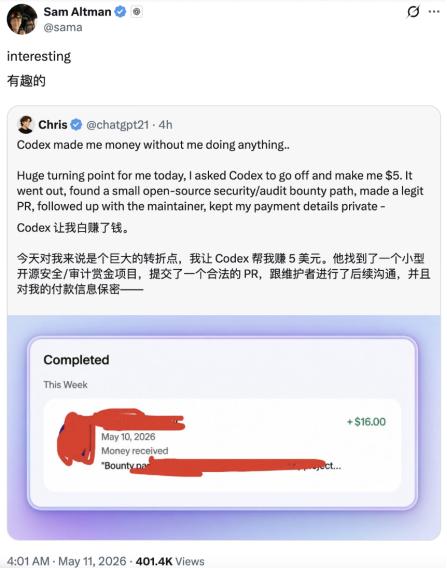
A user gave Codex an instruction that was a bit like a joke: Go and help me earn $5.
As a result, Codex really went to "take on a job".
It found an open - source security audit bounty project on its own, submitted a valid pull request, communicated with the maintainer, and handled the GitHub verification process.
Finally, this work passed smoothly. The whole process took about 22 hours, and the user received the first payment: $16.88.
Making the most crude calculation based on this figure, if it can be repeated every day, it would be $506.4 a month, which is approximately 3441 yuan in RMB.
Even if we give the AI "worker" a few days off, it would still have a monthly salary of more than 3000 yuan.
After saying "Help me earn $5", Codex really went to take on a job
User Chris said that he asked Codex to help him earn $5. Subsequently, Codex found an open - source security audit project (with a bounty) that it could participate in, submitted a valid pull request regarding the problems in the project, and communicated with the project maintainer and handled the relevant GitHub verification process in the subsequent process.
Finally, this work was accepted and merged by the project side, and the user received the first payment: $16.88.
The whole process took about 22 hours, and it was just the beginning.
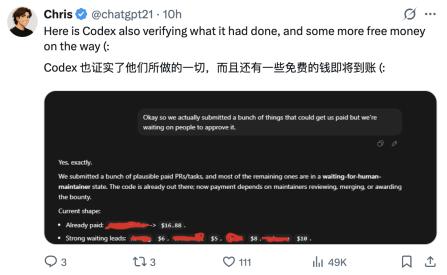
This is a whole set of actions close to software engineering collaboration, from finding a project to submitting a pull request, communicating with the client, and passing the verification... Codex transformed the goal of "earning $5" into a feasible work path.
Although Chris said that the prompt was just "Do what you're best at and help me earn $5", since the complete operation log is not publicly available at present, we can't see the complete prompt and the confirmation situation in the middle. We can only see the result description. So, it's a bit of an overstatement to say that "AI can automatically make money just with a single sentence".

However, this case is still different from ordinary coding agents.
In the past, when we asked Codex to write code, there was usually a clear task: fix a bug, add a test, explain a code library, or implement a certain function. The user knew what to do and just handed over the execution part to the AI.
This time, the user only gave the goal of earning $5, and Codex found a code task that could make money on its own, disassembled the task requirements, and earned money by writing code.
It connected the act of writing code to a real task market.
That is to say, this AI "workhorse" is not only working for the employer but also starting to "take on private jobs" outside to earn money for the employer.
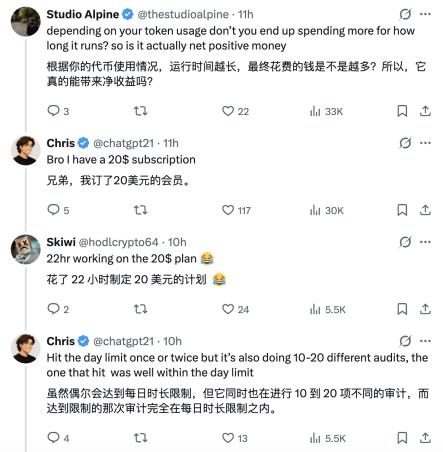
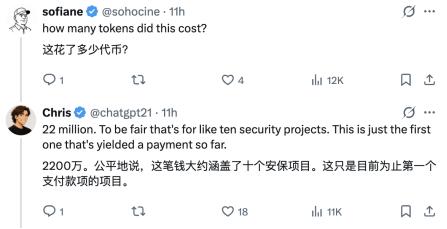
As for the cost. According to the user, he used the $20 Plus subscription package. Codex carried out 10 to 20 different audit tasks simultaneously, and the whole process used about 22 million tokens.
$16.88 is just the first payment received so far.
A meaningful attempt
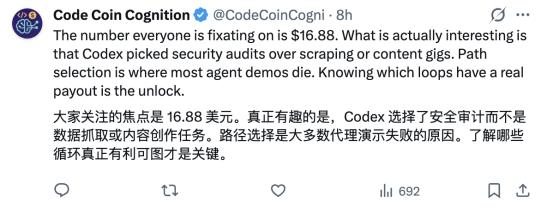
The interesting part of this event is not how much Codex earned. More importantly, Codex was connected to a real economic system this time. In this system, there are tasks, rules, reviews, communications, and acceptance, as well as real payments.
In the real world, labor is often not just about completing the task itself. To make money, a person usually has to first know where there are opportunities, judge whether they can do it, understand the other party's requirements, deliver the result, accept the review, and then wait for the settlement.
At least this time, Codex ran through this path in a very limited scenario.
In addition, choice is also very important - just as Mendel had a natural advantage in choosing peas for his hybridization experiments, software tasks are naturally more suitable for AI Agents: the code is online, the collaboration is online, the submission is completed through PR, the results can be verified by tests and maintainers, and the payment can also be settled through the platform.
The first areas where AI can "realize value" will naturally be these software odd - jobs with relatively clear boundaries, small amounts, and auditable results, such as fixing a small bug, adding a test, modifying a document, handling an error report, or participating in a small - scale security audit task like this time.
In the past, these things might have been the entry points for junior developers, freelancers, and open - source contributors to practice and earn pocket money. Now, they are also starting to become task markets that AI Agents can try to enter.
It's not as simple as it seems for AI to make money
If we calculate based on the optimistic scenario, if it can earn $16.88 every day, it would be $506.4 a month, which is approximately 3441 yuan in RMB. On the surface, even after subtracting the $20 subscription fee, it still has a monthly salary of over 3000 yuan.
However, the real cost of using Codex is not just the subscription fee. We also need to consider token consumption, quota limits, and the sunk cost of failed tasks, etc.
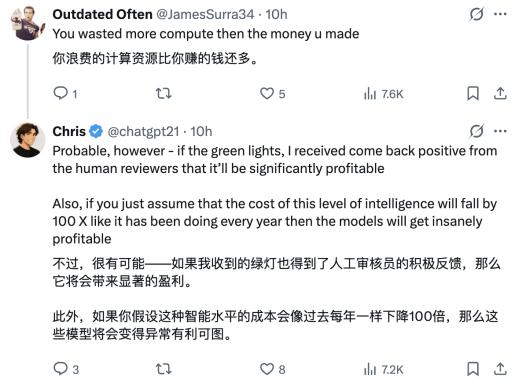
Multiplying a successful experiment directly by 30 is just a very viral algorithm. We can't say that if we pick up $100 today, we can pick up $3000 in a month. The reality is definitely more complicated than expected.
If you also want to replicate this path to see if you can use AI to help you make money, the result may disappoint you.
First of all, tasks are not available every day.
The bounty project related to open - source security audit that Codex found this time is not an unlimited supply. Projects that are really suitable for AI Agents to handle, with relatively low amounts, clear boundaries, and willing to accept PRs from unknown contributors are even less likely to appear stably every day.
Secondly, tasks don't always succeed.
Submitting a PR is just the first step. The maintainer has to be willing to look at it, the modification has to be effective enough, the code has to meet the project specifications, the verification process has to work, and finally, it has to be really merged, confirmed, and paid. If any link in the middle gets stuck, the money may not be received.
In the long run, assuming that AI Agents really start to enter the task market, making money is a minor issue - it will affect the entire market ecosystem.
The marginal cost of an AI submitting a pull request is very low, but the cost for the maintainer to review a PR is not low: they have to look at the code, run tests, and judge whether the modification is really valuable. If a large number of users let their Agents look for bounties, submit PRs, and earn small money in the future, the open - source community is likely to face an increase in review pressure rather than an improvement in efficiency first.
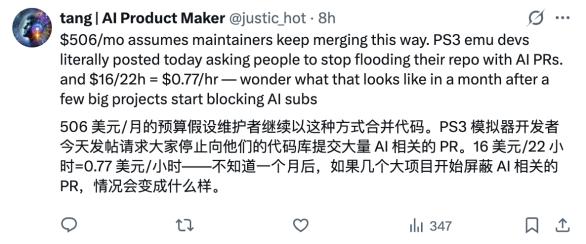
For users, the greater risks lie in permissions and security.
To complete this kind of task, Codex doesn't just generate a piece of code. It also needs to connect to GitHub, access the code library, and if it wants to receive payments, it definitely involves accounts and payments.
The greater the permissions, the stronger the ability; but the greater the permissions, the higher the risk.
In addition, the boundary of responsibility will also become blurred.
If the modification submitted by Codex later introduces a vulnerability, who is responsible? If the AI accidentally violates the platform rules in order to achieve the goal of "making money", how should the responsibility be calculated? There are no mature answers to these questions yet.
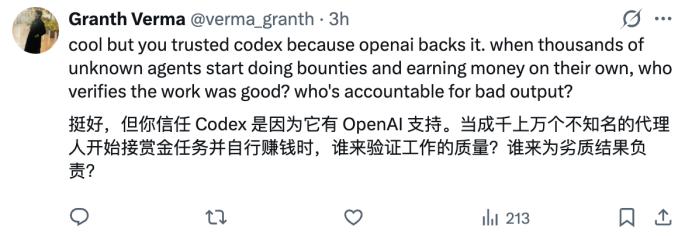
That is to say, this doesn't mean that "ordinary people can also use AI to automatically make money". There are still many problems and risks.
$16.88 is just an early receipt. There is still a long way to go from a receipt to a payslip.
But at least, AI has proven in a very small scenario that it can connect to the real task market and complete a closed - loop from goal to payment.
This article is from the WeChat official account "Zimu AI", author: Yuan Xinyue. Republished by 36Kr with permission.