Anker Innovations Hits a Reef in the "Shallow Sea", Yang Meng's Management Challenges
In 2025, Anker Innovations recalled 2.38 million power banks globally, which made the company realize that it could no longer "lock" its fate in a single product category.
On May 12th, Anker Innovations held its 2025 annual general meeting of shareholders and admitted the problem of having too many charging product models. The company responded, "No company can ensure the quality of 100 types of power banks." In the past 18 months, Anker Innovations has reduced the number of charging models by about 70%, and it will continue to reduce the number by 50% - 70% in the next 18 months.
Since 2020, Yang Meng, the founder of Anker Innovations, has been talking about the "Shallow - Sea Strategy" for more than five years. Its core logic is to avoid "deep - sea" product categories such as mobile phones and computers with an annual sales scale of over $100 billion, and focus on categories with an annual sales scale of less than $50 billion and a R & D investment of about $100 million, such as smart security, audio, and cleaning.
However, it's not easy to shed the title of "the top power bank brand". According to Anker Innovations' 2025 annual financial report, among its total revenue of 30.514 billion yuan, the revenue from charging and energy storage products was still 15.402 billion yuan, accounting for 50.47%.
As one "shallow - sea" market after another turns into a "red - ocean" market, Yang Meng is paying less and less attention to the power bank cash - cow business. At the end of last year, while Anker submitted a listing application to the Hong Kong Stock Exchange, it also turned its attention to "deep - sea" businesses such as large - scale models and embodied intelligence, which are more resource - intensive and in line with the AI narrative.
On April 22nd, Anker Innovations held a technology communication meeting. Yang Meng showed the media an AI audio chip called "Thus™". Thus™ adopts an in - memory computing architecture - while the industry has been using the separated memory and computing architecture for the past 80 years since the birth of computers.
"This goes against the 'ancestral rules'," Yang Meng said. This was the first time Yang Meng systematically showed the outside world Anker Innovations' "deep - sea" ambitions. Compared with the "shallow - sea" approach of having a team of three to five hundred people and persevering for three years, self - developed chips, edge - side large AI models, AI operating systems, embodied intelligent robots, and 3D printers are all hard nuts to crack that require high investment and long - term efforts.
Although Yang Meng said, "There is almost no upper limit to our investment in these advanced fields." It's an undeniable fact that Anker Innovations' financial report is under pressure. In 2025, Anker Innovations' R & D investment reached 2.893 billion yuan, a year - on - year increase of 37.2%. At the same time, the net cash flow from operating activities of the company was only 481 million yuan, a sharp drop of 82.49% compared with 2024.
However, Anker Innovations' diversified development also poses high challenges to organizational management and talent building.
According to China Entrepreneur magazine, Anker's "shallow - sea" and "deep - sea" strategies are operated in the form of "entrepreneurial groups" within the company. Some team members revealed that Yang Meng is a typical "P - type" person in MBTI personality, "with extremely strong strategic vision but weak planning ability and prone to giving up."
Although Yang Meng controls all product details and makes decisions on everything, "his ideas are often hard for his subordinates to follow," which also leads to frequent strategic adjustments and organizational instability in Anker Innovations.
Yang Meng himself also admitted at the press conference, "The biggest change in the past three years is not the change in products, but the change in people."
In December 2025, there were rumors on social platforms that Anker Innovations was "conducting large - scale layoffs, with a ratio close to 30%". Although the official response said that "the ratio is seriously inaccurate", some former employees told China Entrepreneur magazine that the passive turnover rate of senior employees recruited through social recruitment within Anker was relatively high - correspondingly, this also made Yang Meng more eager for senior talents.
At the communication meeting, Yang Meng said, "The future path of Anker is actually getting wider and wider." This statement is both Yang Meng's optimism and his commitment to the capital market. However, the width of the path depends on whether he can turn the "deep - sea" business from a money - burning black hole into a growth engine within a three - year cycle, and also depends on how he balances R & D rhythm and organization.
From "Shallow Sea" to "Deep Sea"
Yang Meng first proposed the "Shallow - Sea Strategy" in 2020. Yang Meng told China Entrepreneur magazine, "The so - called shallow sea refers to product categories with a single - category scale of less than $50 billion. For example, the scale of the sweeping robot market is just over $10 billion. The small revenue scale of these categories also means that the technology stack is not that deep. If you are willing to invest in a team of three to five hundred people and persevere for three years, you will probably be able to launch a product."
Starting with five business units, Anker Innovations expanded aggressively. By 2022, the product line had expanded to 27, covering areas such as lawn mowing robots, 3D printing, pet supplies, electric bicycles, home security, smart cleaning, headphones, and projectors. The number of employees also increased from about 2,000 in 2020 to about 3,700 in September 2022.
Yang Meng soon found himself in a huge management dilemma. The logic of light - asset and short - cycle in the power bank business didn't work in areas such as sweeping robots, security systems, and headphones. The uneven quality of the quickly recruited talents led to low team morale.
In 2022, among Anker Innovations' 27 product lines, nearly 20 couldn't form a competitive advantage. Yang Meng admitted that he once had to learn meditation to relieve his anxiety. Finally, he cut the product lines to 17.
Later, Yang Meng reflected that the root cause of the problem was the "mismatch between talents and positions" - the company was used to the "improvement model", launching an improved product in one year. But when competition intensified and the technical threshold increased, this half - hearted investment approach began to fail.
"Before 2022, Anker usually took about one year to launch a new product category," Yang Meng said. "After 2022, the pre - R & D time for new product categories is basically three years. It took three years for the UV printer, and also three years for the embodied intelligent guard dog - not that it can be developed in three years, but three years is the starting point."
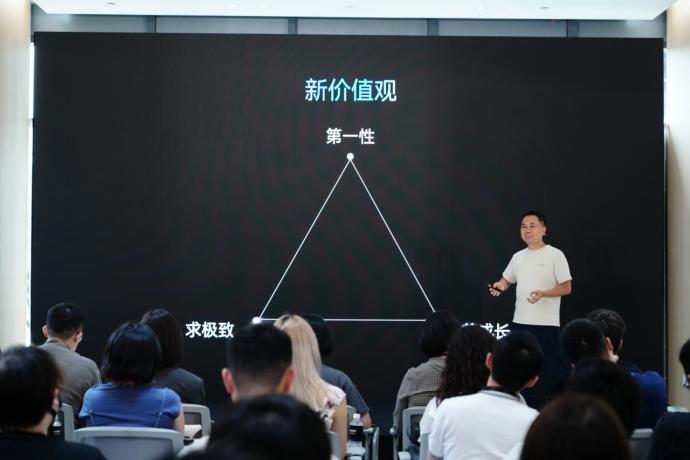
In 2023, Yang Meng changed Anker Innovations' mission, vision, and values from "Be reasonable, pursue excellence, and grow together" to "Focus on the first - principle, pursue the extreme, and grow together". Anker's "explosive - product" logic relying on rapid channel expansion also adjusted accordingly.
Source: Respondent
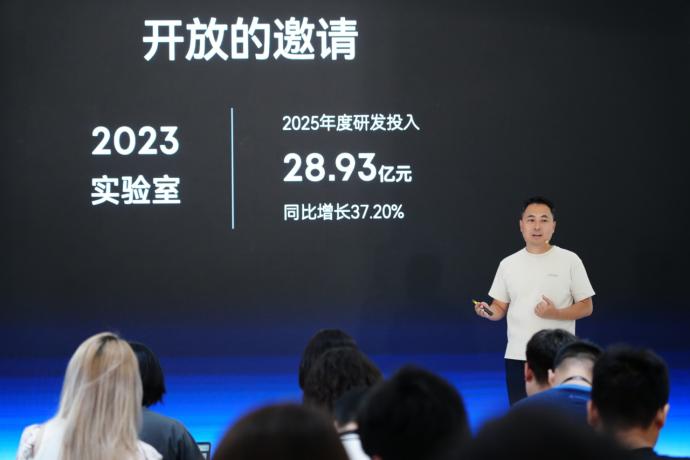
In 2023, Yang Meng established the "2023 Big Laboratory" internally to get rid of the past improvement - dependent path. "Improvement means buying someone else's product, taking it apart, and then making it a little better. But now I want to start from the pain points of users and the most advanced technology. I want to build a set of things from scratch."
Anker Innovations currently has three major business segments: charging and energy storage, intelligent innovation including 3D printing and embodied intelligence, and intelligent audio - visual.
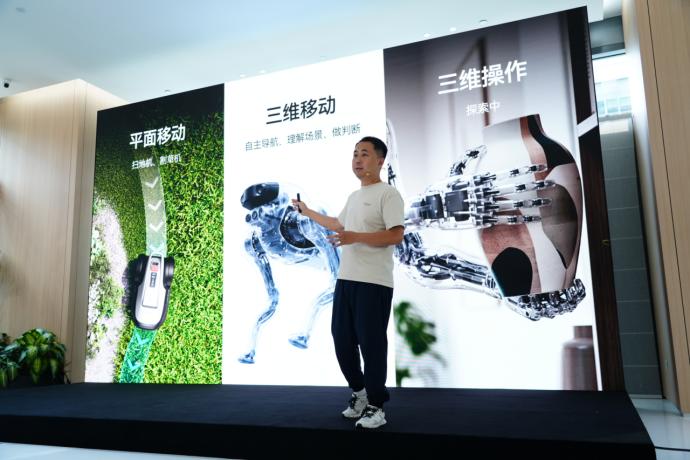
Among them, embodied intelligence is a robot series plan launched by Anker Innovations in March 2025. Yang Meng proposed a "three - step" roadmap for this: planar movement (sweeping robots/lawn mowing robots, already in mass production), three - dimensional movement (security robot dogs), and humanoid robots. At the technology communication meeting in April, Yang Meng showed the media the concept of the "guard dog" - a robot dog that can patrol autonomously in the home environment and drive away intruders, with a target selling price close to $4,000.
Source: Respondent
From avoiding the red - ocean market to jumping into it, Yang Meng admitted, "The industry is very lively, but there is still a clear gap between turning it into a product." He gave an example that the actual measured joint life of the guard dog is only 1,000 hours, which means "your dog may not be able to move after more than a year."
China Entrepreneur magazine learned that audio will also be Anker's main focus in the future. Its brand "Soundcore" will become a key business segment. At the beginning of 2025, Anker cooperated with Feishu to launch the "Recording Bean".
Betting on the audio track is because after the popularity of "Lobster" and Agent, AI recording cards and AI headphones are becoming crucial data transmission channels under the wave of large - scale models. At the communication meeting, the AI audio chip shown by Yang Meng is known as the "world's first mega - level neural network in - memory computing (CIM) AI audio chip", which can enable a pair of headphones to achieve the call noise - reduction effect of "making the other party feel like you are on the phone in a quiet environment" at a concert.
However, expanding from desktop UV printers, sweeping robots, and outdoor laser cinemas to in - memory computing chips, edge - side large AI models, etc., the huge investment also poses a test to the cash flow.
The financial report shows that in 2025, Anker Innovations' R & D expenses reached 2.893 billion yuan, a year - on - year increase of 37.20%. The R & D investment accounted for 9.48% of the total revenue. The company tilted a large amount of resources towards areas such as embodied intelligence and edge - side large models, and the relevant investment was significantly higher than that in traditional categories. Coupled with the general losses in the early stage of new businesses, the net cash flow from operating activities of the company dropped by 82.49% year - on - year to 481 million yuan in 2025.
If Anker grasped the charging technology in the "shallow sea", what technology will it rely on when swimming into the "deep sea"?
"There are few companies in China that truly operate in multiple product categories." Facing the media's question of "why can you outperform the unicorns in the field", Yang Meng's answer went back to the fundamentals: "A set of core technologies, namely end - to - end models, chips, and systems."
Yang Meng said that Anker is building a technology stack that can be divided into three levels. The bottom layer is the chip. "In - memory computing combines the memory and the CPU, so the model doesn't need to move, and the power consumption drops sharply." The middle layer is the edge - side large AI model, and the top layer is the AI operating system. Yang Meng said, "The '2023 Laboratory' already has nearly 500 people, and is promoting the development of chips, models, operating systems, and cutting - edge products simultaneously."
Talent Hunger and Organizational Turbulence
"The biggest change in the past three years is actually not the change in products, but the change in people," Yang Meng said directly at the press conference. Anker Innovations' multi - product approach poses huge challenges to the management of core talents and team building.
According to China Entrepreneur magazine, Anker operates its business units in the form of "entrepreneurial groups". This management model places higher requirements on the heads of business units. However, some former employees told China Entrepreneur magazine that they observed that the passive turnover rate of high - level employees recruited through social recruitment in Anker was relatively high.
There were once a series of talent loss cases: In March 2025, Liu Fang, the person in charge of Anker Innovations' embodied intelligence project, left the company, and the Beijing team was disbanded; in April, Wang Zhiyu, the former person in charge of 3D printers, led a team of nearly 30 people to start a new business.
To support the expansion and development of multiple product categories, Yang Meng has always been extremely eager for business leaders. Since 2025, almost every time Yang Meng appears in public, he will talk about the topic of "recruiting talents". Some people told China Entrepreneur magazine that even when deciding whether to communicate with the media, Yang Meng will ask if a talent recruitment link can be attached to the comment section.
Source: Respondent
A large number of senior executives from large - scale companies joined Anker, but some of them were not well - adapted. According to insiders, after senior executives from large - scale companies entered Anker, they used to manage hundreds of people, but now in the business unit, they may only manage a few people. "Managing fewer people is more tiring because you have to understand all the technical details."
In addition, the fierce competition for external talents has continuously driven up the salaries of high - end talents, forcing a "mid - sized company" like Anker Innovations to maintain an urgent recruitment rhythm, which also causes frequent organizational fluctuations.
"80% of the organizational structure of the embodied intelligence team remained unchanged last year, but two or three key leaders left," a person familiar with Anker's embodied intelligence revealed. "When the company first started to develop embodied intelligence, it didn't understand the industry well and lacked judgment when selecting key candidates. It was often attracted by those with a 'little halo', but after the talents joined, they found that things were not done in that way."
After the business setbacks in 2022, in order to quickly verify whether the new business is closed - loop, Yang Meng significantly compressed the verification cycle of new businesses, and the assessment time is also very tight.
The aforementioned person revealed that the issue of "senior executives from large - scale companies not being suitable for the entrepreneurial environment" has been reflected on within Anker. This has made Yang Meng focus more on values assessment in current management.
"Steven (Yang Meng) spends a lot of time researching how to set the evaluation criteria, how to make the standards, and how to conduct cross - verification. Each large business department in the company has more than a dozen small departments, and the departments will score each other. Departments with lower scores will face a reduction in bonuses and awards. However, in the AI era, everything is transparent. If you try to give each other high scores privately, we can identify it and name you." a former engineer said.
However, employees also have complaints about whether this department - to - department evaluation is scientific. "Our department's evaluation score is very low, but the workload is very large, which makes it easy to not get due rewards for our efforts." The employee believes that the mutual evaluation is still a "perceptual values score" without quantification, but it affects many aspects such as bonuses, which also led to his recent departure.
Frequent personnel flow puts pressure on Anker's organizational stability. And Yang Meng's management logic is direct and decisive: "He sets the strategic direction. If the direction is wrong after a period of time, he will replace the person in charge." a person familiar with Anker revealed.