In - depth Conversation of Ten Thousand Words: Why Has "Space Computing Power" Launched the Second Wave in the Commercial Space Industry?
The concept of space computing power has different keywords in the US and China. In the US, the keyword is "computing power," while in China, it's "space."
In less than half a year, "space computing power" has rapidly evolved from a cutting - edge technological concept to the hottest topic in the global technology and investment circles.
Elon Musk is naturally the most active figure. Space computing power has replaced Mars colonization as the primary goal of his space dream. His latest moves include investing $55 billion to build a Terafab chip factory, applying for an orbital data constellation of up to one million satellites, and integrating his two companies, SpaceX and xAI. Musk has answered three questions: "How to build space computing power, where to place it, and how to consume it," quickly outlining a new narrative logic for AI + commercial spaceflight for the outside world.
Recently, it was reported that Google, another Silicon Valley player, is discussing cooperation on an orbital data center with SpaceX. One side has AI chips and cloud infrastructure, while the other side has rockets and orbital transportation capabilities. Space computing power has transformed from a concept into an infrastructure project that giants can collaborate on.
In China, in a speech in April, the Ministry of Industry and Information Technology publicly stated its support for forward - looking research on space computing power technology and the orderly promotion of the development of the space computing power industry. Leading domestic private space companies have also completed a new round of financing exceeding 5 billion yuan.
Thus, we see that innovators in Silicon Valley and China have quickly reached a consensus on the significance of space computing power for commercial spaceflight and AI. Behind this is not only the early layout of orbital resources in the competitive dimension but also represents a new understanding of space by all of humanity: it will evolve from an "exploration target" into an "infrastructure space" that humans can expand.
Recently, Zhang Peng, the founder of GeekPark, had a long conversation with Zhai Guanglong, an investor and founder of Space Blossom, about commercial spaceflight and space computing power. Zhai Guanglong graduated from the University of Science and Technology of China and experienced the wave of mobile Internet entrepreneurship as a member of the early founding team of Meituan. In 2017, Zhai Guanglong founded Songguo Chuxing and became the top player in terms of transaction volume and vehicle deployment in the county - level market across the country.
Meanwhile, as a space enthusiast, Zhai Guanglong has conducted in - depth research on several domestic and foreign commercial space companies in the past few years. In his view, space computing power will be the key to driving commercial spaceflight into the second wave (Wave 2). He also sees opportunities for entrepreneurs in it and has launched a new startup project, "Space Blossom."
The following is the transcribed text of this communication, edited and organized.
SpaceX's Growth History: Making Both the Hammer and the Nail
Zhang Peng: Recently, "space computing power" has become the hottest term in the AI and space sectors in both China and the US. What was the starting point of this?
Zhai Guanglong: Space computing power is not a new concept that emerged in 2026. Around 2023, some European research institutions and US startups began to discuss it, but it was mostly on a small scale and did not become the main theme in the AI or space industries, nor did it form a consensus.
It wasn't until last year when Musk started talking about the story of space computing power that the industry began to take it seriously. The reason is that Musk is the person closest to making this new narrative of space computing power a closed - loop.
Zhang Peng: Why is it Musk? What capabilities are needed to make the story of space computing power a closed - loop?
Zhai Guanglong: The most important and fundamental capability is launch capability. In 2025, Musk's SpaceX completed over 160 commercial launches, all carried out by the medium - sized rocket Falcon 9, with a single - launch payload of about 20 tons. SpaceX's next - generation heavy - lift rocket, Starship, can further increase the single - launch payload to the hundred - ton level. So, in theory, Musk is most likely to support the transportation capacity required to build a space data center.
Zhang Peng: Why did such strong rocket launch capabilities emerge from a "private company" like SpaceX?
Zhai Guanglong: If we look at this question from the perspective of the entire history of spaceflight, the context will be clearer. I personally divide the entire development of spaceflight into the following three stages:
The first stage started in 1957. In that year, the Soviet Union launched Sputnik, which greatly stimulated the US. They realized that their opponent had taken a significant lead in a certain field and had to catch up.
So, in this stage, spaceflight was not a commercial issue but a technology competition led by the state, mainly driven by the rivalry between the US and the Soviet Union. It evolved into later space exploration projects such as the Apollo moon landing and the Hubble Space Telescope, as well as the "communication, navigation, and remote sensing" (communication, navigation, and remote sensing) technologies that are more closely related to ordinary people's lives today.
Later, when the US had clearly taken the lead over the Soviet Union, the American public no longer supported the government in spending large amounts of money, and the Apollo program was halted.
In 2002, SpaceX was founded. Over the past two decades, this company has not only developed the medium - sized reusable rocket Falcon 9 but also created the communication and Internet constellation brand Starlink. In fact, the latter and the former form a "supplier - customer" relationship.
In this process, apart from technological breakthroughs, I think another remarkable aspect of Musk is that he has created a stable commercial demand for rockets and spaceflight, allowing the industry to no longer rely entirely on the will of the state and the government to advance.
So, I regard 2002 as the beginning of the 1.0 stage of commercial spaceflight. In this stage, SpaceX is the only company in the world that has successfully achieved a commercial closed - loop.
Zhang Peng: It seems that Musk has both made the hammer and found the nail within SpaceX. So, which came first, the hammer (Falcon 9) or the nail (Starlink)?
Zhai Guanglong: In the early stage, SpaceX focused on breaking through the rocket reusability technology. In 2015, Falcon 9 achieved the first - stage rocket recovery for the first time. This step significantly reduced the cost of accessing space: previously, the cost of launching one kilogram of payload into low - Earth orbit (LEO) was tens of thousands of dollars, and now it has dropped to the level of $1,500 - $2,000 per kilogram.
Starlink actually started around 2014 and 2015 simultaneously. The change is that after the successful recovery of Falcon 9, SpaceX increased its investment in Starlink.
This is a typical logic for a startup to invest in a new business: when to test the waters and when to increase investment. I think Musk has his own rhythm.
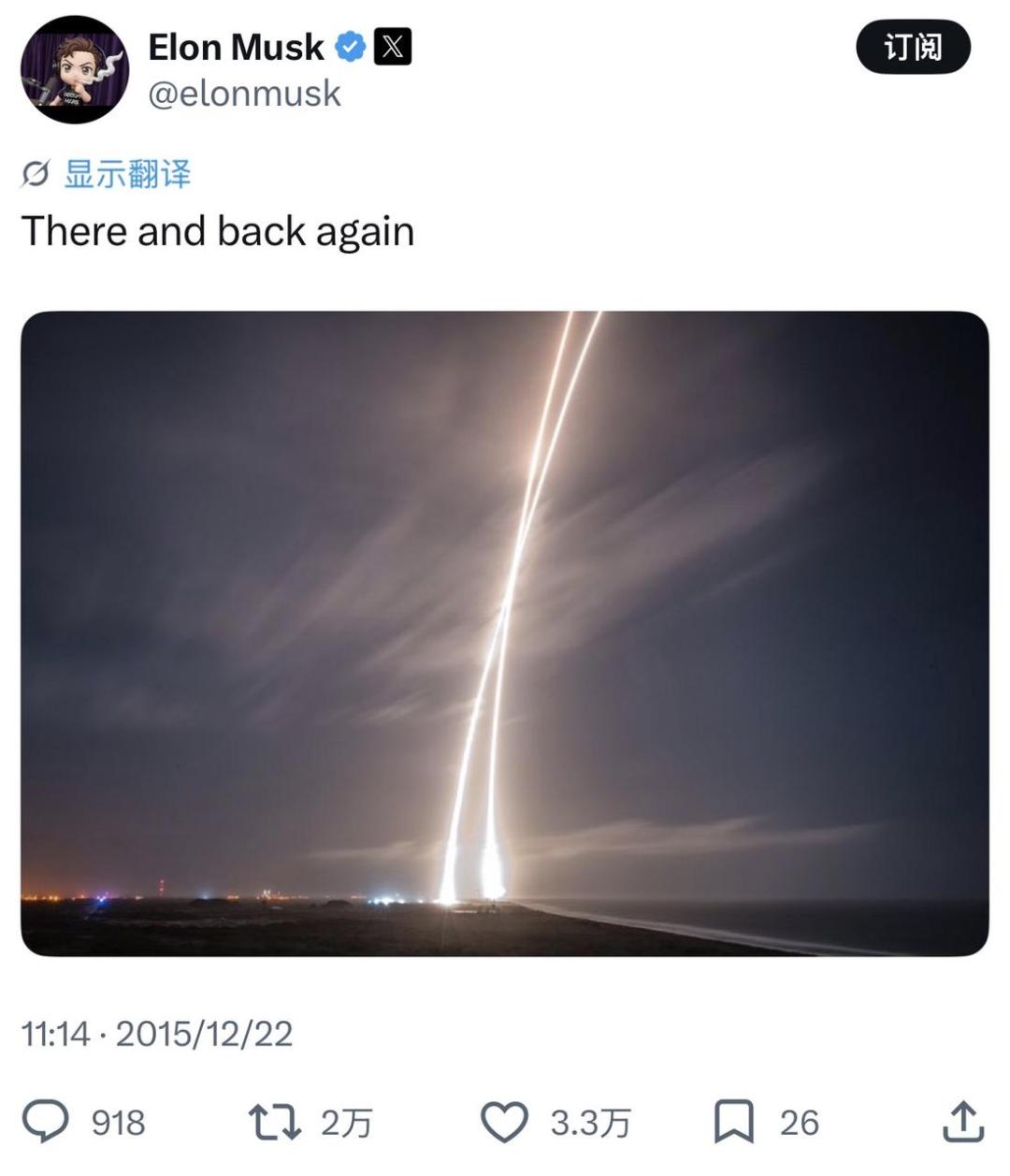
On December 22, 2015, Falcon 9 achieved a successful vertical landing for the first time
Zhang Peng: Since the first successful rocket recovery, how have the growth curves of rocket launch and Starlink businesses changed?
Zhai Guanglong: Morgan Stanley released a report three or four years ago when the Starlink business was just starting. So, in that report, the valuation ratio of the Starlink business to the rocket business was about 2:8, with the rocket being the core. However, now, without considering the latest variable of space computing power, Starlink accounts for 80% of SpaceX's overall valuation logic, a complete reversal.
In terms of revenue structure, Starlink has also become the main cash - cow. In 2025, the revenue of the Starlink business was approximately $11.8 billion, while the revenue of the rocket launch business was about $3 billion.
Zhang Peng: It seems understandable why Musk is promoting this new narrative of space computing power. The market scale of rocket launches is not as large as expected.
Zhai Guanglong: Yes. According to incomplete statistics, the current global rocket launch market is about $5 - 6 billion, and SpaceX accounts for more than half of it. However, there are many industries in China that exceed this scale. So, this is an industry that seems fancy but is actually "extremely small" in scale at the moment.
Moreover, more than a decade has passed since Falcon 9 entered orbit and became reusable. Although the launch cost has continued to decline significantly, the overall market scale has not changed much.
In fact, among the more than 160 launches of SpaceX last year, about 74% were internal "non - profitable" tasks for its own Starlink service. There were actually not many real external customers. If we further remove the "official orders" from institutions such as NASA, the real commercial launch demand in a year is only about 10 times.
Zhang Peng: It seems that there are not many real commercial launch demands at present. And after Falcon 9, SpaceX has a new - generation heavy - lift rocket, Starship, with the transportation capacity increasing from 20 tons to the hundred - ton level.
Zhai Guanglong: This is a very serious commercial problem. The entire Starlink communication constellation can be deployed with about 15,000 satellites, and more than 10,000 have already been deployed. So, the demand from Starlink is completely insufficient to support the large - scale transportation capacity provided by Starship. This is also a typical characteristic of the space industry: many times, you have to start first and then think about the demand.
Musk has told several stories before, such as turning Starship into a passenger plane that can travel from Beijing to New York in two hours, and Mars tourism or even Mars colonization. In essence, these are his attempts to create new demands, but these demands do not seem to hold up at present.
Zhang Peng: So, do you think "going to Mars" is no longer Musk's current space goal?
Zhai Guanglong: Mars is just a story for the transitional stage. Now, when the new variable of space computing power is seriously discussed, I believe that the commercial spaceflight field will enter a second wave and enter a new 2.0 stage with this as the demand.
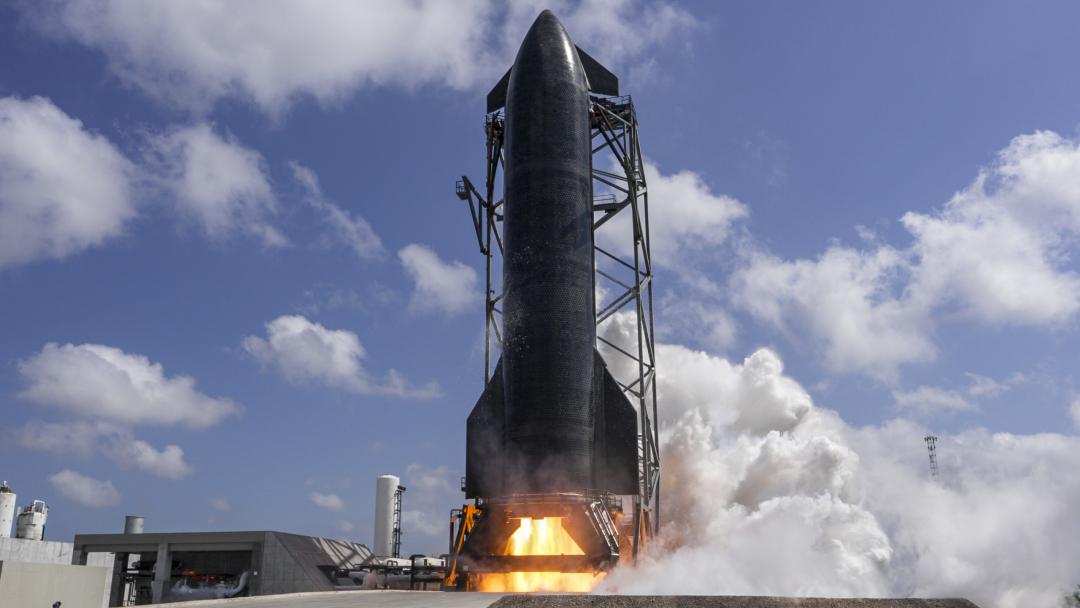
Starship during a static fire test: The goal is to achieve a hundred - ton - level transportation capacity and complete recovery of the first and second stages | Image source: SpaceX
China Doesn't Need to Copy SpaceX
Zhang Peng: What is the current overall situation in the domestic commercial spaceflight field?
Zhai Guanglong: In the past 10 years, no Chinese company has been able to copy the success stories of the Internet and AI and quickly catch up with SpaceX in terms of technological gap.
An important technical reason behind this is that the spaceflight industry is highly engineering - intensive, strictly regulated, and has a segregated supply chain. Many capabilities cannot be simply replicated by understanding them; one has to face new challenges in the engineering process.
Zhang Peng: So, how do you think domestic private space companies should plan their development paths? The "domestic Starlink" has been discussed quite a lot in the past few years.
Zhai Guanglong: China has low - orbit communication constellation projects such as Xingwang and Yuanxin, which can provide some launch demands for rocket companies. However, I think the commercial application scenarios of domestic communication constellations are different from those of Starlink and are difficult to support large - scale C - end application scenarios like Starlink in the US market.
Zhang Peng: What are the differences in the application scenarios between the two markets?
Zhai Guanglong: From a technical perspective, Starlink is not a substitute for 5G; it is complementary to 5G.
Limited by the bandwidth and the number of beams of satellite communication, the number of users that services like Starlink can support per unit area is limited. So, it is suitable for scenarios with low population density and low network coverage, such as rural areas in the US, cruise ships at sea, outdoor hiking, and national parks.
However, in China, the population is highly concentrated in cities, and our ground - based communication infrastructure such as 5G and fiber - optic networks is very densely covered. Naturally, it is difficult to form a large - scale, C - end consumer - oriented satellite Internet demand like in the US.
From this perspective, I don't think Chinese companies should completely copy Starlink's development path.
Zhang Peng: So, do domestic private space companies also face the dilemma of "lack of commercial demand"?
Zhai Guanglong: You can understand it in this way. Rockets are important, and transportation capacity is important, but commercial spaceflight cannot be successful just by relying on rockets. We not only need to solve the rocket problem technically but also answer the question "what to send into space" at the very beginning.
Without this large - scale demand, commercial rocket companies will always face the questions of "who to send for, what to send, and how much to send."
So, what Chinese commercial spaceflight really needs to find is not just the next rocket model but also the next application scenario that can consume a large amount of transportation capacity.
Zhang Peng: Is space computing power a new opportunity for China? Has a consensus been formed on deploying space computing power in China?
Zhai Guanglong: Currently, different regions and institutions are exploring their own paths according to their own plans, but a fully unified national - level project has not been formed.
The biggest question that has not been answered is: if there is no shortage of computing power in China, why must we send computing power into space? And who will pay for it?
So, more accurately, space computing power is now a new driving force and a new direction. Whether it can really be established depends on the technical route, construction cost, payment mechanism, and strategic consensus at the national level.
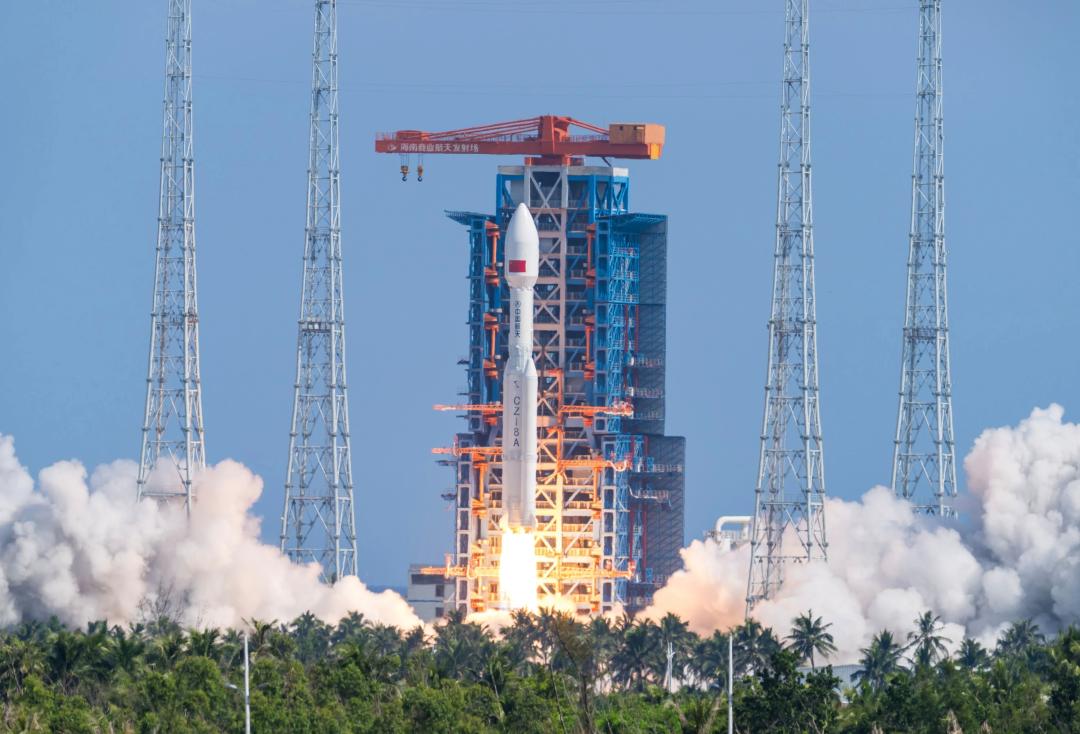
The Long March 8A carrier rocket carrying the low - orbit 06 group of satellites of the satellite Internet is launched into space | Image: China National Space Administration
Zhang Peng: Are the problems to be solved for space computing power different in China and the US?
Zhai Guanglong: Space computing power is important for both China and the US, but the reasons behind it are different.
For the US, not only does Musk need to answer the question of "excess transportation capacity" of rockets, but more importantly, electricity, land, and infrastructure are becoming the core issues restricting the development of AI.
For China, we are not short of electricity and land, and we have strong capabilities in large - scale infrastructure construction. However, the domestic commercial spaceflight field needs a new impetus.
Chinese commercial spaceflight should not only ask "when can we create a Chinese version of SpaceX" but also ask: what kind of new demand can enable Chinese rocket companies, satellite companies, orbital service companies, energy and communication companies to grow together?
In this sense, the value of space computing power is not just the computing power itself but that it may reorganize the industrial chain of Chinese commercial spaceflight. It provides launch demands for rockets, new tasks for satellites, new scenarios for energy, communication, and orbital operation and maintenance, and a new industrial starting point for local governments and national strategies.
Therefore, at this stage, the keyword for space computing power in the US context is "computing power