Why do Tim Cook and Lei Jun both want to take a photo with Elon Musk?
At that dinner, many people wanted to take a photo with Musk.
Lei Jun wanted to, and so did Cook.
But Musk didn't seem very keen.
Someone captured that moment. When Lei Jun stepped forward with the Xiaomi 17 Pro, Musk didn't really cooperate physically, and there even flashed a hint of impatience on his face.
Later, Cook also moved closer, and the situation remained delicate.
Throughout the dinner, Musk sat there all the time, like an outsider who was in the center of the hustle and bustle but extremely detached.
1
This time, Trump brought 17 business leaders to visit China. Jensen Huang of NVIDIA was pulled onto Air Force One at the last minute. The bosses of Qualcomm, Boeing, BlackRock, Blackstone, Goldman Sachs, and Citigroup all came.
But only Musk seemed like a person who had nothing to do with this grand event.
This is a very interesting scene.
Today, almost all technology entrepreneurs in the world, to some extent, live in the era defined by Musk.
Before Lei Jun started making Xiaomi cars, he specifically visited the Tesla factory.
In July 2013, Tesla's market value nearly quadrupled in a year, and the Model S had just won the title of the best - selling luxury car in the United States. Lei Jun flew to Silicon Valley, visited the Fremont factory, met Musk in person, and the two took their first group photo.
Three months later, Lei Jun visited again and directly bought two Teslas.
In those years, Xiaomi internally studied Tesla for a long time. From the product logic to the organizational structure, and then to the direct - sales system and user operation, the shadow of Tesla could almost be seen everywhere.
In a sense, Xiaomi cars themselves are a localization reconstruction of the Tesla model by the Chinese consumer electronics industry.
Needless to say about Cook.
It only takes about ten minutes to drive from Apple Park to the Tesla Fremont factory. In the past decade or so, they have been the two most important companies in Silicon Valley and have jointly reaped the greatest dividends of the era of globalization, supply chain, and capital.
So, it's not strange to take a photo.
What's strange is Musk.
2
Musk rarely shows an obvious sense of detachment on such occasions.
In the past decade, he has almost been one of the most prominent central figures in the global technology world. Whether in China, the United States, or Europe, whenever Musk appears, the on - site atmosphere will naturally revolve around him.
But this time, something very subtle has changed.
At that moment, everyone still seemed to regard Musk as "Musk".
But Musk himself seems no longer willing to continue to play the Musk who is highly sought after.
This doesn't seem to be just a momentary emotion of an entrepreneur, but more like a change of position.
Lei Jun is actually the most symbolic person in this change.
Ten years ago, the Chinese new - energy industry looked at Tesla as if it were looking at the future.
In 2014, when Lei Jun first systematically came into contact with Tesla, the new - energy vehicle industry in China had far from formed the industrial potential it has today. At that time, Tesla was an outlier in the industrial world. A Silicon Valley company was trying to remake cars in the way of consumer electronics.
And today, the Xiaomi SU7 has begun to directly compete with the Model 3 and Model Y.
Numbers don't lie.
In the domestic new - energy vehicle retail list in April 2026, Xiaomi ranked 5th with 36,702 vehicles sold, while Tesla only sold 25,956 vehicles and fell out of the top ten. The new - generation Xiaomi SU7 was launched on March 19, and the number of locked orders exceeded 80,000 in 48 days; since the start of delivery in March 2024, the cumulative delivery of Xiaomi cars has exceeded 655,000 vehicles.
More importantly, Xiaomi understands the Chinese market today better than Tesla.
It understands traffic better. It understands social communication better. It understands user operation better. And it also understands the real emotions of Chinese new - energy consumers better.
Today, Lei Jun is using the method that Musk is best at to take the initiative in Musk's territory.
This is actually very cruel. It means that for the first time, Tesla has changed from the one who defines the industry to just a player in the industry.
3
For many years in the past, Tesla's greatest advantage in the Chinese market was not its products.
It was an advanced concept.
When the Model S entered China, Chinese consumers were not just buying a car, but a ticket to the future world. Later, the Model 3 and Model Y continued to expand this advantage. After the establishment of the Shanghai Gigafactory, Tesla even became a teacher for the Chinese new - energy industry for a while.
BYD learned its efficiency. New - energy vehicle startups learned its direct - sales model. The entire Chinese automotive industry was studying how it managed the supply chain, how it compressed manufacturing costs, and how it defined cars with software.
But today, the Chinese new - energy industry has entered another stage.
BYD started to cut prices. In April 2026, it sold 182,000 new - energy vehicles in retail, with a market share of 21.4%, and its sales volume was about 7 times that of Tesla. Huawei defined the intelligent cockpit, Li Auto remade the family SUV, XPeng raised the upper limit of AI intelligent driving, and Xiaomi brought consumer - electronics traffic into the automotive field.
Tesla's market share in the Chinese new - energy market in April was only 3.06%, the lowest since November 2025.
For the first time, Tesla found that the Chinese market no longer revolved around it. This is the real subtlety of Musk's emotions at that dinner.
Today, the Chinese new - energy market is no longer an opportunity market for Musk, but a pressure market.
In Q1 2026, Tesla sold 112,800 vehicles in China, a year - on - year decrease of 16.2%; in January, only 18,485 vehicles were sold, a year - on - year plunge of 45%. Despite continuous price cuts and the launch of a 7 - year low - interest loan, its market share was still eroded by local brands. Starting from April 30, the 7 - year loan was cancelled due to bank risk control and compliance pressure, and starting from May, the longest loan term is only 5 years.
The Model 3 and Model Y can still be sold, but they no longer have the overwhelming generational advantage they used to have.
More importantly, Chinese car companies are becoming more and more like local - version Teslas.
And Tesla, on the contrary, is becoming more and more like a traditional foreign - owned car company.
This role reversal may be more difficult for Musk to accept than the decline in sales.
Musk's real strength has never been building cars, but defining the future. But now, his ability to define the future is slowly being diluted.
4
This is why Musk has talked less and less about cars in the past year.
A series of Tesla's most important recent actions actually illustrate this point.
Just 4 days before coming to Beijing, on May 10, the last Model S and Model X rolled off the production line at the Tesla Fremont factory. This flagship sedan, which went into production in 2012, and the Model X, which was born in 2015, were officially discontinued in Q2 2026. (Extended reading: Musk Kills "Automobile Company" Tesla with His Own Hands)
The production line will be dismantled within 4 months and transformed into a production line for the Optimus humanoid robot, with an annual production target of 1 million units.
Robotaxi has been repeatedly emphasized. Optimus has begun to occupy the core position of press conferences.
The simple story of electric vehicles is no longer enough to support Tesla's past valuation myth.
In 2025, Tesla's annual revenue was $94.8 billion, a year - on - year decline of 3%; the net profit plunged 46% to $3.794 billion, only a quarter of the peak in 2023. The global delivery volume for the whole year was 1.636 million vehicles, a year - on - year decline of 8.6%, and it was also Tesla's first annual negative revenue growth in history.
So, Musk has to keep jumping into the farther future.
Autonomous driving. Robots. AI. Mars. General artificial intelligence.
The problem is that these new stories haven't really taken shape yet.
On May 6, 2026, xAI was officially incorporated into SpaceX and became an internal product line. This AI company, which was established less than three years ago and once had a valuation of $250 billion, burned $1 billion per month on average in 2025. All 11 co - founders left, and its 220,000 NVIDIA GPU super - computing clusters were finally rented to its competitor, Anthropic.
Today, Tesla has entered a very subtle stage. The old narrative is losing its charm. The new narrative hasn't become a reality yet.
This is a very dangerous state. What the capital market fears most is not that the company's growth slows down, but that the sense of the future begins to disappear.
5
In the past decade, Musk's most powerful ability has been to make everyone believe that he is always half a step ahead of the times.
But today, the Chinese new - energy industry is quickly closing this half - step gap.
More importantly, the competition in the AI era is also becoming more and more like a collective push by large companies.
Behind OpenAI is Microsoft. Behind Anthropic are Amazon and Google. Behind Chinese AI are ByteDance, Alibaba, Tencent, and Huawei.
The entire industry is starting to return to the competition of computing power, organization, supply chain, capital, and ecosystem.
This is precisely not the battlefield that Musk is best at.
When Musk was at his strongest, he was always a lone fighter challenging the entire old world.
This was the case in the PayPal era. This was the case in the Tesla era. And this was also the case in the SpaceX era.
What he is good at is defining the direction alone and then making the entire industry chase after him.
But the problem today is:
The world no longer needs a single future.
The new - energy industry has become a mature industry. AI has become an infrastructure. Robots are entering the engineering stage. Everything is starting to shift from individual heroism to large - scale system competition.
This may be Musk's real helplessness.
He is still one of the most powerful entrepreneurs in the world. SpaceX is still irreplaceable. Starlink is still changing global communication. Tesla is still one of the most important companies in the global new - energy industry.
But for the first time, he has begun to realize:
When the future becomes within reach, the loneliness of a pioneer turns into the weariness of a defender.
6
Today, Musk, Cook, and Lei Jun are in three different stages.
Lei Jun is in the ascending stage and attended the dinner with the relaxation of a winner. Xiaomi cars achieved a monthly sales volume of 36,700 vehicles in two years, and the number of locked orders for the SU7 exceeded 80,000. The company's narrative has officially changed from a mobile - phone manufacturer to the fifth - largest new - energy company in China.
His attempt to take a photo with Musk is more like closing a 13 - year loop.
Cook doesn't need to gain anything when he comes to China. Just showing up is a gesture: Apple is still here. The supply chain is still here. This relationship is still here.
For a person who is about to leave the stage, it is enough to represent Apple one last time at the intersection of China - US relations.
Musk is the one who is trapped. Tesla is being hunted down by BYD, Xiaomi, and Huawei in China, and its product line has shrunk to only the Model 3 and Model Y. His AI company has just been dissolved, and Tesla's net profit in 2025 was only a quarter of the peak in 2023.
In the group photos, Lei Jun looks the happiest.
Cook looks the most indifferent.
The person who winked is actually the one who needs this dinner the most.
[Beyond the Page] Words:
At the dinner, it seemed that everyone was trying to take a photo with Musk. But Musk looked a bit tired.
Tesla's market share is being squeezed. Starlink has never applied for a license in China, and FSD has not yet obtained approval in China.
Musk may be the one among those 17 business leaders who has gained the least in terms of real - world interests but has been over - exploited in terms of spiritual symbolism.
He may have realized earlier than anyone else that the era he defined with his own hands is slowly coming to an end.
Shortly after the dinner, Musk posted a message in Chinese on X:
My son is learning Mandarin.
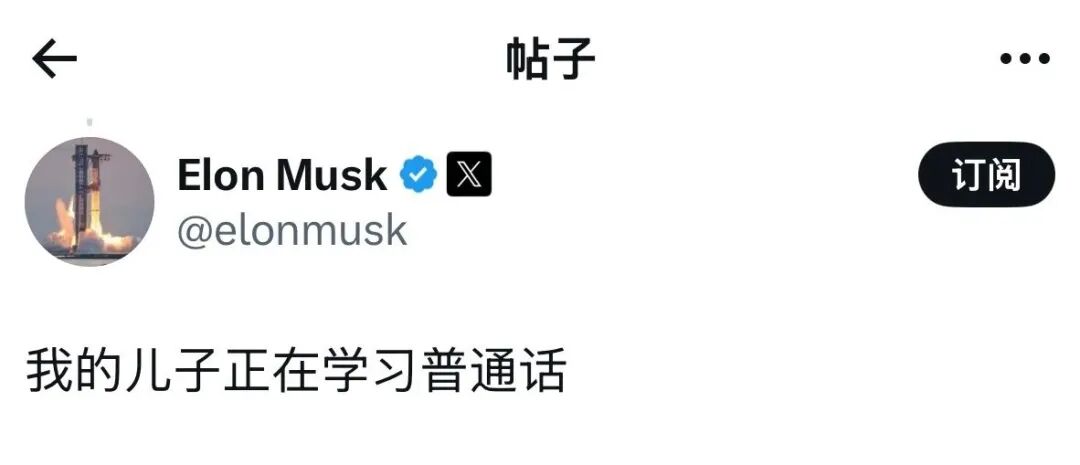
There is no picture and no context.
A person who is experiencing loss in the Chinese market is letting his child start learning from the first syllable.
Maybe it's a gesture of goodwill. Maybe it's a kind of unwillingness.
Maybe, he just wants to say:
Some things are over. But some things are just beginning.
This article is from the WeChat official account "Beyond the Page", author: Huahua. Republished by 36Kr with permission.