Tencent should learn to spend money.
Author | Huang Yida
Editor | Zhang Fan
On May 13th, Tencent released its financial report for the first quarter of 2026.
The financial report shows that Tencent achieved revenues of 196.458 billion yuan in Q1 2026, a year-on-year increase of 9%; during the same period, it achieved an operating profit of 67.375 billion yuan, a year-on-year increase of 17%; the Non-IFRS operating profit reached 75.63 billion yuan, a year-on-year increase of 9%. If the impacts of new AI products (Hy, Yuanbao, CodeBuddy, WorkBuddy, and QClaw) on revenues, costs, and expenses are excluded, the readjusted Non-IFRS operating profit for the same period is 84.4 billion yuan, a year-on-year increase of 17%.
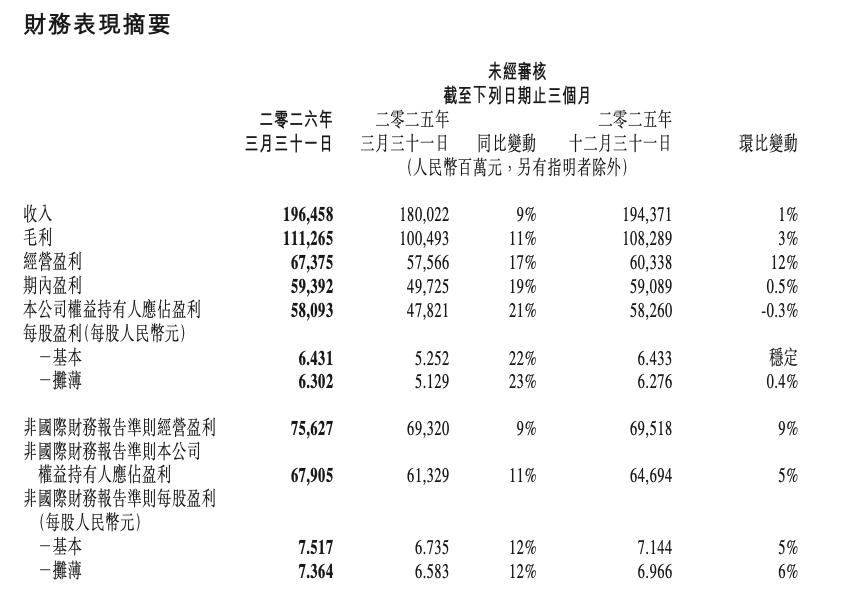
Chart: Summary of Tencent's Q1 2026 financial report; Source: Company announcement, 36Kr
Tencent's performance in Q1 2026 continued its long - standing steady growth trend and generally met market expectations. Looking at Tencent's performance in recent years, the stability of its performance growth has become one of its prominent features. Thanks to the maturity and stability of Tencent's core businesses, its performance is also highly predictable, and the financial data over the years have continuously confirmed this trend.
Compared with the stable performance of its fundamentals, both the focus of Tencent's financial report disclosure and the focus of investors' attention are concentrated on the progress of its AI business and related capital expenditures. In terms of the AI business, the following two points in Tencent's current financial report impressed investors the most:
1. The capital expenditures related to the AI business have increased significantly, fulfilling the previous commitment of the management;
2. With the continuous increase in AI - related capital expenditures and R & D investments, it has put a certain drag on the company's profits.
However, on the day after Tencent released its performance (May 14th), Tencent's stock price opened nearly 5% higher during intraday trading but finally closed down 0.52%. The intraday rise and fall of the stock price after the release of the financial report reflects to some extent the complex attitude of current investors towards the company's financial report performance and future expectations.
So, based on the performance in Q1 this year and the information disclosed in the earnings call, what key points of Tencent's AI business are worth paying attention to? What are the core attractions for investing in Tencent in the future?
01 Balancing Capital Expenditure and Return on Investment
Tencent's capital expenditures in Q1 2026 reached 31.9 billion yuan, a year-on-year increase of 16%; during the same period, R & D investment was 22.5 billion yuan, a year-on-year increase of 19%, mainly used for infrastructure construction and supporting model iteration. For reference, Tencent's total capital expenditures in 2025 were 79.2 billion yuan.
It can be seen that the capital expenditure scale in just one quarter of Q1 2026 has already accounted for 40% of last year's total. This shows that Tencent's investment in the AI business has significantly accelerated, and it also indicates that the management's commitment that this year's capital expenditures will be significantly higher than last year is being gradually fulfilled.
It is worth noting that the management said in the earnings call that the increase in capital expenditures in the second half of this year will be more obvious. This statement is crucial for supporting Tencent's valuation. The core difference among investors regarding Tencent currently mainly lies in the relatively moderate capital expenditures, and they are worried that Tencent will fall behind in the AI arms race.
Regarding the understanding of this issue, on the one hand, with Tencent's increased investment in the AI business, remarkable progress has been made at the business level, which can alleviate market concerns to a certain extent. Among them, the reconstructed Hy3 preview has significantly improved in core parameters such as response speed and average task completion time compared with the previous generation. Not only is its current call volume at the top of OpenRouter, but it has also driven a significant increase in cloud revenues.
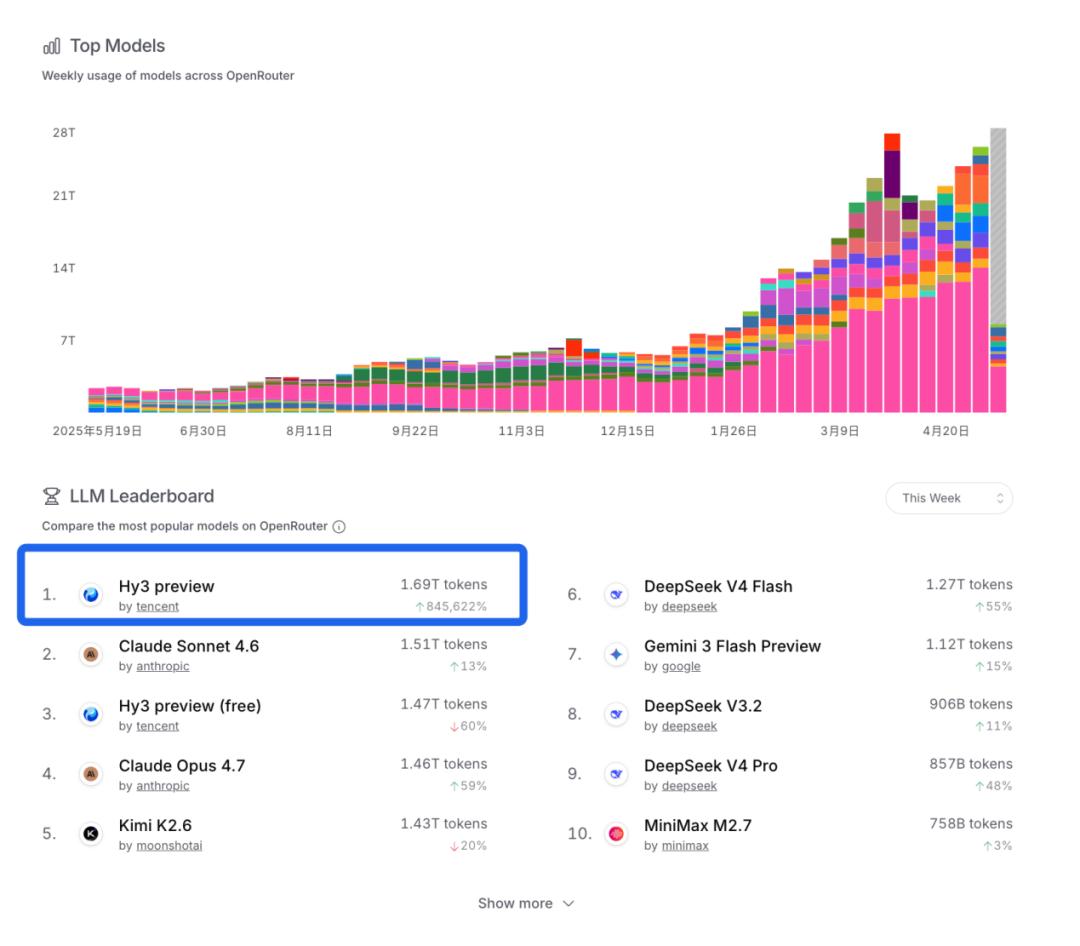
Chart: OpenRouter model call weekly ranking (May 11th); Source: OpenRouter, 36Kr
On the other hand, Tencent's relatively restrained capital expenditures are also a major feature of its operation and management. That is, while planning the scale of capital expenditures, it also takes into account project benefits and return on investment. Indeed, the pace of capital expenditures is an important attraction for investing in Tencent. At the same time, it is also necessary to consider the enhancement of the AI business to core businesses such as advertising and Tencent Cloud, and then its supporting effect on the company's valuation.
02 Investment Strategy
Looking back at the performance of Tencent's core businesses in Q1 2026, the revenues from value - added services increased by 4% year - on - year, mainly affected by the deferral of domestic game revenues due to the Spring Festival factor. The revenues from overseas games increased by 13% year - on - year during the same period, reflecting that the value - added services business still has strong resilience. During the same period, the revenues from the advertising business increased by as much as 20% year - on - year, and the growth rate was significantly higher than the overall advertising industry. The enhancement of the AI to the advertising business was very prominent. During the same period, the revenues from the financial technology and enterprise services increased by 9% year - on - year. The enhancement and contribution of AI to enterprise services were also important highlights of this financial report.
From the perspective of Tencent's current business structure, the core businesses still play the role of cash cows, providing stable support for Tencent's investment in the AI business. However, in the context of the AI arms race, due to the market's excessive emphasis on the impact of capital expenditures on the long - term expectations of enterprises, there are concerns about Tencent's relatively conservative current AI investment intensity, which has led to an obvious undervaluation of Tencent in the market.
Especially after the release of this financial report, Tencent's stock price opened high and closed low intraday, which is essentially a concentrated manifestation of investors' differences in its investment value. From the perspective of investors, Tencent currently has abundant cash flow, and the liquid funds reserve (mainly cash and deposits) on its balance sheet is also quite abundant. Even if it further expands capital expenditures, the impact on the company as a whole is relatively limited. However, Tencent's current "cautious" investment in AI is difficult to meet the market's expectation for it to break through more rapidly in the AI era.
From the valuation perspective alone, Tencent's current PE - TTM of less than 16 times is still in the historical bottom range. The low valuation is one of the core foundations for Tencent's current high investment value. Moreover, Tencent's performance has strong stability and high predictability, and the medium - and long - term profit expectations are generally positive. Supported by Tencent's stable fundamentals, with the current investment intensity in the AI business, the erosion of the company's short - term profits is limited, and the impact on the company's overall valuation is also relatively limited.
Moreover, as Tencent continues to increase its capital expenditures related to the AI business, the market's long - term growth expectations for Tencent are expected to continue to recover, and the strength of this expectation recovery is linked to the scale of expenditures. In general, even though the intensity of share repurchases will weaken this year, Tencent currently has a sufficient margin of safety in valuation. Coupled with the warming long - term growth expectations, it will resonate with the valuation repair supported by performance growth, and is expected to jointly drive Tencent to start a new round of valuation re - evaluation.
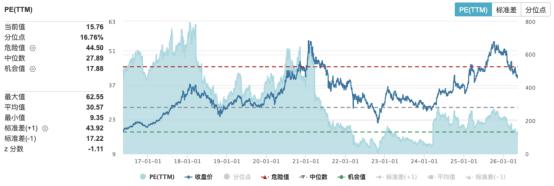
Chart: Long - term performance of Tencent's valuation; Source: wind, 36Kr
*Disclaimer:
The content of this article only represents the author's views.
The market is risky, and investment should be cautious. In any case, the information in this article or the opinions expressed do not constitute investment advice to anyone. Before making an investment decision, if necessary, investors must consult professionals and make decisions carefully. We have no intention to provide underwriting services or any services that require specific qualifications or licenses for the parties involved in the transaction.