The "ambitious" ZHIYUAN and its embodied universe
Editor's note: The term "embodied intelligence" has been attracting capital and talent at an unprecedented pace in the first half of 2026. A single round of financing of 500 million yuan has become common, and huge checks of 2 billion and 3 billion yuan have been successively issued. Start - up companies established two or three years ago have seen their valuations cross the 10 - billion - yuan threshold after several rounds of financing, with top investment institutions such as Sequoia Capital, Hillhouse Capital, and Tencent standing behind them. Technical geniuses and industry veterans have joined forces, and entrepreneurs with backgrounds from Huawei and Alibaba have become the norm.
As the gap between valuation and revenue widens, we focus on those embodied intelligence companies that have entered or are on the verge of entering the "10 - billion - yuan club". We hope to explore: How deep is the moat of the core technology of embodied intelligence companies behind the dazzling valuations? How can the difficulties of mass production and delivery be overcome? When will the sky - high - priced robots find real demand scenarios?
From full - stack self - developed body manufacturers, to model companies focusing on the "brain", to leading companies specializing in robots' dexterous hands, precise tactile senses, and simulation data, we will visit these star enterprises with a valuation of 10 billion yuan one by one to analyze their technical paths, business logic, and survival philosophy.
On May 12th, Zhipu Robotics (hereinafter referred to as "Zhipu") held a partner conference in Hong Kong to promote its robot products. Since April, this company has been speaking out frequently. What previously attracted attention was an 8 - hour live broadcast of a humanoid robot working in a factory, which was watched by 200,000 people. In addition to netizens who wanted to supervise the robot's work, some investors and competitors were also watching.
This was the first live broadcast in China of a humanoid robot loading and unloading on a real production line in a 3C factory. Zhipu tried to tell the outside world that robots can really work. It's not a demonstration version, not a specific scenario, not a staged shot, but real work.
In the public's impression, Zhipu Robotics is not as well - known as Unitree Technology, but Unitree Technology regards Zhipu as an important competitor in its IPO prospectus.
In April 2026, there were nearly 20 embodied intelligence companies in China with a valuation of over 10 billion yuan, and Zhipu had a valuation of 15 billion yuan as early as March last year.
Among a group of embodied intelligence companies, Zhipu has distinct characteristics. Some other companies focus on the body, some on the "brain", some on the "cerebellum", some on dexterous hands, and some on data. Zhipu does all of them.
At the same time, Zhipu has spun off 6 subsidiaries, invested in more than 60 companies, and joined hands with more than 180 partners. This approach is more like that of giants such as ByteDance or Alibaba, rather than a start - up company that has only been established for 3 years.
Some industry insiders describe Zhipu as "aggressive" because it has always shown great ambition. In its first year of establishment, Zhipu built its own robot mass - production factory and data collection factory in Zhangjiang, Shanghai. In its second year, when it released products, it launched 5 robots.
In 2026, Zhipu began to strive for the first place in various fields: the first company to mass - produce 10,000 robots, the first company to live - broadcast a robot working in a factory for 8 hours in real - time...
On April 17th, at Zhipu's partner conference, founder Deng Taihua used 31 superlatives and 18 "firsts" (the first, the first - ever) in his 2 - hour speech. "We have a huge lead," Peng Zhihui (also known as Zhihui Jun), co - founder, president, and CTO of Zhipu, said to Economic Observer.
Zhipu seems to be trying to achieve in 3 years what its peers take 10 years to do. Due to its large - scale business, it has more employees than its peers. The number of employees in other billion - level embodied intelligence companies is generally two or three hundred. Even Unitree Technology, which has been established for nearly 10 years, has only 480 employees (as disclosed in Unitree's prospectus as of the end of September 2025). Zhipu alone has more than 1,570 employees in its parent company, and this number will increase to more than 2,000 by the end of this year.
The management teams of most embodied intelligence start - up companies are not large, usually consisting of the founder, CTO, or chief scientist. In Unitree's prospectus, there are 4 core executives. Zhipu has 2 founders and 5 partners, each with the rank of president or vice - president. Some people who are not familiar with Zhipu commented on social media, "How many people are there in the company? So many presidents."
In 2026, when many embodied intelligence companies announced new financings of 1 billion and 2 billion yuan, Zhipu did not announce any financing news. A person close to Zhipu told Economic Observer that Zhipu received a round of financing at the end of 2025 but did not announce it publicly. Some Zhipu insiders said that many investors wanted to invest in Zhipu, but they were rejected.
The Cost of Mass Production
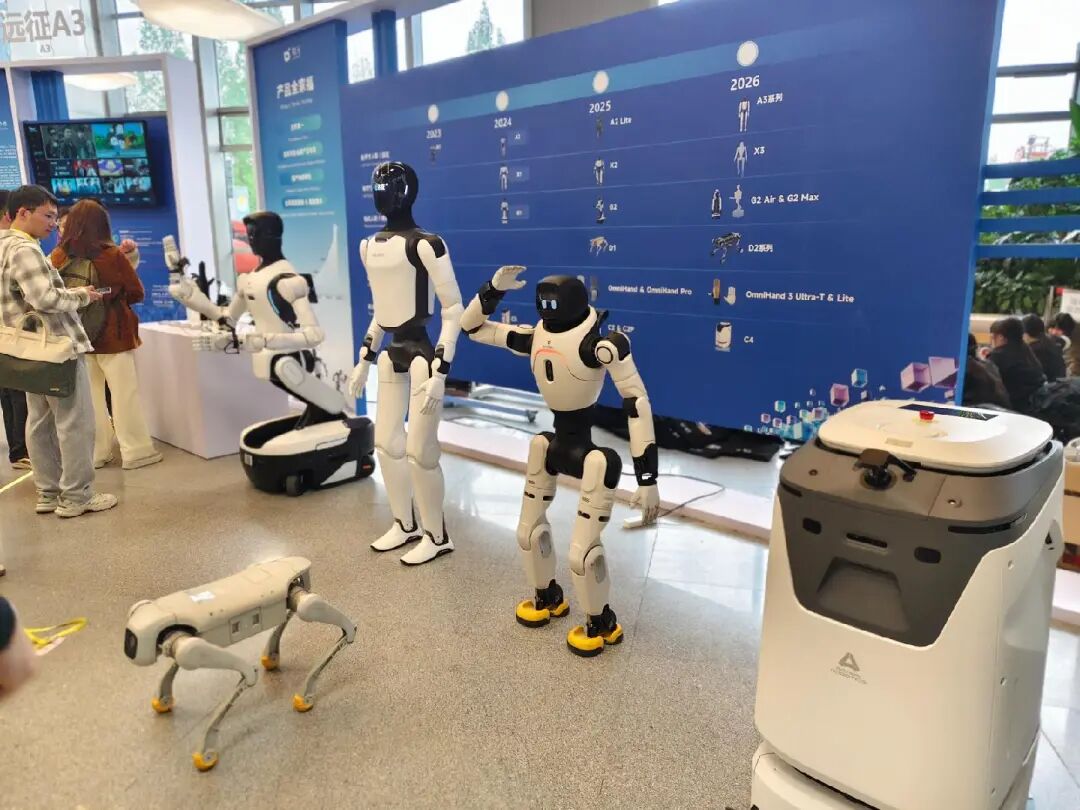
On April 17th, Zhipu released 4 new robot products. Together with the previously released Expedition A1 and A2, Lingxi X1 and X2, Elf G1 and G2, and Q1 from its subsidiary Shangwei Qiyuan, Zhipu already has 11 humanoid robot products.
Compared with its peers, Unitree Technology released 4 humanoid robots in 3 years, Zhongqing Robotics has 4, Yinhe General has 3, Xinghai Map has 3, and Independent Variable has 2.
Among Zhipu's embodied intelligence peers, Unitree Technology, Songyan Power, etc. focus on the body and care more about the robot's movement ability, while Yinhe General, Xinghai Map, Independent Variable, etc. focus on the "brain" and emphasize the robot's intelligence. Zhipu is a full - stack company that does everything. The reporter learned that more than 70% of Zhipu's current more than 1,570 employees are engaged in the research and development of embodied large models, and the number of R & D personnel is more than the total number of employees in many embodied intelligence companies.
On March 30th, Zhipu announced the mass production of 10,000 robots. At a time when the shipment volume of most of its peers is still in the range of a few hundred to a few thousand, mass - producing 10,000 robots is a relatively rare event. In mature product fields such as mobile phones and automobiles, mass - production manufacturing is a series of standardized processes such as assembly lines, mold - opening, injection molding, and assembly. However, the mass production of humanoid robots is not easy.
Wang Chuang, a partner, senior vice - president, and president of the general business department of Zhipu, is in charge of the mass - production business. He said that the first batch of mass - produced robots could be described as a "suffering". The main reason is that the supply chain of humanoid robots is immature, the cooperation degree is not high, and the parts are incomplete.
When the first batch of mass - produced robots in Zhipu's factory were just assembled, serious problems were found, and they needed to be reworked in batches. In August 2024, Zhipu increased the production of robots from 1 to 200. At that time, each robot needed to be reworked up to 10 times.
This attempt allowed Zhipu to run through the factory production line construction, machine production testing process, and supply chain system. After that, the mass - production speed became faster. It took nearly a year to increase from 1,000 to 5,000 units, and 3 months to increase from 5,000 to 10,000 units.
Zhang Yu, the founding partner of Qingzhi Capital, who has invested in several embodied intelligence unicorn companies, estimated that a full - process mass - production robot factory requires an investment of tens of billions of yuan.
Compared with its peers, Zhipu has received more rounds of financing in the capital market. According to public information, Zhipu has raised funds 12 times in 3 years since its establishment, Yinhe General has raised funds 5 times in 3 years, and Unitree Technology has raised funds 9 times in 9 years.
After August 2025, Zhipu has not announced any financing news. Peng Zhihui told Economic Observer that Zhipu can now generate its own revenue and is not short of money. It does not have an urgent need for financing in the external primary market. Moreover, if it takes too much money, the company's shares will be diluted.
Zhipu has not publicly announced the amount of money invested in robots, but it is very likely to be the company that spends the most among embodied intelligence companies. Cao Wei, a partner of BlueRun Ventures, who has invested in Zhipu 4 times, roughly estimated that Zhipu's R & D investment is 5 to 10 times the average investment of its peer competitors.
Yao Maoqing, a partner, senior vice - president, and president of the embodied business department of Zhipu, mentioned that the number of Zhipu's team may reach more than 2,000 by the end of 2026. Just the employee salaries alone cost at least one to two billion yuan per year. Coupled with the robot body, equipment, data collection, model training, computing power, etc., Zhipu has made a very large investment in embodied intelligence.
Being willing to spend money is also one of the deep - seated impressions of Zhipu in the industry.
A person from an embodied intelligence unicorn company in Haidian, Beijing, mentioned that before 2026, the evaluations of Zhipu among people in the embodied intelligence industry were quite divided. One group thought that Zhipu was spending money to gain popularity and was setting up a capital game. The other group believed that Zhipu was doing business step by step in a down - to - earth manner and was winning the right to survive by expanding its circle of friends. After 2026, as Zhipu showed a series of achievements, more people's attitudes began to lean towards the latter.
The Embodied Universe
Although it is a start - up company that has only been established for 3 years, Zhipu already has 6 subsidiaries, namely: Zhiding Robotics, Shangwei New Materials, Qingtian Rent, Mifeng, Critical Point, and Zhipu Kutu.
Shangwei New Materials is a listed company acquired by Zhipu in 2025, and Peng Zhihui serves as the chairman. Qingtian Rent is a platform for robot leasing, and Jiang Qingsong is in charge. He is also a partner of Zhipu and the president of marketing and services. Mifeng is a company specializing in embodied intelligence data collection, and Yao Maoqing is the person in charge. Critical Point is a company focusing on dexterous hands, and Deng Taihua serves as the chairman. He is also the founder and CEO of Zhipu and the person in charge of the company. Zhipu Kutu is a company making robot dogs, and Qiu Heng is responsible. He also serves as the CMO of Zhipu.
As early as April 2025, Zhipu established its first subsidiary, Zhiding Robotics. The other subsidiaries were all established within the last six months, and the latest one to be spun off was Zhipu Kutu, which was independently spun off in April this year.
Peng Zhihui described Zhipu's subsidiaries as "second - generation entrepreneurship". Some subsidiaries have a valuation of more than 500 million yuan just three months after their establishment, and their development speed is much faster than that of Zhipu at that time. In February this year, Mifeng, Critical Point, and Qingtian Rent each received hundreds of millions of yuan in financing. Among them, Critical Point was registered in January this year and had completed 3 rounds of financing by February. Qingtian Rent completed 4 rounds of financing in 4 months. CEO Li Yiyan said that it will promote financing at a rate of "about one round per month" until mid - 2026.
Qingtian Rent was established in December last year and currently has 120 employees and more than 400 city distributors. A city manager of Qingtian Rent told the reporter that robots can also be leased overseas in North America, Europe, etc. through Qingtian Rent. The current valuation of the company is 3 billion yuan.
The reporter learned that Zhipu's subsidiaries will not engage in heavy - asset operations in the early stage, and the number of employees will be maintained at more than 100. Each company has an independent CEO, COO, CSO, CMO, etc. Although Zhipu's senior management serves as the person in charge, they rarely appear in public, and the main decisions are made by the senior management of the subsidiaries. However, Zhipu is the major shareholder of each subsidiary, with a shareholding of basically over 58%, and has strong control over the subsidiaries.
In addition, Zhipu has also established a large circle of friends. According to the reporter's incomplete statistics, Zhipu currently has more than 180 ecological partners, including multiple dimensions such as investment and financing, supply chain, technology, market channels, solutions, and JV (joint venture).
In mid - April, the 8 - hour live broadcast of Zhipu's robot working took place at Longqi Factory in Nanchang, Jiangxi. Longqi Factory belongs to Longqi Technology. Longqi Technology participated in Zhipu's Series B financing in March 2025 and contributed 30 million yuan to participate in the early - stage investment fund - Shanghai Lingzhi Xinchuang Venture Capital Partnership jointly established by Hillhouse Capital and Zhipu. In October last year, Longqi Technology placed a framework order worth hundreds of millions of yuan for Zhipu's Elf G2 robots, planning to deploy nearly a thousand robots.
Currently, Zhipu has 4 robots working at Longqi Factory. For this work, Zhipu and Longqi Factory established a tackling team of dozens of people, which took nearly half a year. These 4 robots mainly do the pre - shipment inspection work for tablets. If they are to be used to inspect mobile phones, they need to be debugged again.
Zhang Long, the person in charge of the embodied robot application project at Longqi Technology's 2111 Laboratory, said that the integration of the manufacturing site and the embodied system still faces very big challenges. Before the robots officially enter the factory, the tackling team needs to first build a simulation environment in the laboratory, then conduct tests on the secondary production line, adapt to the real - world lighting environment on - site, and only after reaching a certain continuous pressure - test passing standard can they enter the real production line.
According to Tianyancha, the number of companies invested by Zhipu (existing or in operation) has reached 65. There is an evaluation that Zhipu is no longer simply manufacturing robots but is building an "universe" of embodied intelligence.
Cao Wei believes that through penetration in the industrial end, Zhipu can obtain more resources because industrial partners are in a "you - have - me, I - have - you" relationship, and everyone hopes for mutual benefit.
A person close to Zhipu's senior management told the reporter that Zhipu aims to be the leading enterprise in the embodied intelligence industry. Peng Zhihui also mentioned in a previous interview that Zhipu is starting a business in a way of operating a large company and managing a large - scale project.
The Genes of Big Companies
This entrepreneurial idea is related to the background of Zhipu's management team.
Zhipu's management team mainly comes from companies such as Huawei, DJI, and Li Auto. Peng Zhihui, the most well - known among Zhipu's executives, worked at OPPO and Huawei before starting his business. Deng Taihua, the founder of Zhipu, once served as the president of Huawei's computing product line.
BlueRun Ventures invested in Zhipu in August 2023, with an initial investment of 150 million yuan. After that, it continued to invest in multiple rounds, with a total investment of more than 300 million yuan. Before the investment, Cao Wei conducted research through multiple channels and judged that Deng Taihua is a person who can manage complex platform - type businesses.
"He has more than 20 years of work experience. He has worked in technology, product, pre - sales, overseas regional management, partner ecosystem operation