Taking off in the industry trend, attracting heavy investment from capital: How did "Profound" become the benchmark in the GEO field?
As AI sweeps across the marketing field, the GEO track is becoming increasingly popular. In this trend, the startup company Profound on the other side of the ocean has become the "competitor" closely watched by many domestic investors and peers.
Many GEO service providers told "Deep Echo" that in the early days, they referred to Profound's practices to polish their own products and services, such as emulating its data - driven GEO optimization technology route. The founder of a startup GEO enterprise also revealed that it was after seeing Profound successfully secure multiple rounds of financing and accumulate many customers that they firmly believed there were huge business opportunities hidden in the GEO industry.
Profound's growth rate is indeed enviable.
Just one year after its establishment, Profound completed three rounds of financing successively, with a total financing amount of over $58.5 million. The interval between Series A and Series B financing was only three months. Its shareholders include well - known institutions such as Kleiner Perkins, Sequoia Capital, and Saga VC. Among them, Kleiner Perkins participated in both Series A and Series B financing. In terms of business, Profound also successfully acquired leading customers such as Bank of America and Indeed, and was selected as one of the "51 most disruptive startups in 2024" by TechCrunch.
In the industry, Profound seems to have become an inescapable name, which has further piqued our curiosity. After in - depth research, questions arise: Is Profound's success a replicable model or an accidental product under special conditions? Against the backdrop of the accelerating iteration of AI models, can GEO service providers really provide stable optimization services by "understanding AI"? In the fierce market competition, what is the moat for GEO service providers?
Monitoring + Creation + Customized Services,
Profound's "Three - Pronged Approach"
Profound was founded in 2024, and its founding team is a standard "cross - border combination".
James Cadwallader, the founder and CEO, is the co - founder of the influencer marketing agency Kyra. Having long - term cooperation with Fortune 500 companies, he keenly discovered the marketing pain points of brands in the AI era: many enterprises invest a large amount of budget in traditional marketing channels, resulting in low AI visibility and a huge gap in GEO services. Dylan Babbs, the CTO, is a senior engineer at Uber with rich product R & D experience.
The combination of a marketing "veteran" and an engineer from a large company just meets the requirements of "technology + market" capabilities in AI marketing. They leveraged their network advantages to recruit talents from large companies such as AMD, Microsoft, and OpenAI, and quickly built a "monitoring + creation + customization" service system.

James Cadwallader (left) and Dylan Babbs (right) Source: Sequoia Capital
First of all, data monitoring is Profound's most mature and popular service among customers. It mainly includes tools such as Answer Engine Insights (answer engine insights), Agent Analytics (intelligent agent analysis), and Conversation Explorer (conversation explorer).
These tools have different focuses, but the underlying logic is the same: to provide quantitative insights into the inference logic of large AI models, source preferences, and brand AI visibility, enabling brands to see their position in the AI ecosystem.
The fintech company Ramp has benefited from this service. Founded in 2019, Ramp mainly provides digital financial management solutions, such as corporate expense management and bill payment. Previously, it mainly relied on traditional search engines to obtain traffic, resulting in low AI visibility.
Through Profound's Answer Engine Insights, Ramp learned that AI is more inclined to quote content related to automation, artificial intelligence, and financial software comparison. It specifically created two official website pages that adapt to AI crawling habits. The effect was immediate: within a month, these two pages received more than 300 AI citations. Ramp's AI visibility increased from 3.2% to 22.2%, and its ranking in the accounts payable application vertical rose from 19th to 8th.
Being the first to propose the concept of "quantifiable monitoring" and solving the "black - box" confusion of brands when facing AI models is the core highlight of Profound's monitoring service. Its hourly data refresh ability has established a relatively high industry standard in terms of response speed.
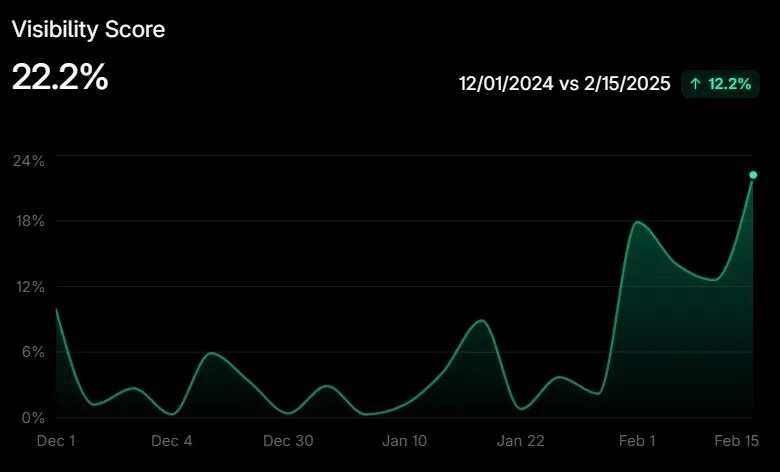
Ramp's AI visibility improvement Source: Profound official website
Secondly, there is the content creation service, which mainly includes AEO content creation templates and data - driven content creation briefs. The former mainly generates articles and product copywriting that conform to AI crawling habits, while the latter provides content creation suggestions to customers based on AI platform preferences.
The SaaS enterprise Zapier, which focuses on providing a no - code automation platform, quickly established its position in the AI ecosystem through Profound's content creation service.
Through cooperation, Zapier connected Profound's API interface with its internal data dashboard and formed a new AEO team. It produced corresponding content based on the AI preference themes, factual data citations, and semantic logic provided by Profound. After optimization, the traffic Zapier obtained through AI applications increased threefold, and its Citation Rank (citation ranking) in mainstream large models increased by 12%.
"Low threshold" and a complete service chain are Profound's advantages. On the one hand, its AEO templates and creation briefs do not require much technical foundation and can be compatible with and integrated with the customer's internal system, allowing customers to quickly get started. On the other hand, the monitoring and creation services are closely combined, and the creation direction is controlled through upstream data to improve stability.
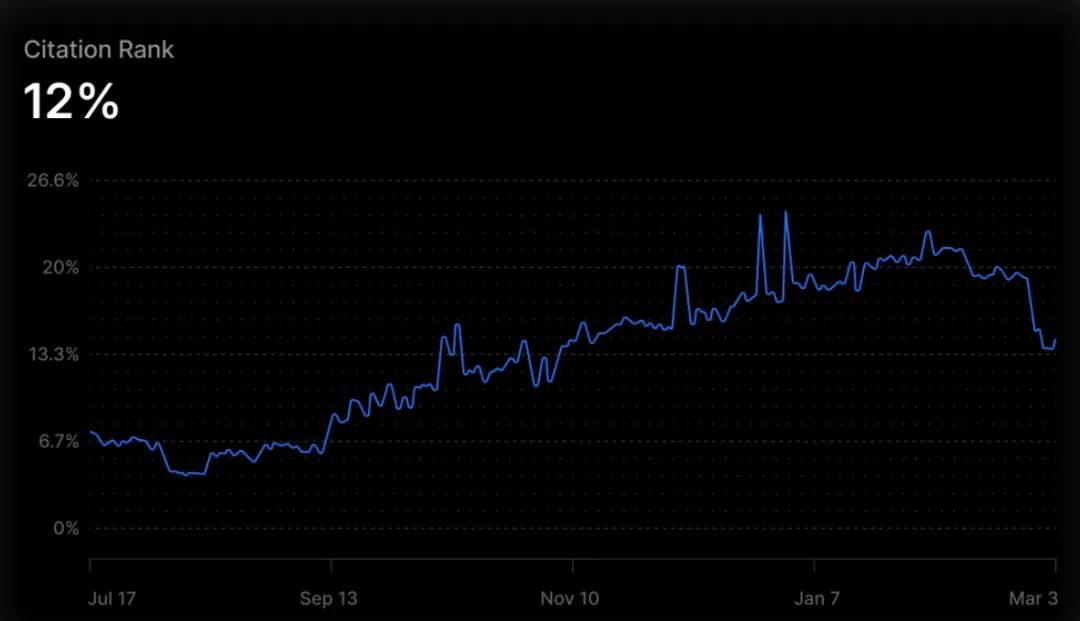
Zapier's AI citation ranking improvement Source: Profound official website
In addition, there is also a one - stop, customized service, which mainly includes large - scale marketing campaign strategies with multi - agent collaboration and a full - chain solution integrating monitoring - creation - distribution - attribution.
This type of service targets enterprises with high industry competition and strong AI penetration. The customers' requirements are straightforward: fast and accurate. They need to complete the deployment quickly to seize the fleeting opportunity window and find their own position accurately in the complex industry branches.
For example, the human resources service platform 1840.Co. is in the remote human resources service field dominated by leading players such as Toptal and Upwork. It is at a natural disadvantage in terms of user perception, and traditional marketing methods have limited effects.
After adopting Profound's service, 1840.Co. first scanned the source preferences and acceptance principles of large models through the monitoring system and found that AI is more inclined to quote short comparison lists and content that directly answers common questions such as "Why choose us". Then it created and published blog papers specifically. Its AI visibility increased from 0% to 6% within two weeks and 11% within a month. Then, it used Profound's tracking tools to monitor the changes in AI citation data and adjust the content regularly to ensure the sustainability of the optimization effect.
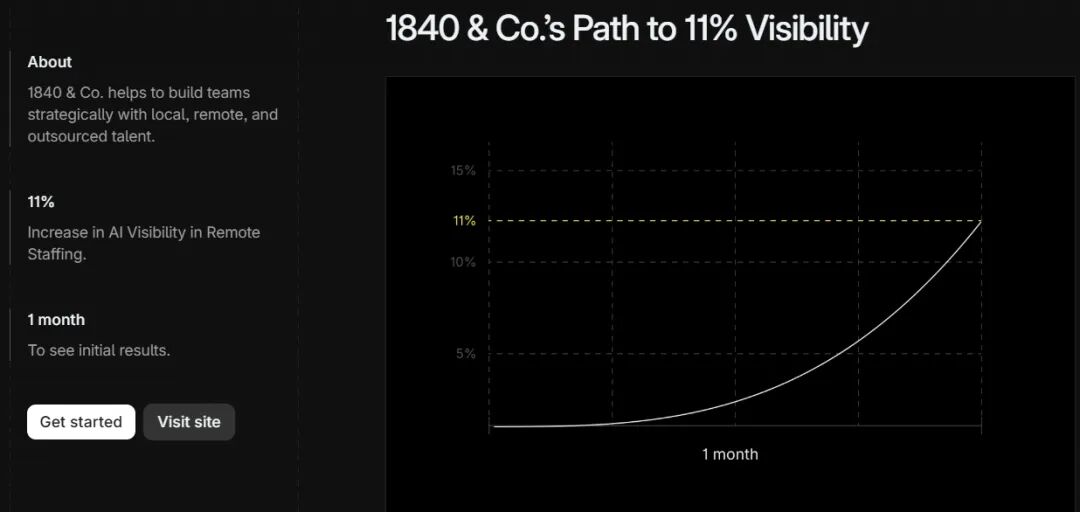
1840.Co.'s AI visibility improvement Source: Profound official website
In addition to the complete service segments, Profound also adopts a more precise tiered pricing strategy: the "Lite service" for startups and small and medium - sized enterprises is priced at $499 per month, providing basic monitoring and creation assistance. For the complex needs of large brands, it provides high - end services including exclusive AEO strategists, full - platform monitoring, personalized content creation, and 24 - hour support, with the price negotiated on a case - by - case basis.
Through tiered pricing, Profound can cover enterprise customers of different scales and maximize its market share. Running through the service chain of "insight - creation - delivery - attribution" can not only ensure the optimization effect of a single project but also extend the business boundary and improve customer stickiness. It can complete the accumulation of original customers and the verification of the business model in a relatively short time, and naturally gain the favor of capital.
At the Forefront of the Trend:
Why Do Investors Favor Profound?
However, Profound's success in the capital market is not entirely due to its own performance but is the result of the superposition of multiple factors of "timing, geographical location, and human harmony", and this superposition effect is difficult to simply "clone".
Timing refers to the irreproducible first - mover advantage.
In 2024 when Profound was founded, it was a crucial node when the popularity and user scale of generative AI soared. The GEO track was in the "cognitive enlightenment period", and the market was almost blank.
According to a survey by Morgan Stanley, as of September of that year, the monthly usage rate of generative AI in the United States reached 35% - 40%, a year - on - year increase of more than 10%. Max Altman, the co - founder of Saga Ventures and one of Profound's shareholders, once said that the market demand for GEO far exceeded expectations. Sequoia Capital also pointed out that the core logic of investing in Profound was that it seized the window for the transformation of AI marketing from the "keyword era" to the "intention era".
Geographical location refers to the severe "FOMO" mentality of Wall Street capital in the context of the AI investment boom.
2024 - 2025 was the "golden period" of global AI investment. According to a report by the data company Dealroom, global investment in the AI field exceeded $110 billion in 2024, a year - on - year increase of 62%. AI marketing was also a core track for capital injection. Against this background, capital urgently needed to expand and bet on future potential, and particularly valued leading service providers like Profound.
Human harmony refers to Profound's own ability and case accumulation, which is also the source of capital confidence.
As one of the earliest service providers in the industry to establish a complete "insight - creation - delivery - attribution" system, Profound's "three - pronged approach" lies in accurately hitting the pain points of brands and quickly accumulating cooperation cases such as Ramp, Airbyte, and 1840.Co., proving the value of its services.

Some of Profound's customers Source: Profound official website
In contrast, there are obvious differences in the growth trajectories of the GEO industries at home and abroad, which is also the core reason why many domestic peers cannot fully replicate Profound's service system and development path.
Firstly, there is a misalignment in the development rhythm.
When Profound was founded, overseas large AI models (such as ChatGPT, Perplexity, and Gemini) had entered a stable iteration period, and the demand for AI marketing of brands continued to rise. According to statistics from Bain & Company, at that time, more than 80% of enterprises in the United States believed that generative AI projects met the expected effects, and the average budget soared to tens of millions of dollars. In contrast, the domestic GEO industry started relatively late. For example, institutions such as Analysys regarded 2025 as the "Year of GEO".
A mature ecological environment is the foundation for Profound to quickly implement services, verify effects, and then gain the recognition of capital and customers, which conforms to the development logic of "technology - driven - effect verification - capital expansion".
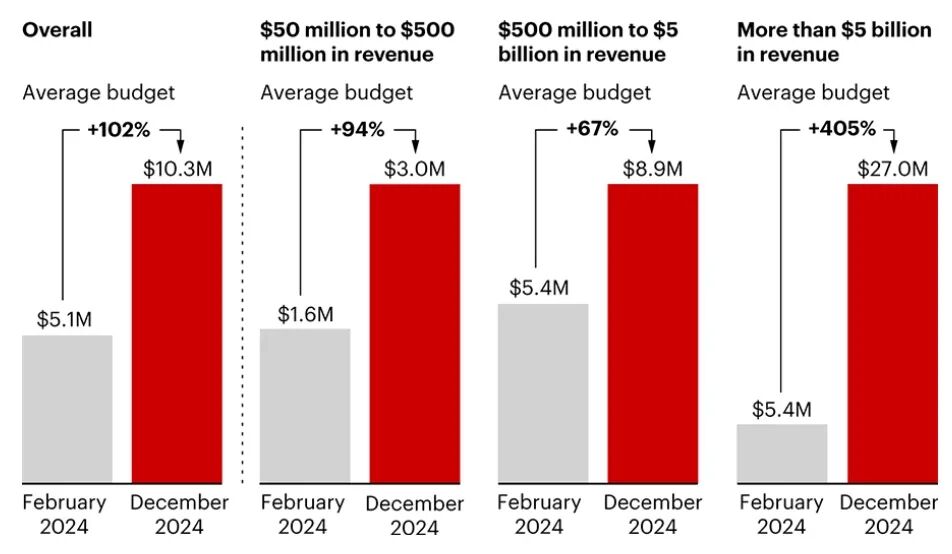
The average budget of AI projects of US enterprises Source: Bain & Company
Secondly, there are differences in the technical environment.
Data insight and effect attribution highly depend on the open interfaces of large models, and self - developed agents also need the support of underlying large models. In this regard, the United States has a special ecosystem, and the model open interfaces are relatively complete. For example, LLaMA adheres to the open - source route, and most early startup models are fine - tuned and integrated based on it.
Finally, there are differences in the content ecosystem.
The target path of overseas GEO optimization is relatively unified, following the mainstream strategy of "building authoritative information sources and gaining AI trust". There are mature authoritative media resources, and brands generally pay attention to the construction of official channels. In Profound's cooperation with customers such as Ramp and Airbyte, the optimization of official website content is an important part. In contrast, the domestic media environment, content ecosystem, and AI model source preferences are more complex, which brings more challenges to service providers at the initial stage.
For domestic service providers, rather than blindly following Profound's model, it is more important to see the current situation clearly: the first - mover advantage is long gone, overseas experience cannot be copied, and the attitude of capital changes rapidly. Where is the future of GEO?
Beyond the Hype:
How High is the Ceiling for GEO Service Providers?
In fact, Profound's success is highly accidental, and its growth model is far from "flawless". As the challenges in the market and technology intensify, more in - depth contradictions are emerging.
On the one hand, Profound's core technology does not have a high degree of exclusivity and non - replicability, and its moat is far from as stable as expected - this is also a common problem for many GEO service providers.
Profound's technology layout is still limited within the traditional search and monitoring technology framework, only making "internal optimizations" for AI rules, lacking a real "disruptive technological change". For example, the underlying technology of monitoring services such as Agent Analytics is web crawlers, and the accuracy is greatly affected by the openness and iteration speed of AI models.
As the differences in the underlying technical architectures of mainstream large models continue to widen and the iteration speed of training data and semantic understanding logic accelerates, it is becoming increasingly difficult for third - party service providers' monitoring systems to adapt to all models.
