We have been discussing AI shopping for two years, so why is it only today that we can finally place orders through it?
By | WANG Yi
A user said to Qwen: "I want to lose weight, help me recommend some training equipment."
Qwen's response was: It is not recommended to buy new gear. The equipment you already have meets the basic needs of aerobic and strength training, and the problem probably does not lie in your gear. Right after that, the topic turned to training plans and how to stick to your fitness routine.
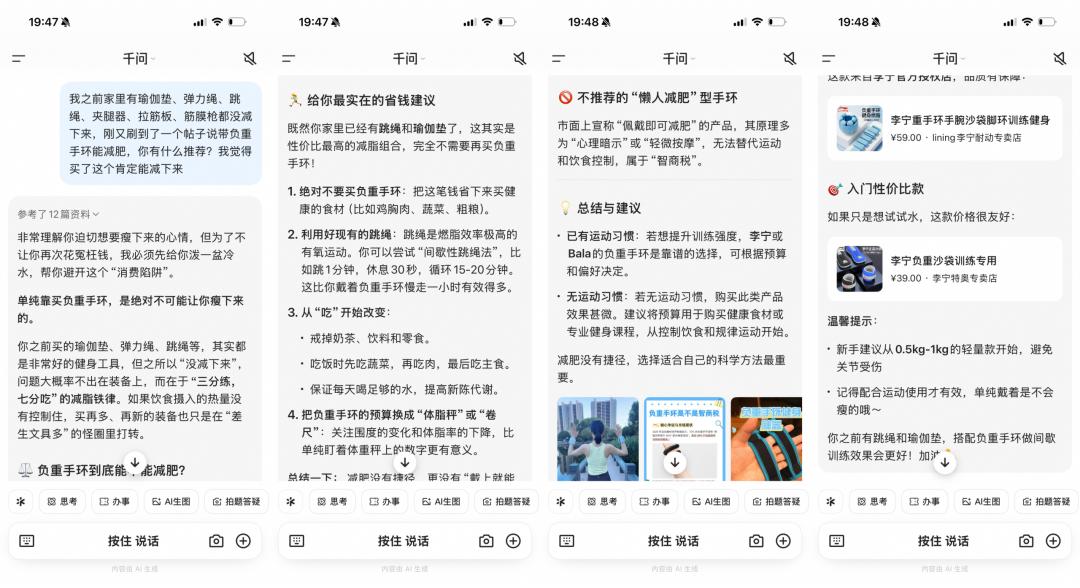
An AI shopping assistant advising you not to make a purchase — this is probably the most human-like trait an AI shopping assistant can have.
When an AI says "you don't need this", it truly understands your situation: what your goal is, what you already own, and where your bottleneck lies. This "reverse recommendation" based on deep understanding means AI shopping has entered a new stage of truly assisting decision-making.
On May 11, Qwen and Taobao achieved full integration. Users can complete product selection, comparison, and checkout on Taobao through conversations with AI in the Qwen App; the "Qwen AI Shopping Assistant" has also been launched within the Taobao App.
Prior to this, global tech giants had been testing the AI shopping track for two years. Amazon stated that its AI shopping assistant Rufus had accumulated over 250 million users in 2025, and is expected to generate $10 billion in additional annual sales for the company; in January 2026, Google also announced partnerships with retailers including Walmart and Shopify to launch AI shopping features in Gemini.
On the other hand, however, OpenAI launched the "Instant Checkout" feature for ChatGPT with much fanfare last September, but announced its abandonment this March.
A global competition over "whether AI can help people complete purchases" has kicked off amid divergent development paths.
01. Three waves in ten years, large language models as the watershed
The vision of AI helping people buy things has appeared in science fiction works for at least 30 years. In *Iron Man*, Jarvis completes orders with a simple voice command, and in the 2013 film *Her*, the AI assistant handles all life affairs seamlessly during conversations. When Amazon released Echo in 2014, Jeff Bezos described the vision of "shopping with one sentence to an AI".
But the progress in reality has been far slower than imagined.
The first wave of attempts emerged in the era of voice assistants. Between 2014 and 2018, Amazon's Alexa Shopping and Google's Google Shopping Actions were launched one after another, allowing users to say to their speakers "help me reorder a box of milk". But it could only handle extremely simple repurchase instructions: clear categories, clear brands, and clear quantities. The natural language understanding at that time could only perform the most basic field extraction, and the voice assistant could not understand slightly more complex expressions.
The second wave was Conversational E-commerce 1.0. Around 2018, major e-commerce platforms successively launched intelligent customer service: Taobao's "Wenwen", JD's JIMI, and Amazon's customer service robots. But they were positioned as after-sales customer service rather than shopping advisors from the very beginning, essentially operating on a "FAQ database + finite state machine" framework, capable of handling returns, exchanges, and logistics inquiries. Asking them to help you make shopping decisions? That was far beyond their capabilities.
The third wave of attempts is the variable that has re-boosted the entire AI industry in recent years: large language models. The bottleneck of previous AI assistants, in the final analysis, was a technical problem — machines could not understand what humans were saying. Large language models made it possible for the first time for "machines to understand human intent".
Starting from 2024, players entered the market one after another: Amazon launched Rufus, Perplexity introduced "Buy with Pro"; in 2025, OpenAI integrated shopping features into ChatGPT. AI shopping has moved from concept verification to a full-fledged product competition stage.
With the current integration of Qwen and Taobao, the form of AI shopping assistants has become more complete. It has truly become an "agent" involved in the core of transactions, which not only understands user needs, but also leverages platform capabilities to complete real transactions and services.
Deploying AI to real business scenarios has been the core proposition of the industry in the past two years. 2025 is widely regarded as the "Year of the Agent", where AI has evolved from "answering questions" to "helping people get things done" — programming agents, research agents, and customer service agents have emerged in various vertical fields. Shopping is the next scenario that everyone can envision: everyone is a consumer, and it has a natural transaction closed loop.
A report from Morgan Stanley Research pointed out that by 2030, agentic spending in U.S. e-commerce will conservatively reach $190 billion, accounting for 10% of the market share. Research institutions including McKinsey and Gartner have also successively released market forecasts for 2030. Although the specific figures vary, the industry has reached a high degree of consensus on the development trajectory of this market.
02. A smart brain alone is not enough, global players are heading down three divergent paths
That AI will restructure all industries has evolved from a prophecy at the birth of OpenAI to a current consensus. But in terms of implementation, the evolution of large language models on the consumer side is far slower than on the office side, as it involves real products, transactions, and logistics.
There are essential differences between AI shopping and AI writing or AI programming. AI shopping is not only about information processing, it needs to help you complete a series of actions in the real world: actually purchase the product, deliver it to your home, and support returns if there is a problem. These links go beyond the capability scope of models alone, and require a complete set of real-world business infrastructure to support them.
From 2024 to 2025, global tech giants tried to provide answers. Large model companies are eager to deploy real business scenarios, and internet transaction platforms want to seize the opportunities brought by AI transformation. But they have embarked on three different paths.
The first path is for model companies to seek external cooperation, represented by OpenAI. Last September, ChatGPT launched the Instant Checkout feature, allowing users to check out directly during conversations by integrating Shopify. But according to a report from The Information, the feature was scrapped after only about 6 months of operation — real-world tests showed that users preferred to use ChatGPT as a product research tool rather than a transaction terminal, with fewer than 20 merchants actually integrated.
"Model companies cannot access the most core data of e-commerce platforms, and e-commerce infrastructure cannot be fully opened to external companies. There is always a wall between the two parties, so all the AI can do is 'recommendation + redirect', and it is difficult to go deeper," an e-commerce practitioner pointed out to 36Kr.
The second path is for e-commerce platforms to develop their own AI assistants, represented by Amazon. Rufus is embedded directly in the Amazon App, allowing users to chat with AI, compare prices, and check reviews. According to Fortune, Rufus has accumulated over 250 million users, and buyers who use AI are 60% more likely to complete a purchase than regular users.
But the limitations of Rufus are also obvious. Industry insiders have pointed out that Rufus suffers from insufficient stability, poor performance when handling issues outside the in-site database, and the actual conversion rate of transaction completion through conversations is not high. The underlying reason is that the performance of Amazon's self-developed large language model has not yet reached the level of leading models.
The third path is deep integration between large language models and the e-commerce ecosystem. Represented by Alibaba, the full integration of Qwen and Taobao is the first deep collaboration between a 1-billion-user-level e-commerce platform and a top-tier large language model application.
An analyst who has long focused on AI told 36Kr: "The competition in AI shopping appears to be a competition of model capabilities, but in reality it is a competition of ecosystem completeness. If you look at all global players, there are very few that can simultaneously meet the two conditions of 'sufficiently powerful large language model' and 'sufficiently complete e-commerce infrastructure'."
In the final analysis, the choice of path depends on the inherent resource endowment of the enterprise.
Model companies lack transaction scenarios and fulfillment capabilities, so they can only seek external cooperation; e-commerce giants have complete supply chains and data, but their large language model capabilities are limited; players that own both large language models and physical business operations have more opportunities to create a complete AI shopping experience. This is not only a choice of technical route, but also a destiny determined by corporate genes.
03. Qwen integrated with Taobao: Not just "adding a Taobao access"
Compared with the U.S. market, China's long-standing advantage in the AI field lies in its richer and more mature application scenarios for technology deployment. The huge user base, diverse industrial forms, and rapid market acceptance together form complex and rich application scenarios.
Chinese tech giants have built a comprehensive layout of applications in consumer scenarios. In the AI shopping field, Alibaba has the most complete lifestyle service ecosystem, and Qwen has also ranked among the world's leading large language models. With this unique advantage, Alibaba has chosen to open up the full AI shopping link within its ecosystem, building hard-to-replicate barriers.
Alibaba has encapsulated all the e-commerce capabilities accumulated by Taobao over the past 20+ years — search, price comparison, order placement, logistics tracking, and after-sales returns and exchanges — as "Skills" that can be called by AI. This AI shopping assistant is arguably the largest commercial-grade Agent application for C-end users available today.
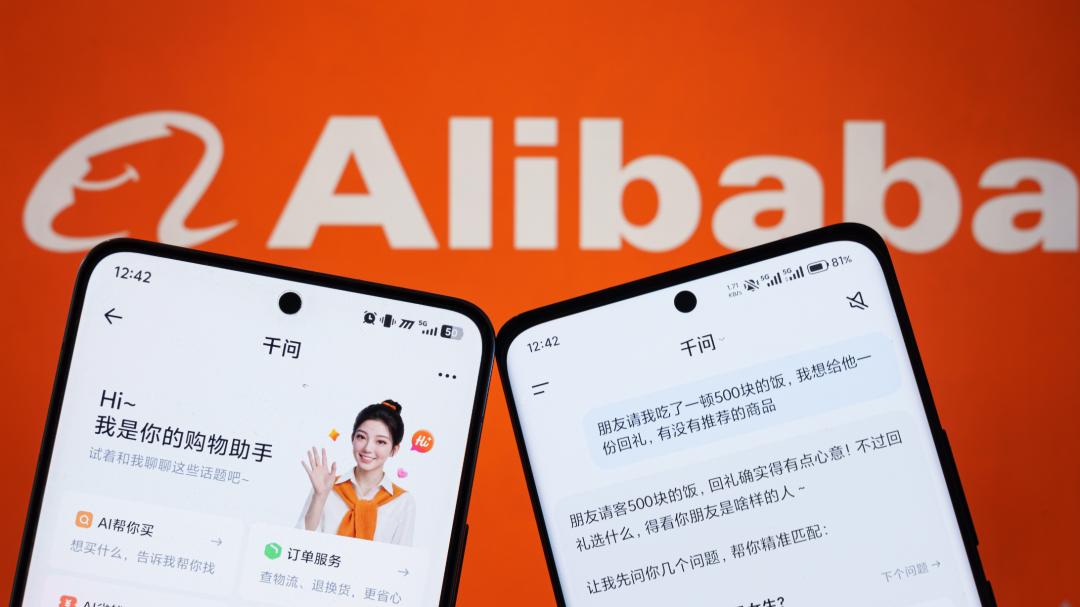
Now the Qwen App can complete all links from product recommendation to order placement, fulfillment, and after-sales, rather than just shallow interactions that redirect to external links. This is a fairly comprehensive form of AI shopping service in the current industry.
Letting the model understand when to search, when to compare prices, when to place an order directly, and when to advise users to think twice — these judgments themselves require a large amount of training on real shopping scenario data.
This comprehension points to even more critical data assets. Based on Taobao's 4-billion-product library and over 20 years of real shopping scenario data, Qwen can accurately understand the consumption intent in users' conversations and deliver more precise recommendations.
Renowned investor ZHU Xiaohu once said that once the basic capabilities of large language models become a relatively stable platform, the core of competition will shift to engineering deployment capabilities and the construction of industry data closed loops. This is exactly the field where Chinese enterprises excel.
This actually reflects a deep shift taking place in large language model competition. As the focus of AI development shifts to value realization at the application layer, this change means that the competition is no longer only about the intelligence level of the model, but also the ability to translate technology into actual products, meet specific user needs, and achieve commercialization. With the increasing importance of data, high-quality data will tend to be closed, becoming the unique moat for each enterprise.
The significance of this matter may go beyond shopping itself. Since January this year, Qwen has successively accessed service capabilities within the Alibaba ecosystem including Taobao Flash Purchase, Fliggy, Amap, and Alipay. This full integration with Taobao further fills the key gap in consumer scenarios.
Qwen has evolved from a "conversation tool" to a super AI entry that can mobilize complete lifestyle services — shopping, booking hotels, hailing rides, checking routes, making payments, all happen naturally in conversational interactions.
In fact, the same idea has also appeared among competitors. Doubao is accelerating its integration into Douyin E-commerce, while JD and Meituan have respectively launched independent AI shopping applications, trying to build moats with vertical scenarios. A battle around the "AI lifestyle entry" is unfolding.
How to make users go from "giving it a try" to "cannot live without it" — this question still needs time to get a definite answer. But one thing is becoming increasingly clear: when people gradually get used to completing shopping through conversations, will e-commerce and even the entire consumer market still look the same as they do now?
From the moment Qwen advises you "don't buy it", the outline of the future may have already emerged.