The overlooked "life-saving configuration" is triggering a hidden battle in the automotive industry.
When driving on the highway at a speed of 120 km/h, the tire suddenly emits a shrill popping sound. The vehicle body instantly veers sharply to one side, the steering wheel spins out of control, and the warning lights on the dashboard flash wildly. This is a dangerous moment that no car owner wants to experience.
Once upon a time, a high - speed tire blowout was almost equivalent to a "countdown to loss of control." However, today, the "Tire Blowout Stability Control System" is rewriting this situation and has become a new battlefield for domestic automakers to compete. From extreme tests to price cuts, from CEOs personally taking the wheel to maximizing technical parameters, automakers are using various means to take safety to a new level.
Just at the press conference held by Fangchengbao Automobile tonight, Fangchengbao released the Yunlian P - Ultra. This technology is first applied to the flash - charging versions of the Leopard 5 and Leopard 8 models, bringing the function of lifting wheels in all working conditions. It enables the vehicle to drive with three wheels on the ground and can be used in the Tire Blowout Stability Control System.
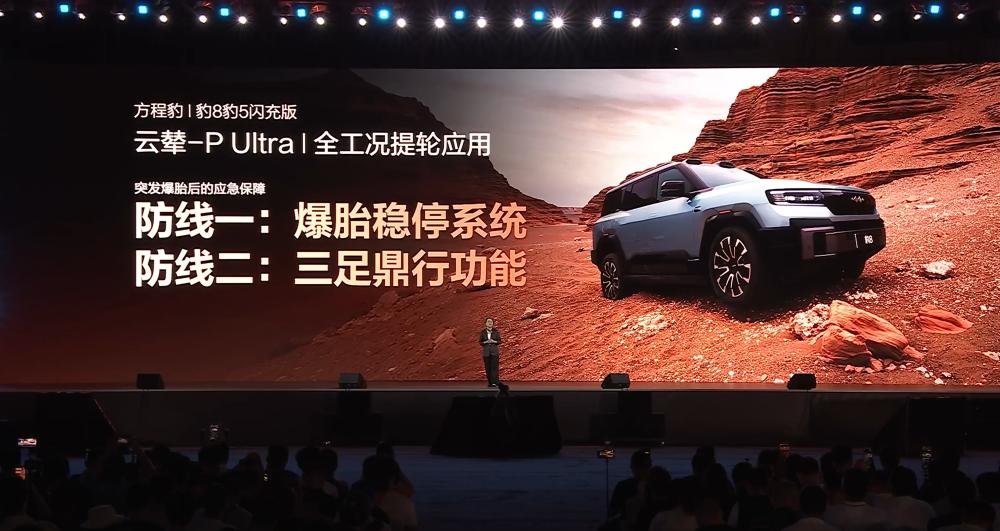
▲ The Yunlian P - Ultra can be used in the Tire Blowout Stability Control System
At recent new product press conferences of domestic automakers, the Tire Blowout Stability Control System is no longer an "exclusive configuration" for high - end models. Instead, it has firmly become a "must - have highlight" taking up a whole page of the PPT.
So, why are automakers going all out to develop this technology? And how do they push the performance of tire blowout stability control to the limit through various competitions?
01.
CEOs Take the Wheel for Personal Tests
The Speed Competition Reaches 220 km/h
Of course, automakers are not just simply listing parameters on the PPT. Nowadays, the way automakers present the Tire Blowout Stability Control System focuses more on actual - test demonstrations, allowing users to more intuitively feel the practicality of this technology.
At the same time, it can be clearly seen that the Tire Blowout Stability Control System is gradually being introduced from high - end new - energy vehicles to models priced under 100,000 yuan.
In the initial implementation of the Tire Blowout Stability Control System, it was mainly concentrated on relatively high - end new - energy vehicles. The focus of competition among automakers in this price range is on "extreme performance" and "sincere endorsement." Operations with high topicality, such as CEOs' personal tests and ultra - high - speed tire blowout tests, all stem from this.
Li Bin, the founder, chairman, and CEO of NIO, has personally taken the wheel many times to demonstrate the Tire Blowout Stability Control System. At the recent press conference of the NIO ES9, Li Bin "stepped up" by demonstrating a tire blowout of the front and rear wheels on the same side in a snow - covered scenario at a speed of 153 km/h. This made the joke "Automakers really wear out their CEOs at press conferences" spread throughout the industry again.
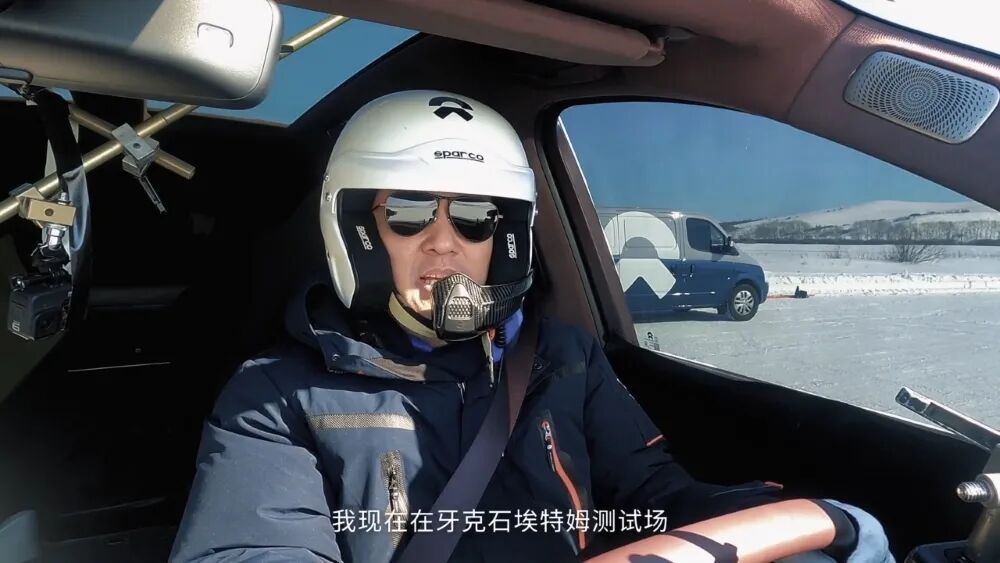
▲ Li Bin personally demonstrates the system
Fan Junyi, the general manager of Geely Automobile Sales Company, also once drove the Geely Galaxy M9 for a high - speed tire blowout test on an ice - and - snow circular road at a speed of 80 km/h for a 200,000 - yuan - level model.

▲ Fan Junyi personally demonstrates the system
Automakers have not overlooked the maximum speed at which the Tire Blowout Stability Control System can take effect. Taking the new Avita 12 as an example, it demonstrated a rigorous test of four - tire blowouts at a speed of 220 km/h.
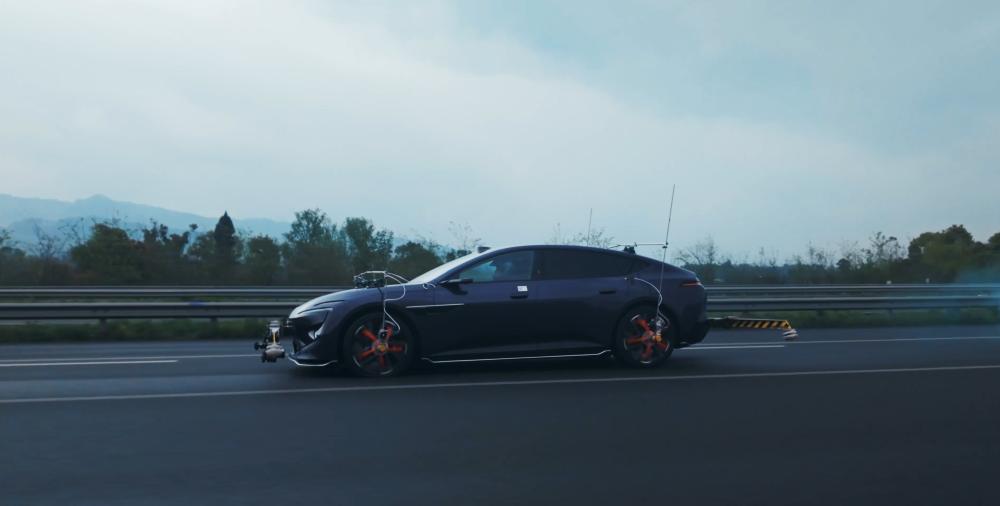
▲ Four - tire blowouts of the new Avita 12 at a speed of 220 km/h
Recently, the competition in the Tire Blowout Stability Control System has extended to the market for vehicles priced under 100,000 yuan.
The recently launched Leapmotor A10, a small car priced under 100,000 yuan, is also equipped with this system. It can achieve tire blowout stability control at a speed of 140 km/h and also showed an actual - test video at the press conference.

▲ The Leapmotor A10 demonstrates the Tire Blowout Stability Control System in the snow
At around 100,000 yuan, models such as the 2026 MG 4 EV, Changan Qiyuan A06, and XPeng MONA M03 are all equipped with the Tire Blowout Stability Control System.
It can be said that automakers have taken the competition to a new level in terms of the functions, scenarios, performance, and price ranges of the models equipped with the Tire Blowout Stability Control System.
02.
The Risk of Tire Blowout Accidents Is Extremely High
The Traditional ESC System Can Hardly Meet the Requirements
The core reason why automakers are competing so fiercely in this technology is to face the deadly threat of high - speed tire blowouts. As the main culprit of highway traffic accidents, the harm of tire blowout accidents far exceeds imagination.
According to public data, in 2024, 18.7% of traffic accidents nationwide were caused by tire problems. In highway accidents, this proportion soared to 46%, and the mortality rate caused by tire blowouts is 3.2 times that of ordinary accidents.
Of course, automakers are not just noticing this problem now because of the high risk of tire blowout accidents. For example, there is the relatively traditional ESC (Electronic Stability Control) system.
The history of the ESC system can be traced back to the late 1980s to the early 1990s. Its core working logic is to monitor the vehicle's driving attitude in real - time through body sensors. When it detects a normal loss - of - control trend such as understeer or oversteer, it applies braking force to one or more wheels to correct the vehicle's driving trajectory. It is mainly used to deal with normal dangerous scenarios such as skidding on slippery roads and emergency lane changes.
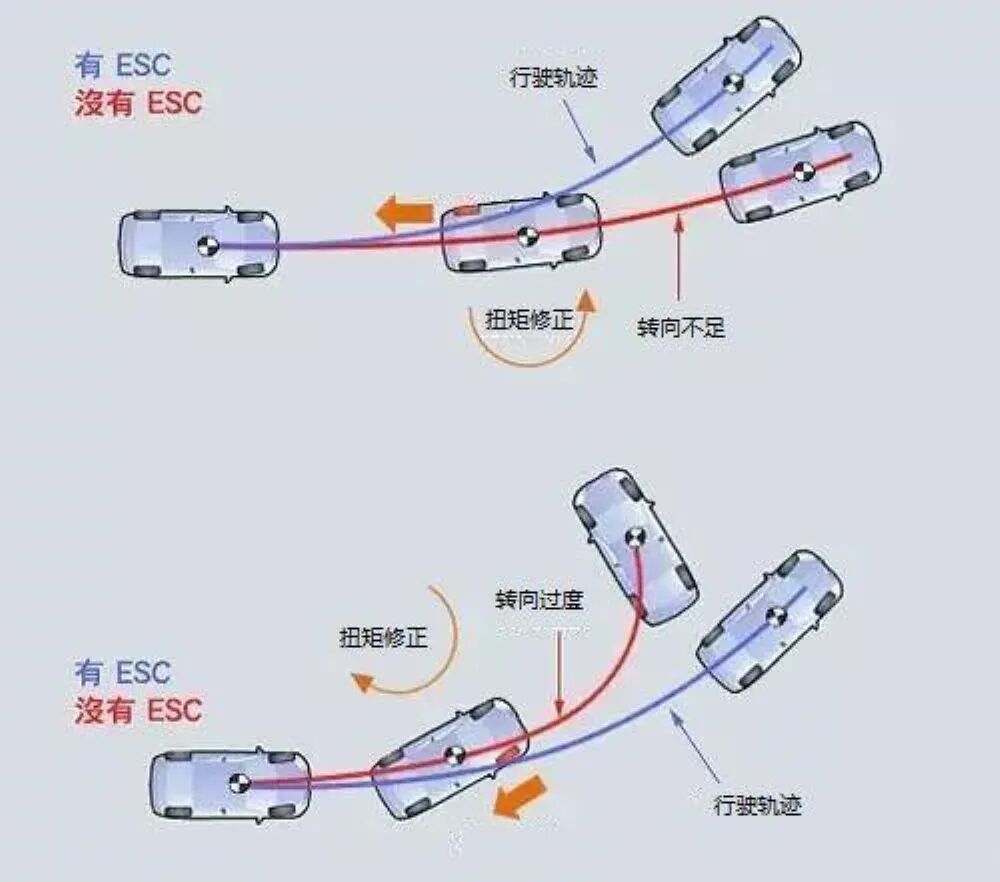
▲ Schematic diagram of the ESC system (image source: Internet)
After a tire blowout, the vehicle will yaw uncontrollably towards the side of the blown - out tire. When the vehicle detects the yaw, the ESC system will apply a correction through "differential braking."
Simply put, it applies braking force to the wheel on the opposite side of the yaw direction. For example, if the right front tire blows out and the front of the vehicle veers to the right, the ESC may apply braking force to the left rear wheel to generate a reverse torque to help "pull" the front of the vehicle back on track.
However, the ESC system has some limitations, which are also the difficulties that the Tire Blowout Stability Control System needs to face.
The sensors relied on by the traditional ESC focus on the "current loss - of - control state." It can only sense the problem when the vehicle has already shown abnormal postures such as yaw and skid. In a critical situation like a tire blowout, the system needs to get an earlier warning. It can be metaphorically said that the "eyes" of the Tire Blowout Stability Control System need to be more sensitive, and the "brain" needs to react faster.
In addition, in terms of control, the core ability of the traditional ESC is still braking, and it usually does not directly control steering and suspension. That is to say, the Tire Blowout Stability Control System needs more agile "hands and feet."
03.
The "Eyes," "Brain," and "Hands and Feet" Are the Core of the Upgrade
Multi - dimensional Coordination of the Motor Suspension
Automakers' ability to achieve tire blowout stability control at speeds of 160 km/h or even 220 km/h is not the credit of a single sensor or algorithm. It is the result of the coordinated action of a closed - loop system of "perception - decision - execution."
The core logic for the Tire Blowout Stability System to stabilize the vehicle body is: quickly capture the tire blowout signal → accurately judge the loss - of - control trend → instantly execute the control command. Corresponding to the previously mentioned "eyes," "brain," and "hands and feet," each part has a clear technical breakdown and specific work process.
So, how has the Tire Blowout Stability Control System been improved in terms of the "eyes," "brain," and "hands and feet"?
1. "Eyes": Perception - Capturing the Tire Blowout Signal without False or Missed Judgments
In terms of the "eyes," the first is real - time perception and data fusion. Nowadays, new - energy vehicles are generally equipped with high - precision direct - sampling tire pressure sensors (direct TPMS), which, together with wheel speed sensors and attitude sensors, achieve all - around perception from a sudden drop in tire pressure to the vehicle body's attitude.
The high - precision direct - sampling tire pressure sensor is a device that directly collects air pressure and temperature data through high - precision sensors installed inside each tire and displays the specific values in real - time and accurately.
The specific working process of the high - precision direct - sampling tire pressure sensor is that through the pressure chip built - in the sensor, it monitors the tire pressure change in real - time at a certain frequency. During normal driving, the tire pressure fluctuates little. When a tire blows out, the air pressure inside the tire will suddenly drop - for example, from 2.5 bar to below 0.5 bar.
At this time, the TPMS sensor will immediately trigger a "tire blowout warning" and transmit the three core data of "tire blowout location, tire pressure drop rate, and current tire pressure" to the vehicle's central domain controller at a millisecond - level speed through a signal.
The wheel speed sensor is also installed on the hub of each wheel. Its core function is to collect the wheel speed in real - time. It cannot directly detect a tire blowout, but it can assist the TPMS to verify the tire blowout signal and locate the blown - out wheel to avoid false judgments.
The principle is that after a tire blowout, the tire suddenly deflates, and the effective diameter of the wheel becomes smaller. At a constant vehicle speed, the speed of the blown - out wheel will suddenly increase. At this time, the wheel speed sensor will transmit the signal of "a sudden increase in the speed of a certain wheel" to the central domain controller, which will be cross - verified with the "sudden drop in tire pressure" signal transmitted by the TPMS.
Only when both the "sudden drop in tire pressure" and the "sudden increase in the speed of the corresponding wheel" signals are satisfied will the system finally determine it as a "tire blowout," avoiding false judgments caused by TPMS sensor failures or signal interference.
The inertial measurement unit, also known as the attitude sensor, has the core function of collecting the vehicle's "attitude data" in real - time, including the yaw angle of the vehicle body (whether the vehicle is veering off course), the roll angle (whether the vehicle is tilting), the longitudinal acceleration (whether the vehicle is decelerating/accelerating), and the lateral acceleration (whether the vehicle is skidding). It is equivalent to a "dynamic detector" for monitoring the vehicle body's attitude.
After a tire blowout, the vehicle will immediately yaw towards the side of the blown - out tire (for example, if the right front tire blows out, the front of the vehicle will veer to the right). At this time, the inertial measurement unit will capture the "abnormal yaw angle of the vehicle body" and detect the change in lateral acceleration. These data will be transmitted to the central domain controller and fused with the data from the TPMS and wheel speed sensors. On the one hand, it further confirms the tire blowout. On the other hand, it predicts the vehicle body's loss - of - control trend in advance - for example, if the yaw speed is too fast, it may cause the vehicle to skid, providing a basis for the "brain" to formulate a control strategy.
To summarize the working process of perception: A tire blowout occurs → the direct - sampling TPMS captures the drop in tire pressure and transmits the tire blowout location and tire pressure data → the wheel speed sensor captures the increase in the speed of the corresponding wheel and verifies the tire blowout signal → the attitude sensor captures the deviation of the vehicle body's attitude and judges the loss - of - control trend → the data from the three sensors are fused and transmitted to the central domain controller to complete the "tire blowout identification."
2. "Brain": Decision - making Layer - Analyzing Data and Formulating Control Strategies
Relying on the central domain controller and the dedicated control algorithm for tire blowouts, after identifying a tire blowout, the system will quickly analyze multi - dimensional data such as the vehicle speed, tire blowout location, and vehicle body attitude, accurately judge the loss - of - control trend, and formulate the optimal control strategy.

▲ The central centralized architecture of Huawei's Tuling Longxing platform
The core hardware of the central centralized architecture is the central domain controller. The central domain controller is the "computing power center" of the entire system, and its performance directly determines the decision - making speed and control accuracy.
Different from the "distributed controllers" of traditional vehicles (each system has an independent controller, resulting