The highly anticipated unveiling of the best AI scenario penetration cases in 2026.
If we were to use one word to describe the current AI industry, "implementation" is a bit outdated, and "penetration" is a more accurate term.
"Penetration" means that AI is no longer just a flashy demo at product launches or a conceptual model in PPTs. Instead, it has quietly integrated into the capillaries of enterprise operations and consumers' daily decision - making processes, just like water, electricity, and gas.
According to the "2025 AI Application Status Survey" report by McKinsey, driven by the rapid rise of domestic large - language models, generative AI has widely penetrated into enterprise operations. 83% of enterprises have achieved regular use in at least one function, significantly leading the world. More importantly, 45% of the surveyed enterprises reported that they have achieved large - scale or full deployment of AI, far exceeding the global average of 38%.
Behind the trends and data is a growing consensus in the industry: the main narrative of AI has shifted from "technological competition" to "scenario - centric".
The evaluation criteria have also returned to the essence of business. Nowadays, when judging whether an AI is excellent, the focus is no longer on its technical parameters and demonstration effects, but on how many problems it can solve and how much value it can create in real - world scenarios.
As the tide recedes, value emerges. A more fundamental question lies before the industry. After the early stage of anticipation, trial - and - error, and hype, which AI applications have truly taken root in the industrial soil and borne verifiable, measurable, and replicable fruits?
To answer this question, 36Kr has been continuously following the integration process of AI and industries. In 2023, we launched the WeChat official account "Intelligent Emergence", focusing on the industrial revolution emerging in the new era of AI. In 2024, we officially launched the first AI Partner Conference, aiming to find "benchmark cases of AI innovation applications". In 2025, we turned our attention to "embodied intelligence" and "AI - native", exploring how intelligent agents can deeply integrate with the physical world.
Entering 2026, the depth and quality of AI's "penetration" into the industrial deep - end have become the most core issues. In January this year, 36Kr launched another round of case collection for the AI Partner series, clearly focusing on "scenario penetration". After three months of public collection, case research, and multi - dimensional evaluation, we are now officially releasing the "2026 Best AI Scenario Penetration Cases" and "Special Tribute Figures".
Through continuous selection and exploration, we hope to find benchmark AI application cases that truly solve industry pain points, generate real commercial value, and are replicable. At the same time, we pay tribute to those "lighthouse keepers" and "barrier breakers" who dared to explore and invest in the early stage of AI application implementation, paving the way for the industry. We also focus on the people and spirit behind the technology that drives implementation.

Best AI Scenario Penetration Cases
The short - listed cases this time cover more than 10 key fields, including intelligent manufacturing, lifestyle services, healthcare, finance and insurance, retail e - commerce, culture and education, modern agriculture, and smart cities. Through a systematic analysis of 55 short - listed cases, we have discovered some notable features and trends.
Trend 1: Role Upgrade, from "Auxiliary Tool" to "Decision - making Center"
In the past, AI was mostly regarded as an "efficiency - enhancing tool", such as handling content generation and information collection for certain tasks. However, the short - listed cases this year show that AI is moving from the "execution end" of the process to the "decision - making core".
In complex scenarios such as supply - chain optimization, dynamic pricing, drug R & D, and financial risk control, AI systems can now make predictions, weigh options, generate solutions, and execute them independently based on multi - dimensional real - time data. This indicates that the goal of enterprises in introducing AI has shifted from "local cost reduction" to re - engineering the decision - making logic of key business processes, aiming for an "order - of - magnitude" improvement in decision - making quality and speed.
Behind this upgrade is the result of the deep integration of agent collaboration, reinforcement learning, and industry knowledge. When AI can understand the business cycle and optimize itself autonomously, its value has been upgraded from "a supplement to human resources" to "a new, scalable, and replicable core production capacity".
Trend 2: Form Evolution, from "Digital Assistant" to "Industrial Worker"
The process transformation in the digital world is just one stage. This year, a more remarkable change has occurred in the physical world. Among the short - listed cases, the number and maturity of "embodied intelligence" cases involving robots and intelligent equipment have significantly increased.
In high - end manufacturing workshops, agricultural farms, logistics warehouses, and even substations, AI drives robotic arms and AMRs (Autonomous Mobile Robots) to perform high - value tasks such as inspection, assembly, and patrol. At the same time, the maturity of edge - side AI has given smart cars, smart homes, and other devices unprecedented environmental perception and instant response capabilities.
In such scenarios, AI must create value through precise and reliable physical interactions in complex and unstructured real - world environments. It addresses the ultimate challenges of flexible production with "small - batch, multi - variety" and adaptation to uncertain environments that traditional rigid automation struggles to solve.
It can be seen that AI penetration is making a crucial leap, evolving from algorithms in the virtual world to a stable and reliable new - quality "productive force" in the physical world, gradually achieving a value - closed loop of "perception - decision - execution".
Trend 3: Path Deepening, from "General Capability" to "Industry - Specific Deep Dive"
Although general large - language models are powerful, in highly specialized industry scenarios, "generalists" are often not as good as "specialists". The short - listed cases this time show that successful penetration increasingly depends on a "deep dive" in vertical fields.
Leading practitioners are training models with industry - specific data, building domain knowledge bases, and "solidifying" experts' experience and judgment logic into the system. In scenarios such as medical auxiliary diagnosis, legal document review, and industrial parameter adjustment, vertical models far outperform general solutions in terms of accuracy, compliance, and interpretability.
This seemingly "subtractive" focus is actually building an "additive" competitive barrier. When AI deeply understands an industry's "jargon", processes, and rules, it is no longer an external tool but an internalized "standard component" of the business process. The accumulation of industry know - how and data forms the most solid moat for such AI applications.
The following is the complete list of "2026 Best AI Scenario Penetration Cases"





Special Tribute Figures
Behind every industrial revolution, there are two types of people that are indispensable. One type is the "lighthouse keepers", who point the way, and the other type is the "barrier breakers", who lay a solid foundation.
Most of the short - listed "lighthouse keepers" this time are founders or core decision - makers of enterprises. Their tribute lies not in their commercial success but in being pioneers who were the first to enter the field and invest real resources to verify the feasibility of AI implementation when the AI industry was still in its infancy.
Different from expectations, the short - listed "lighthouse keepers" do not come mainly from Internet or traditional AI companies but are widely distributed in real - world industries such as new - energy vehicles, robotics, chip design, autonomous driving, and unmanned delivery.
This also indicates to some extent that the value dominance of AI is shifting from "pure - technology companies" to "industry companies". Industrial leaders who truly own the scenarios, understand the pain points, and can organize the delivery of complex systems are becoming the core engine for the integration of AI and the real economy.
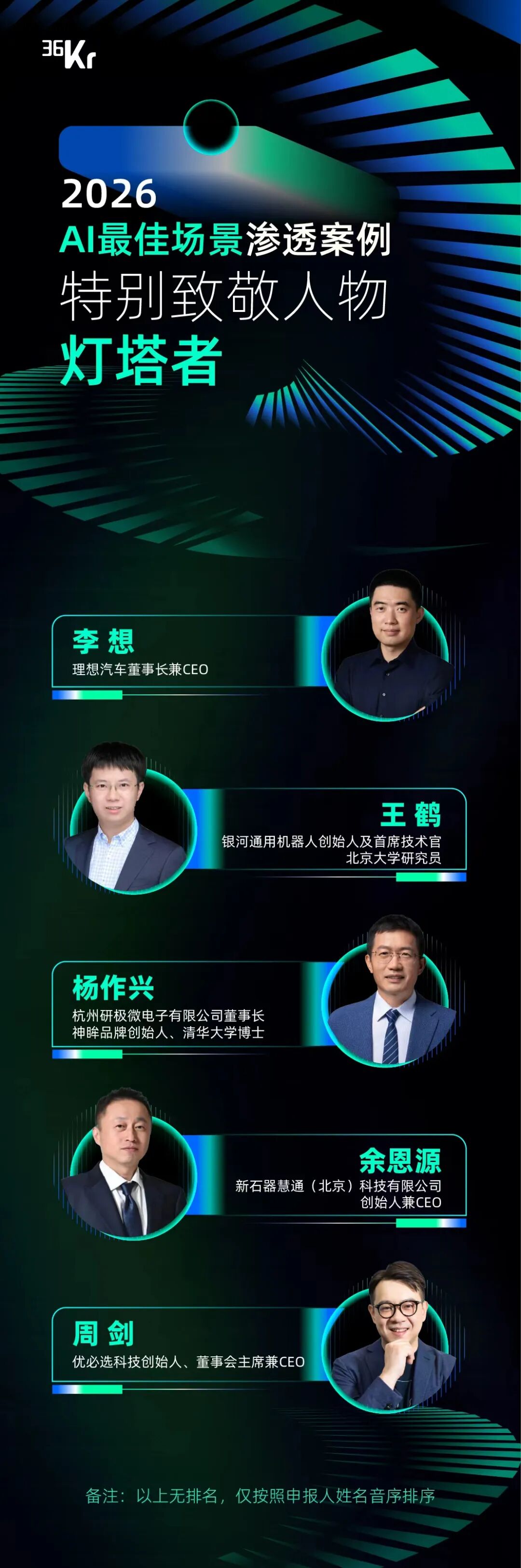
The following is the complete list of "2026 Best AI Scenario Penetration Cases · Special Tribute Figures - Lighthouse Keepers"
The "barrier breakers" are mostly technology leaders, chief scientists, or technology managers who are deeply involved in business operations. Their tribute lies in rooting themselves in the scenarios, pragmatically tackling challenges, and transforming abstract technology strategies into implementable, iterative, and commercializable industrial practices.
Judging from the backgrounds of the short - listed "barrier breakers", they generally have "dual - skills", being well - versed in both the technical core and business pain points. They are the "translators" and "architects" shuttling between the code world and the production site, solving the practical problems of "how to achieve".
In the view of 36Kr, the deep penetration of AI in industries cannot be driven by a single force but is a two - way pursuit and efficient collaboration between "lighthouse keepers" and "barrier breakers".
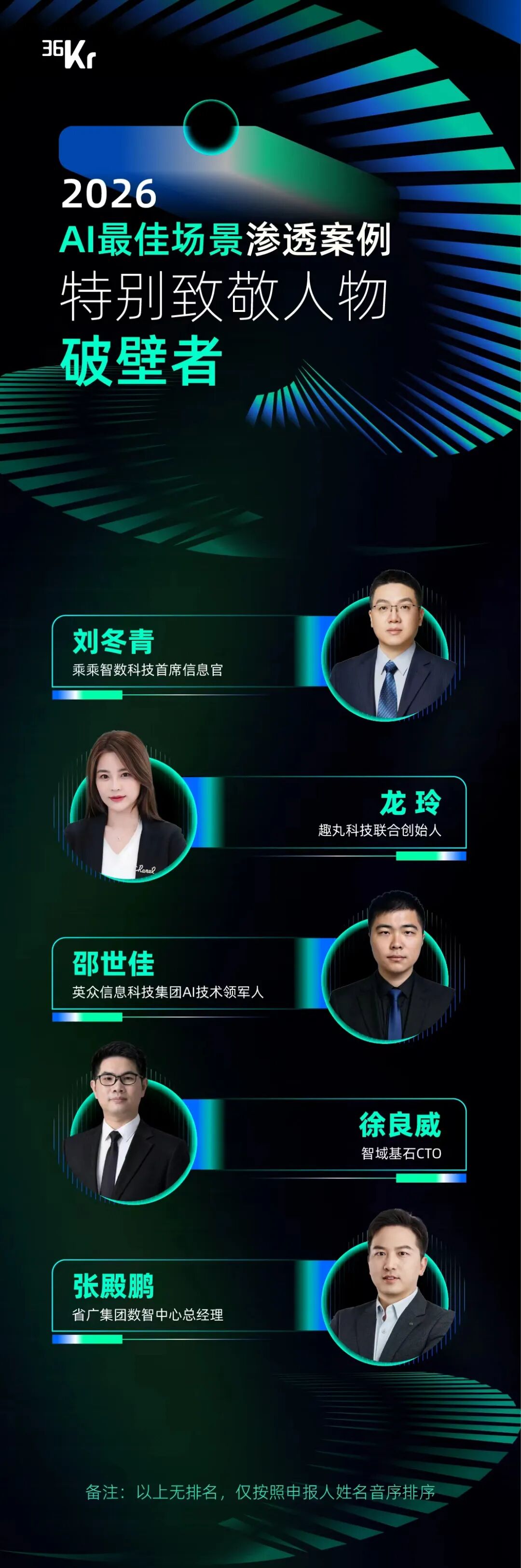
The following is the complete list of "2026 AI Best Scenario Penetration Cases · Special Tribute Figures - Barrier Breakers"

Industrial Big Survey
While collecting cases, 36Kr conducted a special survey on the pain points and expected application directions of AI scenario applications. These real - world feedbacks from the front - line provide valuable data support for us to understand "What problems does AI face when penetrating industries?" and "What AI applications does the market need most?"
We surveyed nearly a hundred buyer managers (including CEOs, CTOs, and business leaders) to understand the core challenges they face when AI projects enter the "implementation and application" stage. The results show that the pain points are mainly concentrated in three aspects:
Pain Point 1: Effect and Data
As many as 52.38% of the surveyed objects stated that the biggest challenge in current AI applications is that the effects fall short of expectations, especially the accuracy and stability in real - world business scenarios are unsatisfactory. This shows that there is a significant gap between the laboratory environment and the real - world production environment. Factors such as edge cases, data distribution drift, and real - time requirements can all "discount