Hundreds of billions vs hundreds of billions: Tesla's FSD battles Huawei's Qiankun, with the bayonet at the tip of the nose
In May 2026, two beams of light almost simultaneously pierced the sky.
On one side is Tesla, the pioneer of global intelligent driving. The cumulative driving mileage of its FSD supervised version fleet officially exceeded 10 billion miles (approximately 16.093 billion kilometers). On the other side is Huawei, the leader of intelligent driving in China. The cumulative assisted driving mileage of its Qiankun Intelligent Driving reached 10.47 billion kilometers. A senior executive on the spot declared, "We will surpass Tesla and become the world's number one this October."
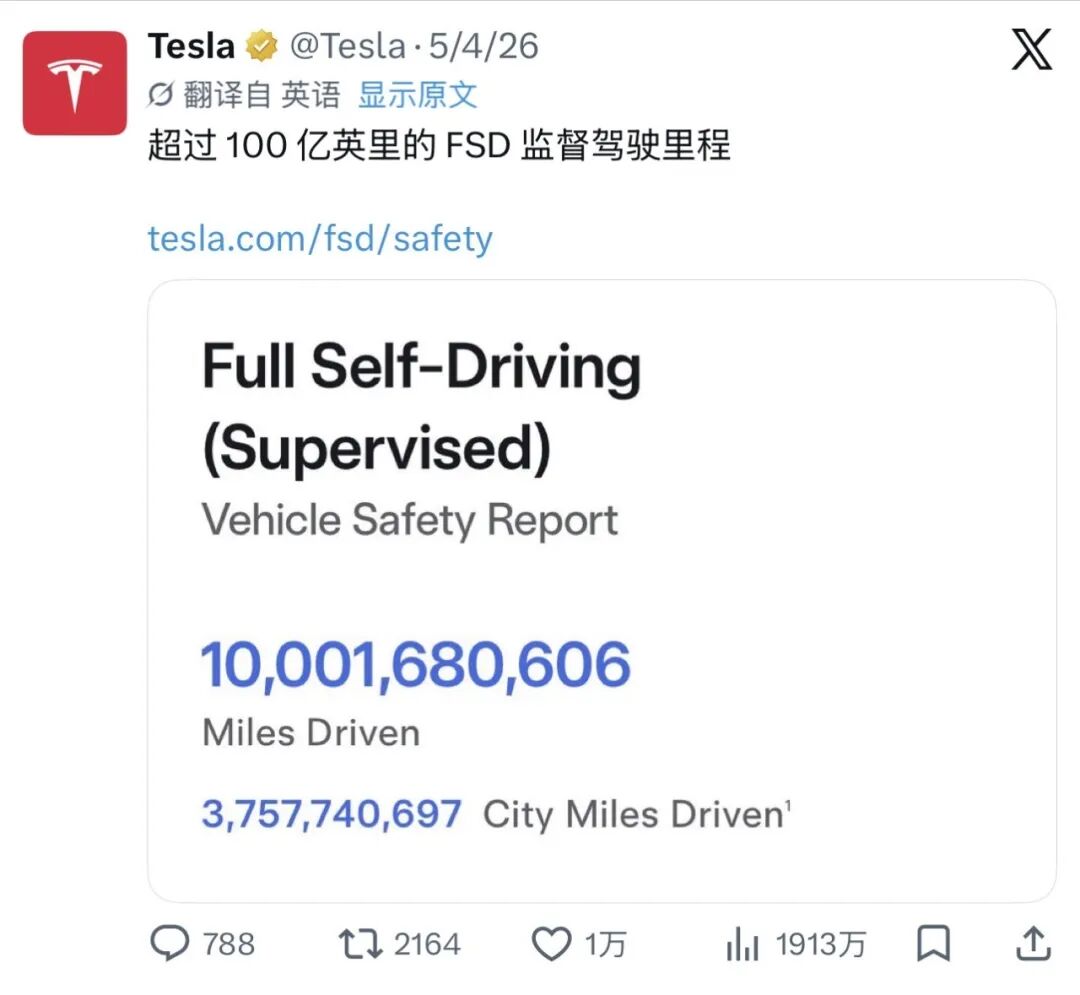
Picture/Tesla's FSD mileage exceeds 10 billion miles Source/Screenshot from Internet's New Energy View
Both contestants are going all out with their respective hundreds of billions of mileage.
In the past few years, although the intelligent driving field has been bustling, a real "full - strength showdown" has never occurred. Tesla has long only been able to provide the LCC (Lane Centering Control) assisted driving version for highway scenarios in China, while Huawei has already implemented urban intelligent driving in hundreds of Chinese cities. They are simply not on the same playing field.
But this time, the situation is completely different. Tesla is reported to have pushed the "full - strength version" of FSD V 14 to its employee vehicles equipped with HW4.0 hardware in China. The liquidated damages in the internal confidentiality agreement are as high as 5 million yuan. This is no longer a cut - down version, but an end - to - end architecture consistent with the North American market. On the Huawei Qiankun side, the data in the safety travel report for April, announced on May 3rd, is also astonishing: the monthly assisted driving mileage is 910 million kilometers, the monthly active users reach 1.43 million, and the user proportion is as high as 94.8%.
Both sides are determined to win the Chinese market in 2026. Tesla's most optimistic prediction is to push the FSD to the public in full in the third quarter, while Huawei has made the bold claim of "surpassing Tesla in October".
The decisive battle between the two intelligent driving giants sounded the charge in this otherwise ordinary May.
1. A Battle is Inevitable: Both Sides Press the All - Out Attack Button
Going back to the beginning of the month, the automotive circle was bombarded with news of "FSD entering China".
According to two bloggers' revelations on social platforms, this push is by no means the previous "weak version". Employees signed a large - scale confidentiality agreement with liquidated damages as high as 5 million yuan before the trial.
What does this mean? The confidentiality clauses of top - tier automotive media are only at this level. Tesla also signed agreements for internal tests in China before, but the amount was never this high. Why is Musk so nervous this time? Because this is the real "full - strength version" of FSD - a complete version using an end - to - end neural network architecture.
The story of Tesla's FSD in China is like the boy who cried wolf. For years, we've heard the talk, but never seen the real thing. But this time is different. Let's highlight the key points - the full - strength, complete version of FSD! According to the most optimistic prediction, the FSD for ordinary users will be pushed to the open market as early as the third quarter of 2026.
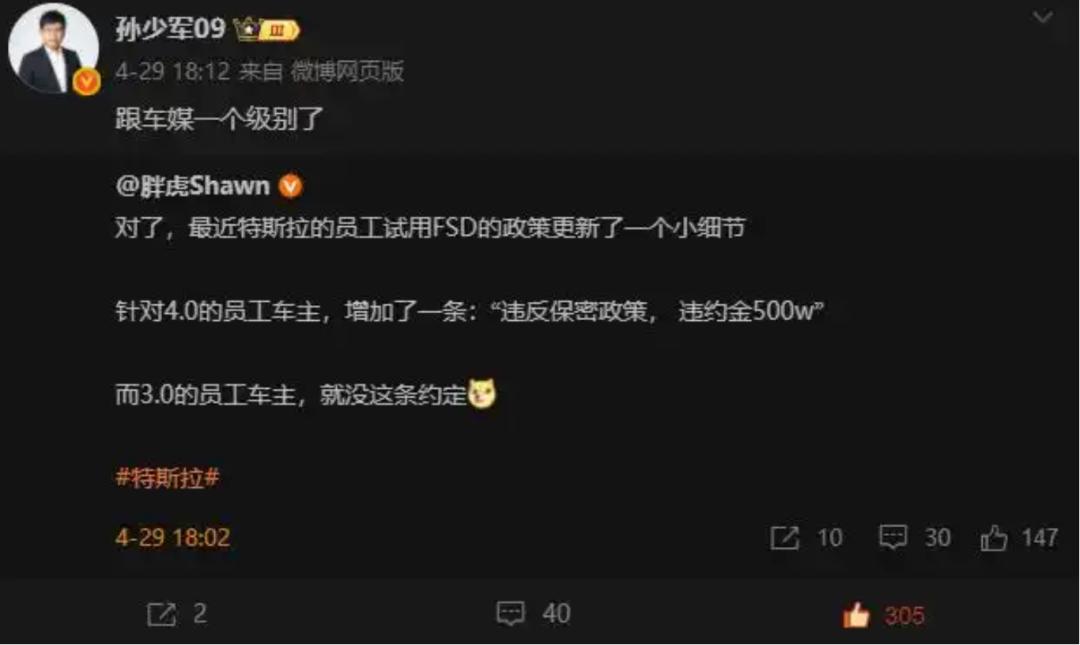
Picture/Tesla pushes the "full - strength version" of FSD Source/Screenshot from Internet's New Energy View
Almost at the same time, Huawei Qiankun released its safety travel report for April 2026. Official data shows that the monthly assisted driving mileage is 910 million kilometers, and the cumulative mileage has crossed the 10 - billion - kilometer milestone, reaching 10.47 billion kilometers.
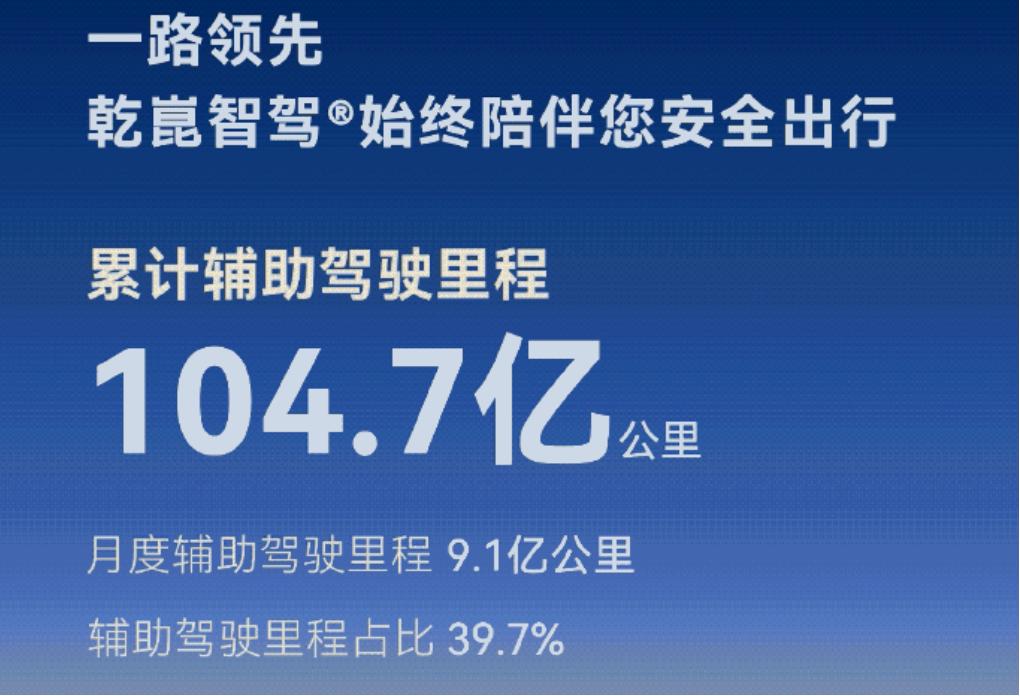
Picture/Mileage situation of Qiankun Intelligent Driving Source/Screenshot from Internet's New Energy View
Huawei also meaningfully stated that Qiankun Intelligent Driving ADS has exceeded human drivers in terms of average safe driving mileage, and set the goal of "surpassing Tesla to become the world's number one in October this year".
No more hiding. Both contestants have shown all their aces under the spotlight, and the meaning of declaring war couldn't be more obvious.
This is the first real showdown in the history of China's automotive intelligent driving. In the past few years, the so - called "FSD" that Tesla could offer to Chinese consumers was limited to the highway LCC level, and the urban intelligent driving function could not be implemented for a long time. Meanwhile, Huawei Qiankun has already implemented map - free intelligent driving in more than 300 cities across the country.
In the past, Tesla was playing with incomplete cards, while Huawei had the best cards. This time is different. Both sides are bringing out their highest - level "full - strength equipment" and going head - to - head on the roads of China's largest and most complex cities.
When two brave warriors meet on a narrow path, the one with more courage will win. The glinting bayonets are already at each other's noses. To win this tough battle, neither side is idle.
Tesla's FSD added more than 1 billion miles of data in the first 50 days of this year. In late April, the daily average driving mileage of the fleet soared to about 29 million miles, almost doubling the daily average of 14 million miles at the beginning of the year. The significant increase in data collection efficiency indicates that Tesla is making the final data preparation for large - scale implementation.
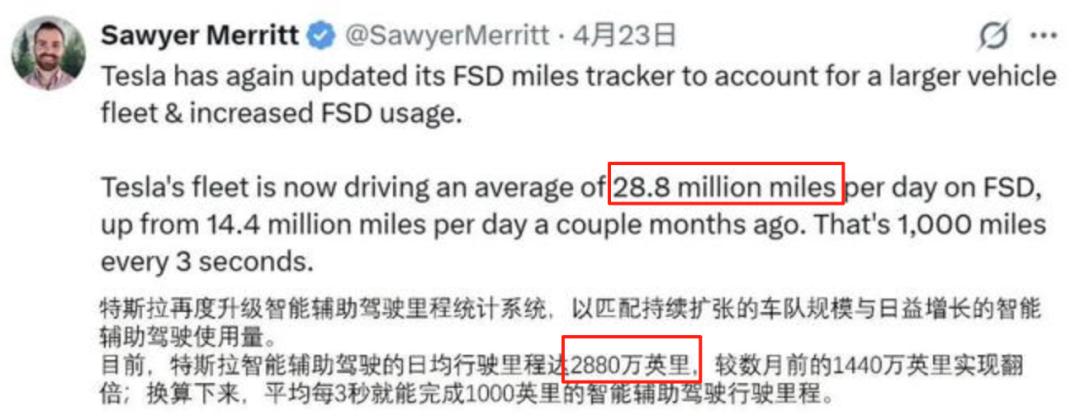
Picture/The daily average driving mileage of Tesla's fleet in late April is about 29 million miles Source/Screenshot from Internet's New Energy View
On the other hand, during the May Day holiday alone, the assisted driving mileage of Huawei Qiankun Intelligent Driving reached 280 million kilometers, accounting for 45% of the total travel mileage of users, and it actively avoided 178,000 potential accidents. Almost 9 out of every 10 car owners used the assisted driving function during the holiday travel.
2. Intelligent Driving Comparison: Head - to - Head on Technical Routes
If the distant challenges at the beginning of May were just signal flares, then the following battle of technical routes is the real tough fight.
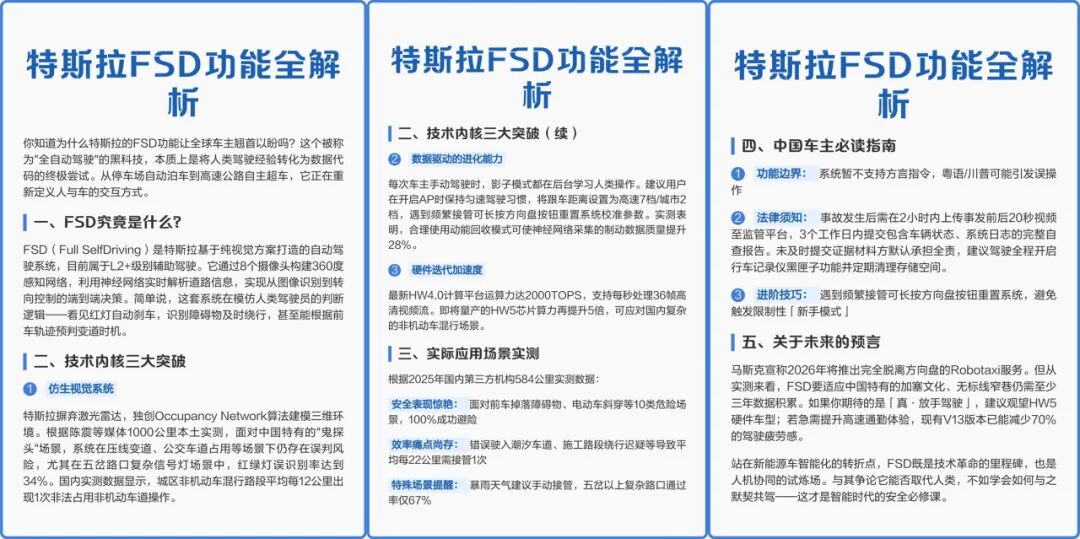
Tesla is playing a "minimalist" card. Its intelligent driving solution can be summarized in three sentences: pure vision, end - to - end, and shadow mode.
The so - called pure vision means only using cameras to collect environmental information, just like a human driving with eyes, without relying on lidar. Its logic is: Since humans don't use radar to drive, why should machines rely on it?
The end - to - end neural network takes it a step further - the system receives camera signals and directly outputs steering, acceleration, and braking instructions, skipping the layer - by - layer disassembly of traditional perception and planning modules. Especially, Tesla's next - generation FSD chip can have a computing performance of up to 2500 TOPS, which is extremely high and reserves inference space for the huge end - to - end model.
Picture/Analysis of Tesla's FSD function Source/Screenshot from Internet's New Energy View
The shadow mode is the data engine in this closed - loop - every Tesla vehicle around the world is silently collecting driving data in the background, continuously feeding back to algorithm training.
Pure vision, end - to - end, and shadow mode also explain why Tesla doesn't rely on high - precision maps. A truly smart driver doesn't need to remember the exact coordinates of every road. It's enough to understand the road markings, traffic lights, and the driving trajectories of other vehicles.
Huawei Qiankun is playing a different set of cards. Its strategy is called "redundancy backup".
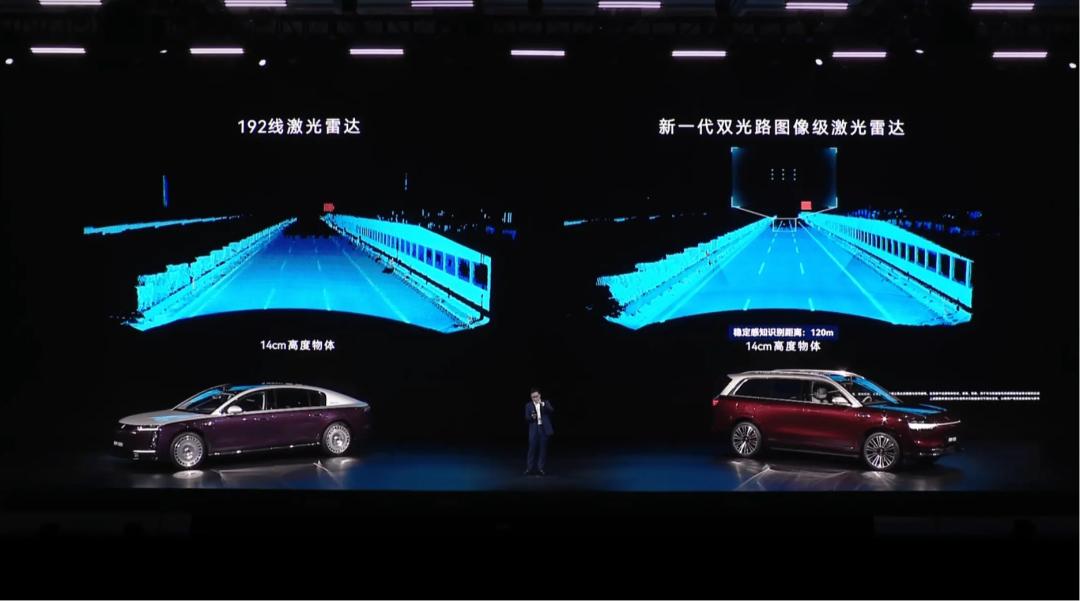
The 896 - line dual - optical - path image - level lidar is the most core perception hardware. Its resolution is 4 times higher than that of the previous 192 - line product. The single - frame point cloud can reach the 4K level, and it can stably identify small obstacles 14 centimeters high at a distance of 120 meters.
Picture/Differences between 192 - line radar and 896 - line radar Source/Screenshot from Internet's New Energy View
At the same time, the new - generation lidar uses the first - of - its - kind dual - optical - path integrated dual - focus architecture, integrating wide - angle and long - focus dual - receiving units. It not only achieves 360 - degree global coverage without blind spots but also can accurately capture long - distance details, solving the pain points of traditional products that "can't see both far and wide, or wide and detailed".
Both routes have their own advantages and disadvantages, but the highlight of the showdown lies in real mass production and implementation.
The advantage of the pure vision solution is low cost and fast iteration. Tesla doesn't need to install a high - performance lidar costing thousands or even tens of thousands of yuan in each vehicle, which enables it to popularize high - level intelligent driving in models priced at $30,000.
There are indeed physical limits that are not easy to overcome in the pure vision solution: in heavy rain, thick fog, or in the few seconds when driving out of a tunnel facing the setting sun, the camera will be briefly dazzled just like the human eye.
Huawei's redundancy solution is not afraid of these extreme scenarios. Lidar doesn't rely on natural light and can still accurately perceive distance and shape in rainy, foggy, and nighttime conditions. The dual - optical - path architecture allows the wide - angle and long - focus to perform their respective duties, neither missing the suddenly emerging electric bikes on the sides nor deviating due to potential safety hazards in corners.
However, the cost of multiple sensors is higher: The hardware cost of a set of ADS solutions is often over 10,000 yuan, which means it can only be installed in mid - to - high - end models in the initial stage. Huawei's attitude is clear: safety comes first, and the cost issue will be gradually resolved by economies of scale.
3. From a Catfish to Two Giants: The Battle is Imminent
The dispute over technical routes is essentially a collision of two philosophical views: extreme subtraction or extreme redundancy. Three years ago, Tesla's entry into China was regarded as a "catfish" stirring up the pool. Three years later, this catfish is being forced by Huawei to become a comparable giant. In this imminent battle, the winner may guide the entire industry in the next decade.
For consumers, the most direct change is the leap in experience.
According to the feedback from Tesla employees in the internal test, HW4.0 models equipped with the full - strength version of FSD have far exceeded the previous weak versions in terms of red - light recognition accuracy, complex - intersection game prediction ability, and lane - changing decisiveness on real - world roads in China. Although drivers still need to be ready to take over in extreme scenarios, a qualitative leap is a certainty.
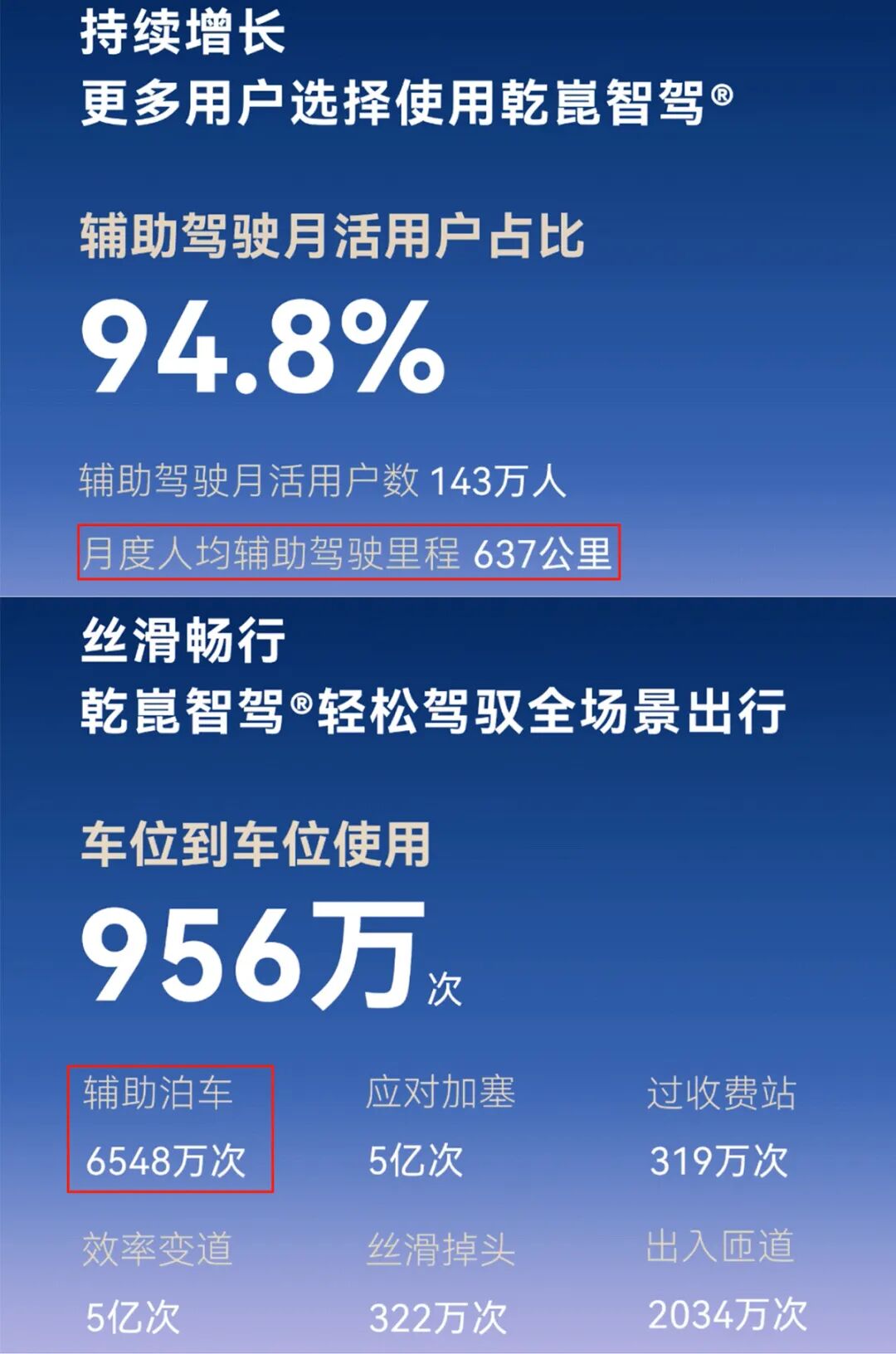
On the other hand, the monthly per - capita assisted driving mileage of Huawei Qiankun is 637 kilometers, the number of assisted parking times is 65.48 million, and the longest single - vehicle assisted driving mileage of users during the May Day holiday exceeded 5,000 kilometers. These numbers indicate that consumers are turning assisted driving from a "novelty toy" into a "must - have partner" for daily travel at an unprecedented speed.
Picture/Some monthly data of Huawei Qiankun Source/Screenshot from Internet's New Energy View
For the industry, this is the real highlight.
Once the pure vision solution works well on China's complex urban roads, the process of "eliminating high - precision maps" in the entire industry will be significantly accelerated. In the past three years, high - precision maps have been regarded as the "golden partner" for the implementation of urban intelligent driving. However, the high collection cost, slow update speed, and high threshold for map - provider qualifications have deterred many automakers.
If Tesla can still achieve stable and excellent urban intelligent driving without high - precision maps, this low - cost, highly generalized technical route will quickly become the new general standard in the industry, and may even force leading new - force manufacturers that have long relied on high - precision maps to accelerate the shift to the "pure vision + end - to - end" technology stack.
The policy gate is also being pried open.
Previously, Level 3 and above autonomous driving in China has always remained in the "pilot" stage. The most fundamental reason behind this is not the lack of technology, but the absence of detailed regulations - who is responsible for accidents in the system? Who manages the data? These issues can only be resolved by real large - scale commercialization, which will force the government to accelerate the improvement of policies. As a foreign - funded brand, Tesla's implementation of the complete version of FSD in China will force the acceleration of the clarification of relevant regulations such as Level 3 liability determination and testing specifications in China.
