Jensen Huang, the top patron of AI: Spending 2 billion yuan per day on average
In the past two years of rapid development in AI investment and financing, who is the biggest financial backer?
The answer is already clear: Jensen Huang.
Just in the past week, NVIDIA has invested a total of $5.3 billion (approximately 36 billion RMB) in Corning, a glass manufacturer, and IREN, a data center operator.
Once this money was invested, the stock prices of the two companies soon soared, attracting countless onlookers for a while.
After some analysis by an institution, guess what? Jensen Huang's identity as the biggest financial backer couldn't be hidden anymore -
In the past fiscal year, NVIDIA invested $17.5 billion in private companies and infrastructure funds (approximately 118.9 billion RMB). This year is even more remarkable. From the beginning of the year to now, in just a few months, it has invested another $40 billion (approximately 271.9 billion RMB).
Goodness! Spending more than twice the amount of last year in just a few months, Jensen Huang's money - spending speed is really a bit exaggerated.
Of course, what's even more exaggerated is the length of Jensen Huang's "shopping list".
OpenAI, Anthropic, and xAI are in fierce competition, but they all have the same financial backer behind them. In more peripheral key areas such as cloud computing power, optical communication, and silicon photonics, NVIDIA's capital tentacles have already spread. Even Intel, a former rival, now has an equity intersection with it.
It can be said that almost every player still active at the AI table today has a business card from Jensen Huang.
So, the questions are:
What has Jensen Huang invested in? Which "basket" has the most "eggs"? And what on earth is he thinking?
What has Jensen Huang invested in? Well... everything.
We may find some answers to the first question in NVIDIA's financial report from last year.
Looking up from the complex numbers, Jensen Huang's investment style stands out clearly: large - scale and wide - ranging investments.

Jensen Huang's large - scale investment is reflected in:
In the past fiscal year (as of the end of January 2026), NVIDIA invested $17.5 billion in private companies and infrastructure funds at once.
This $1.75 billion "is mainly used to support early - stage startups", including AI model companies that purchase NVIDIA products directly or through cloud service providers.
This is just the direct investment. In addition, NVIDIA also provided $3.5 billion in land, power, and factory guarantees for its data center partners - simply put, not only does it invest its own money, but when friends have trouble with construction funds, Jensen Huang can also sign off.
However, investing a large amount of money is just one aspect. The frequency of Jensen Huang's investments is even more astonishing.
According to PitchBook data, throughout 2025, NVIDIA participated in approximately 67 venture capital transactions, more than five times that of 2022. Among them, NVentures, NVIDIA's corporate venture capital fund, alone made 30 investments.
The pace has been even more rapid since 2026.
In the first four and a half months, it has invested $40 billion. Approximately 7 investments in listed companies are all large - scale deals in the billions of dollars, and the remaining money is scattered in about 24 financing rounds for non - listed startups.
On average, it's equivalent to spending $298 million per day (2 billion RMB per day), including weekends.
As for the wide - ranging investments, we need to look at Jensen Huang's "shopping receipts".
Breaking down the companies invested by NVIDIA layer by layer along the AI industry chain from top to bottom, it becomes very clear -
A clear vertical integration map.
The top layer consists of AI model companies, including but not limited to the "Big Three" mentioned at the beginning, as well as Mistral, Cohere, Thinking Machines Lab, and Perplexity. In short, Jensen Huang has invested in almost all the surviving cutting - edge large - model companies.
The middle layer consists of computing power and cloud companies, also including but not limited to CoreWeave, Nebius, IREN, and Nscale. This layer is special because these companies are both NVIDIA's customers and its shareholders. This will be discussed in detail later.
The bottom layer consists of hardware and optical interconnection, including Corning (up to $3.2 billion), Marvell ($2 billion, specializing in silicon photonics), Lumentum, and Coherent (specializing in optical communication). By the way, Corning has also promised to build three new factories in the United States specifically for NVIDIA to serve its optical technology.
This layer is the key infrastructure for NVIDIA's next - generation rack - level AI systems to shift from copper cables to optical fibers. Although not many people are discussing it outside, this is exactly the bottleneck.
Obviously, NVIDIA has covered every layer from models to computing power to hardware.
Notably, Intel, which helped NVIDIA make a big profit last year, is particularly worth mentioning.
In September 2025, NVIDIA announced that it would subscribe to approximately 4% of Intel's shares at a price of $23.28 per share, totaling $5 billion, and the transaction was completed at the end of December of that year.
At that time, the outside world was still sighing that "Jensen Huang is going to save his rival". But a few months later, the current value of this investment has exceeded $25 billion -
Because Intel's stock price has risen by more than 200%, and Jensen Huang's investment has been described as a "historic return within a few months".
From $5 billion to $25 billion, and this is just Intel.
Zooming out - in the past fiscal year, the book value of non - listed equity investments on NVIDIA's balance sheet soared from $3.39 billion to $22.25 billion, almost seven times in one year.
The paper profits have boosted the financial report figures. NVIDIA's investment income in the past fiscal year reached as high as $8.92 billion, nearly nine times that of the previous year's $1.03 billion. A significant part of this is due to the investment in Intel.
Overall, to some extent, Jensen Huang has also reaped the benefits of the AI valuation boom:
Continuously buying while enjoying the rising tide.
Is OpenAI really the favorite of Jensen Huang?
However, if you think that Jensen Huang is simply "spreading his investments evenly", you've misunderstood him.
In April this year, when Jensen Huang was asked in a podcast, "Since you saw the future of AI so early, why didn't you invest in these AI labs earlier?", he rarely reflected:
Looking back, I didn't fully understand that basic AI labs like OpenAI and Anthropic had no other choice at that time. Venture capital couldn't invest $5 billion or $10 billion in an AI lab and expect it to become Anthropic in the end. Google and AWS were in a position to do this at that time, but we couldn't. This was my mistake.
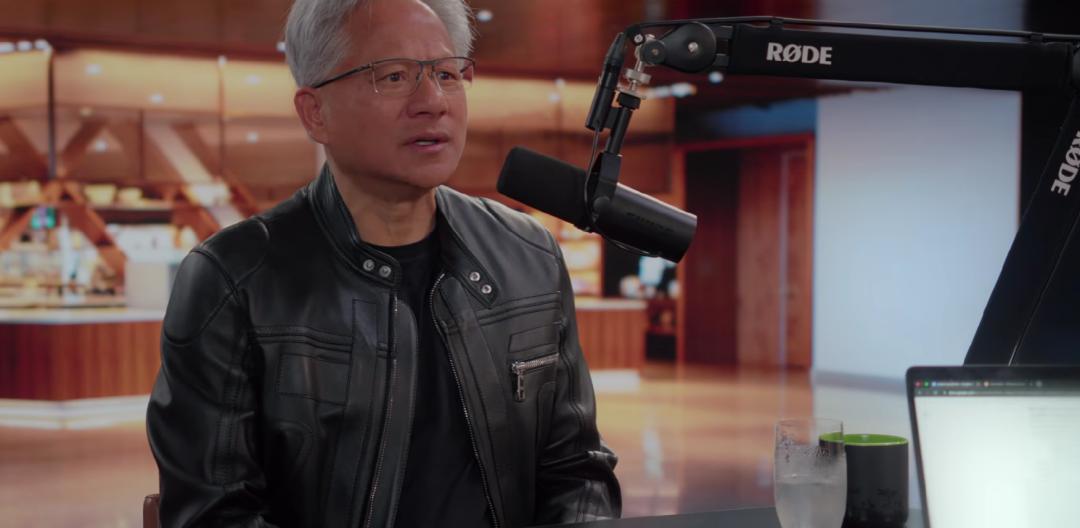
In other words, Anthropic was "snatched" by Google and AWS with a large amount of money for ecological binding rights, and NVIDIA missed that window.
So this time, NVIDIA definitely can't miss out.
And the protagonist this time, as you might have guessed, is OpenAI, the old rival of Anthropic.
How much does Jensen Huang favor OpenAI? The numbers speak directly:
Out of the $40 billion, OpenAI alone took $30 billion.
Even more exaggerated is that the $30 billion is actually a reduced version.
In September 2025, when NVIDIA and OpenAI first announced their cooperation, the figure the outside world saw was $100 billion -
Invested in batches, corresponding to OpenAI's deployment of 10 gigawatts of NVIDIA systems, which is roughly equivalent to the power of ten large - scale nuclear power plants.
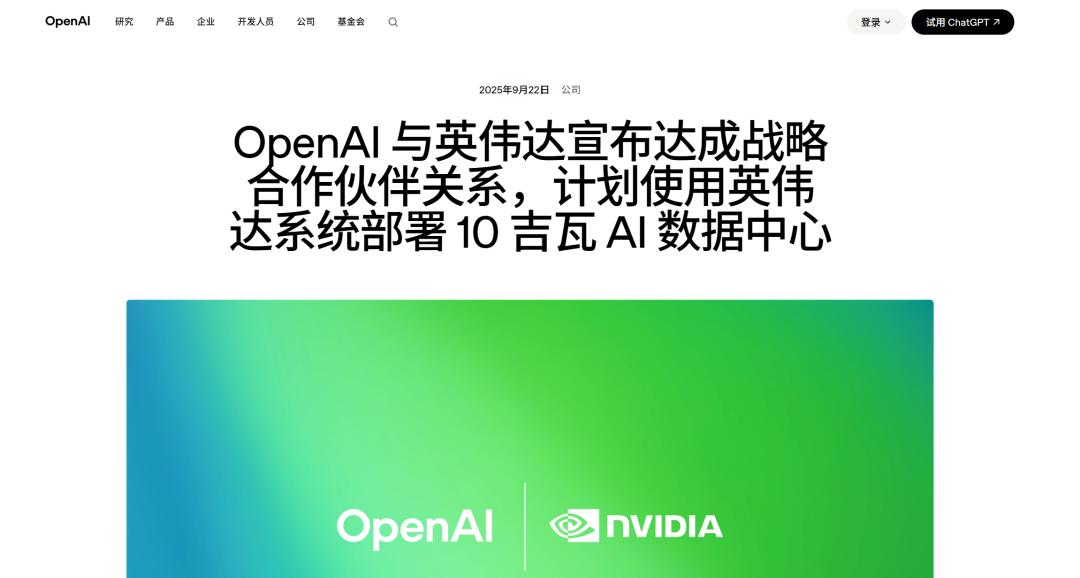
However, just half a year later, Jensen Huang personally scaled back this figure significantly.
He publicly stated in March this year that the $100 billion "probably won't happen", and the $30 billion that has been transacted "might be the last investment before the IPO".
The outside world generally believes that the reason is not complicated -
Because OpenAI's IPO is on the way, and the remaining money can be provided by the secondary market.
But even after being reduced to $30 billion, this deal is still one of the largest equity investments by a single enterprise in a single company in history.

In fact, Jensen Huang's favor for OpenAI didn't start this year.
It's more interesting to look at this over a longer time scale.
In 2016, Jensen Huang personally delivered the first DGX - 1 to OpenAI's office in San Francisco at that time and signed a line on the shell -
To Elon and the OpenAI Team. To the future of computing and humanity.
The photo was later posted on Twitter by Elon Musk, a former co - founder of OpenAI, and became one of the most widely circulated group photos in the AI circle.
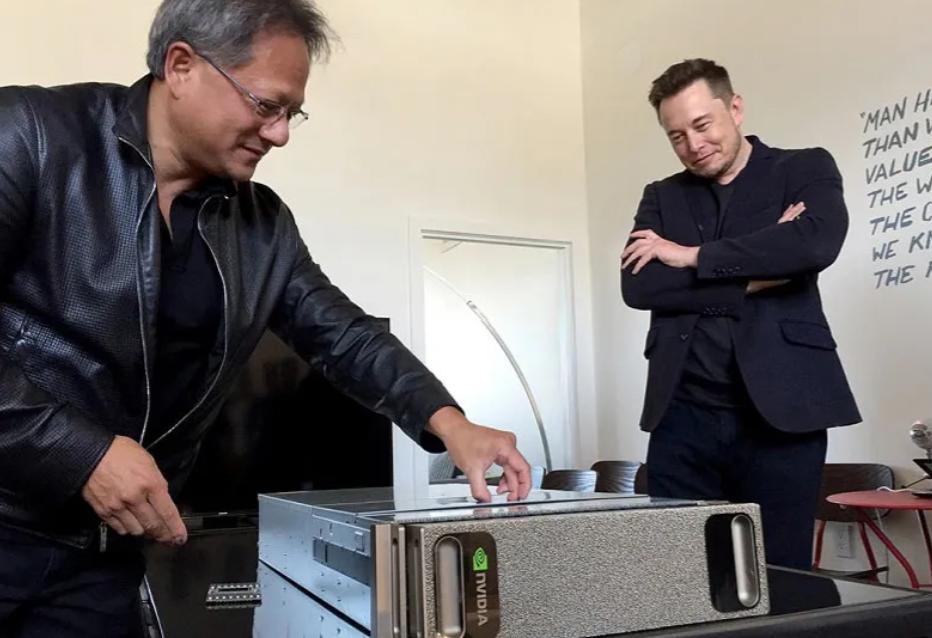
Ten years have passed. Musk left in anger and founded xAI, and is now competing head - on with OpenAI.
As for Jensen Huang, although he is still the "master of balance" who offends no one -
In interviews, he praises OpenAI as "the next trillion - dollar - level super - large - scale company", and then says that Musk is "a pioneer who can always create game - changing companies", being well - rounded and flawless.
But when it comes to writing checks, he can't maintain the balance:
He participated in xAI's investment with a few billion dollars, while leading the investment in OpenAI with $30 billion.
Well, he says "we invest in everyone", but his wallet is very honest (doge).

However, do you think this is the whole story? NoNoNo. As the old saying goes, the business world is like a battlefield.
The relationship between Jensen Huang and these star labs is far more complex than it seems.
Shortly after signing the $100 - billion letter of intent with OpenAI, The Wall Street Journal quoted an informed source as saying that the deal "had been put on hold", and mentioned that Jensen Huang privately expressed concerns about OpenAI's business model and expansion pace.
It seems that from then on, Jensen Huang realized that he couldn't put all his eggs in one basket -
So he participated in multiple rounds of xAI's financing intensively on one hand, and announced a $10 - billion investment in Anthropic on the other.
But what was the result? Both new "baskets" had problems.
On the xAI side, the situation took a sharp turn. In March this year, Musk personally admitted that xAI "wasn't built right the first time and needed to be rebuilt from the ground up". Then, all 11 co - founders left one after another, and finally only he remained. xAI was merged into SpaceX and renamed SpaceXAI.
On the Anthropic side, due to some well - known stances and interest divergences, the atmosphere between Jensen Huang and Anthropic's CEO, Dario, also changed subtly.
After going around in a big circle, Jensen Huang had to come out to refute the rumor, saying that the so - called "strained relationship between NVIDIA and OpenAI" was completely unfounded, and emphasized that the cooperation between the two sides "was still in progress", and finally the actual investment of $30 billion was officially finalized.
After all, there is no eternal love at the AI table, only eternal interests -
This also applies to Jensen Huang.
What does Jensen Huang want to do?
So, with so much money invested and such a wide - ranging business, what on earth does Jensen Huang want to do?
On the surface, the reason is not complicated -
Jensen Huang is deeply practicing the investment philosophy of "Don't put all your eggs in one basket".
Still in that podcast interview, Jensen Huang shared his business philosophy:
There are many very excellent and amazing foundation - model companies. We strive to invest in all of these companies. We don't pick winners; we need to support all companies.

Is it really all? Actually, no.
At the earnings conference call in February this year, Jensen Huang gave a more restrained version -
NVIDIA's investments are "very focused and strategic in expanding and deepening the reach of our ecosystem".
In plain language, as long as you use my GPUs, I'll invest in you, and once I invest in