60%. Electric cars are selling like hotcakes, and the countdown for gasoline cars has begun.
How popular are new energy vehicles nowadays?
Out of 10 people buying cars, 6 of them choose electric vehicles.
According to the latest data released by the Passenger Car Association, the retail sales volume of new energy vehicles in April reached 849,000 units, and the penetration rate climbed to 61.4%. This is the first time that the penetration rate of domestic new energy vehicles has exceeded the 60% mark.
Moreover, this data was achieved on the premise of a 21.5% decline in the overall auto market. This means that the role of new energy vehicles has changed from a “supplement” to a “dominant force” in the market. It is no longer just for early adopters but has become the mainstream.
At the same time, the export volume has also witnessed an explosive growth. Especially for new energy vehicle models, the proportion has reached 52.7%, which is also the first time in history to exceed 50%.
While new energy vehicles are surging forward, traditional fuel - powered vehicles are facing a tough situation. For example, Honda, which recently made it onto the hot search due to its poor sales, only sold 22,600 units in April, even less than the sales volume of Xiaomi SU7.
It's really a pity.
01 More and more people are buying new energy vehicles
Let's first look at the specific data.
In April, the retail penetration rate of new energy vehicles in the domestic overall passenger car market reached 61.4%. Both year - on - year and month - on - month, the growth rate was close to 10%. Compared with the same period last year, it increased by 9.7 percentage points, and month - on - month, it increased by 9.6 percentage points.
However, in the entire month of April, the national passenger car market as a whole showed the characteristics of “total volume under pressure and structural differentiation”.
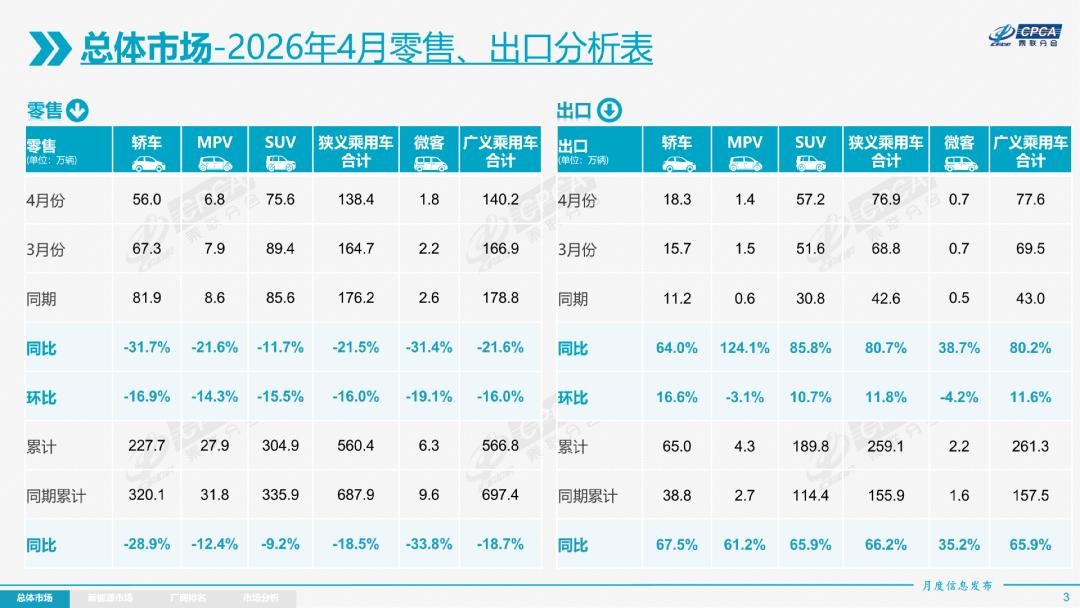
From the overall market perspective, the total retail volume of domestic narrow - sense passenger cars in April was 1.384 million units. Compared with March and the same period last April, the sales volume declined significantly, with a year - on - year decrease of 21.5% and a month - on - month decrease of 16.0%.
While the total volume is decreasing, the share of new energy vehicles is increasing, which is enough to show one thing: Fewer and fewer people are buying fuel - powered vehicles.
The impact of rising oil prices on fuel - powered vehicles has become apparent. According to the data of the Passenger Car Association, the sales volume of fuel - powered vehicles in April decreased by 365,000 units year - on - year, with only 530,000 units sold in retail, a year - on - year plunge of 37% and a month - on - month decrease of 33%. This reduction accounted for as much as 84% of the overall sales decline, becoming the main reason for dragging down the overall performance of the auto market.
Moreover, it has become the only major factor dragging down the entire passenger car market. “This is mainly due to the decline in the retail sales volume of fuel - powered vehicles. The retail sales volume of fuel - powered vehicles did not meet expectations, which directly led to the decline in retail sales in April and also caused the year - on - year decline in the cumulative retail sales volume of national passenger cars in the first four months of this year,” explained Cui Dongshu, the secretary - general of the Passenger Car Association.
Specifically in terms of data, from January to February, the retail sales of fuel - powered vehicles decreased by 740,000 units year - on - year, accounting for 40% of the total reduction in the entire passenger car market; in March, the year - on - year decline of fuel - powered vehicles was 345,000 units, and its impact on the market decline increased to 52%; from January to April, the retail sales of fuel - powered vehicles decreased by more than 1.45 million units year - on - year, accounting for 84% of the reduction in passenger car retail sales.
If we look at a longer time span, this change is even more shocking. In 2020, the market share of Chinese fuel - powered vehicles was still over 90%, while now it has dropped to less than 40%. In less than 6 years, the Chinese auto industry has completed an extremely drastic structural transformation.
In sharp contrast to the cold market of fuel - powered vehicles, new energy vehicles are “surging forward”. In April, the production of new energy passenger cars reached 1.209 million units, a year - on - year increase of 4.7% and a month - on - month increase of 7.6%. The wholesale sales volume reached 1.225 million units, a year - on - year increase of 7.5% and a month - on - month increase of 7.0%.
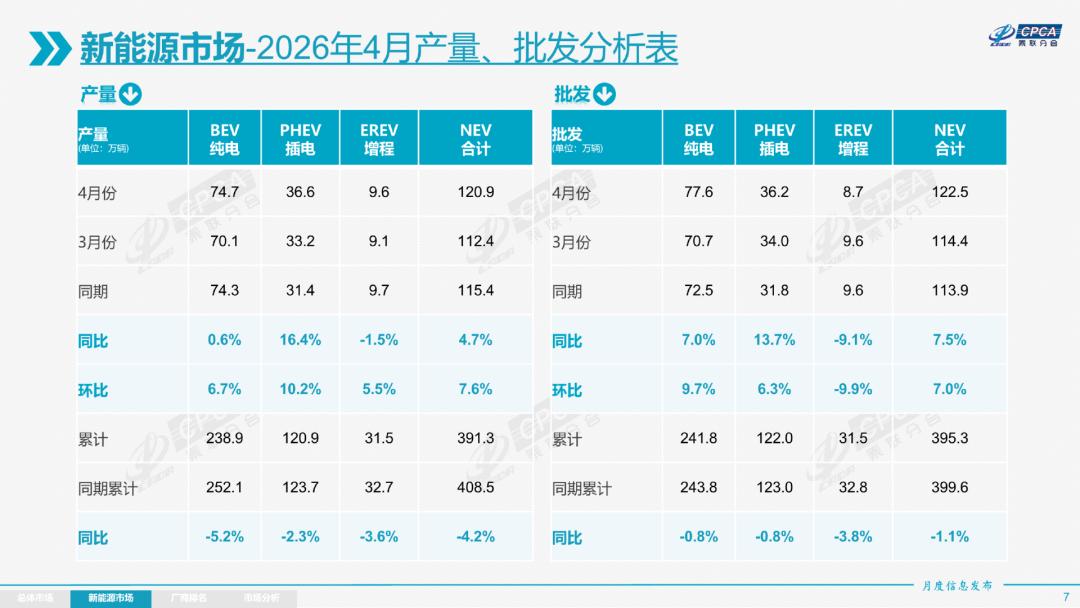
However, in the context of the overall cold situation of the domestic auto market, the retail sales of new energy passenger cars in April were 849,000 units, a year - on - year decrease of 6.8% and a slight month - on - month decrease of 0.3%. But against the backdrop of the sharp decline of fuel - powered vehicles, the retail penetration rate of new energy vehicles exceeded the 60% mark.
In terms of power type, the retail sales of battery - electric vehicles (BEV) were 579,000 units, accounting for 68.2% of the total retail sales of new energy vehicles, still the absolute main force; the retail sales of plug - in hybrid electric vehicles (PHEV) were 192,000 units, a year - on - year decrease of 25.4%; the retail sales of extended - range electric vehicles (EREV) were 79,000 units, a year - on - year decrease of 11.1%.
This also means that the long - discussed “long - term coexistence of fuel - powered vehicles and new energy vehicles” in the industry is being gradually broken by real - world conditions. As the penetration rate of new energy vehicles crosses the 60% critical point, the Chinese auto market has entered a new stage of “electrification dominance”, and fuel - powered vehicles are starting to retreat from the main role in the market to a marginal role.
If we only talk about the penetration rate, some people may think it's the micro - cars and small cars that are driving the volume. But in the data released by the Passenger Car Association, there is an inconspicuous detail: Class B electric vehicles have witnessed an explosion, and the proportion of models priced over 300,000 yuan has significantly increased.
In April, the wholesale volume of Class B electric vehicles was 243,000 units, a year - on - year increase of 27% and a month - on - month increase of 7%, accounting for 31% of the pure - electric vehicle share, an increase of 4.8 percentage points compared with the same period last year. In contrast, the market share of A00 + A0 - class economy electric vehicles has declined. The former accounts for 9% of the pure - electric vehicle share, a decrease of 12.3 percentage points compared with the same period last year, and the latter only accounts for 27% of the pure - electric vehicle share.
This also means that more people are buying expensive new energy vehicles. This change in perception also means that fuel - powered vehicles are starting to lose their default status.
However, the rapid increase in the penetration rate of new energy vehicles does not mean that car manufacturers are entering an era of high profits. According to the data of the Passenger Car Association, from January to March 2026, the sales profit margin of the auto industry further dropped to 3.2%. Although it is better than the 2.9% performance from January to February, it is still at a historical low, far lower than the average profit margin of 6% of downstream industrial enterprises.
02 Going global is a major boost
The differentiation in the auto market is also reflected in the different situations of different brands.
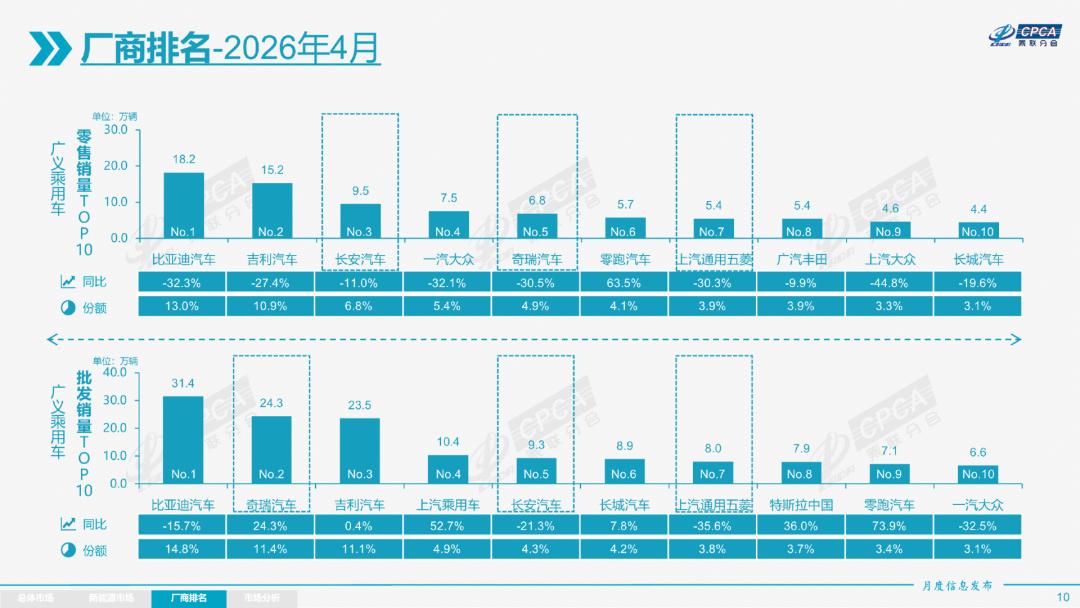
According to the data of the Passenger Car Association, among the top ten car manufacturers in the retail sales list, almost all of them showed a decline, with an average decline of about 30%. The only one with positive growth was Leapmotor, with 57,000 units sold, a year - on - year increase of 63.5%.
Nevertheless, when looking at the entire domestic market, self - owned brands seem to be regaining the dominant position in the industry. In April, the retail sales of self - owned brands were 970,000 units. Although affected by the overall market, the year - on - year decrease was 16% and the month - on - month decrease was 5%, but the domestic retail share was as high as 69.6%, a year - on - year increase of 4 percentage points, accounting for 70%.
For joint - venture brands that once occupied half of the Chinese market with fuel - powered vehicles, the retail sales in April were only 280,000 units, a year - on - year decrease of 37% and a month - on - month decrease of 33%.
If we look at the penetration rate of new energy vehicles, the gap is even more significant.
According to the data of the Passenger Car Association, the penetration rate of new energy vehicles of self - owned brands has reached 80.1%, while the penetration rate of new energy vehicles of mainstream joint - venture brands, although increasing, is only 14.1%. Among them, the penetration rate of German brands is 13.3%, a year - on - year decrease of 2.2 percentage points; the penetration rate of Japanese brands is 10.9%, a year - on - year decrease of 1.2 percentage points; the penetration rate of American brands is the lowest, only 4.5%, a year - on - year decrease of 0.3 percentage points.
The luxury car market is also not immune. In April, the retail sales of luxury cars were 140,000 units, a year - on - year decrease of 16% and a month - on - month decrease of 33%.
It is worth noting that when the domestic retail end is under pressure, automobile exports have shouldered the banner of sales growth. In April, the export volume of domestic passenger cars reached 769,000 units, with a year - on - year increase of more than 80%, and the proportion in the overall sales volume of manufacturers directly reached 36%, while this figure was only 19% in the same period last year.
New energy vehicles have made great contributions. The export volume of new energy vehicles was 406,000 units, a year - on - year doubling growth of 111.8% and a month - on - month increase of 18.3%, accounting for 52.7% of passenger car exports, an increase of 8 percentage points compared with the same period last year. Among them, pure - electric vehicles accounted for 57.2% of new energy vehicle exports, which is also the first time in export history that the proportion has exceeded 50%.
Specifically looking at the three major export players, BYD exported 134,500 units in April, a year - on - year increase of 70.9%, setting a new monthly export record for the brand, and the overseas sales accounted for more than 40% of the total sales; Chery Group exported 177,600 units in April, more than doubling year - on - year, setting a new monthly export record for Chinese automobile brands, and the export proportion exceeded 70% of the total sales; Geely Automobile's overseas export sales also reached 83,200 units in April, a year - on - year increase of about 120%, achieving year - on - year doubling growth for four consecutive months.
Of course, it's a bit one - sided to conclude that the entire auto industry has entered the era of electric vehicles just based on the temporary penetration rate of new cars. After all, we can't just look at the new sales volume but also need to consider the stock and the number of vehicles in use.
In terms of stock, fuel - powered vehicles are still the absolute main force. By the end of 2025, the number of domestic fuel - powered vehicles in use was as high as 320 million, accounting for 88%. Moreover, most of these 320 million fuel - powered vehicles are within 5 to 8 years old.
This also means that in the next three to five years, these vehicles will still be the main models on the road. But it is undeniable that as the penetration rate of new energy vehicles gradually increases, new energy vehicles will surely take the main stage of the industry, and no one can stop it.
This article is from the WeChat official account “SuperEV - Lab”, author: Wang Lei. Republished by 36Kr with authorization.