Exclusive Interview with Liu Bingbin, CEO of Zento: Instead of Being the "Pioneer" of Balcony Energy Storage, Aim to Be the Home Energy Center in the AI Era
"I majored in information management and have always wanted to develop intelligent products." In the office of Guangzhou Jianghai Technology (overseas brand Zendure) located in Dazun Innovation Building in Shenzhen, founder and CEO Liu Bingbin recalled his obsession at the beginning of the business to 36Kr.
He noticed early on that "adding Bluetooth and Wi-Fi to power banks doesn't make sense. Later, when developing outdoor power sources, we also tried adding 4G modules, but there wasn't a strong demand in outdoor scenarios."
It wasn't until 2022 that he discovered the balcony energy storage scenario: the device is fixed at home and connected to the internet in real-time. Users want to know how much electricity is generated and how much money is saved every day. Most importantly, different from traditional household energy storage which requires installation, balcony energy storage can be used immediately after plugging in, perfectly bypassing the bottlenecks of installation contractors and the number of electricians. It can enter thousands of households as quickly as household appliances. "This scenario is exactly the 'highly sticky, strongly demanded, 2C consumer electronics' scenario we want to create." Liu Bingbin's tone carried a long-awaited certainty.
This intelligent and 2C gene, which was planted on the first day of the business, is enabling Zendure to stand out from a group of traditional energy storage companies.
In the past five years, this national-level specialized and sophisticated "little giant", recognized in the industry as the "pioneer of balcony energy storage", has achieved an annualized growth rate of over 102%. According to the company's development expectations for 2026, it is expected to enter hundreds of thousands of European households, ranking first in total sales in France and first on the independent website in Germany.
During nearly two hours of communication, Liu Bingbin repeatedly emphasized a concept: "We don't define ourselves as an energy storage hardware company. We are the pioneers of the global plug-and-play home energy management system (HEMS)."
In his view, energy storage is just the hardware foundation, and the real barrier lies in the ecosystem and AI. Zendure has made many "ahead-of-time deployments" in this area: connecting with more than 840 European power companies, integrating over 5,000 heat pump models, and being the first to access Shelly, the largest home energy management platform in Europe. These "industry firsts" have left competitors at least one year behind.
At the end of 2025, Zendure received a strategic investment from Dazun Laser, which filled the shortcoming in the supply chain. Meanwhile, ZenWave™, the industry's first dynamic power retail service, was launched in Germany, marking Zendure's leap from "selling hardware" to "selling energy services" in its business model.
Liu Bingbin is not a person who likes grand narratives. In the interview, what he talked about the most were not visions but the details of product iteration: how the first generation was compatible with micro-inverters, how the second generation was made into a split design, how the third generation became an integrated one, and how they later discovered the demand for rooftop photovoltaics among French users and pioneered the AC coupling solution.
Currently, Zendure is conducting a Series C financing, and many leading institutions are actively participating. The progress is far beyond expectations.
Liu Bingbin told 36Kr that the funds will be mainly used for R & D investment and new market expansion. "Our vision is to become the home energy center in the AI era, just as the PC is the computing host in the information era. In an increasingly volatile future, people all over the world in every household will need it. Therefore, we can enter tens of millions or even hundreds of millions of households in the future." When he said this, his tone was calm, but his eyes showed a sense of certainty.
Defining Balcony Energy Storage
36Kr: Your company initially focused on mobile power banks. When did you start the transformation?
Liu Bingbin: When we were founded in 2017, we only wanted to create a distinctive brand and a very durable power product. The first-generation product was a power bank that couldn't be crushed by a car.
In 2020, the pandemic hit. Users stopped traveling, but the electricity consumption at home increased significantly, with many people working from home. We realized that the electricity consumption and energy demand were greater in the home scenario, so we shifted to home energy management. In 2022, we discovered the opportunity of balcony energy storage - it is fixed at home with Wi-Fi, and users need to monitor the power generation, electricity consumption, and money saved in real-time. It has a very strong user stickiness and is particularly suitable for intelligent and AI products. So we completely shifted to this field in 2022.
36Kr: What is the essential difference between plug-and-play balcony energy storage and traditional household energy storage?
Liu Bingbin: The essence is the decoupling of balcony energy storage from rooftop photovoltaics. Traditional household energy storage has always developed along with rooftop photovoltaics and is a "fitting" for rooftop photovoltaics. Its development is severely restricted by rooftop photovoltaics, and the hardware installation cost, labor cost, and time cost are all very high. Although it's called balcony energy storage, it should actually be called "plug-and-play energy storage" because most of our users are villa owners who place photovoltaic panels in their gardens, and some users don't use photovoltaic panels at all. So it is completely decoupled from rooftop photovoltaics. Therefore, it can be used immediately after plugging in without the need for an electrician to come for installation.
This category has only a history of more than three years, and we've explored it step by step. That's why the industry says we are the "pioneers" of the balcony energy storage industry, haha.
The first-generation product was designed to provide energy storage for existing micro-inverter users. At that time, we found that there were hundreds of thousands of such users in Germany who had bought micro-inverters and photovoltaic panels and plugged the micro-inverters into the sockets at home to generate electricity, but had no power at night because there was no energy storage solution for micro-inverters on the market. Micro-inverters come in a wide variety of models and brands, and they don't open their APIs. We could only drive the micro-inverters to discharge by simulating photovoltaics. But we bought all the micro-inverter brands on the market and achieved a compatibility rate of 99%, while the compatibility rate of our competitors who imitated us was less than 50%, and many of them later gave up.
In the process, we found that there were only two or three hundred thousand existing users, but the number of new users was growing faster, with hundreds of thousands of new users added in Germany every year, and the energy storage matching rate was as high as 70%. So we simply integrated the inverter and energy storage. The second generation was a split design, and the third generation was an integrated one.
When expanding into the French market in 2024, the backend data showed that 70% of users didn't connect solar panels at all. Later, when we asked the users, we learned that they already had rooftop photovoltaics. So we pioneered the AC coupling series to provide plug-and-play energy storage for existing rooftop photovoltaics. This is very interesting.
So, to answer your question, the essence of balcony energy storage is to transform a traditional industrial household energy storage product into a plug-and-play household appliance.
36Kr: Will traditional household energy storage manufacturers shift in this direction?
Liu Bingbin: To be honest, it's very difficult. They have their own path dependencies, and their product systems, channel systems, and service systems are all built around traditional household energy storage. If they want to shift to the plug-and-play product form, it means they have to abandon their original advantages, which is not an easy decision.
More importantly, their understanding of "intelligence" is different from ours. For many traditional manufacturers, "intelligence" just means adding an app to view data. Our AI is truly making millisecond-level decisions, dynamically dispatching energy based on weather forecasts, electricity price fluctuations, and user behavior habits. This is not a problem that can be solved by simply attaching an intelligent label. It requires data accumulation, algorithm iteration, and ecosystem integration. These can't be caught up with overnight.
36Kr: You've proposed the concept of "energy host". How can this be understood?
Liu Bingbin: The concept of the energy host is actually based on our insight into user pain points. It has two meanings: First, our integrated machine itself can serve as an energy host with a certain computing power, with built - in energy management functions. It can connect with Tesla and heat pumps and control electrical appliances through smart sockets. Second, in the future, we will launch an independent energy host that goes beyond the energy storage device. Our vision is that just as the PC is the computing center in the information era, Zendure's "energy host + OS + ZENKI" will become the home energy center in the AI era. The strategic details of this product are kept secret for now.
36Kr: What kind of company is Zendure now?
Liu Bingbin: Our brand positioning is "the pioneer of the global plug-and-play home energy management system", not an energy storage hardware company.
Our first-generation product already had home energy management functions. In September 2023, we were the first to connect with Shelly, the largest home energy management platform in Europe, while our competitors didn't achieve this until September 2024. We also connected with Tesla and were the first in the balcony energy storage industry to manage electric vehicles. We can manage over 5,000 heat pump models and have connected with more than 840 European power companies, all being industry firsts. Our competitors were about one year behind. As the first brand to introduce the plug-and-play balcony energy storage system to the European market, we have fully evolved from a single hardware manufacturer to a provider of a complete intelligent energy solution. ZenWave™ dynamic power retail service is a core part of our ecosystem upgrade. This service has been launched in Germany first and is accelerating its expansion to other European countries, providing a real-time electricity price mechanism and 100% green electricity. With the intelligent dispatching of HEMS and ZENKI AI, home energy management can be upgraded from manual adjustment to system-level automation.
Based on this ecosystem, our goal is to reach one million users by the end of 2027. When we have one million users, the annual revenue from power trading and services will be a very large figure.
Over 102% Compound Annual Growth Rate in 5 Years, Nearly 200% Growth Rate in Q1 2026
36Kr: From Dazun Laser's investment, to the intensive release of new products this year, and then to the launch of the power retail service. What do these series of actions mean for Zendure?
Liu Bingbin: It means we have entered a stage of reaping the rewards of our long - term efforts. We've been deeply involved in this field for nearly four years and were the first in the world to introduce the plug-and-play home energy management system to the European market.
When the product was first launched in 2023, there was no such concept in the market at all. We initially used the DTC strategy for a blitzkrieg and achieved 4 million euros in the first month. But later, the supply chain became our shortcoming, and our growth was restricted during the rapid development of the industry in 2024 and 2025. In fact, we could have grown faster.
So in 2025, when we met Dazun Laser, the two sides hit it off. Dazun is a global leader in the upstream supply chain of lithium batteries and automation equipment and has many resources in the lithium battery industry. They lack a company that understands the European market, can build a 2C brand, and has R & D capabilities in the energy field. We are a perfect complement to each other. With the support of Dazun's supply chain resources, our performance exploded in the first quarter of this year, with a year - on - year growth of nearly 200%.
36Kr: In what specific aspects does Dazun empower you?
Liu Bingbin: On the one hand, it assisted us in establishing a European headquarters in Switzerland as a strategic fulcrum to radiate across Europe. Dazun's European headquarters is also in Switzerland, which is beneficial for building a mid - to - high - end brand image. More importantly, in terms of the supply chain, the dedicated factory they built for us can produce one million units per year, using the most advanced lithium battery laser welding and automation equipment developed by Dazun, comprehensively improving our product quality and supply chain.
36Kr: Your 5 - year compound growth rate has reached 102%. Where does the growth mainly come from?
Liu Bingbin: The growth mainly comes from our own development. One is the rapid product iteration. From the first generation to the fourth generation, each iteration covers more customers. The other is the expansion into new countries. We've expanded from Germany to France and the Netherlands, and we're going to enter the UK next. The UK has just announced the opening of the balcony energy storage market. Many users are urging us to enter the UK market.
We believe this is a global revolution, and we are the driving force behind it. The plug-and-play of small micro-inverters is a basic civil right for ordinary people and should not be monopolized by the power grid. Small - power inverters below 800 watts have no impact on the power grid. All countries around the world will eventually accept this standard, which is also the basis for our future growth. In addition, we are constantly expanding the power boundaries and application scenarios of balcony energy storage, such as providing energy storage for existing rooftop photovoltaics, which is also a very promising market.
36Kr: From the perspective of global market demand, has there been any obvious change in balcony energy storage?
Liu Bingbin: It's hard to generalize. The demand and development stage in each country are different. German users are the most educated, and the DIY user group is very large. But in other countries, rooftop energy storage may come first. For example, there are more than 3 million existing rooftop photovoltaic users in the Netherlands. The subsidy for photovoltaic power generation will end in 2027, and these users are eager to install energy storage. Generally speaking, the trend of balcony energy storage is becoming more and more intelligent and AI - enabled. In the future, balcony energy storage without AI capabilities will have no competitiveness even if it has hardware. Many competitors claim that their balcony energy storage products have AI capabilities, but in fact, they only have a user interface, and their actual AI capabilities are far from enough.
36Kr: Does the product rely heavily on national policies? What if the policies change?
Liu Bingbin: Different from traditional household energy storage, which relies heavily on national subsidy policies, balcony energy storage is actually market - driven rather than policy - driven. For example, existing rooftop photovoltaic users are starting to buy balcony energy storage precisely because of the decline of the on - grid electricity price subsidy policy. There are 40 million sets of existing rooftop photovoltaics globally, and the energy storage matching rate is only about 10%. After the subsidy decline, these users have to use the electricity they generate themselves, and energy storage has become a necessity. While traditional household energy storage in Europe and the United States costs thousands of euros for installation, our system has zero installation cost. The total price is only 1,000 euros, which has a very obvious advantage. As for the 800 - watt policy limit for balcony energy storage, more than 20 European countries have opened it, and the UK and the US are also opening up. This is a global revolution, and the trend is irreversible. We just need to follow the trend.
Save 73% of Electricity with AI
36Kr: Currently, does your income mainly come from hardware or software?
Liu Bingbin: Currently, our income still mainly comes from hardware, but our focus is rapidly shifting to software and services. We are a third - party power supplier and earn the electricity price difference through ZenWave™ power retail, which is a continuous source of income.
More importantly, we want to occupy the entrance of home energy management. Once millions of households form a network effect, and they pay electricity bills, manage energy, and connect Tesla and other devices with us, it will be very difficult for them to switch to other platforms. Just like the Apple ecosystem, hardware is a means to acquire customers, and the ecosystem is the moat.
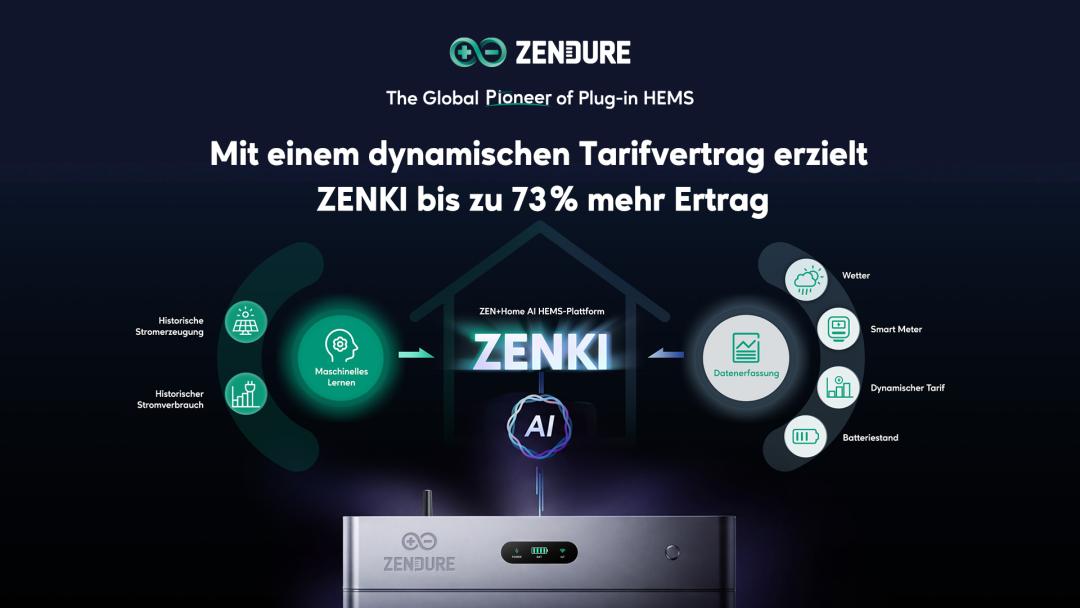
ZENKI Intelligent Energy Management: Achieve 73% Cost Savings under Dynamic Electricity Prices
36Kr: Where is Zendure's strong AI ability?