Digging deep into the robot "App Store": There are many actions, but they are all dance and martial arts. Have domestic manufacturers gone astray?
Figure is on fire again. The reason is that in the demonstration released yesterday, two F.03 humanoid robots tidied up a real bedroom, made the bed, arranged the pillows, and even "cooperated" with each other: when one robot pulled the quilt, it would actively wait for the other to get ready and then pull together.
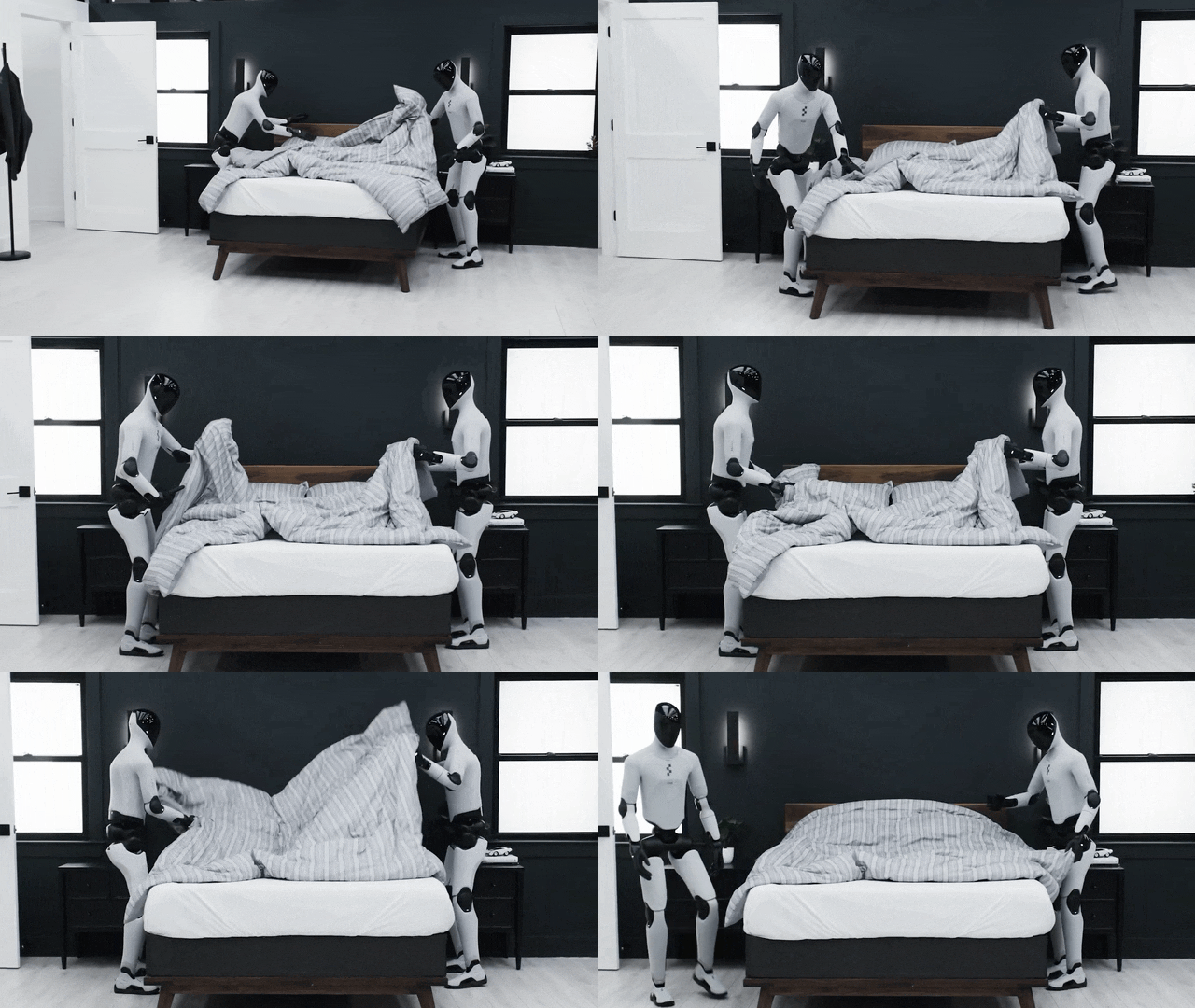
2x speed, Image source: Figure
Especially when seeing the "eye contact" between the two robots, many people will be amazed. Most of the previous humanoid robots were still at the stage of "being able to walk", "being able to carry boxes", and "being able to do backflips". When they really entered the home scenario, they often showed their true colors quickly: slow movements, slow reactions, and getting stuck when the task became complex, not to mention completing an entire task continuously.
It seems that humanoid robots are really getting close to being able to "do work". So the discussions on social media quickly split into two camps. One camp began to excitedly envision "robot nannies" and "robot housekeeping"; the other camp was more realistic: even if the robot was really bought home, how should ordinary people use it?
This question is actually very crucial. Because most of today's humanoid robots still have extremely high usage thresholds. Apart from the actions and scenario applications developed by manufacturers, it is very difficult for non - professional developers to use them in their own required scenarios. No wonder since the end of last year, the robot App Store has become a new direction.
At the end of last year, Zhiyuan launched the Lingchuang Platform, and Unitree also introduced UniStore, which the official claims to be the world's first humanoid robot task action application store, and it was officially fully opened two days ago (May 7th). At the same time, the well - known large - model community Hugging Face also launched a robot App Store based on the Reachy Mini open - source robot.
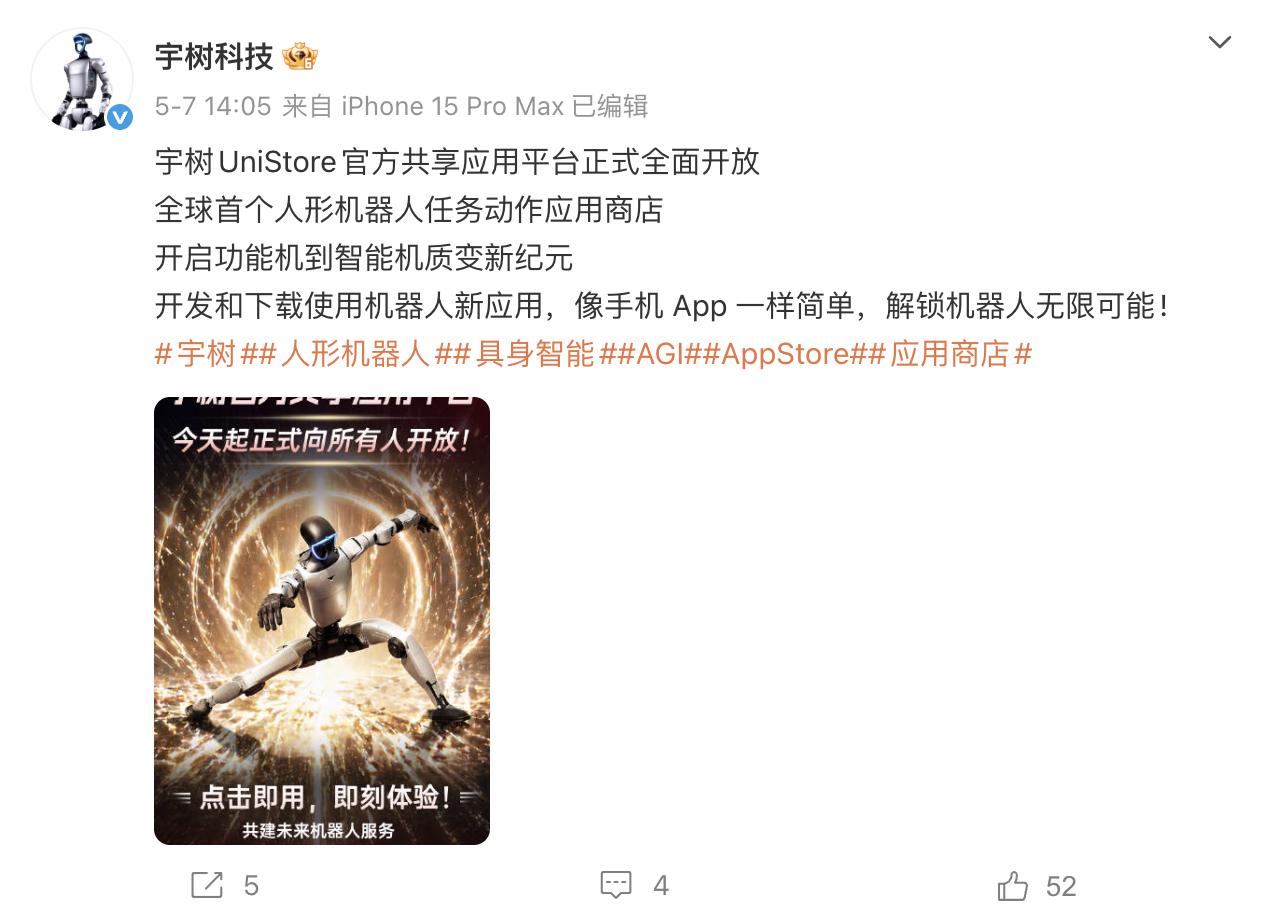
Image source: Weibo
However, I also found that the robot application stores of different companies are different. Both Zhiyuan and Unitree want more people to be "directors" and choreograph robot performances like editing videos. On Hugging Face, a large number of practical robot applications can be seen.
It's very different.
The App Store is not qualified yet. It needs to catch up with the model community of RoboMaster first
Although the outside world often refers to Zhiyuan's Lingchuang Platform and Unitree's UniStore as "robot App Stores", in fact, they are more like a "motion community" for robots, similar to the model community MakeWorld behind RoboMaster 3D printers, rather than a robot - version App Store.
Take Unitree's UniStore for example. Considering that there is currently no content in the "data set", it basically means opening up a bunch of "actions", including "Bruce Lee's Jeet Kune Do", "Wing Chun", "Mechanical Dance", "Michael Jackson - style dance", "Disco dancing", "Big - step walking", etc. In fact, there are only 24 sets of actions, and currently it is only limited to the G1 Edu/Edu+ humanoid robots.
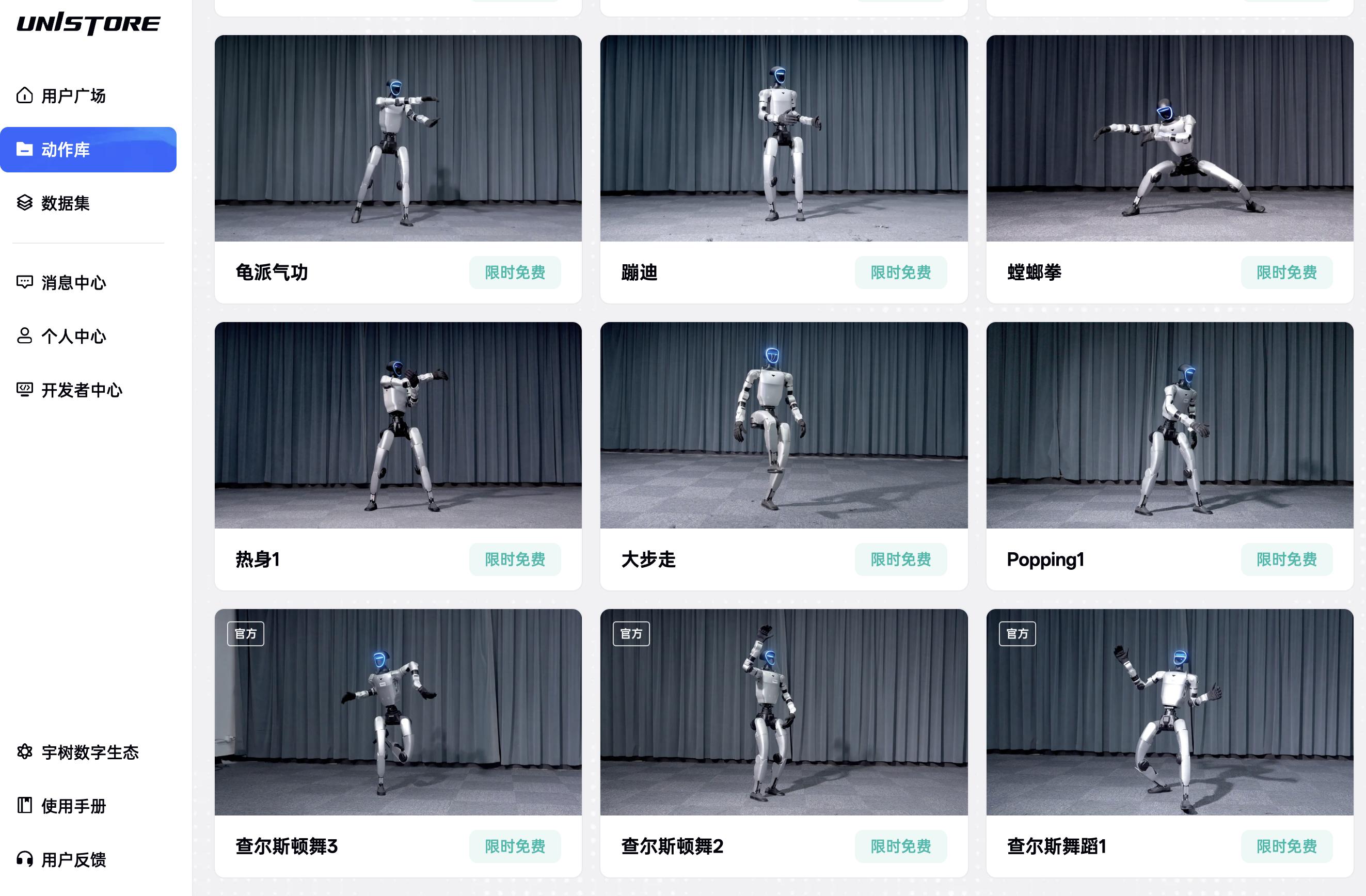
Image source: Unitree UniStore
This number is really pitifully small. Especially in the current market situation, the main "application areas" of humanoid robots are still various performances. I think most people have seen many of these actions, whether on TV, short - video platforms, or offline performances.
Zhiyuan's Lingchuang Platform has many more actions. I actually checked, and the flagship version of Lingxi X2 already has 662 published works, the youth version of Lingxi X2 has 467, and the flagship version of Yuanzheng A2 is much quieter, with only 2 works.
More importantly, most of the actions on Zhiyuan's Lingchuang Platform are shared and uploaded by third - party users. Although the quality is generally not very high, the advantage lies in the quantity scale.
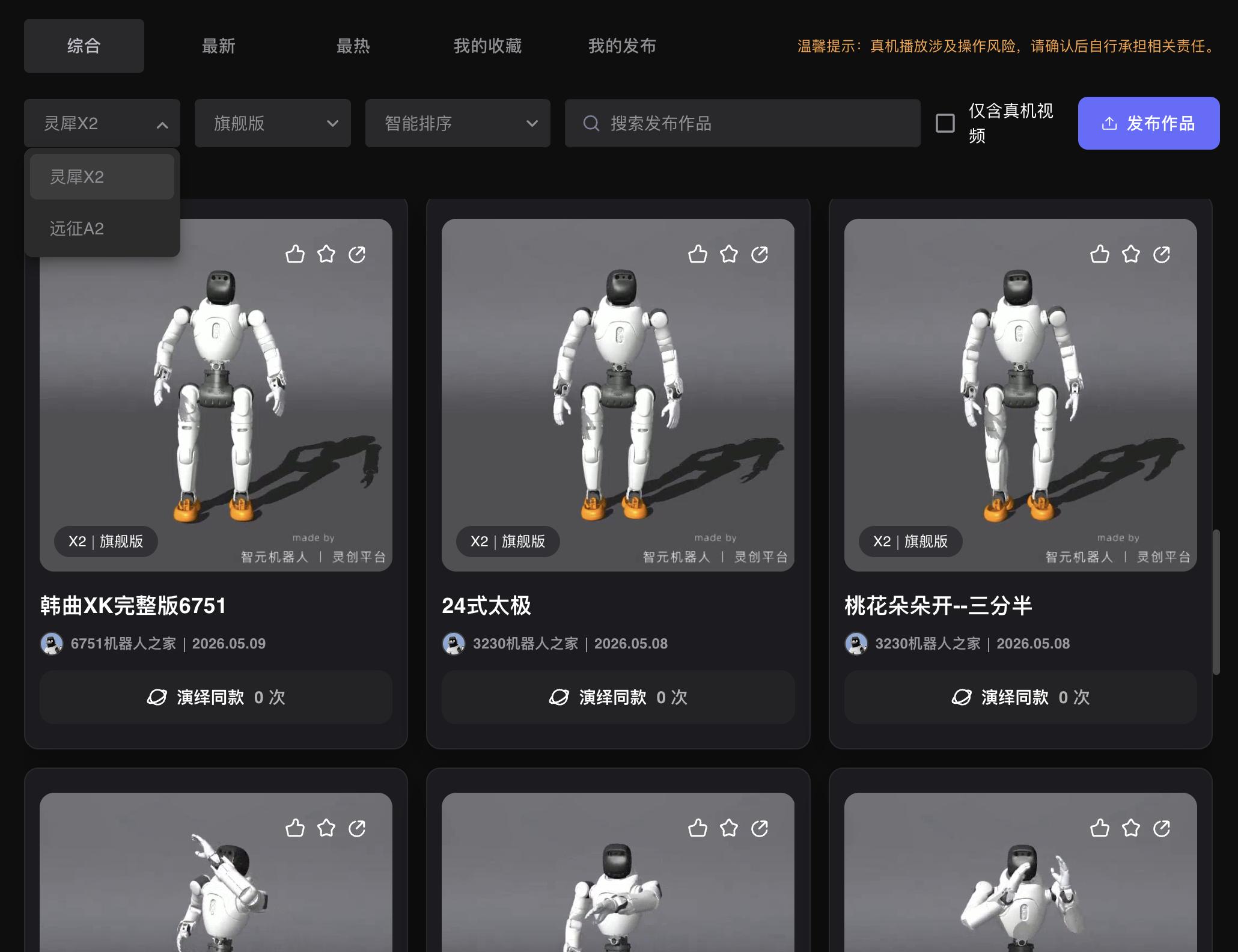
Image source: Zhiyuan Lingchuang Platform
Among them, there are a large number of music - based action performances, such as those based on "Wild Wolf Disco", "Love Emergency", "Don't Say You Love Me When I'm Lonely", "Suddenly Thinking of You", etc. Of course, there are also a large number of dance actions, martial arts actions, and funny interactions.
Of course, they are still far behind the million - level model community of RoboMaster MakeWorld. Not to mention the ecological barriers, they currently cannot well meet the basic action needs of users.
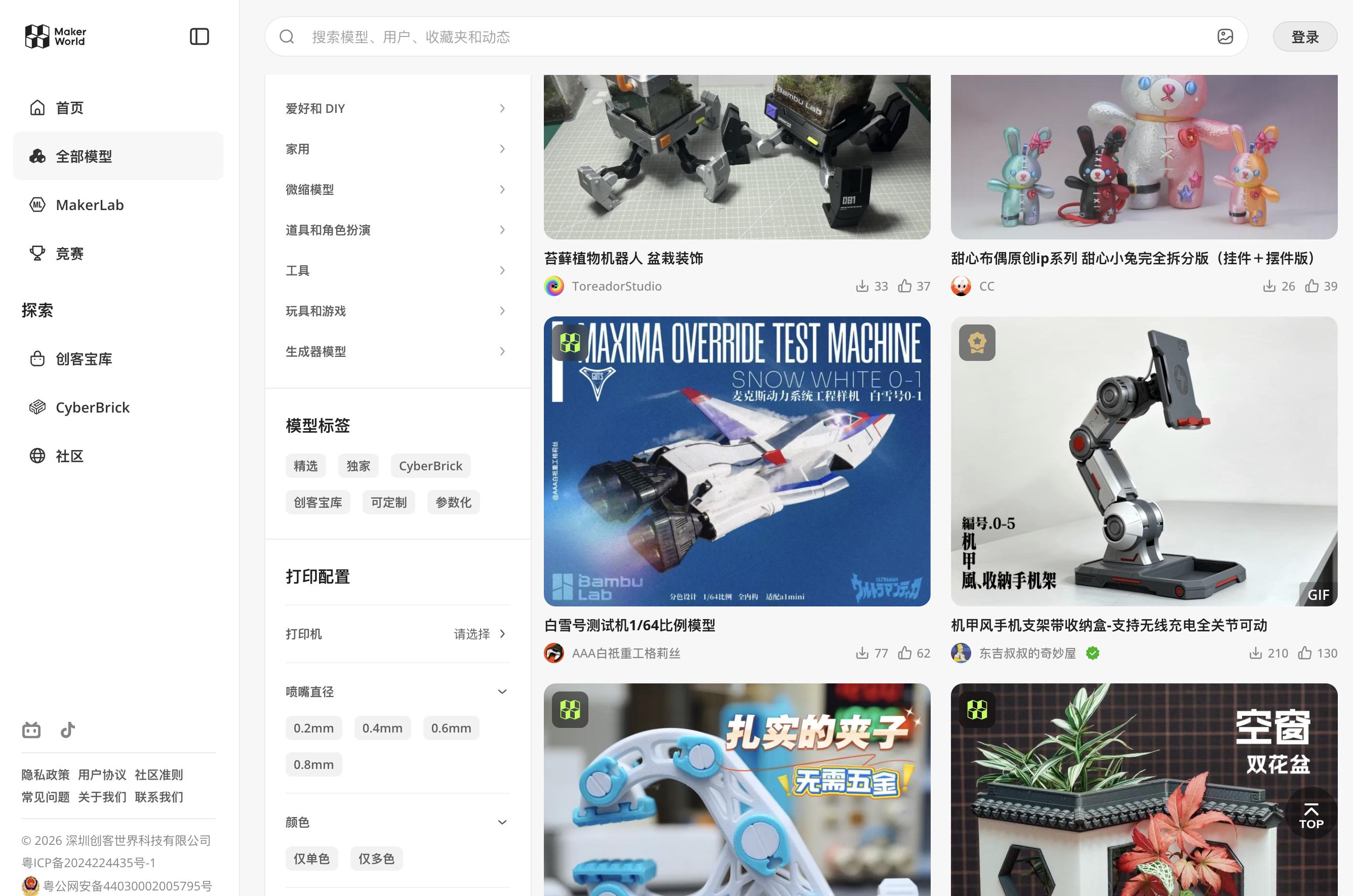
MakeWorld model community, Image source: RoboMaster
Compared with Unitree, Zhiyuan may pay more attention to its own motion community at this stage. The home page shows a "Call for Creators across the Platform", indicating that it wants to attract more people to become "robot (performance) directors" and share the choreographed actions of robots, so that more ordinary users without technical and creative backgrounds can "import with one click" the robots they buy or rent.
The core logic of the entire platform is that professional users train actions, upload actions, and display actions, and ordinary users can send them to the robot for use with one click.
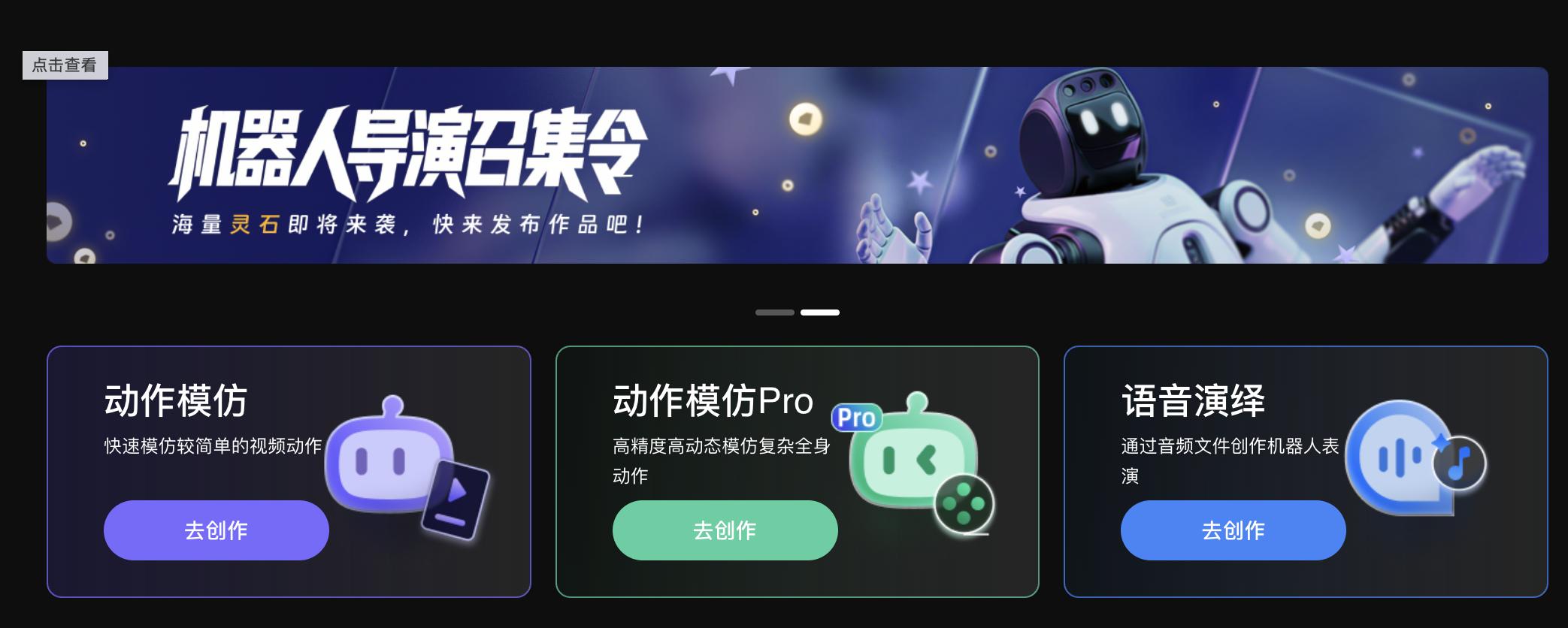
Image source: Zhiyuan Lingchuang Platform
However, it should be said that although there are many actions on the Lingchuang Platform, most of the actions shared by users are actually relatively simple. Many works are just single - segment dance actions or fixed - action cycles, with uneven quality, more like people are "competing in quantity". Relatively speaking, although the number of actions in Unitree's UniStore is small, except for a "fun - making wiggling robot", the rest are all officially produced, so the overall quality is relatively high, and all are equipped with real - machine demonstrations.
The reason for emphasizing this is mainly because the Lingchuang Platform is basically still a 3D demonstration. The advantages of 3D demonstration are obvious. It is convenient for creators. They don't need to have a real robot. They can upload the actions after training. It is also very intuitive for users to watch, and they can directly see the robot's actions from a 3D perspective.
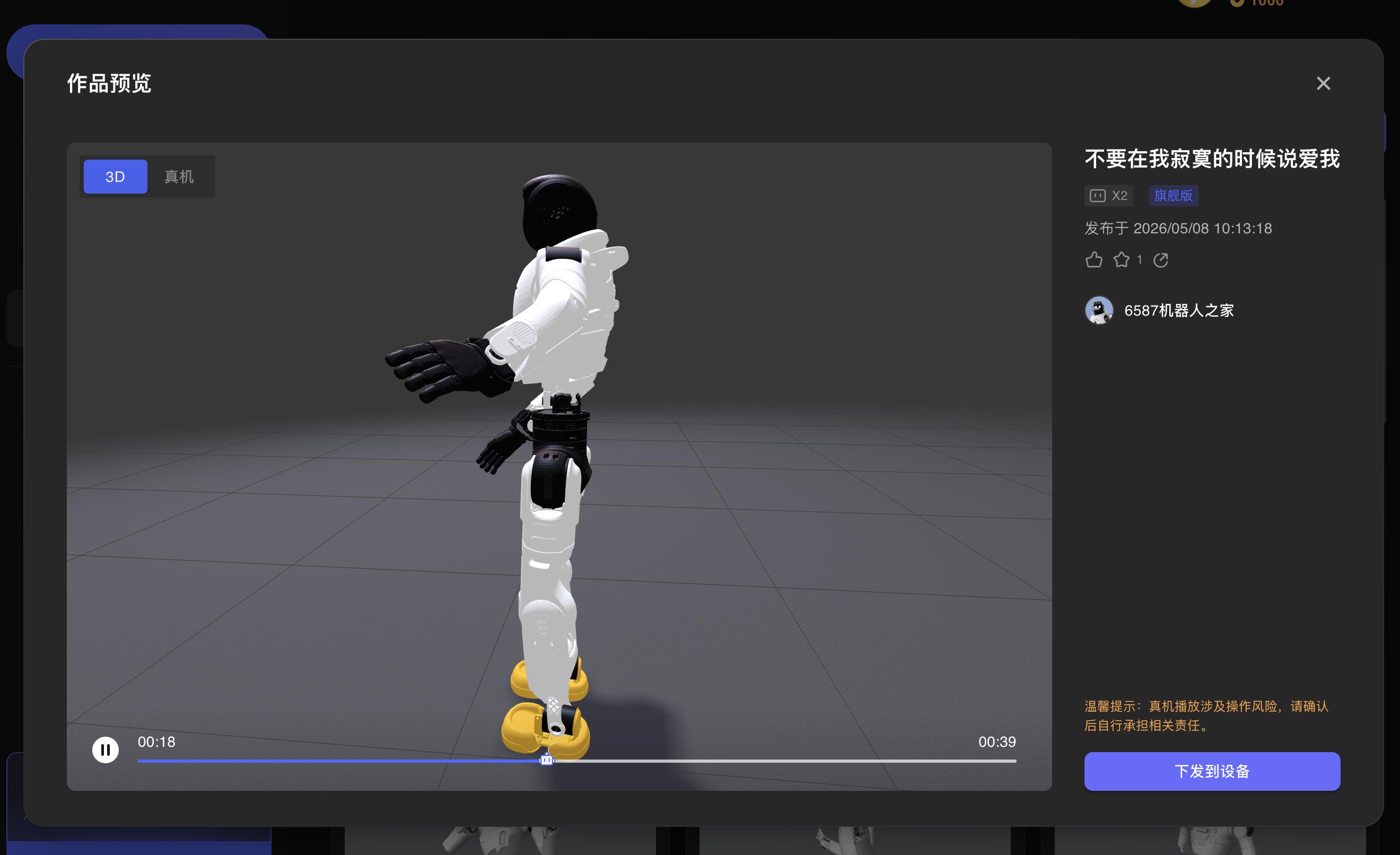
Image source: Zhiyuan Lingchuang Platform
But the problem is also obvious. 3D demonstrations are often closer to the "ideal state". When the actions are really sent to the robot, there may be a certain gap in stability and performance. So the Lingchuang Platform actually also supports real - machine demonstrations and can filter out "only real - machine videos" with one click.
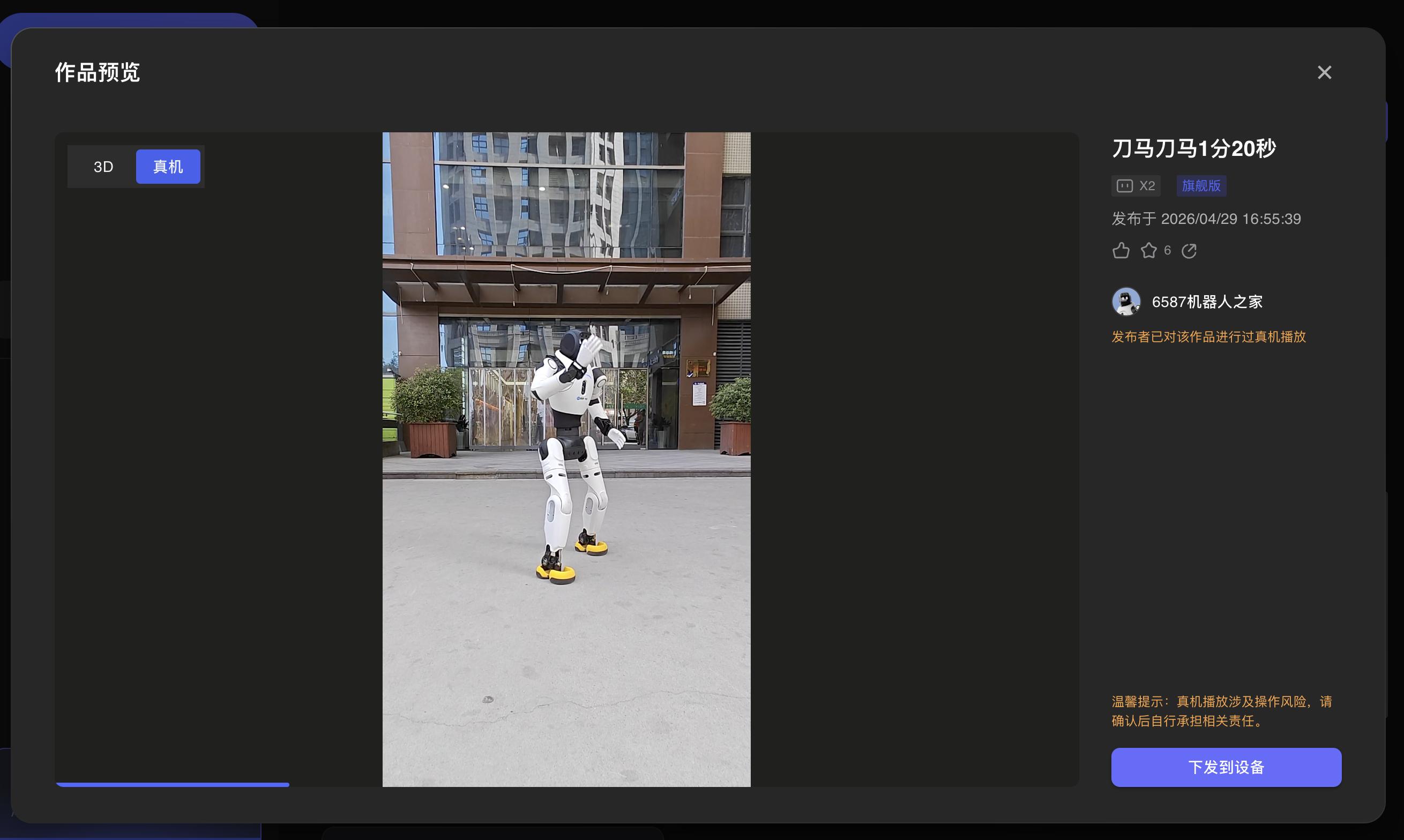
Image source: Zhiyuan Lingchuang Platform
To put it bluntly, Zhiyuan actually understands that "real demonstrations" are more valuable for reference.
But generally speaking, the Lingchuang Platform is currently a more mature and rich "robot motion community". It also supports directly "training" actions through videos in training, which reduces the technical threshold for becoming a "robot director" to a certain extent.
On the other hand, although Unitree's UniStore is still relatively simple at present, it has already listed a large number of models in advance, including G1, H1, A2, GO2, and even the As2 robot dog. It is obviously reserving a place for the subsequent ecosystem.
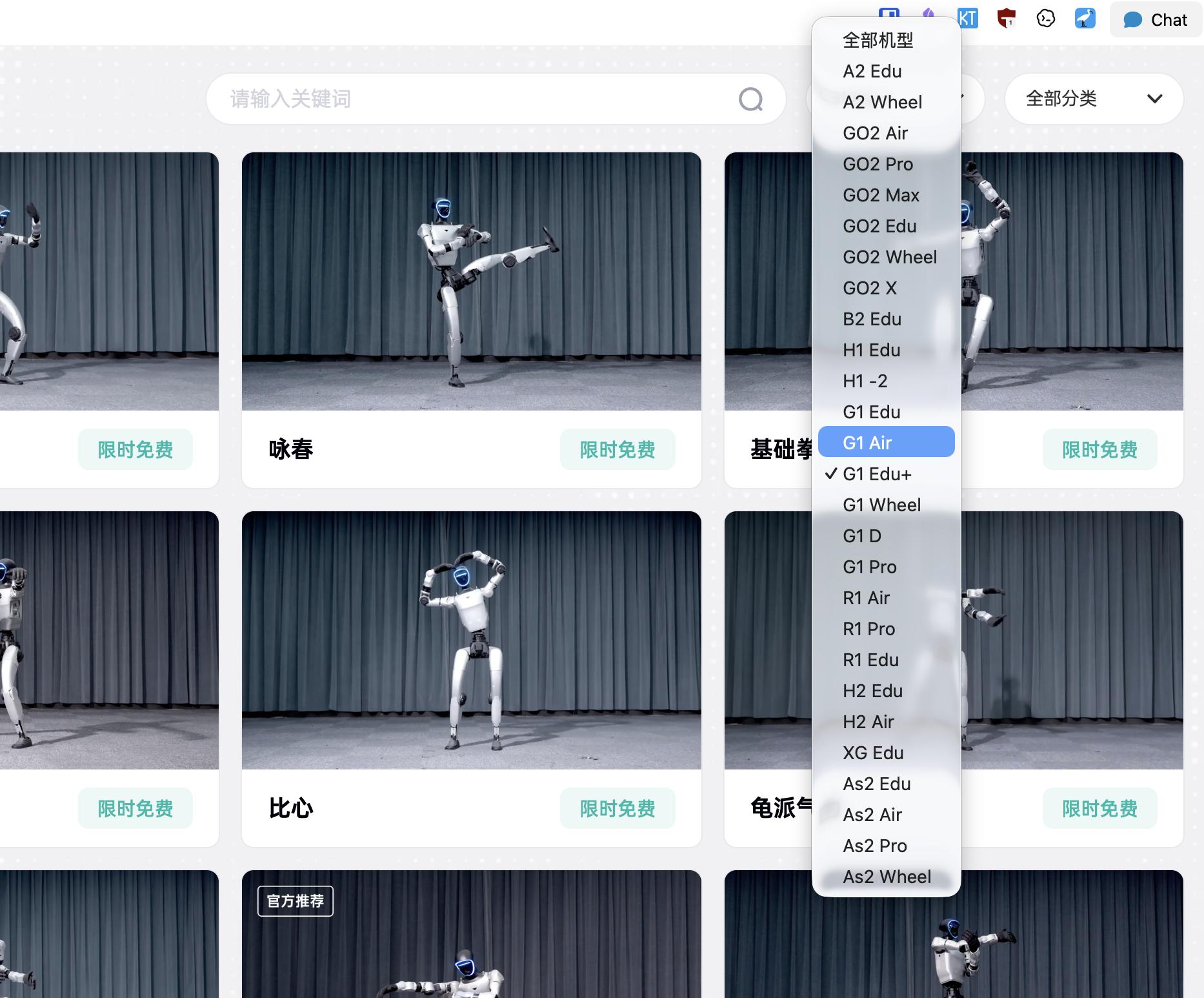
Image source: Unitree UniStore
It is also worth mentioning that the Lingchuang Platform is more like a community - sharing platform. Actions can be directly sent to the device, and it mainly relies on the "Spiritual Stones" in the community to stimulate creators. While all the actions in UniStore are marked as "free for a limited time", users need to "purchase" them first and then bind the device. Although they don't need to pay for now, Unitree has obviously considered the plan to add a charging system later.
Anyway, robots really need their own App Store.
Not a humanoid robot, but closer to an App Store
To put it bluntly, many humanoid robots today are still essentially in the "technological spectacle" stage. But precisely because of this, when I learned about Hugging Face's Reachy Mini application store from NVIDIA's official tweet, I was actually a little surprised.
Strictly speaking, Reachy Mini is not even a humanoid robot. It is even just a desktop open - source robot. But its application ecosystem is starting to have the flavor of a "robot - version App Store".
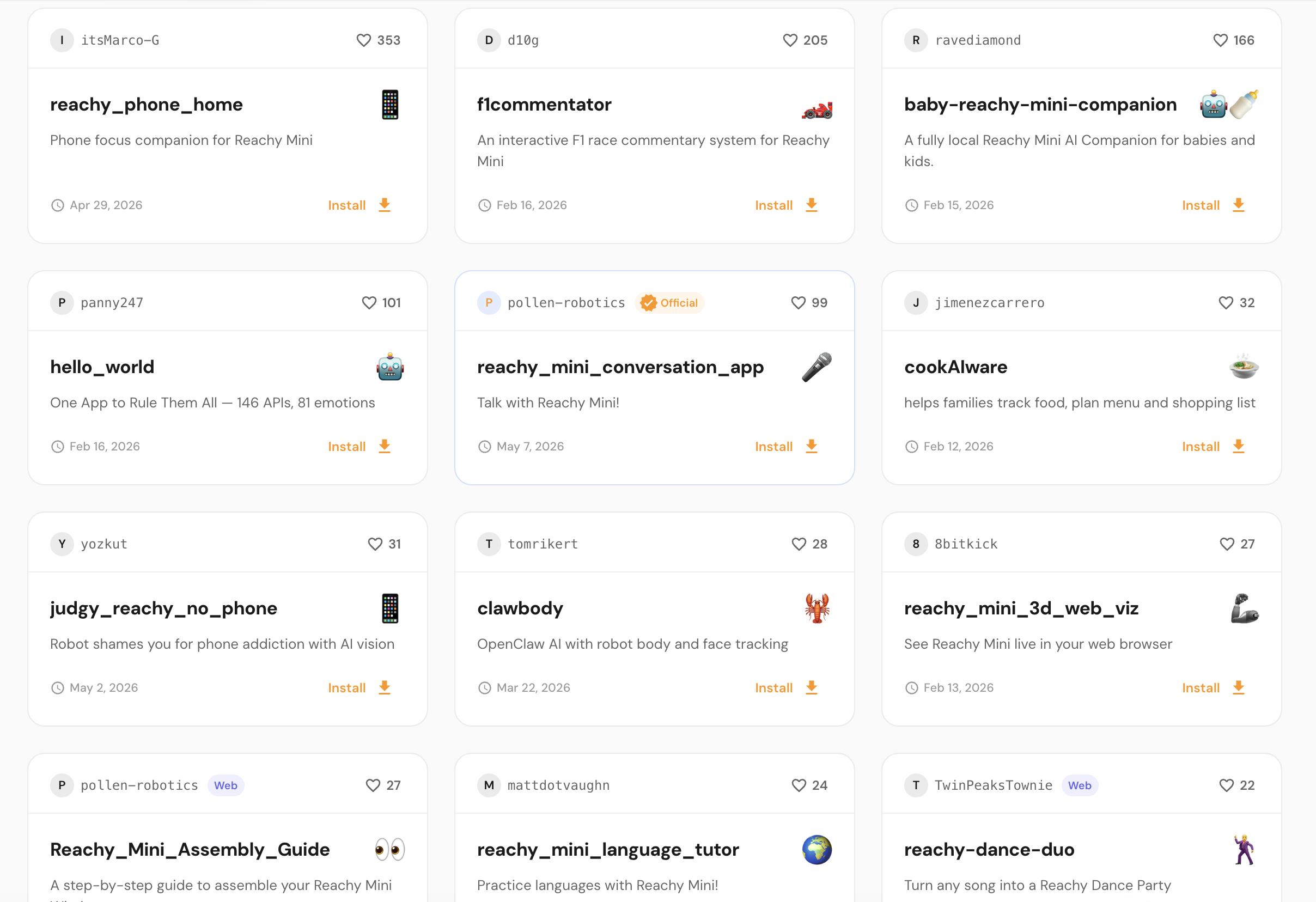
Image source: Reachy Mini
Currently, the Reachy Mini application store has gathered 219 applications, of which only 8 are officially produced, and most of the rest are from third - party developers. More importantly, many of the applications inside have obviously deviated from the "performance" logic.
For example, there is the reachy_mini_conversation_app that can have continuous conversations with the robot, the reachy_mini_home_assistant that can be connected to Home Assistant as a home central control, as well as language learning, gesture tracking, music interaction, children's companionship, mobile - phone anti - addiction reminders, F1 race commentary, web 3D visualization, etc.
Some people even connected OpenClaw to Reachy Mini.
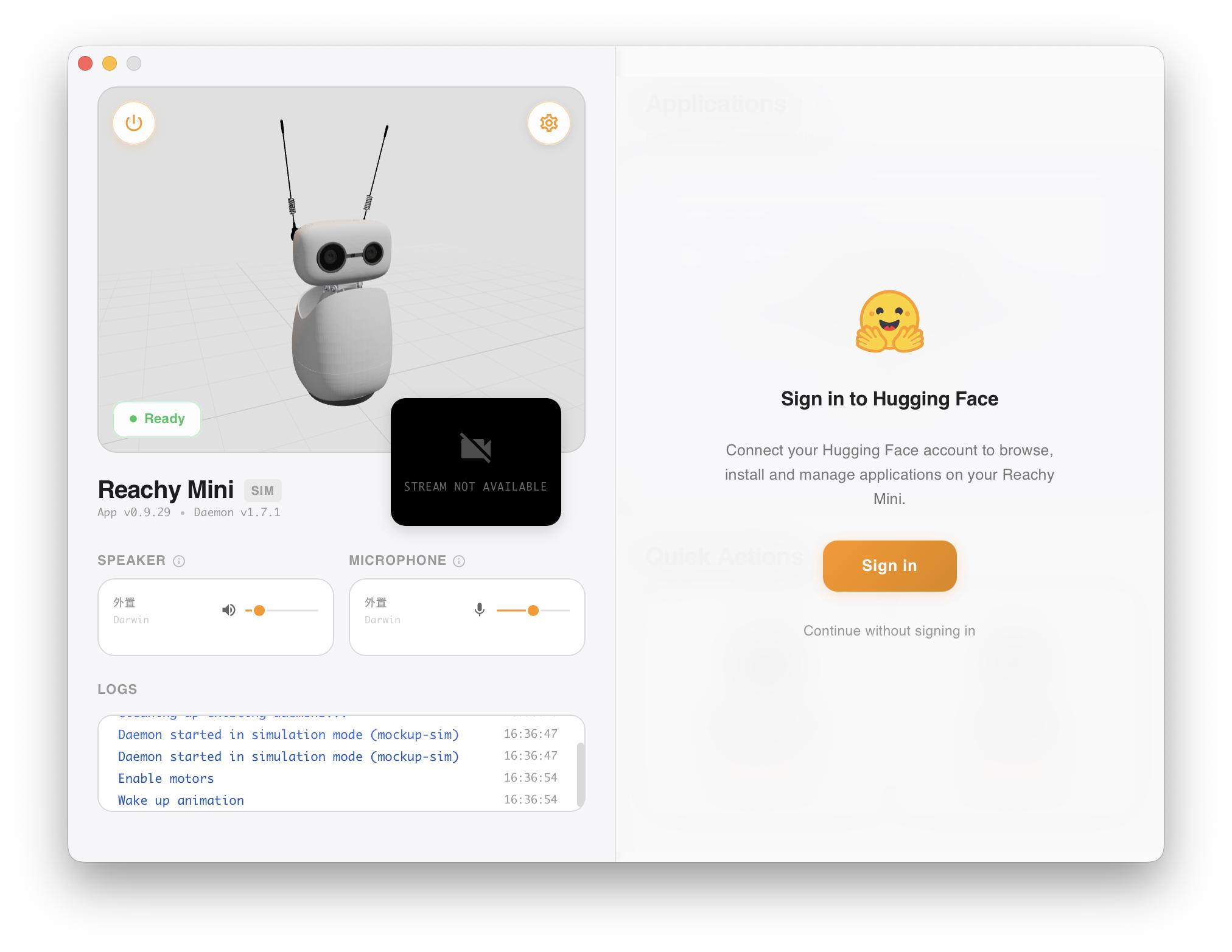
Image source: Reachy Mini
Although many applications are still in the early stage, you can already clearly feel that their goal is not "to make the robot perform", but "to make the robot participate in daily life". This is actually a big difference.
In the past year, although the domestic humanoid robot industry has become more and more popular, it has also become more and more like a large - scale robot Spring Festival Gala: dancing today, martial arts tomorrow, somersaults the day after tomorrow, and combined with short - video dissemination, it is really easy to attract attention.
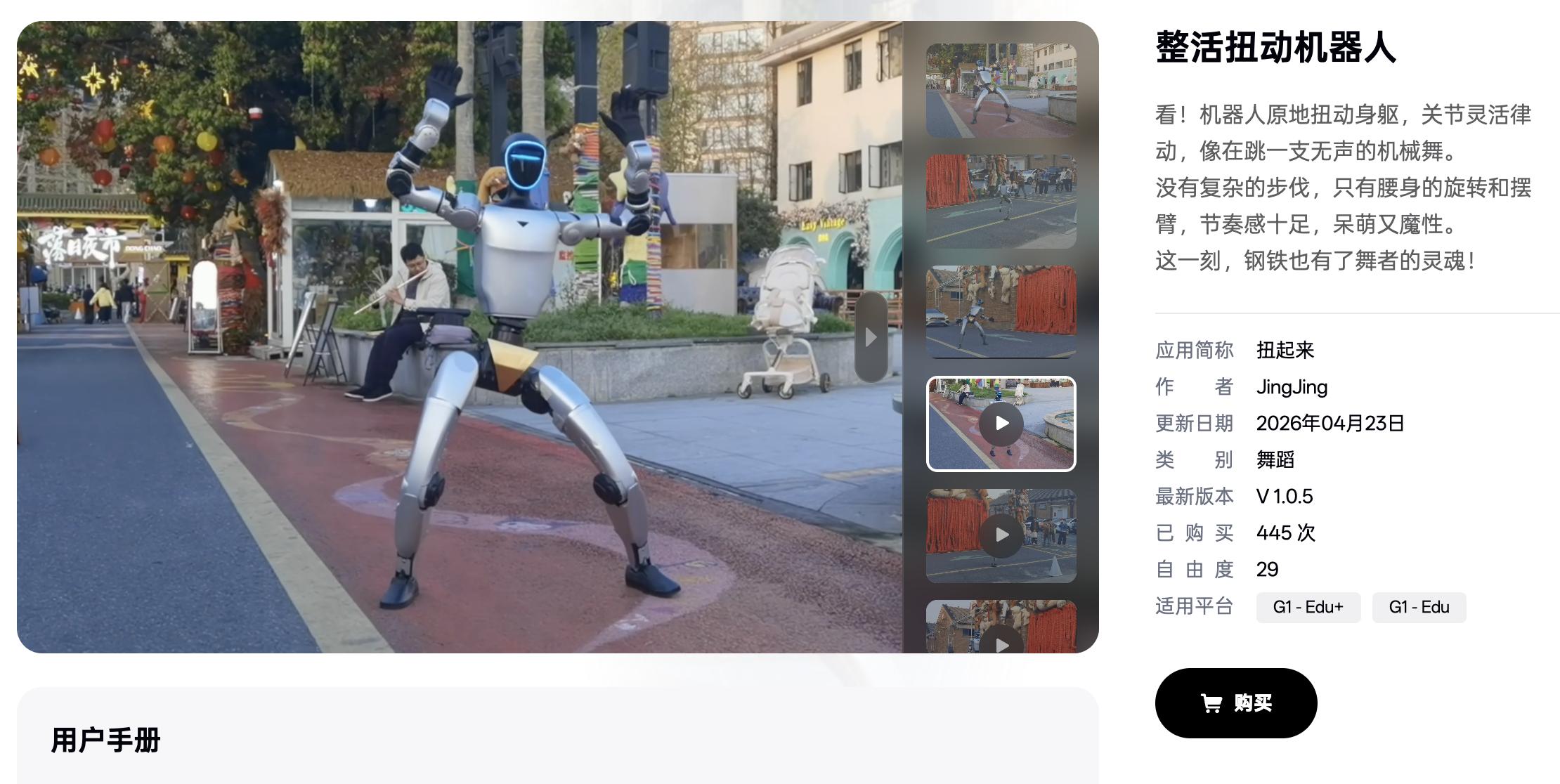
The only third - party action, Image source: Unitree UniStore
But the freshness of ordinary users wears off very quickly.
Especially after Figure F.03 has started to tidy up the room, make the bed, and work collaboratively in a real - life home scenario, when looking back at a large number of "mechanical dances", "Bruce Lee's Jeet Kune Do", and "fun - making hip - wiggling robots", the sense of gap actually becomes very obvious.
Of course, this doesn't mean that domestic manufacturers have really "gone astray". On the contrary, "performance" may be