Who is more valuable, Kimi or DeepSeek?
Kimi is the startup that has raised the most funds, while DeepSeek is the technology - oriented company with the highest valuation. The former focuses on business, and the latter bets on the "national fortune".
Recently, Kimi (Dark Side of the Moon) and DeepSeek (Deep Exploration), known as the "twin stars of China's AI open - source", have been frequently on the news.
First, new models were released one after another. Kimi launched K2.6, and soon after, DeepSeek released V4.
Then, there was a significant change in the capital market trend.
Two days ago, Kimi announced the completion of a financing round of about $2 billion, led by Meituan Longzhu. After the investment, its valuation is about $20 billion. After three rounds of financing and nearly a year of commercialization, Kimi's ARR has exceeded $200 million, and the revenue from paid subscriptions and APIs is growing rapidly.
Almost at the same time, DeepSeek, which had long refused external financing and relied almost entirely on Magic Square Quantitative for self - financing, officially opened up to external financing.
According to the latest news, DeepSeek plans to raise 50 billion yuan. Its founder, Liang Wenfeng, plans to invest 20 billion yuan first, accounting for 40% of this round. After the investment, its valuation has been pushed up from the initial level of tens of billions of dollars to over $51.5 billion, about 2.5 times that of Kimi.
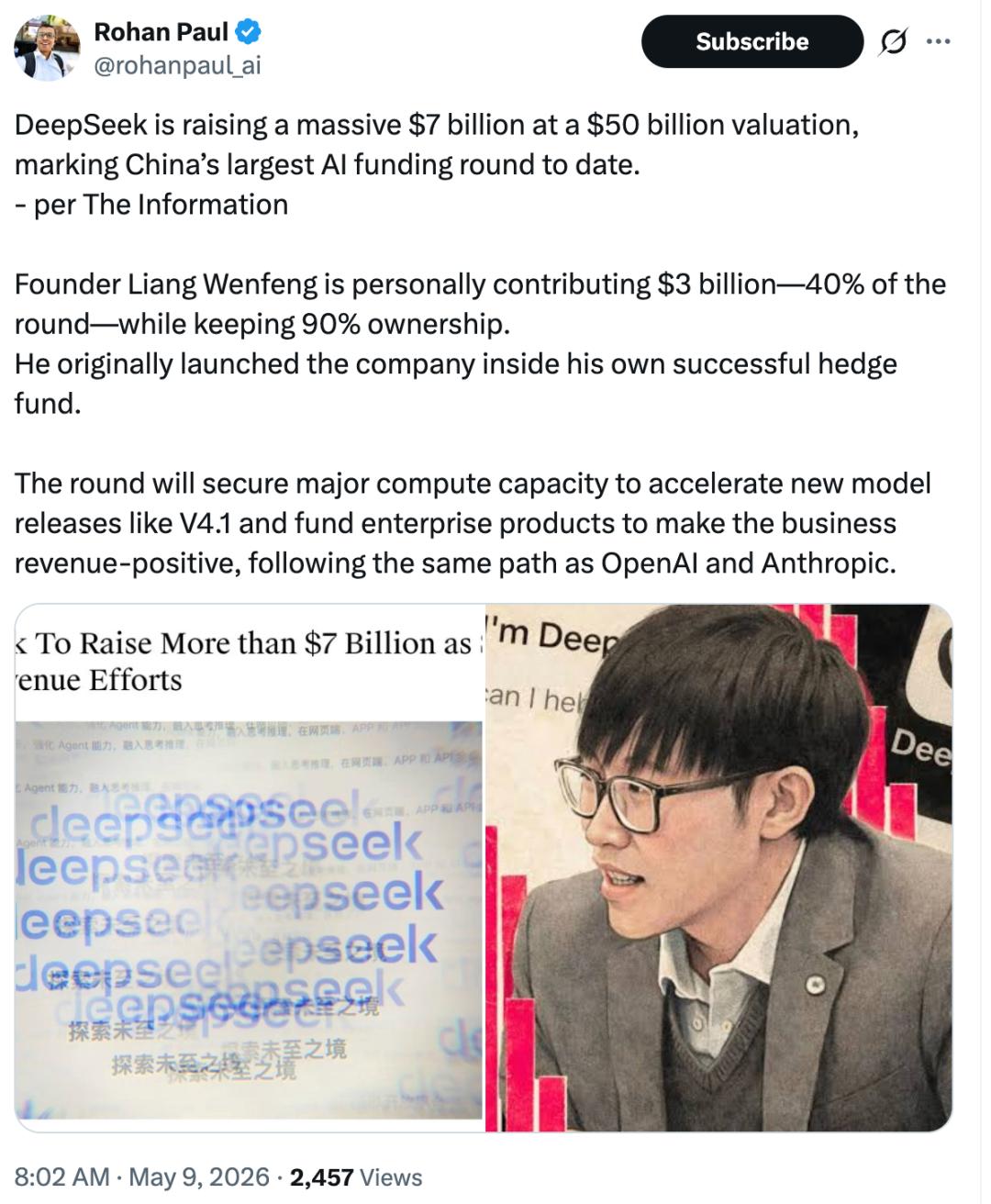
Once realized, this will not only be the largest single - round financing record in China's AI history but also set a ceiling for the valuation of the first - round financing among all Chinese startups.
Both are open - source models and are challenging the trillion - parameter level. Why do the two companies have such a big difference in chips at the capital table?
02
The Taste of Two Kinds of Money
If only looking at the financing amount, Kimi is the most successful startup in the field of large - model development in China at present.
Since its establishment in 2023, Dark Side of the Moon has raised more than 37.6 billion yuan in total.
This number seems dazzling. However, if you look closely, you will find that what Kimi has received is not just "money" but a whole set of resource systems deeply bound by capital, cloud providers, and Internet giants.
In early 2024, Alibaba invested about $800 million in Kimi and became the single largest shareholder, holding about 36% of the shares. This financing was a real turning point for Kimi.
However, not all of the $800 million was in cash. A significant part of it was in the form of cloud computing credit from Alibaba Cloud, and the actual cash investment was less than $600 million.
In other words, the "ammunition" Kimi got is essentially pre - paid cloud resources; the credit limit will decrease as the consumption increases, and Alibaba will record this part as cloud business revenue.
There is another meaning here for the relationship between cloud providers and large - model startups, which is "you are in me, and I am in you".
Later, Tencent over - subscribed in a financing round. As a result, two competing Internet giants became important shareholders of Kimi at the same time.
In the latest round of $2 billion financing, Meituan Longzhu, China Mobile, CPE Yuanfeng, etc. have joined the list of investors. Alibaba and Tencent also over - subscribed in previous rounds.
It is reported that Tencent is also in contact with DeepSeek. It has invested in Kimi and is in touch with DeepSeek.
For Tencent, this is more like an "insurance strategy in the AI era"; but for Kimi, Tencent can both balance Alibaba and become the capital force behind a potential competitor.
This is the reality of market - oriented AI startups. There is more and more money, but each sum of money comes with its own demands.
DeepSeek is backed by Magic Square Quantitative. For a long time, the R & D of DeepSeek has been almost entirely supported by Magic Square's own funds, without external VCs, a financing schedule, or a binding relationship with cloud providers.
So in the past few years, Liang Wenfeng didn't have to rush. While others were focusing on commercialization, he focused on training efficiency; while others were competing for market entry, he continued to work on open - source projects.
Now, DeepSeek is preparing to introduce external capital for the first time. However, even so, Liang Wenfeng still firmly holds the control, planning to invest 20 billion yuan himself, accounting for 40% of this round of financing. It is reported that the National Integrated Circuit Industry Investment Fund is in talks to lead the investment. The appearance of the national team may change the nature of DeepSeek.
These two kinds of money essentially correspond to two types of companies. If Kimi is the most typical market - oriented AI startup, DeepSeek is more like an extension of "national strategic capabilities".
What's more interesting is that while the outside world is still comparing the model capabilities of the two companies, their technical foundations have actually quietly "merged".
In the technical report of DeepSeek V4, the Muon optimizer proposed by Kimi is used; in the underlying architecture of Kimi K2, the MLA proposed by DeepSeek is used.
The papers of the two companies cite each other, and their technology stacks are nested. They are like two interlocking gears, competing with each other while providing power to each other.
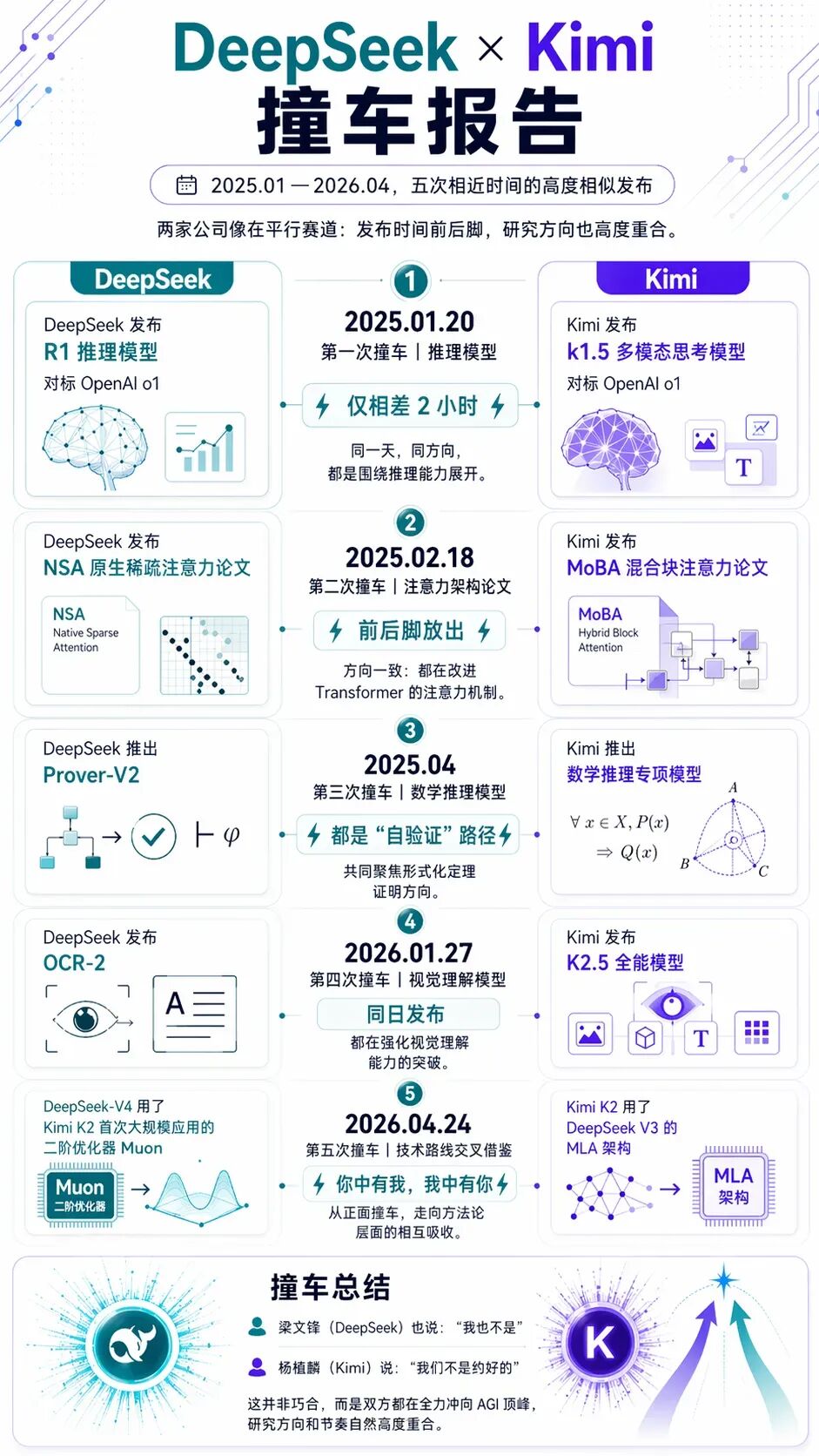
Image source: APPSO
OpenAI even pointed out in a paper that Kimi and DeepSeek are the two companies that "first reproduced OpenAI - o1 Long - CoT".
However, now, they are no longer "chasers" of OpenAI. K2.6 brings a 58.6% parallel programming ability of the Agent cluster in the SWE - Bench Pro; V4 makes the million - context feature a standard service and extends the output length to 384K tokens.
In addition, the two companies are also promoting the adaptation of domestic chips simultaneously.
DeepSeek V4 will support Huawei Ascend 950 in the second half of the year, and Cambricon has completed the Day 0 adaptation; Kimi K2.6 also starts to support hybrid inference on domestic chips. The Agent ability, programming ceiling, million - context, domestic chip adaptation, open - source ecosystem... These paths are almost colliding simultaneously.
From "learning to think" to "learning to work", from "modifying Transformer" to "modifying the computing power base", this seemingly competitive technological evolution shows that China's AI is gradually getting rid of simply benchmarking against OpenAI, reducing its dependence on NVIDIA, and finding its own way in the open - source ecosystem.
02
Why Does the Money - Making Company Have a Lower Valuation?
Kimi already has the prototype of a "mature AI startup".
It has C - end products, paying users, and a clearer commercialization path for Agents. Both membership subscriptions and API revenues have entered an accelerated growth stage.
Kimi's ARR, that is, the annual recurring revenue has exceeded $200 million. This figure was actively disclosed by Meituan Longzhu.
In the primary market, investors actively emphasizing ARR is actually endorsing the valuation. After all, among Chinese AI startups, not many have a stable revenue model.
DeepSeek's logic is completely different. Its core strategy is to build an ecosystem first and then focus on commercialization.
The API pricing of DeepSeek has long been maintained at about one - tenth of that of OpenAI. It cares more about model penetration, developer ecosystem, and open - source influence than short - term revenue.
Therefore, until now, DeepSeek's real revenue has not been made public. On the other hand, its user scale is expanding rapidly. At present, DeepSeek's monthly active users have reached 127 million, 14 times that of Kimi (9 million).
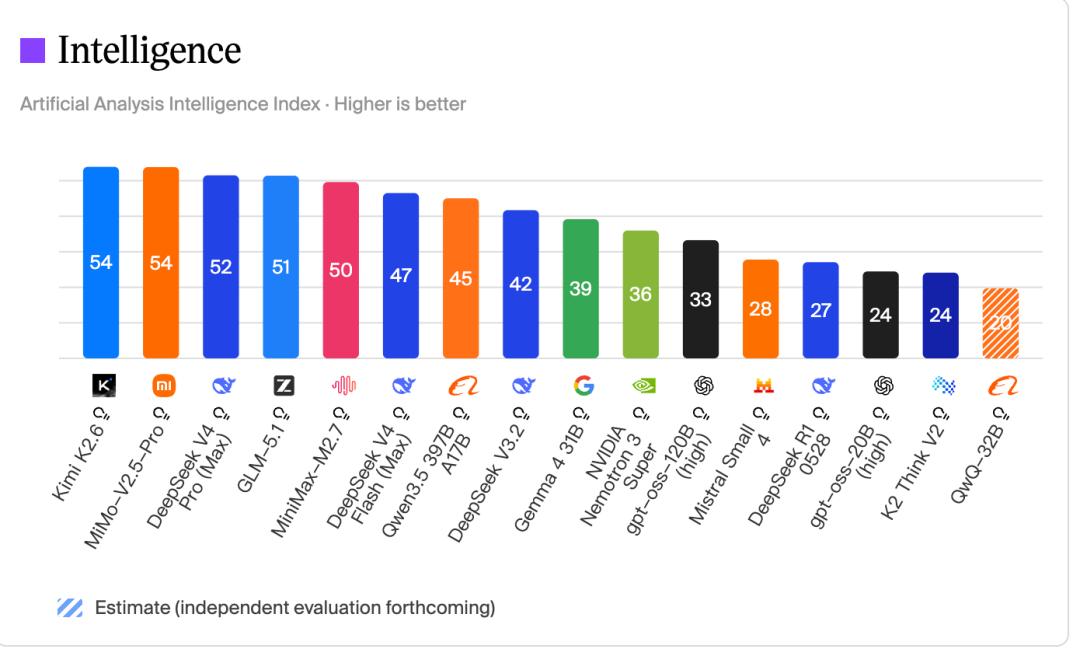
Thus, a very delicate situation has emerged: Kimi, with an ARR exceeding $200 million and a more mature commercialization path, has a valuation of about $20 billion; while DeepSeek, whose revenue scale has not been made public and is still emphasizing low - cost and open - source, has a valuation approaching $51.5 billion, about 2.5 times that of Kimi.
What this reflects is actually a change in the evaluation logic of the capital market.
In today's AI investment, what is rewarded is not only "how much money you can make now" but also "what you may become in the future".
Once national capital truly enters, DeepSeek's narrative may become "China's AI infrastructure", and its corresponding valuation logic will naturally no longer be just the price - earnings ratio of a traditional commercial company.
In the context of AI investment in 2026, Kimi's "ability to make money" actually means clearer boundaries and limited room for imagination.
However, this valuation paradox will not exist in the long term.
The Information reported that after this round of financing, DeepSeek will "accelerate revenue planning and commercialization" and speed up the release of new models, "moving closer to the industry mainstream". It is reported that V4.1, which DeepSeek will launch in June, will also add tool capabilities specifically for enterprise users.
This means that DeepSeek is also being pushed to tell a commercialization story.
In the past, Liang Wenfeng didn't have to rush. Because Magic Square's money has no external LPs and no exit period. But once external capital enters, the clock will start ticking.
The problems that Kimi is facing today, such as revenue, growth, commercialization efficiency, and capital expectations... DeepSeek will probably face them in the future.
To some extent, Kimi's $200 million ARR is more like a "pioneer map".
03
The Accounts of Yang Zhilin and Liang Wenfeng
Yang Zhilin and Liang Wenfeng are both from Guangdong. One is from Shantou, and the other is from Zhanjiang.
Kimi and DeepSeek are among the first players in China to develop open - source trillion - parameter models. They are very similar in their technological beliefs: both believe in the Scaling Law and are challenging large models at the trillion - parameter level.
DeepSeek is better at inference models, while Kimi emphasizes Agent capabilities more.
Although their technical routes are different, their underlying goals are actually highly consistent. Especially in more fundamental architectural innovations, the two companies almost always "collide" in the same direction.
Kimi published a paper on "attention residual", and DeepSeek developed mHC residual connection;
Kimi explored Kimi Linear in the direction of linear attention, while DeepSeek advanced DSA in the direction of sparse attention. Although the routes seem different, they are essentially challenging the "ancient infrastructure" of the Transformer era.
However, the two took completely different paths in "how to protect their technological ideals".
Yang Zhilin's method is institutional design: AB shares, a dual - class equity structure, and the technical team has absolute voting rights. In addition, Yang Zhilin introduced Zhang Yutong. She first appeared in Kimi's financing negotiations as a partner of GSR Ventures and was the key person who helped Kimi secure Alibaba's nearly $1 billion financing.
Later, due to a profit - sharing dispute with GSR Ventures, she left the fund. After a period of public controversy, in late 2025, she officially appeared as the "President of Dark Side of the Moon", fully responsible for the company's strategy, financing, and commercialization.
These are exactly the parts that Yang Zhilin is not good at or doesn't want to spend a lot of time on. Yang Zhilin is a typical technical founder. In his speech at NVIDIA GTC 2026, he spent a lot of time talking about Muon, training efficiency, and stability issues at the trillion - parameter scale.
Liang Wenfeng is also a technical geek. His way of holding control is more straightforward: real money.
In the first round of external financing, he invested 20 billion yuan himself, accounting for 40% of this round. He doesn't rely on complex institutional designs or special voting rights arrangements, aiming to "defeat capital with capital".
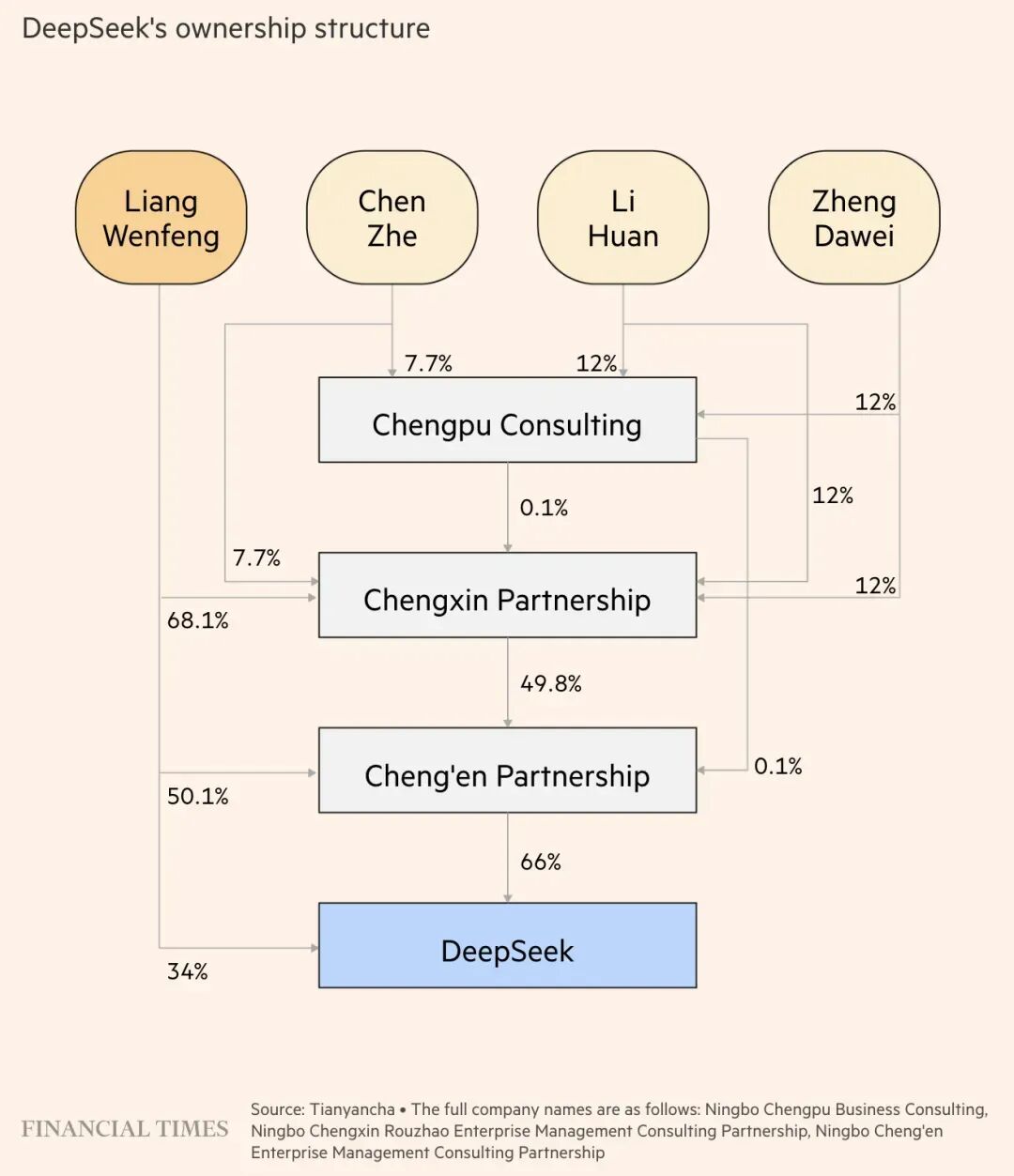
It's hard to say which method is better. The advantage of institutional design is high leverage, locking more control with relatively less equity. However, since the system is designed by people, there will be friction, disputes, and even unexpected costs during the implementation process.
According to Anyong, in the early days of Kimi's establishment, Yang Zhilin took the core team from his previous company, Yuanchuang Intelligence, but the waiver consent forms from the old shareholders were not fully signed. At that time, the large - model financing was in a frenzy, and many problems were defaulted to be "dealt with later".
Later, as Alibaba's nearly $1 billion financing was finalized, the disputes began to surface.
Zhang Yutong, who helped Kimi negotiate this round of financing, was still a managing partner of GSR Ventures at that time, and her husband, Wang Zhen, was also a co - founder of Kimi. Subsequently, Zhu Xiaohu posted on his WeChat Moments late at night, mentioning that "fiduciary duty is a high - voltage line". Later, the old shareholders of Yuanchuang Intelligence also initiated arbitration.
Therefore, a well - designed AB share structure cannot completely solve the personal relationships and procedural issues left over from the early days of the company's establishment.
The advantage of using real money is clarity and no ambiguity, but the premise is that you have enough money and are willing to invest it. Liang Wenfeng has Magic Square behind him, so he can take this path.
Different choices also reflect the different resource endowments of the two companies. Kimi has been a market - oriented