Three days, three companies, over $10 billion: A decisive week of financing for China's large AI models
From May 7th to 8th, three major news items emerged densely in China's large AI model track: Dark Side of the Moon completed a new round of financing of approximately $2 billion, with its post - investment valuation exceeding $20 billion; Step Star is about to complete nearly $2.5 billion in financing and announced that the red - chip structure has been removed, clearing the way for its IPO on the Hong Kong Stock Exchange; Rumors about DeepSeek's financing valuation continue to be updated, soaring from the initial $10 billion to over $50 billion. The Information also reported that it plans to raise 50 billion yuan.
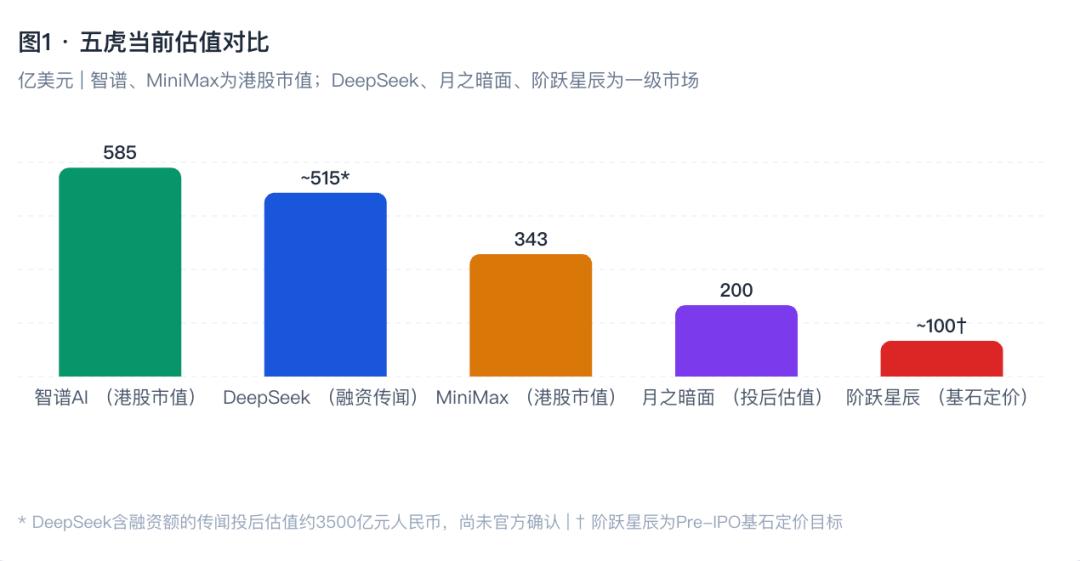
Adding Zhipu and MiniMax, which are already listed on the Hong Kong Stock Exchange, the "Big Five" domestic large - scale foundational models have all reached their respective critical points this spring. This is not a coincidence but a realization by everyone that the window to stay in the game is much narrower than expected.
Everyone realizes that the window to stay in the game is much narrower than anticipated.
01.
The Suddenly Accelerated Capital Race
The valuations of OpenAI and Anthropic have reached the trillion - level. The capital required for the next round of the AI arms race far exceeds the supply capacity of China's primary market. It's not that the total size of China's capital market is insufficient, but the existing capital structure means that no one can write a check of this scale for a single startup.
Dark Side of the Moon's single - round financing of $2 billion and Step Star's single - round financing of nearly $2.5 billion are the largest single - round AI financings in China's history, yet they still cannot fill the ammunition gap required for this race. Xie Siyuan of Yijing Capital put it bluntly: The intensive preparations for listing by domestic manufacturers are essentially due to the insufficient capital supply, and they have to seek survival funds in the secondary market.
Therefore, the "Big Five" have each taken different financing routes. Some are aiming for IPOs, some are aggressively attracting strategic investors, and some are waiting until the last moment to open the door. But the goal is to grab the last batch of heavy funds in this arms race before the window closes.
02.
DeepSeek: The Last to Open the Door, but Asking for the Highest Price
DeepSeek's financing progress has been the most dramatic in the past three weeks.
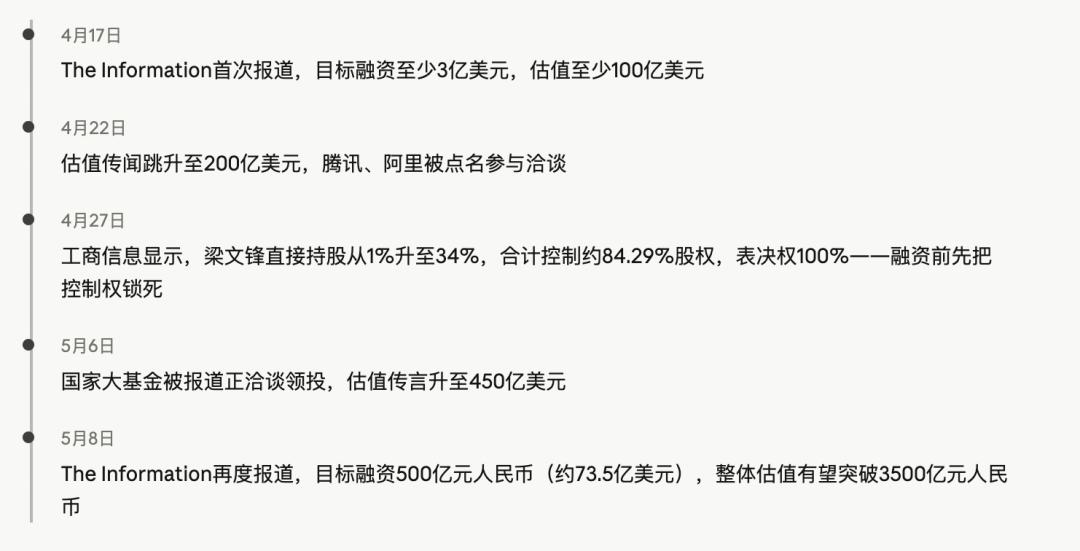
Within three weeks, DeepSeek's valuation soared from $10 billion to $51.5 billion, and there has been no official statement so far.
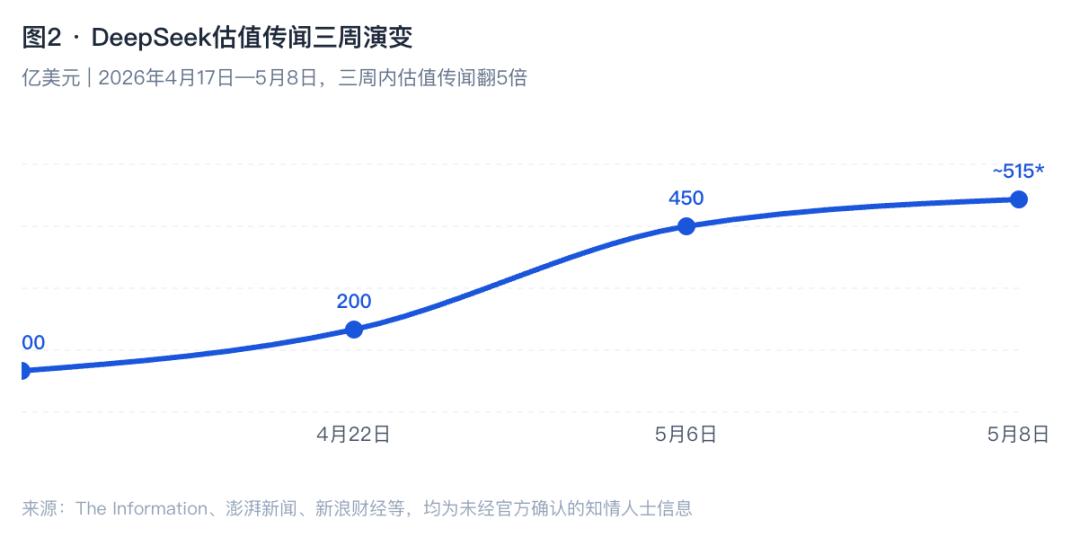
Money is not DeepSeek's most urgent problem. Its parent company, Magic Square Quant, has been providing financial support for three years without interruption. What really made Liang Wenfeng open the door was the departure of five people.
Since 2025, the list of departing core researchers at DeepSeek has been getting longer. Luo Fuli, the core developer of V2, went to Xiaomi; Wang Bingxuan, the core author of LLM, joined Tencent; Ruan Chong, a core contributor to multimodality, went to Yuanrong Qixing; and Guo Daya jumped to ByteDance.
The loss of five core - level experts indicates that in the face of the combination of "cash + options" offered by competitors, the toolbox for retaining talent has been emptied. Financing, setting a valuation, and issuing options are the most direct defensive measures at present.
According to media reports, the overall scale of this round of financing is expected to be 50 billion yuan, with Liang Wenfeng personally increasing his investment by 20 billion yuan. In addition, DeepSeek will also speed up the release of new versions, planning to release V4.1 in June, which will include more enterprise - level tools, strengthen support for MCP, have image and audio processing capabilities, and take a step towards multimodality.
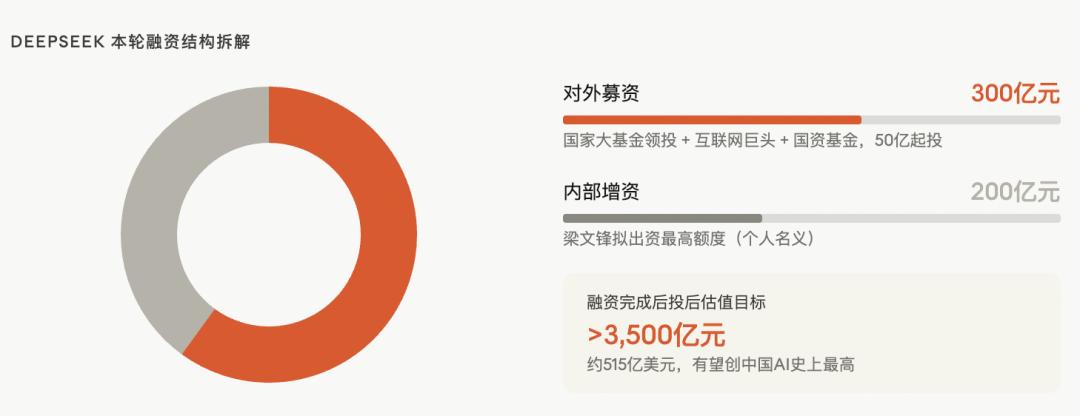
The potential entry of a major national fund means that large models have reached the same strategic position as chip manufacturing. And DeepSeek's priority in adapting to Huawei Ascend is an active move to embed itself in a larger strategic logic.
Liang Wenfeng locked 100% of the voting rights before the financing to reserve a buffer space for independent decision - making in this "deep binding".
03.
Dark Side of the Moon: A Valuation of $20 Billion, the Pay - to - Survive Line for Kimi
Dark Side of the Moon's financing pace has been crazy. It raised nearly $4 billion in half a year, and its valuation quadrupled.

Introducing China Mobile in this round has obvious strategic intentions, betting on the C - end contact interface of the operator. However, Yang Zhilin's previous statement of "not being in a hurry to list" is no longer valid, and Dark Side of the Moon has started to form a listing team. The reason is practical: investors are under pressure to exit, and Step Star is eyeing the Hong Kong Stock Exchange. The first to list will have the pricing power.
A valuation of $20 billion corresponds to an ARR of $200 million. This hundred - fold PS is a typical "belief - based pricing". The market is betting that Kimi can increase its ARR to the level of $4 billion within two to three years. This requires a substantial leap in the paid conversion rate, and currently, no domestic large - model product has truly crossed the threshold from a "useful tool" to "subscription - based payment".
04.
Step Star: The Most Sane "Showroom"
One day after the news that Dark Side of the Moon completed $2 billion in financing, the news of Step Star's financing followed: It is about to complete nearly $2.5 billion in new financing. At the same time, it completed the joint - stock reform in April, removed the red - chip structure, and cleared all legal pre - actions for its IPO on the Hong Kong Stock Exchange.
The two companies are competing for the same window, the "third spot for large models on the Hong Kong Stock Exchange". Zhipu and MiniMax have already taken the first two spots. The one that goes third will enjoy the premium pricing of the current Hong Kong Stock Exchange for pure AI targets.
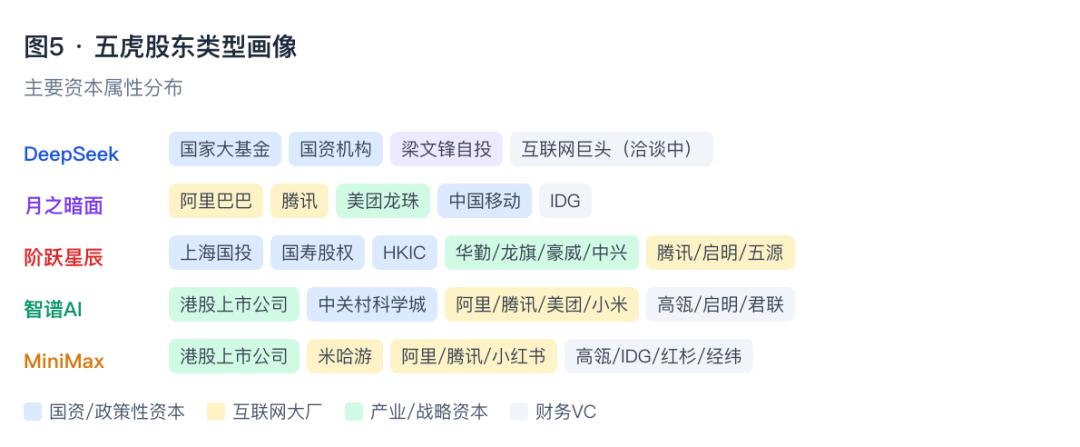
The highlight of Step Star's financing this round is not the amount but the list: Huaqin, Longcheer, OmniVision, and ZTE. These four companies cover the entire industrial chain of mobile phone terminals. Huaqin and Longcheer are in the first echelon of global mobile phone ODMs, OmniVision is upstream of core camera components, and ZTE has mass - produced Step Star's AI functions in flagship models such as the Nubia Z80 Ultra.
This is a capital binding at the supply - chain level. The entry of these companies means that Step Star's AI capabilities will be actively embedded in the product design process by hardware manufacturers, rather than relying on the software team to negotiate cooperation one by one. This deep coupling is a moat that pure software companies cannot replicate.
In addition, the endorsement of HKIC, the so - called "Hong Kong - style Temasek", and Yin Qi's (who also serves as the chairman of Qianli Technology) closed - loop layout in the intelligent cockpit make Step Star's strategy very solid: It has 60% of the top mobile phone brand customers, with an installed capacity of over 42 million units. These hard data are more convincing in the financial statements than a PPT.
05.
Zhipu and MiniMax: How Long Can the "AI Belief" Pricing on the Hong Kong Stock Exchange Hold Up?
Zhipu went public in January, with a subscription multiple of over 1,160 times. It has risen by over 700% in the following three months, and its latest valuation is about HK$450 billion; MiniMax rose by 487% in 43 days after going public, and its latest market value exceeds HK$300 billion. The combined market value of the two companies exceeds that of JD.com, Kuaishou, and Ctrip.
These two figures cannot be explained by any normal valuation model. MiniMax's revenue in the first nine months of 2025 was $53.44 million, and the PS corresponding to its current market value exceeds 700 times. This is more of a belief - based pricing.
However, once Step Star and Dark Side of the Moon are listed one after another, the scarcity premium will be diluted; when the performance is truly scrutinized, a 700 - fold PS has no supporting basis.
However, after Zhipu raised the price of its Coding Plan by 30%, the package was sold out as soon as it was launched. MiniMax's M2.5 is in short supply in the Agent programming scenario, and a purchase limit has been implemented. This shows that in specific vertical scenarios, users are already willing to pay real money for quantifiable efficiency improvements. This inflection point occurred earlier than most people expected. CICC calls it "the industry's pricing logic shifting from traffic consumption to the realization of computing power value", that is, products can finally be sold without relying on money - burning subsidies.
06.
The Real Divide Is Not in the Amount of Financing
The biggest misunderstanding in the market is to use the amount of financing as a ranking of strength.
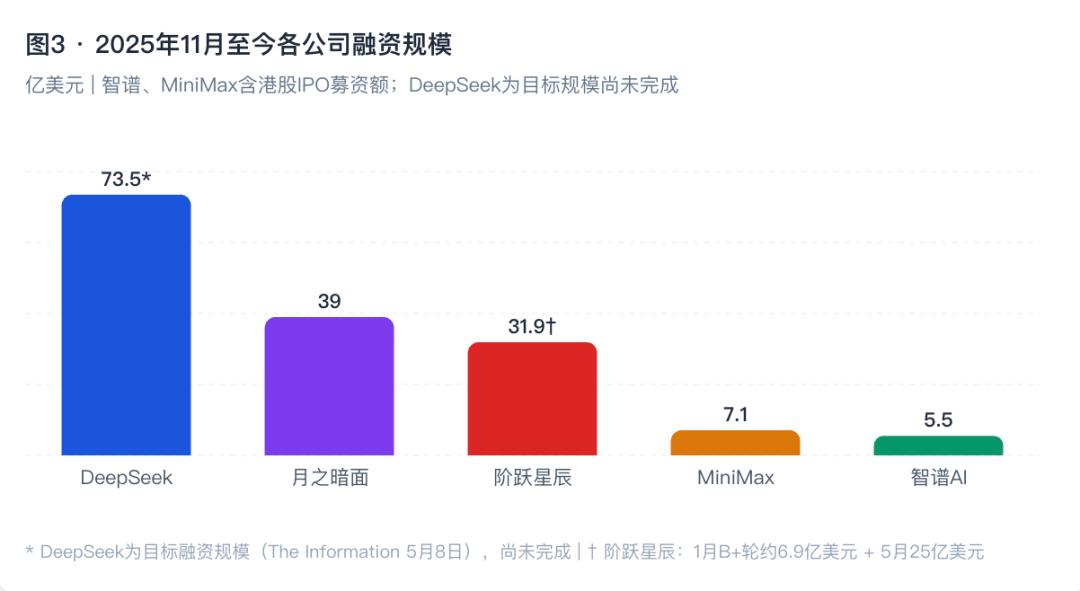
Dark Side of the Moon raised $3.9 billion in half a year, but its business model still centers on C - end traffic products, with a weak revenue foundation and an unproven paid conversion. DeepSeek's rumored valuation has reached $51.5 billion, but it doesn't even have an independent commercial product and makes money through APIs, basically serving as infrastructure for others. Having more money does not mean having a clear commercialization path.
In contrast, the $2.5 billion that Step Star received is of a completely different nature. The entry of industrial players like Huaqin, Longcheer, and OmniVision makes this capital fundamentally different from the money of pure financial investors.
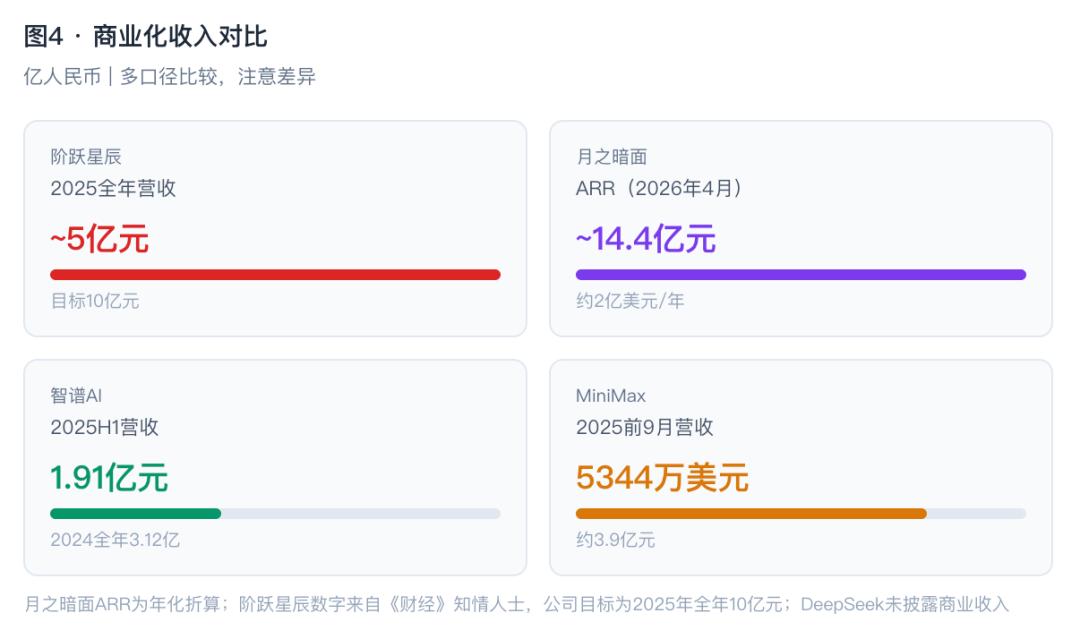
Zhipu's Coding Plan sold out after a price increase, but its market value of HK$450 billion dilutes the credibility of this signal. It's hard to tell which part is the real business quality and which part is the emotional premium from retail investors and hot money.
The major fund leading the investment in DeepSeek means that large models have been upgraded from a "commercial track" to a "strategic asset", following the same logical framework as chips. It's not clear yet what impact this will have on DeepSeek's technical - route independence, but Liang Wenfeng locking 100% of the voting rights before opening the door obviously shows that he has thought through some of the costs.
In the next eighteen months, these five companies will no longer be competing in terms of the amount of financing but in the substantial verification of revenue scale. The one that first proves the paid logic in a certain scenario will be qualified to re - define the industry's valuation anchor in the next round. After Step Star and Dark Side of the Moon are listed, the scarcity premium will be spread out, and the secondary market will be less patient than the primary market. By then, how fast the Coding Plan is sold and how much revenue is converted from the terminal installed capacity will be the real telling figures.
In the past three years, domestic large AI models have been competing in terms of who dares to burn money and who can publish papers. Now, the competition is about who can find a reason for users to pay before the money runs out.
· Explanation of data sources:
Some data in this article are quoted from media reports of Caijing, Science and Technology Innovation Board Daily, Yicai, Securities Times, Sina Technology, Guancha.cn, etc. The financing information is all from media reports citing insiders, and the official announcements shall prevail.
This article is from the WeChat official account "Emphasize Next" (ID: leo89203898), author: Yixiu, editor: Xiaobai, published by 36Kr with authorization.