Zhu Xiaohu bet wrong on Zhang Yutong
On May 6, 2026, it was reported that Dark Side of the Moon was about to complete a new round of financing.
The financing amount is $2 billion. The post - investment valuation is $20 billion. Meituan Longzhu led the investment, contributing over $200 million on its own. China Mobile and CPE Yuanfeng followed the investment.
Half a year ago, the valuation of Dark Side of the Moon was $4.3 billion.
This company has raised $3.9 billion in the past six months, and its valuation has more than quadrupled. In March, its ARR exceeded $100 million, and in April, it exceeded $200 million. It has become the domestic large - model startup with the largest cumulative financing.
It's highly likely that Zhu Xiaohu didn't post on his WeChat Moments.
Because the posts he made on his WeChat Moments about "independent large models" and this company in the past three years are almost enough to compile a prophecy book. Unfortunately, almost none of them have come true.
Zhu Xiaohu's Prophecies about Large Models
Zhu Xiaohu wrote his first prophecy in March 2024.
At that time, Kimi had just become popular due to its long - context ability. He said in public, "I'm not optimistic about large models. It's obvious that they won't succeed." He added, "I don't even want to talk about it. You know, it's meaningless."
He later revealed that when large - model companies started to raise funds in 2023, Jinshajiang didn't intend to invest.
In June 2024, at a venture capital forum, he made an even more radical judgment. "There will be no independent large - model companies in five years because there is no business model." His logic was that general large models have the disadvantage of being a pioneer. Those who start first burn money to test and make mistakes, while the cost for later entrants gets lower and lower. "Americans have money now. Let them spend on GPU cards. Let them try by investing 200,000 or 300,000 GPU cards. After they burn their money, we don't have to."
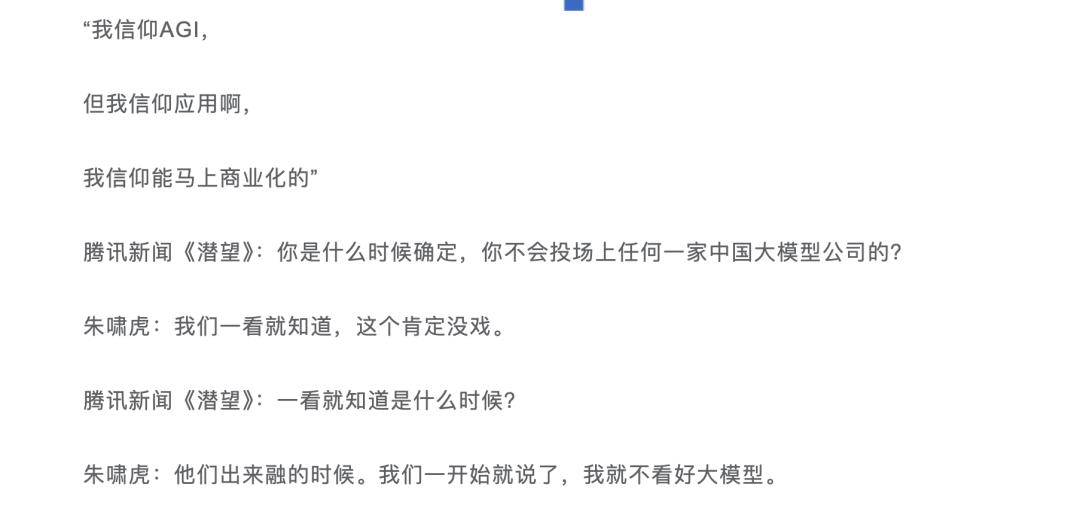
The interview content is from Tencent News' "Qianwang".
By August 2024, he made a judgment on the entire track:
"The best outcome for the 'Six Little Tigers' is to be sold to large companies."
Zhu Xiaohu himself didn't expect that the last page of this prophecy book would turn in December 2024.
In November of that year, old shareholders such as Jinshajiang during the period of Recurrent AI filed an arbitration against Yang Zhilin and Zhang Yutao in Hong Kong. The case involved starting Dark Side of the Moon and initiating financing without the consent of the old shareholders.
In December, Zhu Xiaohu himself stepped in, targeting Zhang Yutong, a former partner of Jinshajiang who later joined Dark Side of the Moon as a co - founder. He accused Zhang Yutong of holding a much larger share in Dark Side of the Moon than the parent company Recurrent AI, claiming that she "concealed and deceived" the fund LPs and Recurrent AI shareholders, violating her fiduciary duty, and thus was fired by Jinshajiang.

He was restrained in his words: He is willing to support young people's AGI dreams, but cannot tolerate moral violations.
Yang Zhilin countered: "Zhang Yutong is a co - founder, and her shares are vested over several years."
The dust of the arbitration case has not completely settled. But at that moment, the narrative of Dark Side of the Moon was forcibly shifted from "AGI startup star" to "defendant in an old - shareholder dispute". This was the heaviest blow Zhu Xiaohu dealt and his closest attempt to win.
The Market Doesn't Believe in Prophets
The capital market responded to that prophecy book in a way that Zhu Xiaohu probably doesn't like.
A valuation of $20 billion means that the current valuation/ARR multiple of Kimi is about 100 times. For reference, OpenAI's valuation/ARR multiple reached about 30 times in mid - 2025, and as its ARR soared to over $25 billion in early 2026, the multiple has dropped to about 20 - 25 times.
The dozens of times difference is not all a bubble. It's a credit premium.
This can be seen from the capital camp in this round.
It's not surprising that Meituan Longzhu led the investment. This CVC led the investment in Dark Side of the Moon as early as the Pre - A round in 2023, and Wang Huiwen's connection has always been there. But contributing over $200 million on its own means that Meituan has been upgraded from an "old friend" to a "deep strategic shareholder". CPE Yuanfeng is also not a surprise. It is backed by insurance/state - owned mother funds, typical patient capital, which aligns perfectly with Yang Zhilin's words that "he's not in a hurry to go public".
The real news is China Mobile.
This is almost the first time that a central - state - owned enterprise directly holds shares in a leading large - model startup (if this round of financing is officially completed and delivered). What China Mobile brings to Dark Side of the Moon is not just the money itself. It's the priority access to computing power of Mobile Cloud, government - enterprise channels, compliance endorsement, and more importantly, being officially recognized as a "front - line player in Chinese AI".
Horizontally compared, which lineup is this most similar to?
It's not like Zhipu (with local state - owned capital from Beijing, Shanghai, Hangzhou, Chengdu, and Zhuhai + diversified capital such as Hillhouse). It's not like MiniMax, which is deeply involved by Shanghai State - owned Investment but also supported by Alibaba, Tencent, IDG, and the Abu Dhabi Investment Authority. It's even less like DeepSeek, which is solely funded by Magic Square and Liang Wenfeng holds over 84% of the shares. In this round, Dark Side of the Moon is backed by a central - state - owned enterprise + CVC + patient capital. For the first time, industrial capabilities, policy resources, and long - term capital, the three most scarce types of capital, appear in the same shareholder list.
But you can't say that the "national team" is the only winning strategy.
The existence of DeepSeek itself is a counter - argument. This company has zero external financing, zero VC, and zero national - team support. It is purely funded by Magic Square Quantitative, and Liang Wenfeng directly and indirectly holds over 84% of the shares. In early 2025, the R1 model shocked the entire market with less than 1/10 of the industry's cost. At the end of 2025, the V3 model caused a stir in Silicon Valley. It has no Meituan, no China Mobile, no CPE Yuanfeng, no Zhu Xiaohu, and nothing. It just proves another logic: When technological power is pushed to the extreme, the capital structure itself can be redefined.
On the other hand, Manus actually shows another possibility. Butterfly Technology doesn't develop basic models but general AI agents. By "wrapping" existing models, it has achieved task - execution capabilities that surprised Silicon Valley. It doesn't burn GPU cards or train base models, but has received a much higher user - payment willingness than most large - model companies.
But you can't say that Zhu Xiaohu is wrong.
On the day the term "Six Little Tigers" was coined, there were at least six companies in the race: Baichuan, Lingyi, Dark Side of the Moon, Zhipu, MiniMax, and Jieyue. After two years, Baichuan and Lingyi have basically withdrawn from the basic large - model field, leaving only four on the table. Zhu Xiaohu did win the bet on the business - model level: Most independent large - model companies really can't survive.
He did miss a few variables, though.
The Missed Variables
Zhu Xiaohu didn't misjudge Kimi. He is implementing a self - consistent VC philosophy, which has once established his position in the Chinese VC industry.
The core of that philosophy is PMF: Focus on the business model, aim for a return on investment within 18 months, and take advantage of the "pioneer's disadvantage". It emerged from the era of Chinese Internet consumption and has been repeatedly verified by Didi, Ele.me, ofo, and Xiaohongshu. This is not a wrong philosophy; it's a philosophy designed for another era.
In March 2025, Zhu Xiaohu officially announced that he was "withdrawing from humanoid - robot companies in batches". Many people misinterpreted this news as "a judgment on humanoid robots", but in fact, it's a self - reaffirmation of this philosophy: Don't invest in long - cycle, money - burning, and industries without a clear business model. This is his unchanged bottom - line persona for twenty years.
However, the capital camp of Dark Side of the Moon in this round represents another philosophy.
What's happening in 2026 is not about the victory or defeat of a single company. It's that the AI track has entered the era of "stratified competition". At the bottom, DeepSeek is demonstrating technological power, using the money of Magic Square and Liang Wenfeng's ambition to prove that China can develop a globally top - level base model. In the middle, Kimi is collaborating with the national team for large - scale development, using a $20 - billion valuation and tens of billions in cash to prove that "independent large models" can obtain unprecedented resources in the national narrative.
Zhu Xiaohu is still calculating. The WeChat Moment about withdrawing from humanoid - robot companies in batches proves that he has never stopped calculating. His attitude towards DeepSeek changed 180 degrees at the end of 2025: "I will definitely invest!" He didn't stick to old ways.
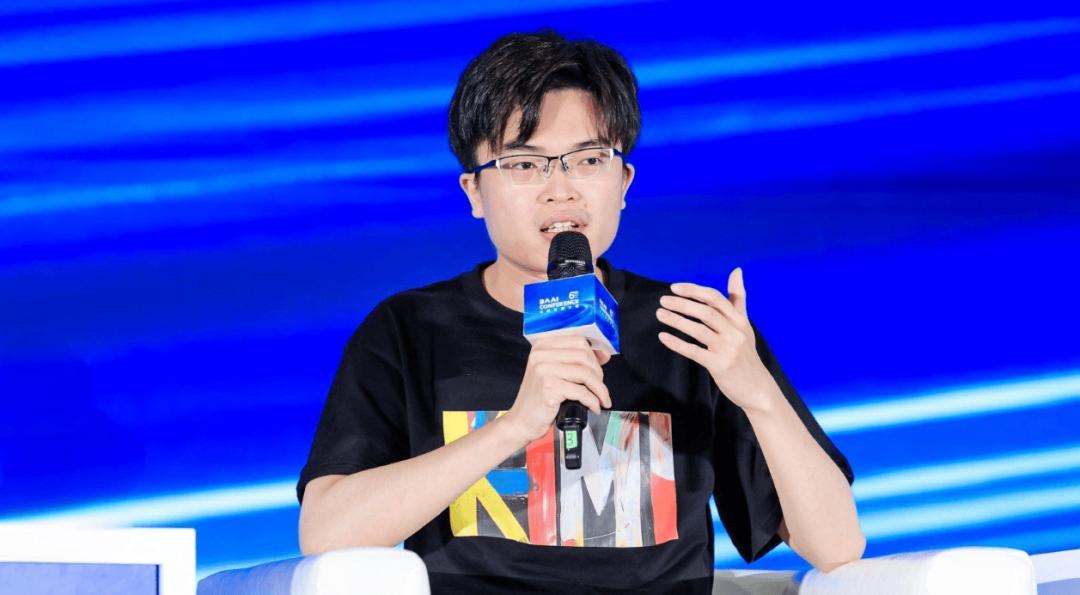
The $2 billion for Dark Side of the Moon is not just for Yang Zhilin. It's a necessary deposit for "China's AI must have its own front - line players" and a market guarantee for "independent large - model companies can avoid being sold".
The prophecies about large models are far from being written.
It has just turned to the next chapter. In this chapter, four forces are playing simultaneously: Zhu Xiaohu's PMF, China Mobile's central - state - owned enterprise credit, DeepSeek's technological power, and Manus's Agent monetization. It's too early to conclude who will reach the end. But one thing is certain: The judgment that "independent large models have no future" was temporarily disproven on May 6, 2026, by the $20 - billion valuation. As for how long this disproof can last, it depends on whether Yang Zhilin can turn the $200 million in ARR into $2 billion before burning through the tens of billions in cash on the balance sheet.
This article is from the WeChat official account "Xiangxianzhi", written by Aka and published by 36Kr with authorization.