In the auto market in April, who feasts on the meat and who sips the soup?
As the spotlight at the 2026 Beijing Auto Show begins to fade, on the other side of the hustle and bustle lies an extreme imbalance between the hot and the cold.
This is the best of times and the cruelest of times. At the beginning of May, the new car - making forces and traditional giants submitted their latest monthly reports. Leapmotor broke through the ceiling of the segmented market with a delivery volume of 71,400 units. However, NIO, once a leading player, was not only squeezed out of the club with a monthly sales volume of 30,000 units but also surpassed by Xiaomi, which made a late - comer's counterattack.
The market no longer believes in tears but only in real orders. If the keyword in 2025 was struggling to survive, then the theme in 2026 has evolved into a brutal battle for survival. In this round of reshuffle, the iron fist of the Matthew effect is precisely hitting every vulnerable competitor.
In the qualifying race of the final round, no one is absolutely safe.
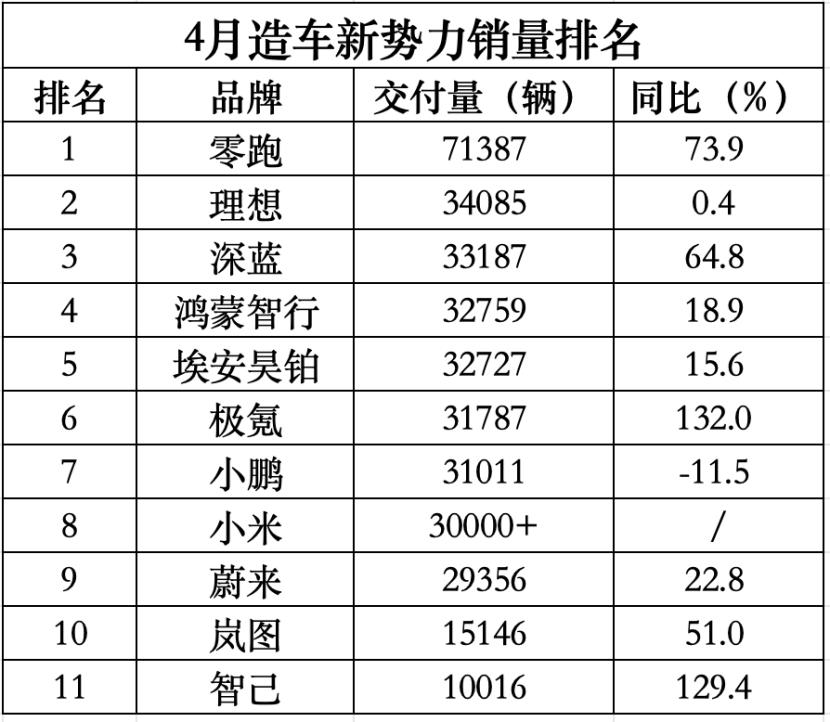
01 The Rise of a New King and the "Close - Range Competition" in the Second Echelon
In the camp of new forces, there was a significant shift in the rankings in April.
The biggest winner is still Leapmotor. The Leapmotor, which once focused on cost - effectiveness and was called the "half - price Li Auto", delivered 71,387 units in April, a year - on - year increase of 73.9% and a month - on - month increase of 42.7%, setting a new historical high. Since March 2025, except for January this year, Leapmotor has been the monthly sales champion among new forces.
This latest monthly sales figure is equivalent to the sum of the monthly sales of Li Auto and NIO, and more than twice that of Li Auto. Zhu Jiangming's goal of annual sales of one million units was once questioned by the outside world as "pie in the sky" in the cold winter of the car market. However, according to the current growth momentum, achieving the goal seems within reach.
The sudden rise of Leapmotor is essentially the ultimate realization of the cost - effectiveness route. While competitors are still struggling about the premium on the configuration list, Leapmotor has proved with its C - series and B - series that in the price range below 200,000 yuan, whoever can maximize the comprehensive configuration can dominate the market. This is not only a victory for the product but also a verification of the vertical integration ability of the supply chain.
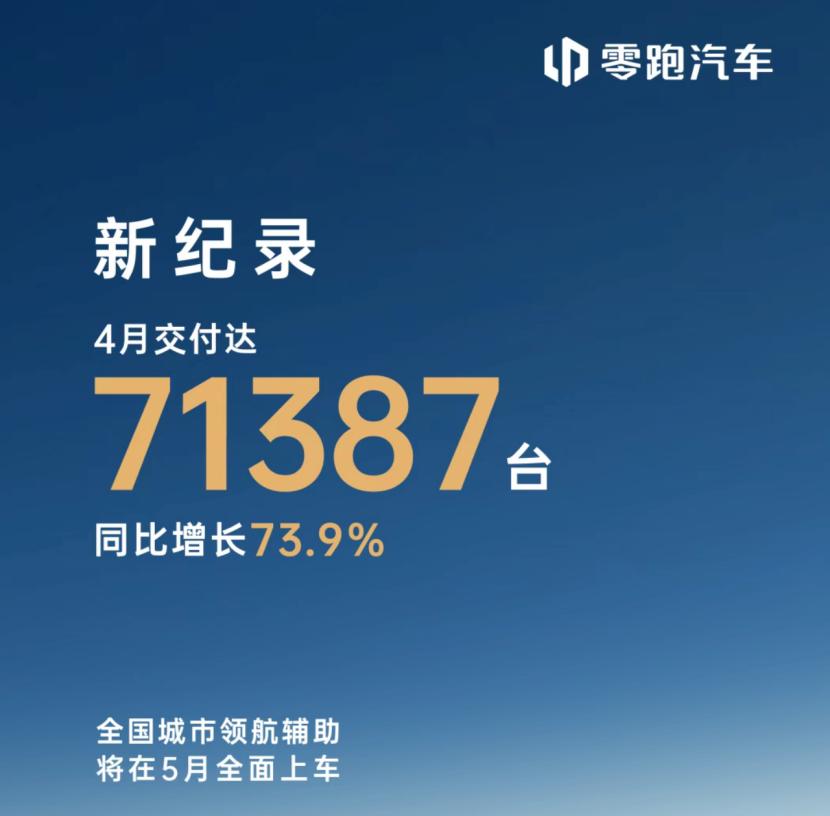
Image source: Leapmotor
Even more dramatic things happened in the second echelon, where the competition has become extremely intense.
Li Auto maintained the second - place position with a result of 34,085 units, but the nearly 17% month - on - month decline sounded an alarm. Although the L9 Livis attracted a lot of attention at the Beijing Auto Show, the upcoming May delivery will be a touchstone to test how deep the moat of the extended - range route can be.
The performance of Hongmeng Smart Mobility should not be underestimated either. It delivered 32,759 units in April, a year - on - year increase of 18.9% and a month - on - month increase of 23%. This is a signal that Hongmeng Smart Mobility has emerged from the trough of product replacement in the first quarter and entered a new growth cycle. Specifically, the pre - orders of the AITO M6 exceeded 10,000 in 15 minutes after its launch, the pre - orders of the Zhijie V9 exceeded 22,500 in 72 hours, and the pre - orders of the Shangjie Z7 exceeded 12,000 in 27 minutes.
It is worth noting that the sales performance of Hongmeng Smart Mobility reflects the influence of the Huawei ecosystem on the sales conversion of car companies. It consists of multiple cooperative brands internally and cannot be directly equated with the sales of a single car company. The industry generally believes that what is more worthy of attention in Hongmeng Smart Mobility is its intelligent ability, channel ability, and brand trust, which are becoming important variables in the high - end new - energy vehicle market.
XPeng Motors surpassed its former rival NIO in April with a result of 31,011 units. The increase in the sales of the MONA series has become the key for XPeng's counterattack. Although there was a slight year - on - year decline, the 13% month - on - month growth proves that its market - penetration strategy is still effective.
Xiaomi Auto delivered more than 30,000 units in April. When the new - generation SU7 was unveiled at the Beijing Auto Show, its huge traffic - siphoning effect demonstrated its remarkable strength to its competitors. In the current automotive industry, traffic has become one of the most important productive forces.
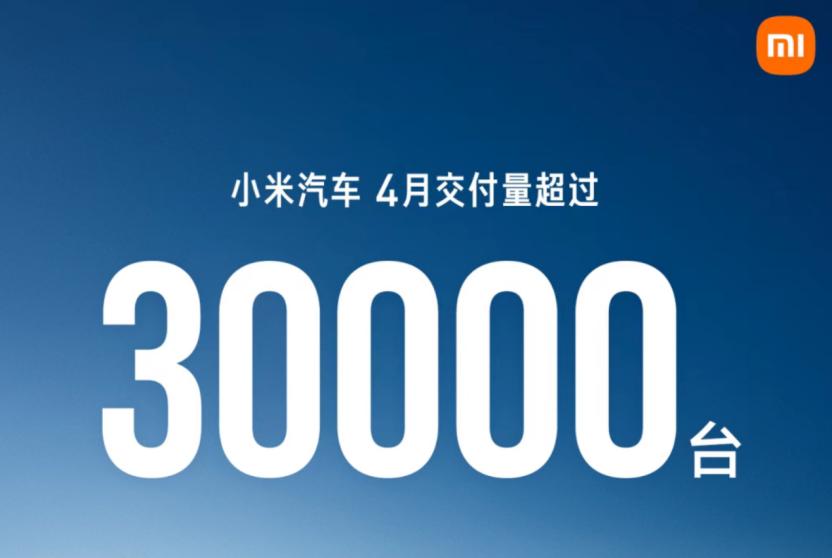
Image source: Xiaomi Auto
Meanwhile, there are also a group of players worthy of attention.
Deepal, backed by Changan, had a global sales volume of 33,187 units in April, a year - on - year increase of 64.8% and a month - on - month increase of 19.03% in overseas sales. Zeekr, under Geely, delivered 31,787 units, a year - on - year surge of 132%, setting a new historical high. The latest performance of these two brands shows that the "second - generation startups" incubated by traditional car companies are gradually becoming capable of competing head - on with internet - born new forces.
In addition, Voyah delivered 15,146 units, a year - on - year increase of 51%. IM Motors' sales exceeded 10,016 units, a month - on - month increase of 39.36%. Although there is still a gap between them and the front - runners, their growth rates prove that there is still room in the high - end new - energy vehicle track.
Perhaps the most regrettable is NIO. In April, the NIO Group (including LeDao and Firefly) only delivered 29,356 units, being surpassed by both XPeng and Xiaomi.
In the eyes of the outside world, the three - brand strategy did not produce the effect of "1 + 1+1 > 3" in April. The NIO brand delivered 19,024 units, LeDao 5,352 units, and Firefly 4,980 units. The total of the three brands is less than half of Leapmotor's sales.
Although Li Bin emphasized internally that the company's goal this year is to "achieve full - year profitability", with the 17% month - on - month decline in sales, the outside world still holds a cautious and wait - and - see attitude towards NIO.
02 The Overseas Battlefield: The New Growth Pole for Giants
Compared with the life - and - death struggles of new forces on the break - even line, traditional domestic brands such as BYD, Geely, and Changan are staging an arms race for "globalization".
BYD remains the ballast stone of the Chinese car market. In April, its total vehicle sales reached 321,123 units. Although in the domestic market, with the weakening of the stimulus effect of the honor edition, BYD's growth rate has slowed down, its real trump card lies in the overseas market. Its overseas sales of 134,542 units, a year - on - year increase of 70.9%, set a new historical high.
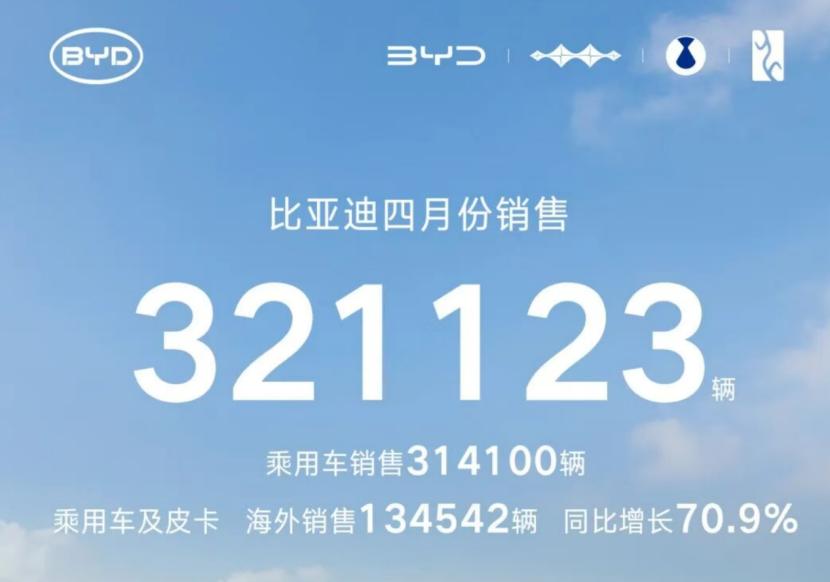
Image source: BYD
The increasing presence of BYD cars on the streets of Europe and Southeast Asia marks that China's automobile exports have shifted from selling low - cost cars to brand - oriented overseas expansion.
Chery is an underestimated hidden champion. Although it is not as well - known as new forces in the domestic market, out of Chery Group's 251,386 units of sales in April, exports accounted for an astonishing 177,573 units, a year - on - year increase of 102.4%.
This situation of "blooming outside while being less noticed at home" gives Chery a solid moat in this involution. However, it should be noted that if the export part is excluded, its cumulative domestic sales are only a little over 70,000 units, and the domestic demand market still faces considerable pressure.
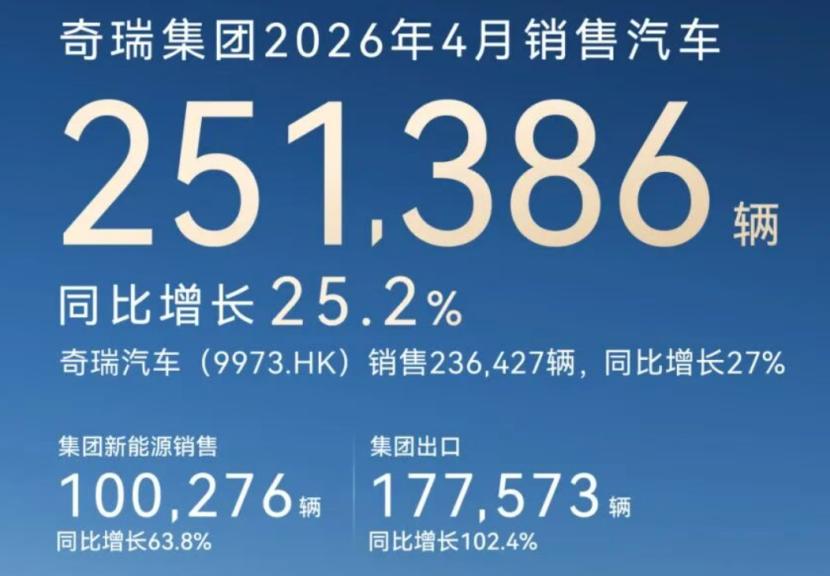
Image source: Chery
Geely shows strong resilience. Its sales in April were about 235,000 units, and its overseas exports were 83,186 units, a year - on - year surge of 245%. Geely's strategic advantage lies in "precise positioning with multiple brands": Lynk & Co is responsible for the profits of plug - in hybrids, Zeekr is responsible for the pure - electric brand image, and Geely Galaxy competes closely with BYD in the low - end market.
Changan Automobile followed closely, with sales of 209,500 units in April. Among them, overseas deliveries were 72,700 units, a year - on - year increase of 69.9%, and new - energy vehicle deliveries were 94,200 units, a year - on - year increase of 32.2%.
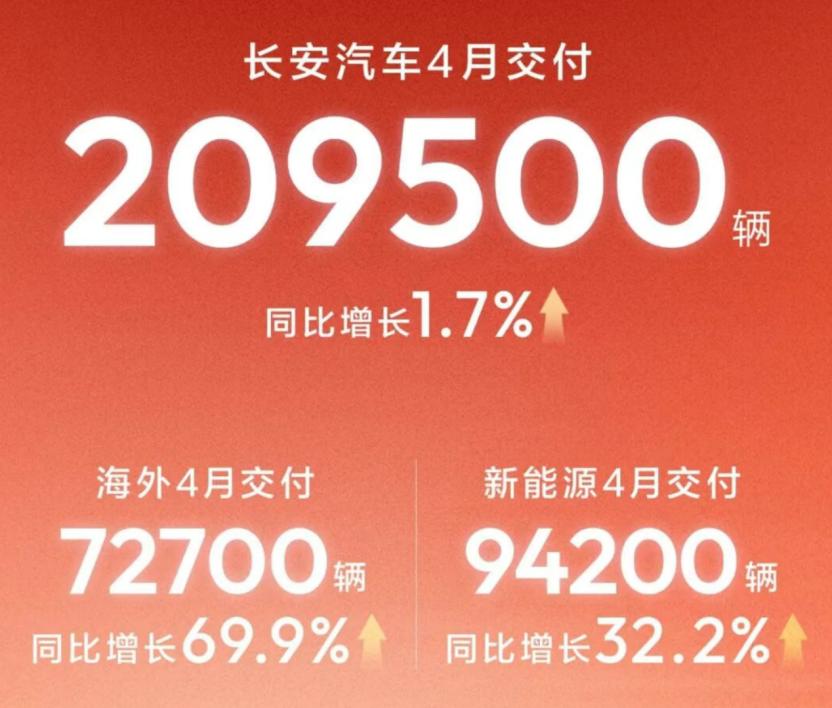
Image source: Changan
Looking through the report card of April 2026, beyond the cold sales figures, the deeper change lies in the iteration of the competition logic.
Currently, the market is bidding farewell to simple policy dependence. Data from the China Automobile Dealers Association shows that the dealer inventory warning index in April was as high as 62.1%, a month - on - month increase of 4.6 percentage points. This may indicate from the side that the growth of some brands is actually achieved through inventory pressure.
As the marginal effect of the trade - in policies in various regions decreases, inventory reduction may become the Damocles' sword hanging over the heads of major brands in the second half of the second quarter.
In addition, the focus of competition has been upgraded from the configuration war to the public - opinion war. At the Beijing Auto Show, Li Xiang publicly commented on the Volkswagen booth, and Lei Jun's interactions with executives of various car companies all indicate that in 2026, the traffic - distribution ability will continue to have a profound impact on the sales conversion rate.
It is undeniable that the losers in the elimination round are emerging. The Matthew effect means that the strong will become stronger. When brands such as Leapmotor, Zeekr, and Deepal have built a strong fire, for those brands still struggling around the 10,000 - unit survival line, the time window is closing.
Whether it is the lessons of WM Motor and HiPhi or the disappearance of some joint - venture brands, they all serve as warnings that this is a marathon with no end. A monthly sales volume of 70,000 units today does not mean safety tomorrow, and a current sales volume of less than 30,000 units is by no means the end of the story. Having cash reserves and in - depth technology may be the only safety cushion for major car companies.
This article is from the WeChat official account "Phoenix Finance", author: Company Research Institute. Republished by 36Kr with permission.