Early-stage Projects | Engineers from the German Aerospace Center Start a Business, Ushering in the "Vibe Era" for Hardware Development
"Traditional industrial software is too difficult to use."
This is the common feeling of Ji Yang, the founder of Orthogonal, and a large number of his industrial peers.
"In the AI era, software development can already use Cursor for vibe coding, while hardware design still remains in the primitive age," Ji Yang said in an interview with Yingke. He pointed out that the giants like Dassault and ANSYS have built a "high wall" made up of high licensing fees and a very steep learning curve. What Orthogonal wants to do is to bring the 'vibe' approach into hardware development.
Ji Yang, the founder of Orthogonal, has been deeply involved in the German Aerospace Center (DLR) and the industrial field for nearly two decades. He participated in the R & D of the core functions of Dassault Systemes' simulation tools, led the R & D of the electrical system of the Airbus A350 wide - body airliner, and played leading or key roles in cooperation projects of global well - known enterprises such as KUKA, BMW, Siemens high - speed trains, Commercial Aircraft Corporation of China, Huawei, and Aero Engine Corporation of China. In 2023, he was awarded the honorary title of "TUM Ambassador" by the Technical University of Munich for his contributions in the fields of scientific research and entrepreneurship.
In his view, AI not only brings a simple improvement in efficiency but also an opportunity to reconstruct the paradigm of industrial software. The complexity of traditional tools has become a bottleneck for the development of the industry.
"In the AI era, the scale of intelligent hardware companies is getting smaller and smaller. One person often needs to master skills in multiple fields. For 95% of small and medium - sized enterprises with innovation needs and individual enthusiasts, traditional industrial software is simply unaffordable and difficult to use. What ODE is doing is to be the 'Dassault' in the AI era - but it serves not only top - notch engineers but also everyone who wants to create things," Ji Yang said.
Orthogonal's core product, ODE (Orthogonal Design Engineering), is an AI Native cloud - based hardware development platform. It integrates the entire hardware development process from industrial design, structural analysis, thermal simulation, circuit design, 3D printing to manufacturing into the same platform. Users no longer need to switch between multiple tools and do not need to have a profound engineering background. Instead, they can directly express their needs through natural language, and the AI will automatically disassemble the engineering logic, perform modeling, simulation, and iterative optimization to complete the development of complex hardware products.
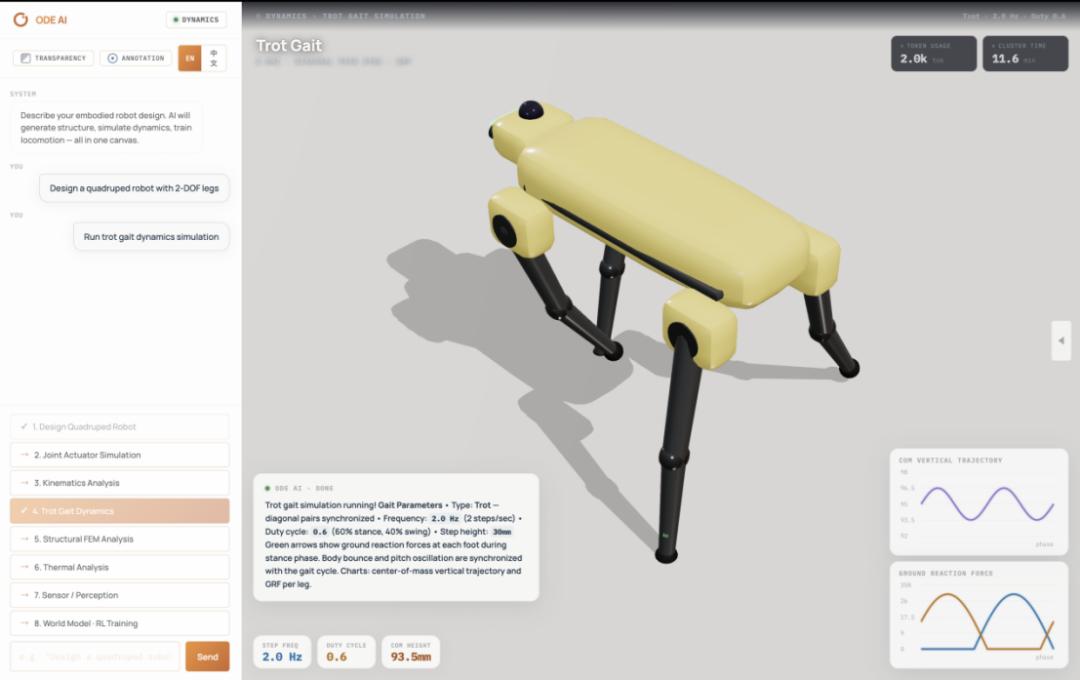
Demo of designing a quadruped robot using natural language (Source/Enterprise)
The key of ODE is not "using AI to generate models" but making AI truly "understand" the underlying engineering logic.
In terms of architecture, ODE is connected to large language models at the bottom layer. More importantly, it has a multi - physical field data engine and a computing engine behind it - which are of the same type of underlying capabilities as those used in traditional industrial software. The difference is that in the past, engineers manually wrote equations and built models, while now AI understands these physical equations and automatically generates and calls them.
Its underlying multi - physical field unified modeling language and solver are based on the same set of technical specifications followed by giants such as DLR and Dassault Systemes. The Orthogonal team has reconstructed and deeply optimized them with a cloud - native architecture. This enables ODE to achieve a performance that is 5 - 10 times that of traditional top - level tools in many core simulation tasks.
"Users only need to give a prompt like 'Help me design a high - speed motor', and the system can automatically generate the corresponding mathematical model and structural model, and further simulate its operating state, such as temperature distribution and rotor behavior," Ji Yang introduced.
To ensure that the generated models are solvable at the physical level, ODE provides two sets of operation interfaces at the same time, one is the AI interaction interface, and the other is the engineer debugging interface. This means that even if the AI makes a deviation, engineers can still take over and correct it to ensure the reliability of the results.
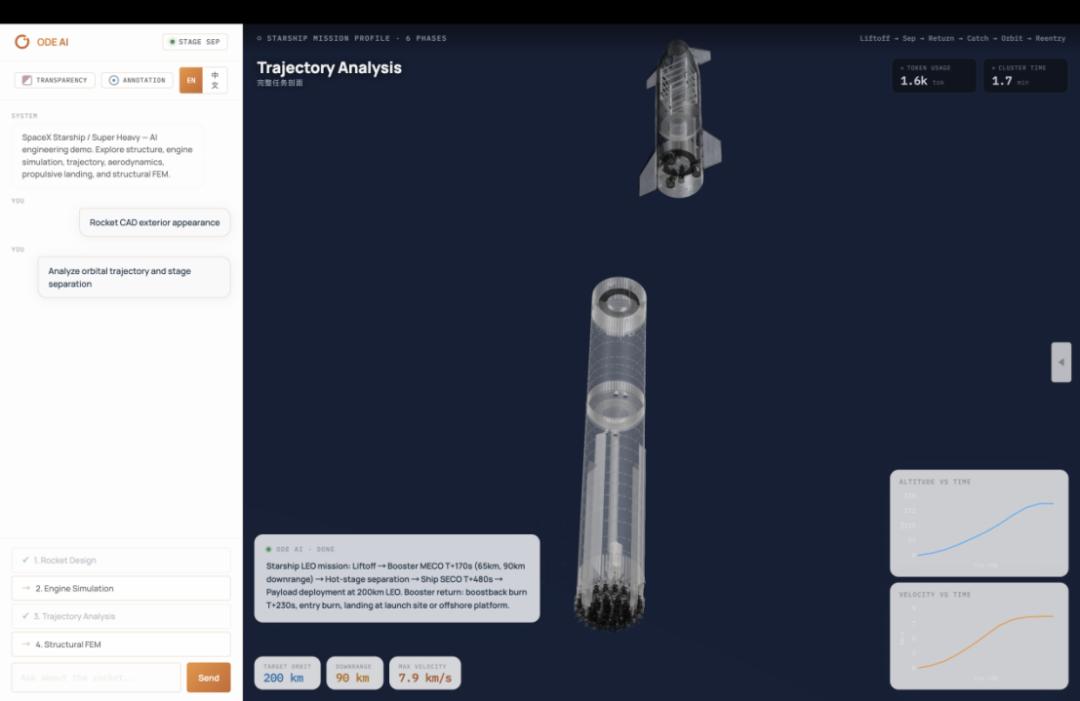
Demo of designing a reusable rocket using natural language (Source/Enterprise)
In terms of business model, traditional industrial software usually adopts the high - price License model, with licensing fees often reaching tens of thousands of dollars a year. However, the basic subscription price of Orthogonal is very low, and subsequent charges will be based on the tokens and computing power consumed in actual use. Ji Yang said that in the AI era, software is essentially no longer "selling tools" but "selling results" and "delivering capabilities." This model means a subversion of the existing business logic for traditional manufacturers and also constitutes a huge resistance to their transformation.
Before ODE was fully mature, universities in Germany, the United States and other places had introduced it into teaching. Since its official launch in October 2025, ODE has accumulated 40 to 50 iconic customers with almost zero market promotion. The early customers are mainly from Europe, including not only well - known institutions such as the European Space Agency (ESA), the German Aerospace Center (DLR), and Volkswagen in Germany, but also hidden champions such as Bühler Motor and Gemü Group.
Ji Yang said that in the next one to two years, Orthogonal hopes to connect the complete link from design to manufacturing and further strengthen the capabilities of AI Agents so that they can automatically call various tools to complete the entire development process of complex hardware products. In an ideal state, users only need to put forward their requirements in a single conversation, and the system can automatically complete the whole process from conceptual design to product implementation.
In terms of financing, it is understood that Orthogonal's angel round was invested by Fengwu Capital, and Linear Capital and Yunqi Capital participated in subsequent rounds of investment. Duowei Capital served as the exclusive financial advisor for the new round of financing.