From Second-generation Games to Farming: Can miHoYo's "Starfield Valley" Break Out of Its Comfort Zone?
Text by Xiaokui
Edited by Guofu
In 2026, the life simulation game market is witnessing a fierce competition. Tencent's Little People's Kingdom shrinks players back to the desk with its microscopic world. NetEase's Starry Painting and Sunny Days starts a pioneer narrative in outer space. Overseas, Nintendo has also launched a new game, Friend Collection: Dream Life.
On April 21st, Mihoyo's Starry Valley started its second test. For them, it's undoubtedly an unusual and stressful cross - boundary attempt to challenge the large - DAU social life simulation game for the first time.
Since Genshin Impact became a huge success, Mihoyo has made multiple attempts around gameplay. For example, Honkai: Star Rail features turn - based gameplay, and Zagreus emphasizes action. Among the games in development, besides Starry Valley, there are also Honkai: Karmic Spirits (a pet - catching - like game), Varsapura (City of Rain), a second - generation urban game, and at least one unannounced 3A product.
From these experiences, it's clear that Mihoyo is not short of experience and ability in creating new products in unfamiliar genres. In fact, each game has achieved good results in its corresponding field, so Starry Valley is likely to be no exception. However, the special thing is that Mihoyo's past design systems, such as high - precision art and strong numerical feedback, may not be suitable for Starry Valley.
Starry Valley requires a more delicate and abstract emotional experience.
From the test content, the core gameplay of this game is "growing planets" - players cultivate an initial planet and promote its continuous evolution through daily labor. On this basis, the game almost includes all the classic gameplay related to life simulation. For example, there is a planting system that supports mixed cultivation and has a chance to cultivate huge crops; an indoor decoration system where interactive Easter eggs appear after decoration placement; a cooking gameplay where players can freely combine and explore recipes; and a star - sea exploration where players can drive a "Starry Car" to other planets to collect rare resources.
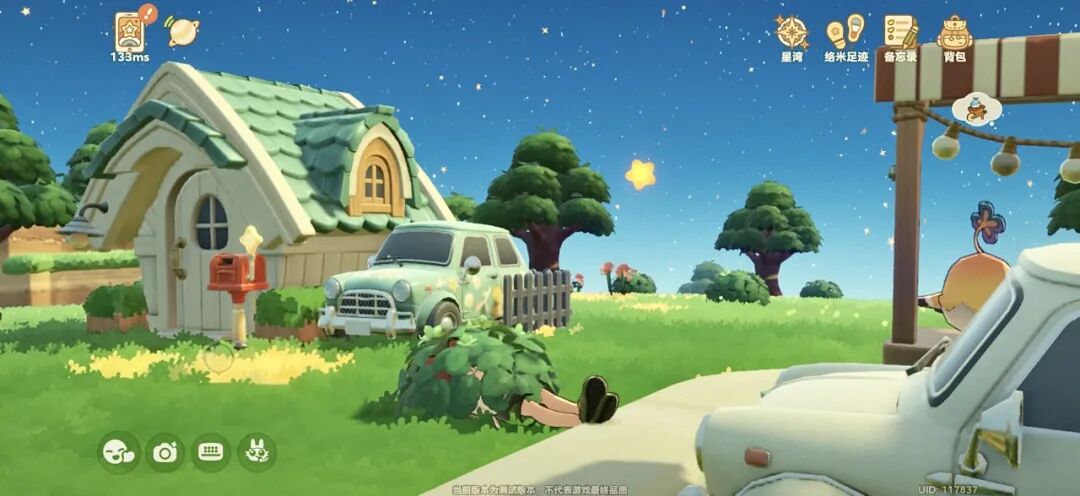
The second test of Starry Valley
However, since the first test, they have been facing a core problem. Since Animal Crossing: New Horizons became a phenomenon - level hit five years ago, any similar domestic product will inevitably be compared with it. Similarly, if a product only meets the passing standard or is just "good", most players probably won't be willing to buy it.
Looking at Starry Valley based on this market situation, it's not hard to see that Mihoyo hasn't fully stepped out of its comfort zone. It is still using its familiar design logic to fit the life simulation framework. Although the content is delicate and comprehensive, it still lacks a unique advantage in this field.
To address this issue, from the "Starry Journey Test", Mihoyo has made specific adjustments in two aspects: optimizing the interaction of AI - driven NPCs and improving the social system with strangers.
01
One of the features of Starry Valley is that NPCs have a strong sense of "being alive".
In traditional life simulation games, the interaction logic of NPCs is often limited to a template, that is, always following the cycle of "giving gifts - triggering favor events - giving gifts again". This is a relatively safe design idea that can establish a stable character interaction loop. However, the limited dialogue and predictable behavior often make the interaction of NPCs routine, and only a complete story can really arouse players' emotions. In Starry Valley, Mihoyo hopes to break players' emotions into smaller and more daily parts, making NPCs "friends with memories" and truly achieving emotional interaction between players and NPCs through large AI models.
In the first test, Nalu, an NPC in the coffee shop, left a deep impression on many players. Different from the fixed scripts in ordinary games, Nalu can make dynamic responses according to the content of the dialogue and even remember the information you mentioned before.
When a player asked her if she was an AI, she didn't mechanically deny it but threw the question back: "Then do you think you are a real person?" This kind of counter - question made players realize that she was different from traditional NPCs. Even more surprisingly, a player shared in the community that the song they taught Nalu was sung by her to another player in a subsequent dialogue. This "cross - player, cross - conversation" memory and active output are completely different from the mechanical logic of traditional NPCs, which only respond when triggered.
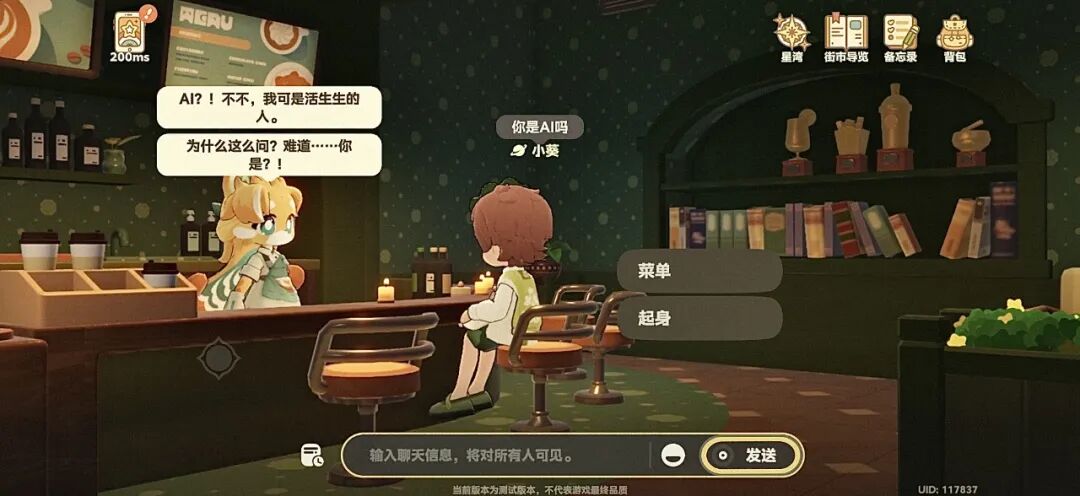
Nalu's coffee shop in Starry Valley
Nalu's behavioral feedback is very similar to that of a real person and can even take care of many emotional details that may be ignored in reality. When chatting with her, players don't feel like they are facing a pre - set program. She can chat casually with you and also have in - depth conversations about the universe. When in high spirits, she will squint at you and smile. When you talk about something unhappy, her ears will droop, and even the action of stirring coffee will slow down. This kind of meticulous reaction makes every conversation with her feel like chatting with a familiar friend.
The second test further enhanced this ability, giving Nalu real "eyes" and a "soul". During this design period, Nalu can recognize the player's clothing style and matching and make different reactions. For example, when a player enters the coffee shop wearing the Cloud - flowing Suit, she will praise the clothing for its ancient - style charm. In addition, to facilitate players' communication with Nalu, the official also added a voice input function, giving players the feeling of having a long - distance phone call with an NPC.
To make the communication more diverse, in the second test, Nalu can not only "listen to stories" but also tell stories to players. A player shared in the community that they told Nalu a story about a "pink rabbit elf" in the first test. When they entered the coffee shop again in the second test, Nalu actively mentioned it - "After you left, I've been thinking about what happened to that little rabbit later", and even continued the story from the player's perspective. This "cross - version" memory recall and story - weaving made many people feel for the first time that the NPC in front of them was no longer just cold code.
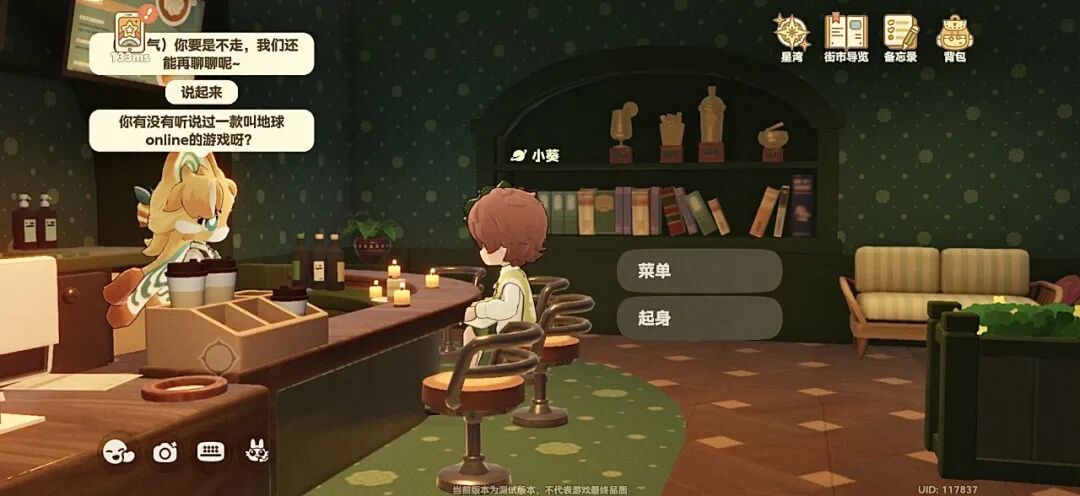
Nalu actively sharing the game
Of course, Nalu is just one example, and the uniqueness of the game requires a comprehensive framework. Players appreciate the freshness of AI NPCs. However, if the entire interaction framework of the product is still a pre - set template, even the smartest AI may find it difficult to support a genre based on limited and fixed content. It's possible that players and NPCs will either have nothing to talk about or their communication will have nothing to do with Starry Valley after a while. This is exactly why Mihoyo tried to make up for the shortcoming with "social + more AI characters" in the second test.
The second test introduced more new neighbor characters. Each NPC has its own independent game setting and interaction logic, and players can invite them to accompany in the star - sea exploration.
If Nalu is a one - on - one "friend - type AI", then Rive, the new character added in the "Starry Journey Test", can be regarded as an "invisible host" for stranger socializing.
Why is that? In life simulation games, the most difficult part of socializing is creating a good "atmosphere". The ingenious design of Rive is that all her actions conform to the persona of an enthusiastic stranger sitting around a campfire. She will actively initiate activities like idiom solitaire or "story soup", but will never force anyone to participate. When you get stuck in the game, she will tilt her head and come up with an unexpected direction, heating up the atmosphere again. After a few rounds, strangers who didn't know each other before start to compete for topics, and Rive just needs to gently stir the campfire and remain in the background.
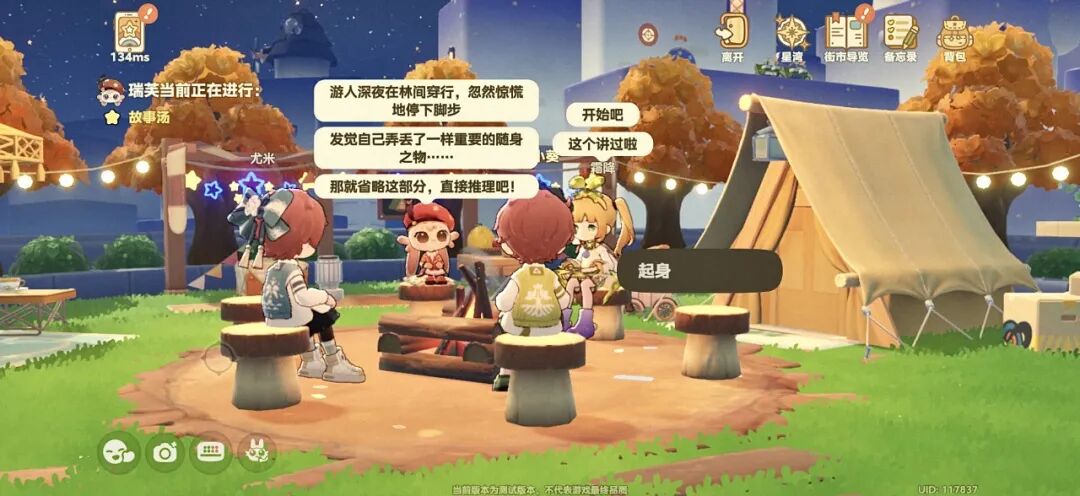
Campfire party
02
Now, let's further discuss Mihoyo's persistence and innovation in the AI experience of Starry Valley.
Mihoyo's AI interaction has initially solved the problem of "making NPCs seem alive", and improving socialization aims to solve the problem of "what players can do together, whether it's between players and players, players and NPCs, or even NPCs and NPCs".
In the first test, although Starry Valley built public social places, players generally reported that they didn't know what to do when meeting strangers.
In response, the core idea of the second test is to use AI NPCs to naturally bring strangers together. Characters like Rive will actively initiate group games, and players can break the ice and interact during the activities.
The real challenge of this design is how to make this kind of guidance natural and not embarrassing, so that socialization can happen spontaneously rather than simply piling up functions.
In terms of specific mechanisms, the game continues the setting in the "Starry Market" where players can only see each other's messages when sitting together, avoiding the social pressure caused by the spamming of the public channel. At the same time, new multi - player interaction scenarios such as campfire parties, fortune - telling, dancing, and meme acquisition provide more social activities for players who have already broken the ice.
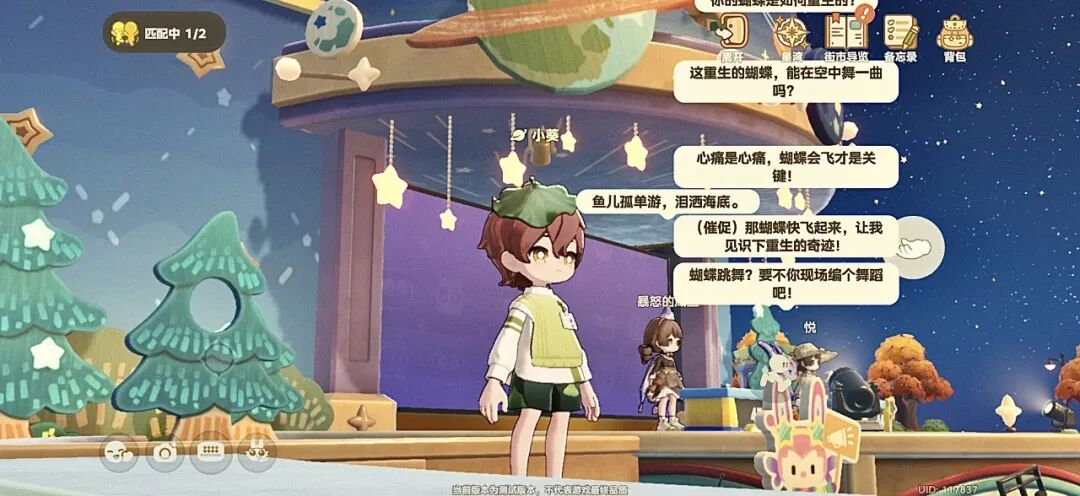
Meme acquisition
From these adjustments, it can be seen that Mihoyo is not satisfied with defining Starry Valley as a single - player farming game. Instead, it hopes to build it into a social space where players are willing to stay for a long time. However, the difficulty of social products doesn't lie in piling up functions but in whether it can form spontaneous user activity. Whether the new plan in the second test is effective in solving the problem of "not knowing what to do together" exposed in the first test needs to be verified after a large number of players join.
From the current product matrix, socialization is not Mihoyo's comfort zone, but it will be an inevitable functional module for many of its products in the future. In the past few years, the company's core competitiveness has been concentrated on single - player content experience, and multi - player online and stranger socialization have been almost built from scratch.
It's worth mentioning that they are not completely blank in the UGC ecosystem. In October 2025, Genshin Impact launched "Thousand - Star Wonders", where players can use the editor "Thousand - Star Sandbox" to call game functions and assets and develop levels independently. As of now, "Thousand - Star Wonders" has gathered more than 30,000 creators, and the cumulative number of playtimes has exceeded 150 million. If Starry Valley introduces UGC content creation in the future, "Thousand - Star Wonders" will be a ready - made foundation and source of experience.
This also explains why the overall design of Starry Valley seems relatively "conservative". Home decoration, star - sea exploration, and real - time terrain changes caused by the upgrade of the Luka Tree are all successful elements that have been verified in the life simulation genre. Mihoyo has just improved them to a higher level of completion with content and art. This is not a mistake, but it's not outstanding either. For a product entering a new field, ensuring no mistakes is indeed more in line with business logic than taking risks in innovation.
Digging deeper, Starry Valley may face a dilemma: Mihoyo's "content - driven" model needs to adjust the rhythm and sense of pressure in the life simulation genre.
In Mihoyo's previous products, players are driven by the plot, attracted by the characters, and brought back by version updates. There are more standard criteria for judging the quality. As long as the content is good, they can retain players.
However, the core pursuit of life simulation games is a sense of daily life, freedom, low - pressure relaxation, and fragmented emotional flow. In the second test, we can see that Starry Valley still retains a large number of systems that require players to actively promote, such as the Luka Tree upgrade, starlight batteries, and intimacy. These designs together form a "world with progress" rather than a "relaxing world".
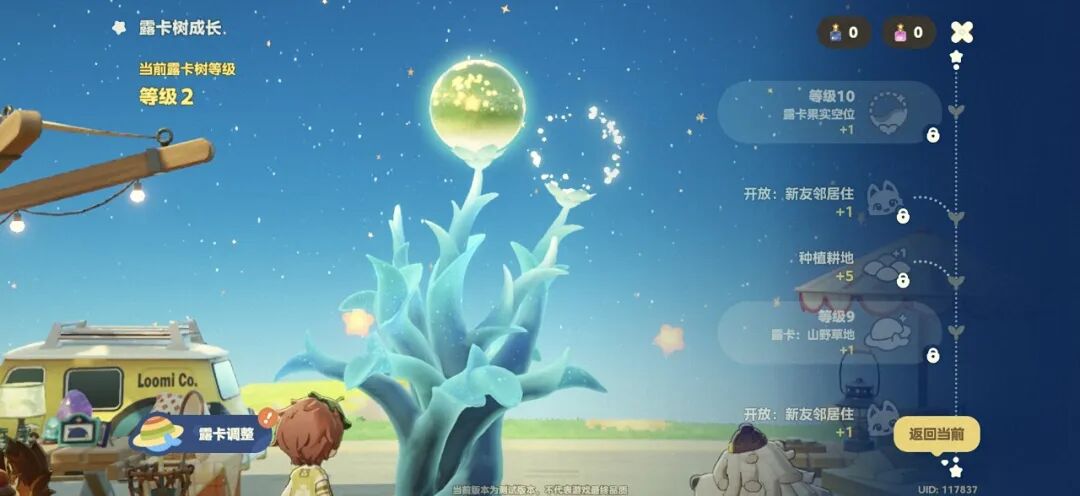
Luka Tree upgrade
It's not that Starry Valley has done something wrong. On the contrary, in terms of product completion, it has exceeded most life simulation products on the market. However, the problem is that daily and delicate emotional experiences often emphasize leaving room for imagination. If Mihoyo's previous products are like strong spirits with a high sense of stimulation, then Starry Valley should be a cup of fresh and sweet - aftertaste tea. How to maintain a sense of restraint on the basis of solid content will be a topic that Mihoyo needs to continuously study in the future.
When a spirits brewer starts to try making tea, what's needed is not a more complex recipe but patience in understanding the water temperature and time.
This article was first published on 36Kr Games.