Artificial intelligence is turning creativity into the "average level of the masses".
God Translation Bureau is a compilation team under 36Kr, focusing on fields such as technology, business, the workplace, and life, and mainly introducing new technologies, new ideas, and new trends from abroad.
Editor's note: AI is producing a vast amount of clean, well - structured, and increasingly similar content, which is gradually eroding human independent and original thinking. This article is from a compilation, hoping to inspire you.
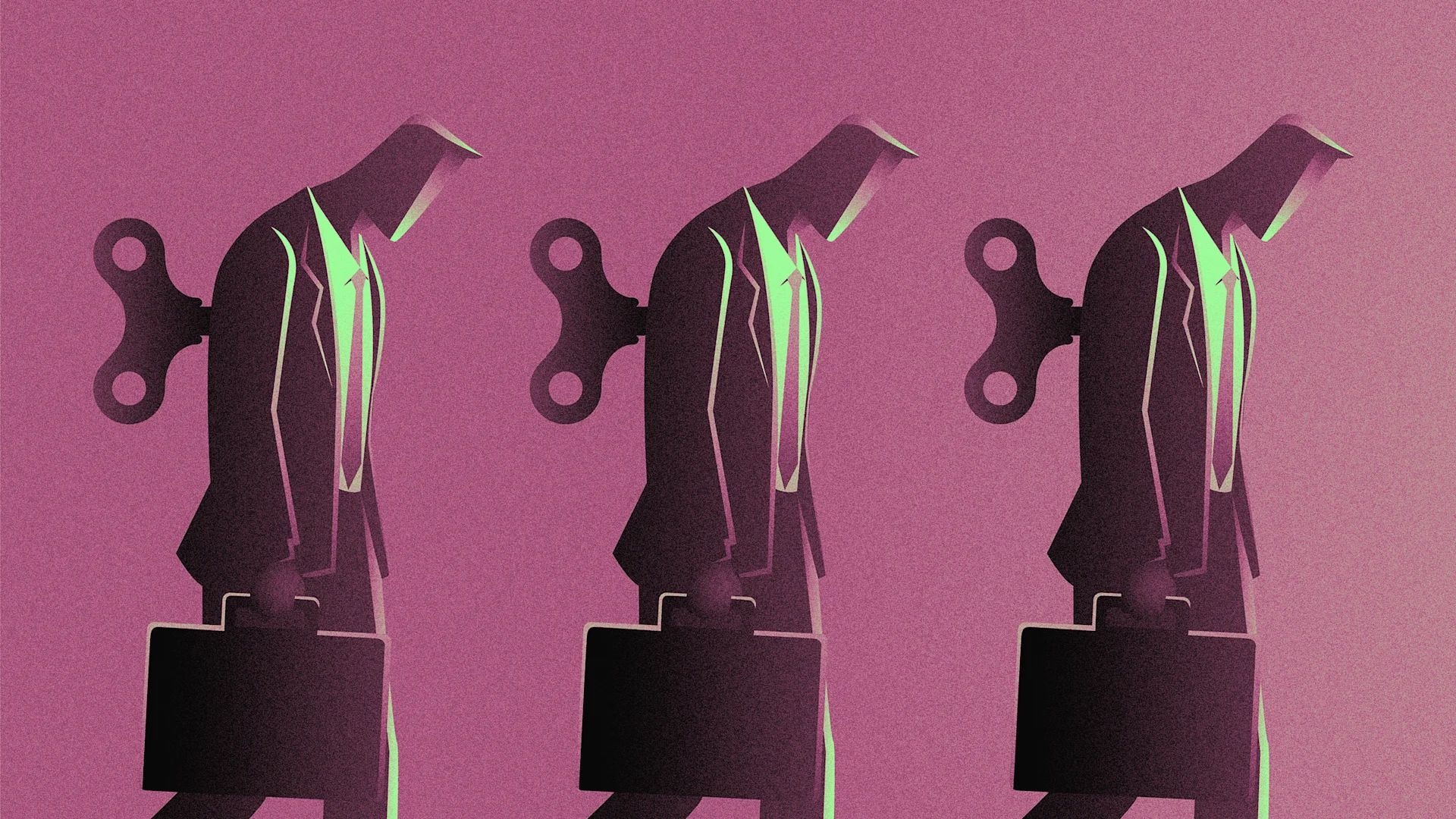
Image source: Getty Images
In the past year, a quiet change has been taking place on the Internet: more and more news and content generated by AI have occupied the major search result pages. These contents are flawless, well - written, and well - structured, but they always seem stereotyped and the same no matter who writes them.
Recently, an analysis by NewsGuard found that there are currently more than 1,000 AI mass - content factories producing articles on a large scale. Most of these articles have no on - the - spot interviews, no personal opinions, and no unique writing styles. The information is complete, but the most crucial thing is missing - independent stance and personal perspective.
This leads to a deeper question: If everyone uses the same model and trains on the same data to generate ideas, where does originality go? We haven't lost information; what we've lost is uniqueness.
The "mediocrity of standard answers" is spreading
AI is best at recognizing patterns, which is both its advantage and its greatest limitation. Since it has no real - life experiences, all its content is pieced together from existing data, just repeating what others have said, written, and been recognized for.
Naturally, AI will only tend towards the safest, most conventional, and error - free middle - of - the - road approach, which is the average level of the public.
A study from Stanford University shows that even if you deliberately ask AI to write something new, its answers will always cluster within the conventional patterns. A related study in the journal Science also points out that although AI can improve work efficiency, it will make group thinking more and more similar, and the difference in thinking will become smaller and smaller.
This is the paradox of AI: It allows everyone to easily access various ideas, but it also compresses the boundaries of diverse thinking. It not only magnifies intelligence but also magnifies the average level of mediocrity.
Culture is polished through collision, not built on efficiency
Human civilization and culture have never been built on the "average level". Its progress stems from the collision of views, the conflict of ideas, and the friction and adaptation between different worldviews.
Sociologist Richard Florida has always believed that an environment where diverse views intersect is the most likely to give birth to innovation. Linda Hill's research on "creative collisions" also shows that breakthrough ideas never come from smoothing out differences but from facing up to disagreements and having in - depth exchanges.
True valuable breakthroughs never come from optimizing existing models to the extreme. Instead, they come from the cross - border integration of seemingly unrelated fields: design and technology, stories and data, art and strategy. This kind of integration does not rely on efficiency but on human unique perception and integration ability.
Everyone is quietly becoming homogeneous
The real risk of AI is not to completely replace creativity but to compress creativity into rigid and predictable templates.
Now we can clearly feel that the writing styles on major platforms are becoming more and more similar. The writing is delicate and the structure is well - organized, but it's getting harder and harder to tell who wrote it. The tones of brand copywriting are becoming similar, and workplace strategic thinking also starts to follow the same set of frameworks and terminologies.
A research analysis in Science Advances found that although AI - assisted writing is smoother and has fewer errors, it weakens language diversity and personal style. The surface of the text has improved, but the temperament, flavor, and soul in the text are gone, and the meaning is precisely hidden in these unique textures. In the long run, it will cause deeper consequences: cultural degradation and ossification. If managers and creators not only hand over execution to AI but also outsource their thinking directly, the core of human thought will be gradually eroded.
The process of inner struggle necessary for polishing inspiration, the pondering in the face of ambiguity and the unknown, and the process of gradually forming insights in confusion are slowly disappearing. Cognitive science has long confirmed that deep and strenuous thinking is the source of original insights. Psychologist Daniel Kahneman calls this the difference between fast thinking and slow thinking. If we directly apply the ready - made answers from AI as soon as we encounter a problem, we skip the in - depth thinking process of incubating novel ideas.
Without the collision of thinking, originality will weaken; without originality, all decisions and creativity will become mere imitation. This is not just a problem at the creative level but also a major issue related to long - term strategy. In the future, the winners will not be those who can produce the most ideas, but those who can give meaning to ideas, make cross - border connections, tolerate contradictions, and see patterns that others can't.
The way out: Build multi - dimensional thinking ability
As a workplace strategy and leadership consultant, I've found that truly influential leaders never use only a single thinking mode but can flexibly switch between different perspectives.
I call this ability multi - dimensional thinking: not being limited to a single angle, and being good at integrating differences and making cross - border connections.
The research of scholar David Epstein also confirms this: People with broader experiences and good at cross - border associations perform far better in complex environments than experts who only focus on a single field. Multi - dimensional thinkers don't rush to solve problems but first re - define them. This is exactly the key to combating AI homogenization: AI can help us obtain a vast amount of information but cannot broaden our perspectives on people and things; it can only replicate everything that already exists but cannot generate new insights from the heart, which is currently humanity's greatest advantage and our irreplaceable role in the collaboration between humans and AI.
How to preserve originality in the AI era
If we want to retain originality and let our unique value continue to shine, we must deliberately train our way of thinking and actively break out of the routine inertia strengthened by AI. The most straightforward and easiest answer is often the most mediocre. To break out of the routine, we need to deliberately stay sober and actively make different choices. At the same time, we should actively retain the "friction" in thinking. Good ideas rarely come from an easy and smooth process. Instead, we should be willing to face difficult problems that can't be solved immediately, be willing to stay in doubt for a while, and not easily hand over the most tangled and brain - burning thinking process to AI.
Research on creativity at Harvard Business School shows that the process of letting ideas remain unresolved and gradually settle can significantly improve the originality of the final plan.
More importantly, we should learn cross - border integration: draw inspiration from different disciplines, life experiences, creative practices, and insights into human nature. AI can be used as an assistant, such as expanding ideas, listing options, and accelerating implementation, but it must not decide what is truly valuable for us.
The real opportunity is not to use AI more but to use it in a different way: Don't regard it as a substitute for thinking but as a partner in thinking; don't regard it as a source of ideas but as a tool to verify, polish, and extend creativity.
When everyone's output is becoming more and more similar, the competition logic has changed: What matters is no longer IQ speed or output quantity but perspective, judgment, and the ability to integrate cross - border value.
If AI gives everyone the same starting point in knowledge, what really makes the difference is no longer what you know but how you view the world - and no AI model can standardize and replicate this.
Translator: Teresa