Zhiyuan wants to compete with Unitree for the top spot.
ZhiYuan and Unitree, two companies that together sold more than 70% of the world's humanoid robots in the past year, rarely appear on the same stage.
Unitree performed flips, large - scale rotations, and table - flipping parkour on the Spring Festival Gala stage. ZhiYuan didn't participate in the Spring Festival Gala but held its own robot special event "Robot Wonderful Night". A few days ago, Unitree participated in the Second Humanoid Robot Half - Marathon in Yizhuang, Beijing, while ZhiYuan held a conference, released products, models, and talked about the ecosystem and applications two days before the competition.
On the surface, the two companies are each busy with their own affairs, but the competition between them has never stopped secretly.
In January this year, Unitree urgently issued a statement to clarify the 2025 global humanoid robot shipment data report released by a third - party institution, claiming that it is the "number one", rather than "ZhiYuan being the first and Unitree the second" as statistics in the report.
At the APC2026 Partner Conference of ZhiYuan on April 17th, Peng Zhihui, the founder and president of ZhiYuan, when asked about Unitree, said that Unitree focuses on the robot body, while ZhiYuan has a full - stack layout. It is not just to launch a general hardware platform but to apply the platform in real scenarios to bring actual productivity to customers.
The implication is that compared with Unitree, which focuses on the humanoid robot body, ZhiYuan has more comprehensive capabilities.
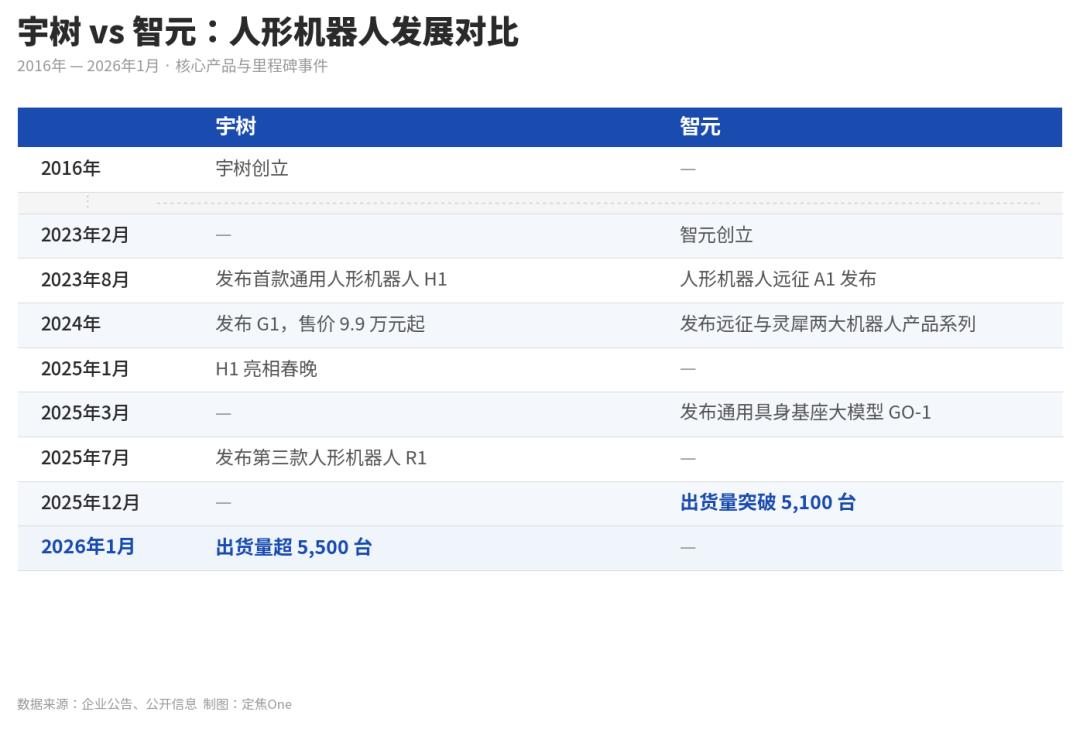
Looking back at the development history of the two companies, since the synchronous release of their first humanoid robot products in August 2023, they have always been each other's main competitors in the humanoid robot field. By 2026, this competition has obviously escalated.
An investor engaged in early - stage investment in embodied intelligence told "Focus One" that there is an "application scenario discount coefficient" in the industry. If there is no progress in the universality of humanoid robots and no real downstream demand scenarios are found in 2026, this coefficient may drop to 0.
That is to say, the humanoid robot industry will enter the final stage in 2026. At this node, the gold content of being the "number one" in the industry is higher than in previous stages. This also explains why ZhiYuan is particularly eager to prove itself this year.
01.
ZhiYuan's ambition to be the top dog can't be hidden
At the recently held partner conference, ZhiYuan not only released four robot body products and six AI models in one go but also disclosed a set of operating data: the company's revenue in 2025 was 1.05 billion yuan, a significant increase from the 60 million yuan revenue in 2024, and it claimed to be the fastest robot company in China to achieve revenue exceeding 1 billion yuan.
In contrast, Unitree, founded in 2016, only exceeded 1 billion yuan in revenue for the first time in 2025, taking 9 years. However, Unitree's previous main business was quadruped robots and it officially entered the humanoid robot track in 2023. A direct comparison of the time taken is not entirely fair, but ZhiYuan's statement itself is a competitive gesture.
In addition to demonstrating its development speed, ZhiYuan also shows a strong desire for industry discourse power everywhere.
Deng Taihua, the chairman and CEO of ZhiYuan Robotics, released the XYZ curve of the embodied intelligence industry and the productivity realization framework at the conference, dividing the industry's development into three stages: the development and trial - use period from 2022 to 2025, the deployment and growth period from 2026 to 2030, and the deployment and popularization period after 2030.
According to ZhiYuan's judgment, the industry has now entered the first year of the deployment state, and the core demand has shifted from "showing off technology" to "realizing practical application value". "The real watershed of embodied intelligence is not just the entry of AI models into the physical world, but the entry of robots into real work processes," Peng Zhihui said.
Currently, ZhiYuan's products mainly cover downstream industrial and commercial scenarios, including industrial logistics, commercial reception and explanation, store shopping guides, etc., which is consistent with this framework.
At this time, the full - stack capabilities emphasized by ZhiYuan, covering the humanoid robot body, cerebellum, brain, training data, and downstream scenarios, are undoubtedly its chips to distinguish itself from other players in the industry.
In fact, this is not the first confrontation between ZhiYuan and Unitree this year over "who is the top dog in the humanoid robot industry".
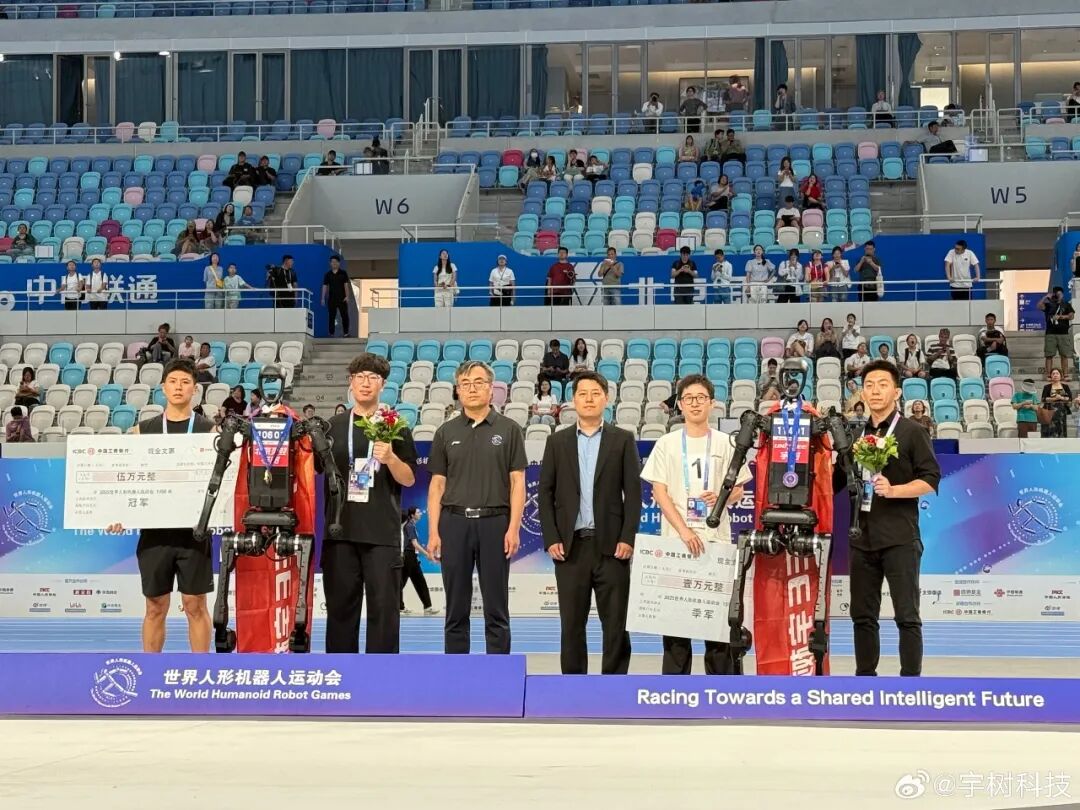
Image source / Unitree Technology Weibo
At the beginning of the year, a report released by Omdia showed that the top three humanoid robot shipments in 2025 were ZhiYuan Robotics, Unitree Technology, and Ubtech, with corresponding shipments of 5,168 units, 4,200 units, and 1,000 units respectively.
However, this statement was quickly refuted by Unitree.
Unitree issued an official announcement stating that according to its own statistical data and third - party verification, its humanoid robot shipments in 2025 were the highest in the world, with an actual shipment of about 5,500 units. It also explained that currently, there are various forms of robots, and it is recommended that people not directly combine the numbers of different types of robots for comparison.
If we look at a longer time frame, the "stealth battle" between ZhiYuan and Unitree is not only reflected in the competition for shipments but also permeates multiple levels such as product layout, listing process, and public statements.
In terms of product layout, the development rhythms of the two sides are highly synchronized. ZhiYuan was founded in February 2023 and launched its first humanoid robot product, the Expedition A1, in August of the same year. Unitree Technology mainly focused on quadruped robots in the early years and also launched its first humanoid robot, the H1, in August 2023. The two sides almost simultaneously sounded the horn to enter the humanoid robot track and formed a direct competitive relationship from the beginning.
In the competition for the "first humanoid robot stock", the competition between the two enterprises is also fierce. In July 2025, Unitree officially launched the listing guidance on the Science and Technology Innovation Board.
Almost at the same time, ZhiYuan acquired 63.6% of the shares of Shangwei New Materials through ZhiYuan Hengyue and became the controlling shareholder of Shangwei New Materials. Although this acquisition did not involve asset restructuring and ZhiYuan's core assets were not injected into Shangwei New Materials, which did not meet the conditions for back - door listing, many people still think that this is a response from ZhiYuan to Unitree at the capital market level.
In public statements, Wang Xingxing, the founder of Unitree, said in an interview in 2024 that "he doesn't care that today's high - value financing is taken away by elite startup companies that come from software and large - model backgrounds but don't have real core products yet."
At that time, ZhiYuan had just been established for a little over a year and had raised funds five times within less than a year after the release of the company's first humanoid robot product. Although the statement didn't name names, people in the industry could understand.
As of now, the controversy in the industry over "who is the number one in the industry" has not subsided. Some people recognize ZhiYuan's large - scale implementation ability and full - stack self - research advantages; others are optimistic about Unitree's hardware strength and cost - control ability, believing that its products are more cost - effective and have more market competitiveness.
The competition for the industry's top position is also a competition of development paths.
02.
Two paths, leading to the same battlefield
The development paths of ZhiYuan and Unitree are significantly different.
In terms of product form and technical route, Unitree's core advantages are concentrated in the fields of hardware R & D and motion control, following the path of "hardware is king, cost wins".
Unitree's greatest advantage is that it self - develops more than 95% of its core hardware, covering key components such as motors, reducers, sensors, encoders, and batteries, and 60% of the parts can be reused between humanoid robots and robotic dogs.
This hardware self - development model enables it to achieve the ultimate in cost control in the industry. For example, the cost of Unitree's self - developed M107 joint motor is only 50% of that of imported motors.
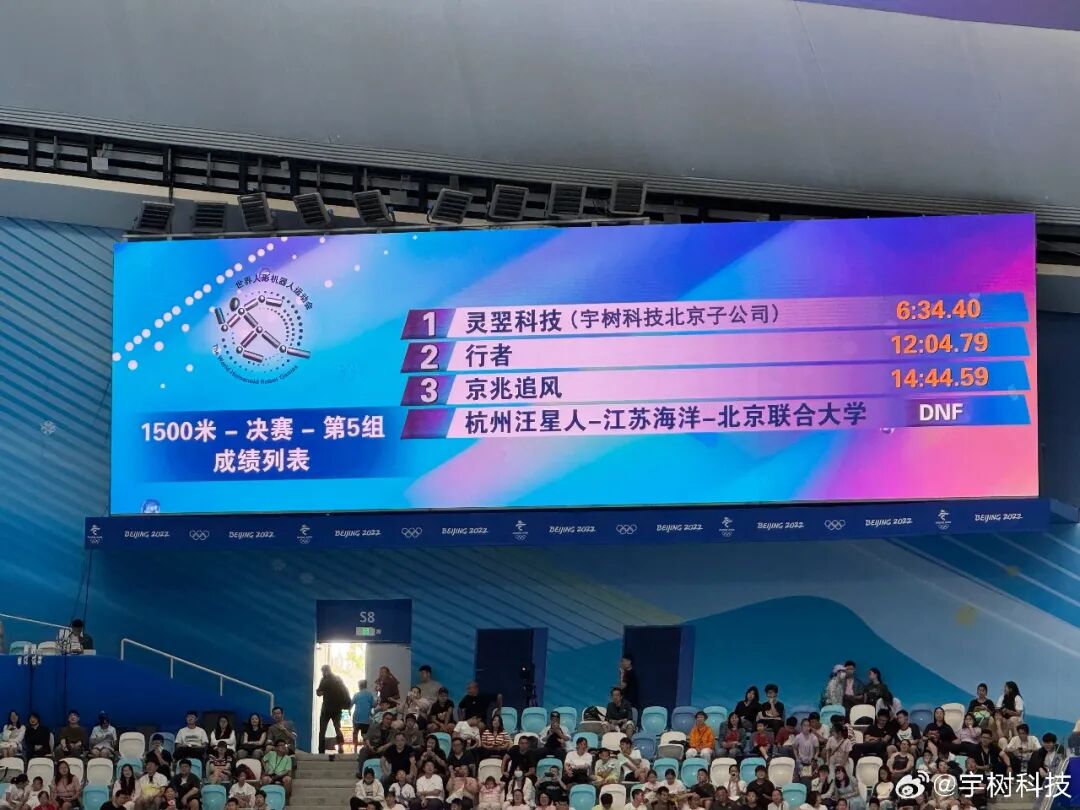
Image source / Unitree Technology Weibo
At the technical level, Unitree focuses more on the development of the robot's "cerebellum", that is, motion control and execution. Through the "imitation + reinforcement learning" motion control algorithm and self - developed high - precision motors, it ensures that the robot can respond quickly and operate stably in dynamic environments.
In terms of product form, the basic version of the G1 focuses on cost - effectiveness, and the H1 is positioned for high - end industrial scenarios, covering multiple segments such as consumer - grade and industrial - grade.
Judging from the financial data, Unitree's path has been successful. Its revenue in 2025 exceeded 1 billion yuan, and its net profit exceeded 600 million yuan. It is one of the few profitable companies in the humanoid robot track at present.
However, the valuation given by the capital market is relatively conservative.
The market's valuation of Unitree emphasizes its hardware attributes. The post - investment valuation in the last round before its listing was about 12 billion yuan. An embodied intelligence investor told "Focus One" that based on the fundraising amount and equity ratio in Unitree's prospectus, the company's issuance valuation is about 42 billion yuan, and the corresponding PS is only more than 20 times. This is still on the A - share Science and Technology Innovation Board, where the premium is generally high. The price - to - sales ratio in the Hong Kong stock market would be even lower.
ZhiYuan also faces the same valuation "dilemma". Its latest valuation is 15 billion yuan, although it follows a completely different "hardware - software combination" path from Unitree.
ZhiYuan positions itself as a full - stack service provider for embodied intelligence. It has self - research capabilities in the robot body, core components, and both the "big brain" and "cerebellum", but it pays more attention to software - level breakthroughs. It has successively launched three embodied large models, Genie Operator - 1 (GO - 1), WholeBodyVLA, and GenieReasoner, and built a complete large - model system.
Among them, GO - 1 introduces the ViLLA framework, which can learn from human videos. ZhiYuan claims that this framework can have good generalization ability in few - shot or zero - shot scenarios.
In terms of product form, ZhiYuan has built a product matrix of three major families: Expedition, Elf, and Lingxi, covering various forms such as full - size, half - size, wheeled, and quadruped. It focuses on industrial and commercial scenarios, and the product prices are relatively high, positioning towards the mid - to - high - end market.
The above - mentioned investor told "Focus One" that ZhiYuan likes to emphasize its ability in the embodied general brain, but in fact, there is no relatively unified evaluation standard in the industry at present. In terms of general model ability, the actual gap between ZhiYuan and Unitree is not large. From the perspective of valuation logic, ZhiYuan is also a hardware - oriented company.
Many investors and analysts in the embodied intelligence industry generally believe in their communication with "Focus One" that different from the "bubble" in most people's impressions, the current market's valuation of humanoid robot companies is actually quite cautious.
A obvious comparison is the commercial spaceflight track. As an emerging technology track that has emerged in recent years, a leading private rocket company in the commercial spaceflight field with an annual revenue of tens of millions of yuan, which has been in continuous losses and has not achieved rocket recovery, can easily have a valuation of over 20 billion yuan in the primary market.
This gap ultimately lies in downstream demand.
Since there are currently few comparable listed company samples in the humanoid robot industry, many investors choose to use AI large - model companies as benchmarks to value robot companies. On this basis, they add a "discount coefficient", which reflects the downstream demand. The market is using the "discount" to hedge against uncertainties.
"The downstream demand of AI large - model companies is clear. Although the product form of commercial spaceflight is not yet mature, the downstream demand for satellite launches is also clear. At present, there is still no clear downstream demand scenario for humanoid robots," an investor said.
Whether it is Unitree, which follows the hardware route, or ZhiYuan, which follows the hardware - software combination route, they have to answer the same question before becoming the industry's top: Where are the usage scenarios for humanoid robots in 2026?
03.
Why is being the industry's top so important at this time?
The reason why ZhiYuan and Unitree are competing for the industry's top position at this time is that the flow of capital is changing.
According to IT Juzi statistics, in the first quarter of 2026, there were more than 50 disclosed financing events in the domestic embodied intelligence track, with a cumulative financing amount of about 20 billion yuan, a year - on - year increase of nearly 60%.
However, if we take a closer look at the companies that have received high - value financing, such as Galaxy General, Xinghai Map, Independent Variable, and Qianxun Intelligence, they generally have certain technical reserves and competitive advantages in the field of general embodied models, that is, the robot's "brain", rather than simply being manufacturers of robot bodies.
In mid - April, Tashizhihang, which focuses on the embodied brain, announced the completion of a financing of over $450 million (equivalent to over 3 billion yuan), breaking the single - round financing record of Chinese embodied intelligence startup companies. Another embodied general model company, Shenduo Jizhi, has reports saying that investors are "lining up" to meet its founder.
This shows that capital preferences are gathering towards enterprises with certain general model capabilities. The company whose robots can serve more real scenarios will become the real industry leader. The primary problem to be solved for robots to "do housework at home" or "work in factories" is generalization ability, that is, whether robots can complete tasks autonomously in new scenarios without special training.
The core bottleneck of generalization ability is data. Large language models can use trillions of human language data for training, but the real - world data required for embodied intelligence has a gap of tens of thousands to millions of times compared with language data, just like trying to build a building with a single brick.
Currently, there are three main ways to solve the problem of insufficient data in the industry: Internet pictures, texts, and videos + synthetic simulation data (large in quantity but the lowest in data quality), self - collected first - person human - perspective data such as UMI (dependent on manual collection and less abundant than the first method), and real - machine robot data (closest to the robot's working scenario, highest in data quality but the least in quantity).
