The mysterious tycoon from Shandong behind the 80 billion IPO
Which company had the largest first-day gain in the Hong Kong stock IPO this year?
The answer is Lightelligence, a newly listed company. As of the close, Lightelligence's stock price soared by 383%, and its market value skyrocketed to HK$81.4 billion, making it a phenomenon-level IPO in the first half of the year.
"MIT physics Ph.D." and "a Nature paper worth $100 million." The entrepreneurial story of genius scientist Shen Yichen has become the front-page news of major venture capital and investment media. In the article "Lightelligence Lists on the Hong Kong Stock Exchange, Zhongke Chuangxing Reaps Another Reward in the 'Pursuit of Light'" on China Venture Capital News, the story of its early-stage financing is described in detail.
However, what surprises me is an institution called Yijing Capital behind Lightelligence. In terms of reputation, this institution is far less well-known than institutions such as ZhenFund, Zhongke Chuangxing, and Baidu Ventures. In terms of strength, it cannot be compared with large institutions such as China Merchants Group Venture Capital, Shanghai State-owned Investment Corporation, and Vertex Ventures.
But it is very special. It manages assets of over 10 billion yuan and almost only uses its own funds for investment. It not only bet on Lightelligence and made more than 10 times the profit but also invested in several IPOs such as Leapmotor and Biren Technology. Moreover, it also operates as a fund of funds and has successively invested in more than 10 GPs such as Futeng Capital, Qiming Venture Partners, and Lanpu Capital. It is an active market-oriented LP.
What exactly is the background of this institution? Who is the person in charge behind it? These questions all point to a low-key industrial giant in Shandong.
01. Making Dozens of Times the Profit, with a Stock Market Value of Nearly 2 Billion Yuan
In 2017, Shen Yichen, a physics Ph.D. from the Massachusetts Institute of Technology, returned to China to found Lightelligence. In the following eight years, it completed nine rounds of financing and was supported by the top domestic institutions. This list includes ZhenFund, BV Baidu Ventures, Zhongke Chuangxing, China Merchants Group Venture Capital, Vertex Ventures, Shanghai State-owned Investment Corporation, and so on.
Although the company did not disclose the corresponding investors for each round of financing in its prospectus, the overall returns for each round from Series A to Series C are still clear based on the investment cost and today's market performance.
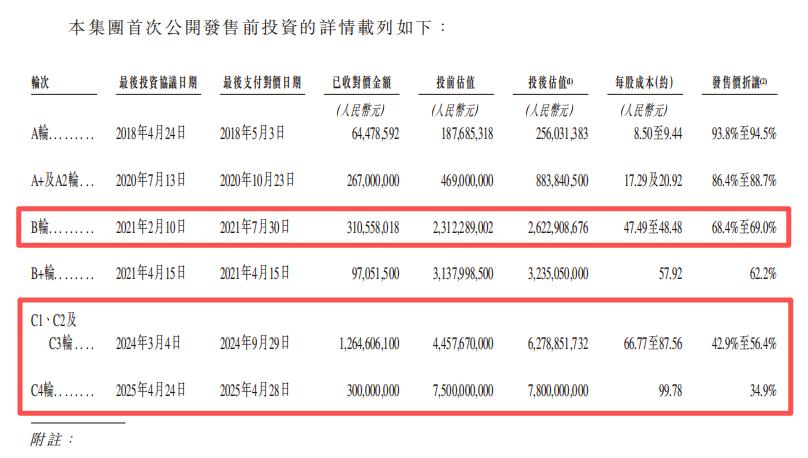
If you participated in the investment in Series A at a valuation of 188 million yuan, your book return today would be 377 times. If you participated in the investment in Series B at a valuation of 2.3 billion yuan, your book return today would also be 30 times.
Yijing Capital participated in the investment twice in Series B and Series C. As of the listing, it held 2,579,630 shares of Lightelligence, accounting for 2.80% of the shares after the listing.
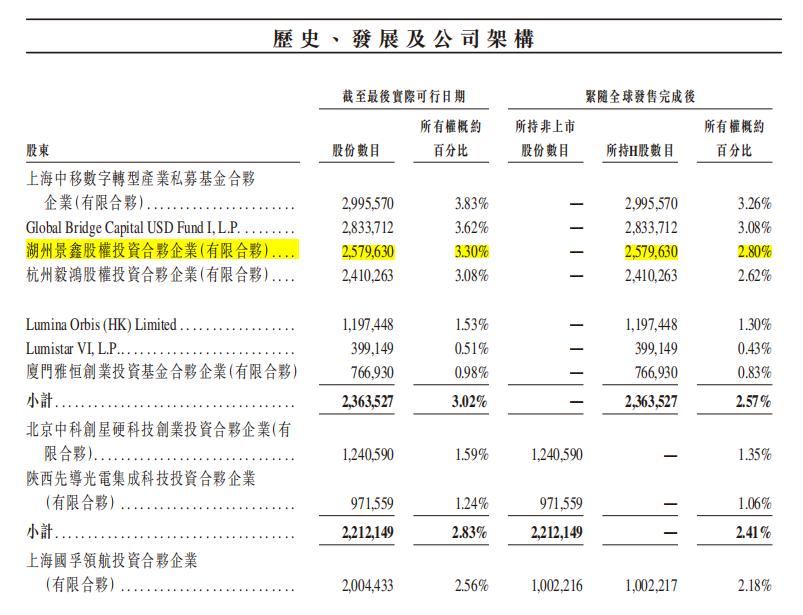
Source of the picture: Lightelligence's prospectus
Calculated only based on the investment in Series C, the pre-investment valuation was between 4.458 billion and 7.5 billion yuan. If calculated based on a valuation of HK$80 billion (70 billion yuan), Yijing Capital's investment in this round would have increased by 10 - 15 times. The overall stock market value of the two investments is 1.99 billion yuan.
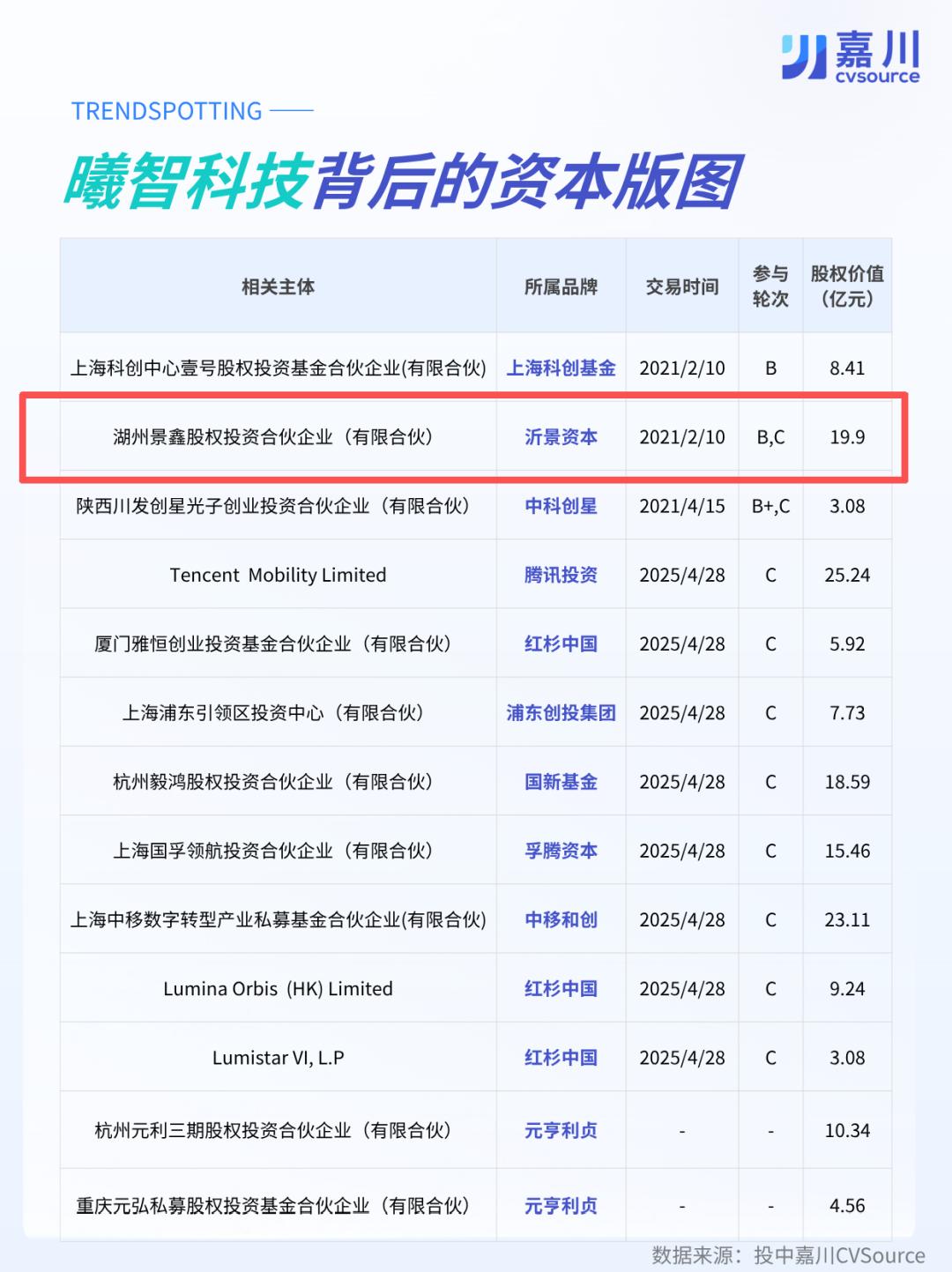
This report card is quite good. Moreover, according to the disclosure on Yijing Capital's official WeChat account, this is not their first IPO. They have already invested in nine listed companies. Star projects such as Leapmotor and Biren Technology are among them.
We reviewed the investment history of this institution since its establishment and found that the number and scale of its investments are much larger than we imagined.
Founded in 2015, Yijing Capital manages assets of over 10 billion yuan. According to data from CvSource, it has made 113 investments in 91 companies in the past 11 years.
In terms of industries, cutting-edge technologies represented by semiconductors are the key investment areas for Yijing Capital.
In 2020 and 2021, Yijing Capital invested in Biren Technology twice. In 2022, it participated in the Series A investment of Xinyuan Semiconductor and the Series A financing of Xinxin Semiconductor. Currently disclosed data shows that it has made more than 11 investments in semiconductors.
Moreover, these investments have yielded substantial returns. Biren Technology went public earlier this year. "Huzhou Jingxin" under Yijing Capital invested 120 million yuan in Biren Technology and finally achieved a book profit of 638 million yuan (calculated based on the stock price on the first day after the listing), with a return multiple of about 5.28 times. Xinyuan Semiconductor also exited through the transfer of old shares earlier this year, and Xinxin Semiconductor was acquired by TCL Zhonghuan in 2023.
In addition to the technology sector, biomedicine is also a key investment area for Yijing Capital. It has successively participated in the investment of more than 40 related companies such as MabGenius, I-Mab, Antuo Biotech, and Taichu Biotech. Therefore, from an industry perspective, Yijing Capital is at least a dual-track-driven institution.
Moreover, data shows that Yijing Capital has gradually shifted from mid- to late-stage investments to early-stage investments in the past one or two years.
For example, recently, they just invested in the angel round of AI agent company Panofy.ai, the angel ++ round of robot brain and cerebellum system developer Zhiyue Space, and the pre-A and A+ rounds of robot cerebellum developer QiaoJie ShuWu. This means that this institution not only seized the computing power opportunity in the past five years but also preempted the early-stage dividends of the AI application and embodied intelligence track.
More importantly, Yijing Capital not only conducts direct investments but is also an active LP.
A 1-billion-yuan fund of funds called "Wuxi Yijing" managed by them has successively invested in 14 institutions such as Futeng Capital, Qiming Venture Partners, Lanpu Capital, Mifang Health Fund, Honghui Capital, and Daotong Capital. And it has a history of multiple co-investments with these institutions.
As a market-oriented LP, being able to maintain long-term and systematic capital contributions is particularly rare in today's primary market.
02. Who is at the Helm? A Shandong Industrial Tycoon with a Net Worth of 40 Billion Yuan
An institution with a scale of over 10 billion yuan that conducts both direct investments and operates as a fund of funds is not from state-owned assets nor a typical CVC but is founded by an industrial tycoon from Shandong.
Public information shows that the actual controller of Yijing Capital is Zhang Jianqun. He also has another identity, the chairman of Yizhou Group, a cement giant in Shandong.
This name has hardly appeared in the venture capital industry. However, with the sporadic reports in local Shandong media, we can still piece together his industrial map and investment history.
Let's rewind the clock to the 1990s. Zhang Jianqun's father, Zhang Huailian, took over the former "Linyi Regional Cement Factory" of Yizhou Group. This was a small state-owned factory established in 1958. When Zhang's father took over, it was on the verge of bankruptcy, with assets of only 6 million yuan but liabilities of 7 million yuan.
Later, the factory completed the shareholding reform. With the hard work of Zhang Huailian's team, it gradually developed from a loss-making small factory into the leading company in the Shandong cement industry.
At that time, Zhang Jianqun, who was only 19 years old, had just graduated from Shandong Institute of Building Materials. He was later seconded to the Art Ceramic Factory as the deputy factory director and the director of the second branch factory. In 1993, he started working in his father's cement factory as the director of the packaging factory. From 1993 to 2006, he successively served as the assistant general manager of the company and the chairman of the packaging company, growing from the front line of the industry to an enterprise manager.
In 2006, 34-year-old Zhang Jianqun successfully succeeded Zhang Huailian as the chairman of Yizhou Group.
During Zhang Huailian's tenure, Yizhou Group successively acquired industrial assets such as the Sixth Cement Factory in Linyi, Luozhuang Power Plant, Luozhuang New District Waterworks, and Zaozhuang Coking Plant, and began to diversify its operations. After Zhang Jianqun took over, the diversification expansion accelerated, and it gradually extended to multiple fields such as chemicals, agriculture, and finance.
For example, in 2015, he founded Yonghui Agriculture, planning four major business segments: special grain, organic vegetables, orchard development, and animal husbandry, and entered the modern agriculture industry. He also invested in institutions such as Shandong Linyi Hedong Rural Commercial Bank and Shandong Feixian Rural Commercial Bank.
After the ups and downs of various businesses, it finally developed into a group company covering three major industrial sectors: building materials, energy, and finance.
According to a report by "Shandong Financial Headlines," in 2019, Yizhou Group's revenue exceeded 40 billion yuan for the first time, becoming the largest private enterprise in Linyi. Zhang Jianqun's net worth also reached 42.3 billion yuan (in 2018), making him the eighth-richest person in Shandong and the richest person in Linyi.
In its diversification expansion, the financial sector is centered around Yijing Capital. In 2015, Zhang Jianqun established Shanghai Yijing Investment Co., Ltd. in Shanghai and officially entered the equity investment industry.
In the early days, Zhang Jianqun's investments were not focused. From 2015 to 2017, he invested in new retail enterprise Guoxiaomei, Henan education company Sunshine Yulu Group, and Beijing new media company Yiou.com. It was not until after 2018 that he gradually focused on the healthcare and technology sectors.
After that, the frequency of his investments gradually increased and reached its peak in 2021. In that year, he made 38 investments with a total investment amount of up to 1.545 billion yuan. Although Zhang Jianqun's investments gradually declined after 2022, he still maintained about 10 investments per year. In the first four months of this year alone, he made six investments.
I think the most commendable thing is here. As we all know, the venture capital industry in Shandong is not well-developed. It was not until after the Global Venture Capital and Investment Conference in Qingdao in 2021 that it became more well-known. As a private enterprise, choosing to enter the industry in 2015 is quite surprising.
Moreover, it is not a typical industrial capital. From cement plants to optical chips, and then to the recently popular AI and embodied intelligence, this span clearly does not emphasize industrial synergy but focuses on financial returns. Its large investment scale and high participation persistence are scarce in today's market. Therefore, it is worth recording.
However, this also shows that China's venture capital market is much broader than what is usually reported in the media. There are always low-key tycoons making money quietly.
Reference materials: 1. Shandong Financial Headlines, "Unveiling the Wealth Creation Model in Shandong" - How "Cement King" Zhang Jianqun Walked Out of Yimeng.
This article is from the WeChat official account "Beyond the J Curve", written by Yang Boyu and published by 36Kr with permission.