Domestic automotive-grade chips are entering the deep end.
First of all, here's a little tip for all friends interested in the 2026 Beijing International Auto Show: When going to the auto show, be sure to wear a pair of comfortable shoes so that you can "keep walking" in the 380,000-square-meter exhibition hall.
At this record-breaking Beijing Auto Show, in addition to domestic automakers launching various debut models to showcase their strength, domestic automotive-grade chips have demonstrated that the domestic automotive chip industry has entered a new stage with their mass-produced products.
Two years ago, the industry's impression of domestic automotive-grade chips might have been limited to "competing on low prices." Now, the competition in the automotive-grade chip market has escalated to a multi-dimensional competition of "competing on performance," "competing on ecosystem," and "competing on innovation."
No longer confined to the red ocean of automotive-grade MCUs, domestic automotive chips are moving forward in the important fields of intelligent driving and intelligent cockpits. The deep waters are no longer just the benchmarking data in the laboratory, but the long-term reliability in real road environments and the supply chain confidence for large-scale delivery.
Accelerated Improvement of the Integration of Automotive-Grade Chips
From single-function chips to cockpit-driving integration, integration has become the first core signal for domestic automotive chips to enter the deep waters.
At the 2026 Beijing International Auto Show, Xinqing Technology released the 5nm automotive-grade AI cockpit-driving integrated chip "Longying 2," which is planned to start adaptation in the first quarter of 2027. "Longying 2" has an AI computing power of 200 TOPS, a built-in multi-core CPU of 360KDMIPS, a GPU of 2800GFLOPS, a bandwidth of up to 518GB/s, and supports LPDDR6/5X/5. It can meet the full-scenario requirements of AI cockpits and cockpit-driving integration, eliminating the data bottleneck of multi-screen interaction and AI computing.
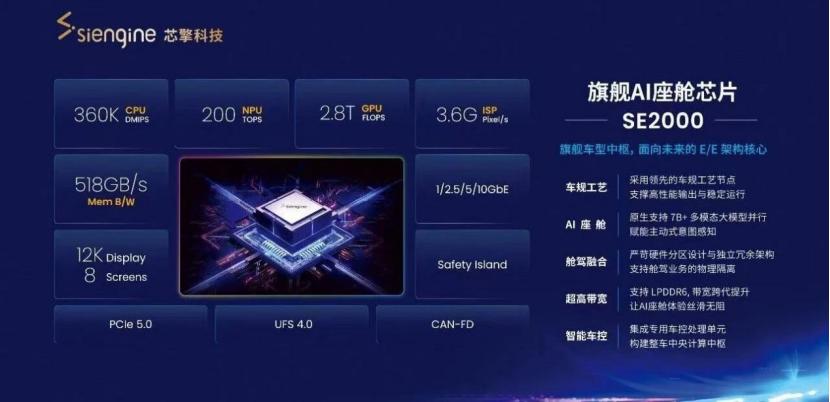
Dr. Wang Kai, the founder of Xinqing Technology, said that "Longying 2" can ensure the parallel operation of three complex tasks: AI, intelligent cockpit, and intelligent driving. This kind of integration can greatly reduce costs and accelerate the intelligent development of mid- and low-end models.
Xinchip released the AI cockpit chip X10, which has achieved a four-fold improvement in large model computing efficiency. With a dense computing power of 80 TOPS and a DDR bandwidth of 154GB/s, it can support the on-device deployment of large models with up to 9B parameters. X10 uses a 4nm automotive-grade process, with significantly improved CPU and GPU performance, reaching 250KDMIPS and 3000GFLOPS. It is equipped with a VPU and DPU that support 8K resolution and also supports 12 cameras and 8 displays. Replacing the traditional combination of cockpit domain controller + external AI Box with a single chip, the DDR storage capacity can be saved by 25%.
Horizon released the cockpit-driving integrated chip "Xingkong" one day before the opening of the Beijing Auto Show. Based on the 5nm automotive-grade process, the BPU computing power of the Xingkong 6P chip reaches 650 TOPS, and the memory bandwidth is 273 GB/s. The space occupation is reduced by 50%, the R & D and delivery cycle is shortened from 18 months to 8 months, and the delivery time of cockpit-driving integrated software and hardware can be shortened by 56%.
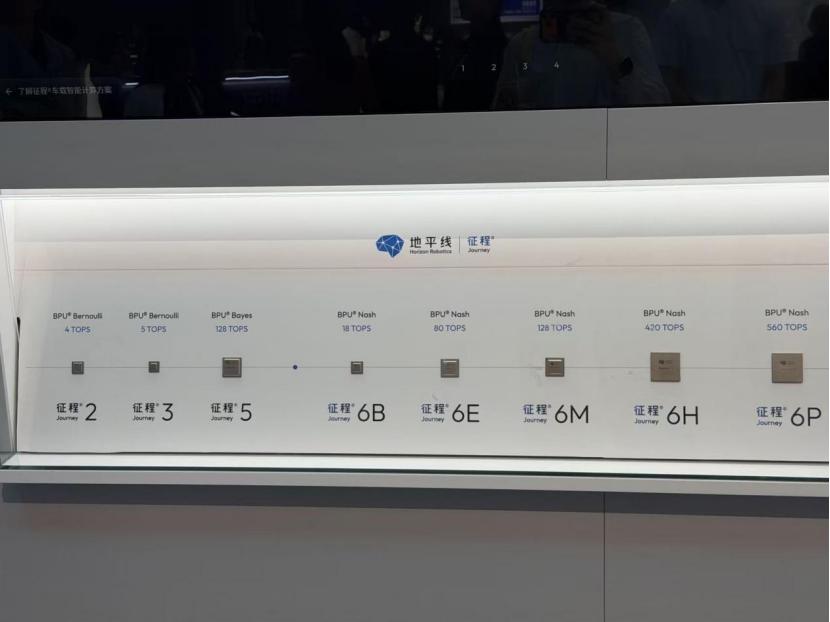
The technical routes of cockpit-driving integration are highly consistent, and the most direct value behind it is to significantly reduce the cost of the whole vehicle. Xinqing's Longying 2 can reduce the BOM cost of a single vehicle by 2000 - 3000 yuan; the AI cockpit solution of Xinchip X10 can reduce the overall system BOM cost by 1500 - 3000 yuan. Horizon said that the cockpit-driving integrated chip Xingkong can reduce the comprehensive cost of a single vehicle by 1500 to 4000 yuan. Integration is becoming the keyword for automotive chips, which also echoes the "chip normalization" advocated by Li Bin, the CEO of NIO, not long ago.
Accelerated Mass Production and Cost Reduction
Higher integration brings obvious cost advantages, and the breakthroughs in technology and cost ultimately have to be reflected in large-scale mass production. This is a crucial step for domestic automotive-grade chips to "hit the road."
The cumulative shipment volume of Xinqing Technology's "Longying 1" intelligent cockpit chip has reached 1.5 million pieces, covering dozens of mainstream models, such as FAW Hongqi, Geely Lynk & Co, Changan Qiyuan, and some models of Volkswagen in Germany.
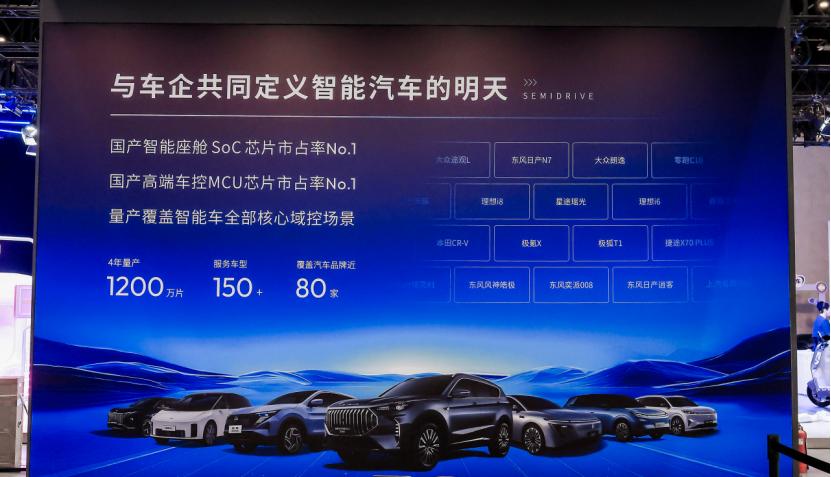
The shipment volume of Xinchip Technology, whose products cover multiple scenarios such as cockpits, gateways, and MCUs, has reached 12 million pieces, serving more than 150 models and covering nearly 80 brands.
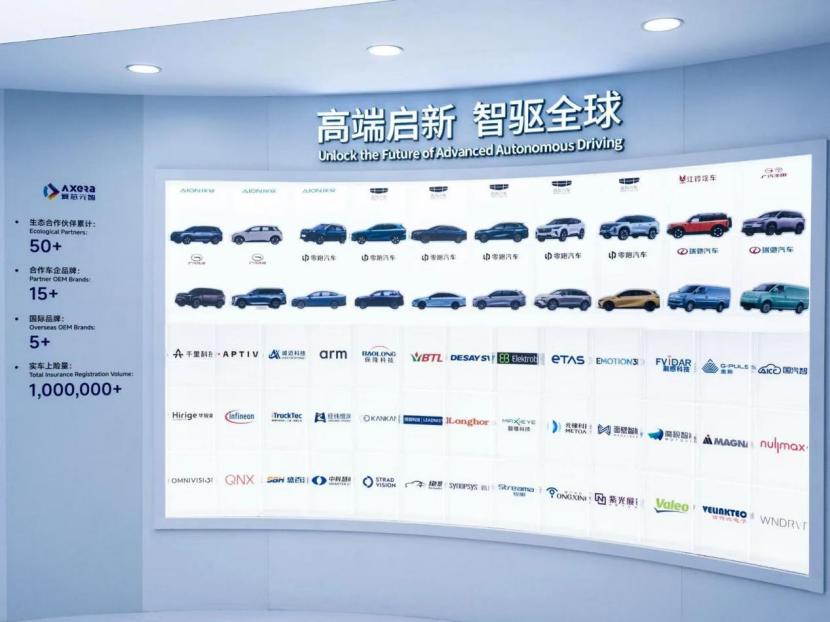
The actual on-road insurance volume of the intelligent automotive SoC of Aixin Yuanzhi has reached 1 million pieces, with more than 15 domestic cooperative automaker brands, such as GAC Aion, Geely Automobile, Jiangling Motors, etc., and more than 5 international brands.
Horizon's Xingkong 6 announced at the time of its release that it had obtained cooperation intentions from more than a dozen automaker brands and several Tier 1 suppliers, including BAIC Group, BYD Group, Changan Group, etc.
Behind the impressive shipment data lies an unchanging iron law in the automotive-grade chip industry: Only with extreme cost-performance and large-scale implementation can one truly gain a foothold in the market.
Against the backdrop of a more clearly divided market for intelligent vehicles, automotive chips need to find the right track and ensure scale. Domestic intelligent automotive chip companies have defined a clear development path: Focus on intelligent driving integrated chips for L2 and L2+ level autonomous driving; continue to explore high-level intelligent driving chips without integration; pay attention to embodied intelligence and other products to expand product application scenarios.
As domestic automotive chips enter the 5nm/4nm era, technologies such as Chiplet and advanced packaging will also become important technologies for automotive-grade chip companies to reduce costs.
Cost reduction is not just about cheaper chips, but rather the successful transformation of the vehicle's electronic and electrical architecture (EE) from a distributed to a centralized system. Shipment volume and cost-performance are just basic thresholds. To gain a firm foothold in the global automotive chip market, domestic automotive-grade chips need to focus precisely on core capabilities and build long-term competitiveness.
Three Focus Areas for Domestic Automotive-Grade Chips
Industry leading companies, such as NVIDIA and Qualcomm, have extremely deep ecosystems in both hardware and software provided for automotive platforms. NVIDIA can offer the Thor chip for vehicles and also provide AI models and development platforms in the cloud. Such strong integration capabilities have built a solid barrier for the leading players.
Therefore, the rise model of domestic automotive-grade chips may refer to the feasible battery development paths of CATL and BYD: Use the domestic scale to gain cost advantages, and then catch up through technological breakthroughs.
From "technological breakthrough" to "mass production verification," the industry's focus has shifted to the real verification of the number of fixed-point projects and the scale of vehicle installation. Automotive-grade chip companies must make efforts in computing power, adaptability, and ecosystem simultaneously.
Computing power determines the basic market share of automotive-grade chips. A highly integrated chip can enable the installation of cockpits, driving, parking, and AI models on vehicles. Horizon said that vehicles are the new terminals for AI interaction, so higher requirements are put forward for the computing power of intelligent driving integrated chips. Intelligent cockpit chips need computing power to sense user status, analyze user needs, and process parallel tasks. With the popularization of urban NOA and highway NOA, intelligent driving chips need safe and sufficient computing power support. In today's automotive-grade chip market, having sufficient computing power is the ticket to enter the competition.
Adaptability determines the speed of automotive-grade chips being installed in vehicles. With the accelerated iteration of intelligent vehicle products, the support of intelligent cockpit chips for functions such as multi-screen display, voice interaction, and map navigation has become a necessity. As automakers continuously update their product definitions, automotive chip companies, as the upstream of the supply chain, need to cooperate with Tier 1 suppliers to quickly form new solutions, which will become an important competitiveness for automotive-grade chips. The adaptability of intelligent driving chips and cockpit chips reflects both the design ability of automotive-grade chip companies and their understanding of the industry.
The ecosystem determines the profitability of automotive-grade chip companies. Deep binding with Tier 1 and other Tier 2 suppliers can accelerate the installation of automotive-grade chip products in vehicles. The financial report of Aixin Yuanzhi shows that the company's annual revenue in 2025 was 562 million yuan, of which the revenue from the intelligent automotive business reached 48.17 million yuan, a year-on-year increase of 618.2%. Expanding the cooperation ecosystem and accelerating the company's profitability have become the common choice of automotive-grade chip companies.
Xinqing Technology announced its cooperation with partners such as WeRide, Shouchuan Microelectronics, and Zhuoyu Intelligence before the 2026 Beijing Auto Show. Xinqing Technology said that the cooperation with Shouchuan Microelectronics will help complete the closed-loop of the domestic solution from computing to transmission, thereby accelerating coordination with vehicle manufacturers. Xinchip Technology announced a strategic cooperation with ZBO Electronics during the Beijing Auto Show, which will accelerate the overseas expansion process of Xinchip Technology's products. The construction of the ecosystem will directly increase the product shipment volume, which will become the driving force for the revenue growth of automotive-grade chip companies.
Automotive-Grade Chip Companies Plan for the Second Growth Curve
As automotive chips tend to be "normalized" and the integration level becomes higher, the number of chip suppliers will be significantly reduced in the end. This is a problem that industry players in the deep waters need to face.
Computing power, adaptability, and ecosystem have built the current competitive barriers. However, as the industry moves towards a red ocean, market players will face a new round of reshuffle. Finding the second growth curve has become an inevitable choice for automotive chip companies to survive the cycle.
Domestic automotive chip companies can be roughly divided into two types in terms of product matrix: one type is companies that specialize in automotive chips, and the other type is companies that cross over from other fields to enter the automotive chip market. As their products are mass-produced and installed in vehicles, companies specializing in automotive chips are looking for the second growth curve, and embodied intelligence and the industrial control track have become popular choices for these companies.
The reason for choosing embodied intelligence is that vehicles are regarded as embodied intelligent products on four wheels. The interaction ability of the cockpit and the control ability of intelligent driving correspond to the brain and cerebellum of embodied intelligence respectively. For automotive-grade chip companies, there is a smooth migration path.
The background for choosing industrial control is that the requirements of automotive-grade chips (such as AEC - Q100/Q101 certification) in terms of operating environment (temperature, vibration), stability, and failure probability are all higher than industrial-grade standards. As the safety requirements of industrial control systems (especially high - end manufacturing and power grids) increase, automotive-grade chips have become a better "high - reliability" alternative. In terms of market potential, the scale of the industrial control market is several times that of the automotive-grade chip market. For automotive-grade chip companies, this will be an important area for large-scale products.
Conclusion
From technological breakthrough to mass production verification, from breaking through in the domestic market to cross - border expansion, domestic automotive-grade chips have completed a three - step jump from "usable" to "good to use" and then to "large - scale installation in vehicles."
When domestic automotive-grade chips bid farewell to the "low - price involution" and enter the deep waters of 5nm integration and mass production delivery, has China truly grasped the right to speak in the intelligentization of the automotive industry?
Perhaps, the answer will not be known until domestic automotive chips define Chinese standards in the global market.
This article is from the WeChat official account "Semiconductor Industry Insights" (ID: ICViews). Author: Liu Qian. Republished by 36Kr with permission.