At this Beijing Auto Show, the stars aren't the cars.
At this Beijing Auto Show, the concept of "intelligence" permeated the entire event. From the underlying support of high-computing-power chips, the infusion of AI large models, to the gradual implementation of large-scale L3-level autonomous driving, an intelligent transformation triggered by the deep integration of the upstream supply chain and automobile manufacturers is accelerating.
01
The Auto Show Turns into an "Intelligent" Show, with AI Taking the Lead
181 globally premiered models, 219 press conferences... The 2026 (19th) Beijing Auto Show, which opened on April 24, broke multiple historical records. The official said it was the largest-scale Beijing Auto Show ever.
However, the significance of this auto show goes far beyond the breakthrough in numbers. It also marks that the global automotive industry is moving from the "first half" of electrification to the "second half" of intelligence - AI has undoubtedly become the core of all automobile manufacturers' narratives. The auto show is no longer just a showcase for car models but also a global barometer for AI technology routes and business logics in the field of intelligent mobility.
Lu Fang, the chairman and Party secretary of VOYAH, told Caixin that AI will restructure or subvert the automotive industry because future cars will definitely be products deeply integrated with AI. Once integrated, the product structure, organization, and even business models will change, which is an inevitable trend. "When we study cars in the future, not studying AI may be considered slacking off."
Zhao Chunzhang, the head and senior consultant of the automotive industry at Ries Strategy Consulting, also expressed the same view to Caixin. In his opinion, the core variable from electrification to intelligence is actually the technology represented by AI large models and AI capabilities. In the era of electrification, it mainly relied on the capabilities of the three electric systems, while in the era of intelligence, it tests the ability to combine software and hardware, and even software capabilities determine the upper limit of a car's performance. "Those automobile manufacturers that fail to transform quickly in this process are doomed to be eliminated."
▲ Image source: Caixin
The new car-making forces are the most radical in this regard.
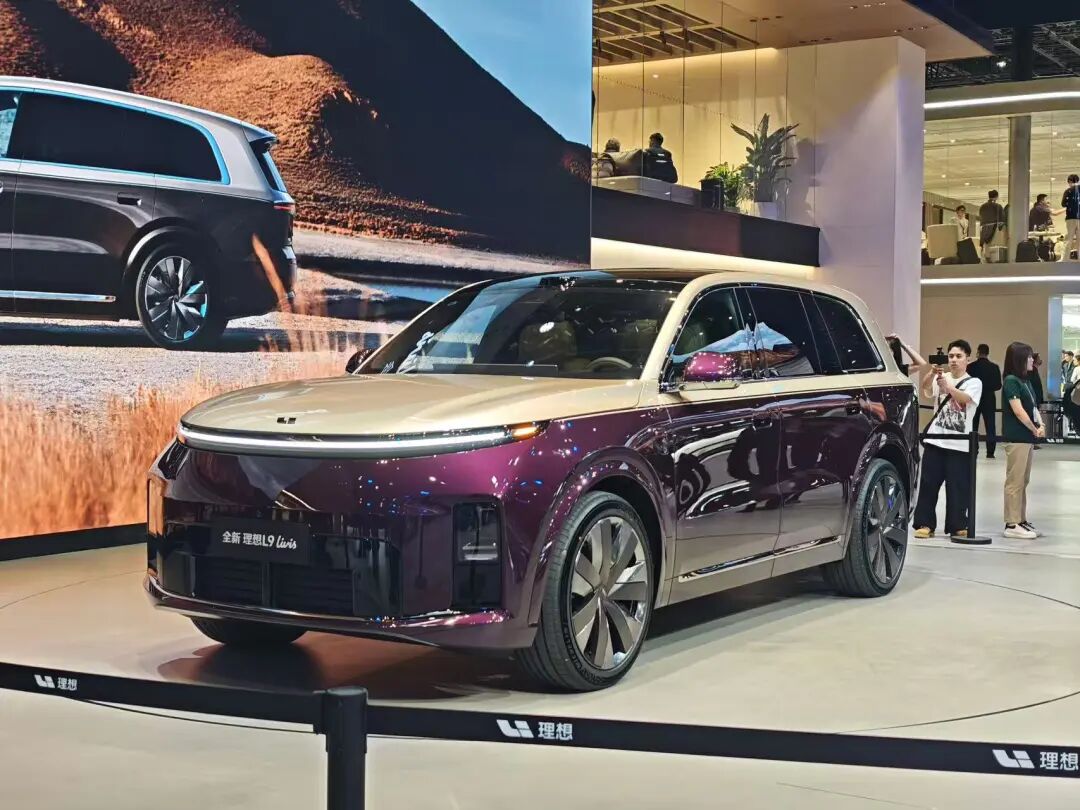
The Li L9 Livis, positioned as an "embodied intelligent flagship SUV" by Li Auto, made its global debut at this auto show. The car is equipped with two self-developed 5nm Mach 100 chips, with a total computing power of 2560 TOPS. Li Xiang, the CEO of Li Auto, excitedly talked about the design and details of the car on the stage. Almost everything was related to AI. When the atmosphere reached a climax, he even demonstrated the anti-pinch ability of the car door himself.
XPeng Group took "AI Changes the World" as the theme and made its debut at the auto show as a "physical AI technology company" for the first time. The XPeng GX, positioned as an "AI new luxury six-seater flagship SUV", was unveiled at this auto show. It is built based on XPeng's SEPA 3.0 physical AI vehicle architecture and is known as China's first mass-produced Robotaxi prototype with full-stack self-developed pre-installation. It is equipped with four Turing chips, with a computing power of up to 3000 TOPS. In addition to its intelligent vehicle business, XPeng Group also displayed a new generation of humanoid robot IRON and a "land aircraft carrier" split flying car.
Geely Auto created a theme space of "Geely Technology Ecosystem" in a "semi-pavilion" form at the exhibition hall, showcasing its complete and systematic all-domain AI 2.0 technology system. For example, the first native Robotaxi prototype, "Eva Cab", was unveiled. The car is developed based on Geely's quantum-level AI electronic and electrical architecture EEA 4.0 and integrates three chips: NVIDIA SuperChip, Thor U, and Qualcomm Snapdragon 8797, with a total computing power of over 3000 TOPS. It is understood that Geely will launch a customized version of Eva Cab for Caocao Chuxing in 2027 to accelerate the large-scale commercialization of Robotaxi.
SAIC Roewe also started to integrate an AI large model into its cars for the first time, releasing the world's first AI-native car series "Jiayue" and collaborating with Volcengine to integrate the Doubao large model 2.0 series.
Not only Chinese independent brands but also established joint-venture and luxury automobile manufacturers are accelerating their transformation towards full AI integration. Oliver Blume, the chairman of the board of management of Volkswagen Group, emphasized: "After the popularization of electrification and advanced driver assistance functions, we are entering a new era where intelligent agent AI fully empowers cars."
Volkswagen Group officially released the technology roadmap for "all-domain intelligent agent AI" and announced that starting from the second half of 2026, all new models based on the CEA electronic and electrical architecture will be equipped with in-vehicle AI intelligent agents, using locally trained large language models (LLM) as the core of natural language interaction to achieve a more intelligent and safe cockpit experience. BMW also actively embraced the local AI ecosystem, introducing Alibaba, DeepSeek large models, and the HarmonyOS ecosystem to deepen its intelligent layout.
The AI narratives of automobile manufacturers are inseparable from the power of the industrial chain behind them.
In previous auto shows, suppliers would be separated from vehicle manufacturers and concentrated in independent exhibition halls. However, at this Beijing Auto Show, core supply chain and technology companies entered the main exhibition hall on a large scale for the first time, competing with automobile manufacturers on the same stage, such as Huawei Kunpeng, CATL, Horizon Robotics, and Momenta. CATL occupied an independent exhibition area of 1500 square meters at the entrance of Hall W4, where luxury cars were gathered, standing side by side with BMW and Porsche; in Hall B3, Horizon Robotics, WeRide, and iFlytek displayed their products in the same hall as Toyota and Changan Automobile Group; Momenta settled in Hall B4, next to Hongmeng Zhixing, Leapmotor, and Volvo Cars.
Zhao Chunzhang believes that the software and hardware of intelligent cars highly depend on leading suppliers, such as CATL's batteries and Huawei Kunpeng's intelligent driving technology. The technical strength of suppliers directly determines the product power of the whole vehicle. This trend not only changes consumers' purchasing habits but also promotes suppliers to step from behind the scenes to the front, becoming brands with C-end influence. Now, the brand status and appeal of core suppliers are on a par with those of vehicle manufacturers, becoming a key force affecting the market.
It is worth noting that after announcing its entry into the automotive industry in August 2025, Dreame Technology made its debut at the Beijing Auto Show as a "new car-making force" for the first time, setting up an independent booth. Two models, the performance coupe Nebula NEXT 01 and the luxury large SUV Nebula NEXT 01X, were displayed on-site, each in two color schemes, with a total of four exhibition cars. However, all the exhibition cars were isolated by retractable fences and could only be viewed from a distance, not experienced up close.
02
Industry Leaders "Visit Each Other" to Compete for the Technological Spotlight
As press conferences jointly held by automobile manufacturers and suppliers have become the norm, the spotlight at the 2026 Beijing Auto Show shifted to the "T-shirt socializing" and "visiting for experience" among CEOs.
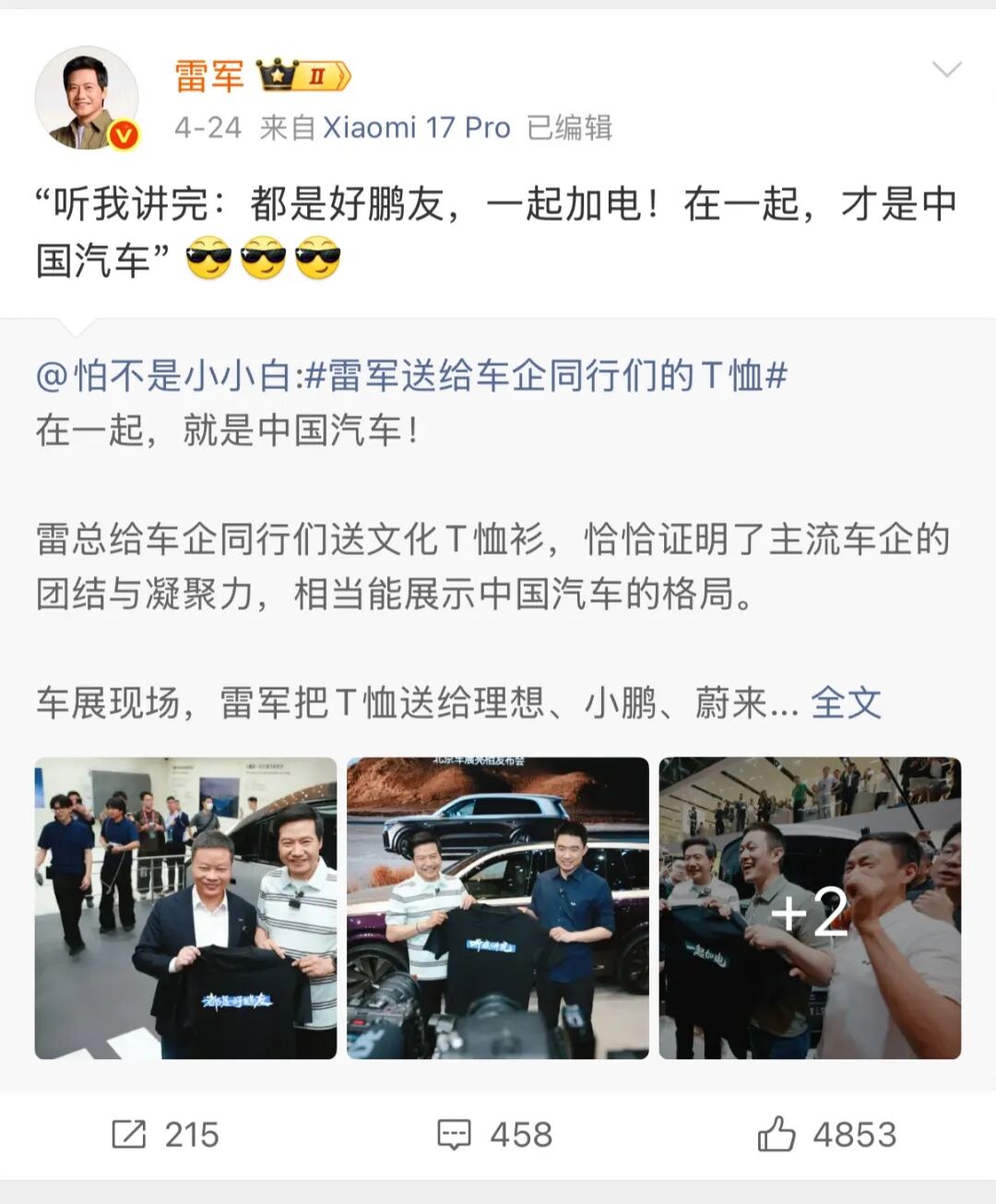
Lei Jun, the founder of Xiaomi, became the "strongest atmosphere group" and gave customized T-shirts with exclusive "meme" prints to four automobile industry leaders: "Let me finish speaking" to Li Xiang, the CEO of Li Auto; "Good friends forever" to He Xiaopeng, the CEO of XPeng Motors; "Charge together" to Li Bin, the CEO of NIO; and "Together, we are Chinese automobiles" to Wang Chuanfu, the chairman of BYD. In addition, he also gave a car model to Zhang Jianyong, the chairman of BAIC Group.
That night, Lei Jun strung the four sentences together into a Weibo post: "Let me finish speaking: Good friends forever, charge together! Together, we are Chinese automobiles!"
▲ Image source: Lei Jun's Weibo
If the interesting interactions among CEOs added a human touch to this technological feast, then the technological competition hidden behind the "visiting" outlined the three core forces of this auto show: "the rise of independent brands, the counterattack of joint-ventures, and the emergence of the supply chain".
Looking at different camps, many "flagship" large cars of domestic brands are quite high in technological content. Compared with the past practice of piling up configurations in the cockpit, domestic brands this time focused their "high-end" perspective on the chassis. If a car doesn't use a wire-controlled chassis or an active suspension, it's almost embarrassing to stand in the C position. These configurations, which were only available in million-level luxury cars in the past, are now brought down to the level of four or five hundred thousand yuan by domestic brands.
Chinese automobile manufacturers are coming on strongly, and traditional luxury brands are not to be outdone. BMW brought a total of 16 models from its three brands, BMW, MINI, and BMW Motorrad, to the auto show. Four heavyweight models, the all-new BMW 7 Series and i7, the new-generation BMW iX3 long-wheelbase version, and the new-generation BMW i3 long-wheelbase version, were all publicly unveiled for the first time globally. Among them, the new-generation BMW iX3 long-wheelbase version was developed specifically for the Chinese market, using a combination of BMW's technical platform and a local Chinese intelligent solution, hoping to provide a "win-win" choice for the Chinese market. The all-new pure-electric Mercedes-Benz GLC, which made its global debut, and the new-generation S-Class sedan, which made its Chinese debut, are both equipped with Momenta's intelligent driving solution. Mercedes-Benz also announced that it will enable AI-powered intelligent cockpits and driver assistance systems to cover most of its models in the next 9 - 15 months.
As traditional luxury brands make up for their shortcomings in intelligence, Chinese manufacturers are only one step away from collectively entering the mass-production era of L3-level autonomous driving. Huawei Kunpeng's ADS 5.0 system was officially unveiled and will start the commercialization of L3-level autonomous driving; automobile manufacturers such as Li Auto, NIO, XPeng, and VOYAH are all waiting for the approval of L3-level autonomous driving by pre-installing hardware.
Lu Fang believes that high-level intelligent driving liberates the time of human drivers, which also brings more imagination space to the business scenarios of intelligent cockpits. "Once hands are liberated, the demand will be infinitely released, and people can do many things in the car." Lu Fang told Caixin.
There is intense competition not only among automobile manufacturers but also among suppliers.
As intelligent driving technology matures, the concept of "cockpit-driving integration" has become a hot topic at the auto show. "Cockpit-driving integration" refers to the technical architecture that deeply integrates the intelligent cockpit and intelligent driving systems to form a unified computing platform. As early as September 2022, NVIDIA proposed the concept of "cockpit-driving integration" and designed a chip named "Thor". NVIDIA said that the single-chip computing power of the "Thor" chip can reach 2000 TOPS. Based on this, a single controller can control multiple systems such as intelligent driving and in-vehicle infotainment systems to run simultaneously.
▲ Image source: Caixin
However, NVIDIA failed to be the first to achieve the simultaneous implementation of the software and hardware of "cockpit-driving integration". Instead, Chinese companies took the lead in making breakthroughs. This Beijing Auto Show was a concentrated display of domestic "cockpit-driving integration" solutions.
SenseTime's Jueying and T3 Chuxing reached a strategic cooperation. The two parties will jointly promote the implementation of the intelligent driving solution for cockpit-driving integration and plan to start the trial operation of Robotaxi across the board within 2026. Before the Beijing Auto Show, Black Sesame Intelligence also reached a cooperation with Dongfeng Motor. Dongfeng's Tianyuan Intelligent Cockpit Plus cockpit-driving integration mass-production platform will be equipped with Black Sesame Intelligence's Wudang C1296 chip. The "cockpit-driving integration" solution will be first implemented in the Dongfeng Yipai 007 and will be extended to more models under Dongfeng within two years.
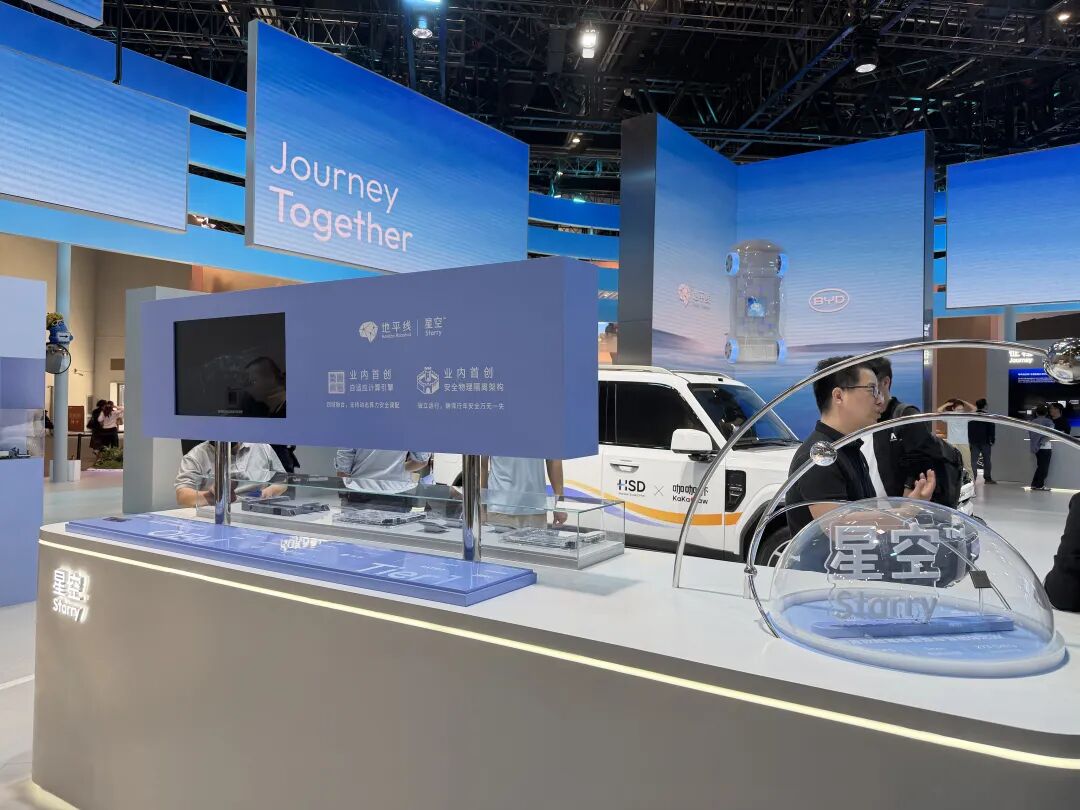
Horizon Robotics' booth was almost filled with the world's first mass-produced "cockpit-driving integration" software and hardware package, which was just released before the auto show - the cockpit-integrated vehicle intelligent body chip "Xingkong", the vehicle intelligent body operating system "KaKaClaw", and the intelligent driving system HSD 1.6 version.
A staff member of Horizon Robotics revealed to Caixin that the cockpit-driving integration solution equipped with Xingkong is expected to be mass-produced in June or July for the chip and system, the domain controller will be mass-produced 3 - 4 months later, and it will take another 2 - 3 months to be installed in vehicles. That is to say, by the end of this year or the beginning of next year, the above solution will be applied in mass-produced vehicles.
For manufacturers, the most direct benefit of "cockpit-driving integration" is cost reduction. For users, it brings an experience leap from "command execution" to "active understanding". More importantly, the technical path of cockpit-driving integration is highly consistent with the development logic of embodied intelligence. In other words, cockpit-driving integration is the closest real-world application of embodied intelligence in the automotive field.
Zhao Chunzhang pointed out that the core competitiveness of automobile manufacturers in the future comes from two aspects: First, strategic determination, that is, whether they can, based on their judgment of the future, invest core resources in key areas such as AI in the long term, even if there is no short-term return, to complete the accumulation from quantitative to qualitative change; Second, user perception, that is, the positioning of the brand in consumers' minds. If a brand is labeled as "traditional" or "technologically backward", even if its product functions are leading, it will be difficult to achieve a breakthrough.
In the future, a car will be far more than just a means of transportation. The idle computing power, energy, and people's time will form a business scenario with huge imagination space. This scenario will gradually become clear starting from the Beijing Auto Show.
This article is from the WeChat official account "Caixin WEEKLY". Author: Dong Xue, Yang Shier. Editor: Shi Ye. Republished by 36Kr with permission.