Auf der diesjährigen Peking Auto Show ist das Auto nicht der Hauptakteur.
At this year's Beijing Auto Show, the theme of "intelligence" was palpable everywhere. From the lowest level of high - performance chips to the introduction of the thinking of large AI models and finally to the gradual implementation of mass production of L3 self - driving vehicles - an intelligent transformation triggered by the close bond between the supply industry and automobile manufacturers is accelerating.
01
The Auto Show becomes an "Intelligence Show", and AI takes center stage
181 world premieres of vehicles, 219 press conferences... The 19th Beijing Auto Show, which opened on April 24th, has broken numerous historical records. The organizers said that this was the largest Beijing Auto Show of all time.
However, the significance of this auto show goes far beyond the numbers. It also marks the transition of the global automotive industry from the "first half" of electrification to the "second half" of intelligence - AI has undoubtedly become the core of the narrative of all automobile manufacturers. The auto show is not only a stage for vehicles but also a global guide for AI technology and business logic in the field of intelligent mobility offerings.
Lu Fang, Chairman and Party Cell Secretary of Voyah, said to "Caixin Global": "AI will restructure or even subvert the automotive industry, because future cars will inevitably be products deeply integrated with AI. Once this integration occurs, the product structure, organization, and even the business model will change. This is an inevitable trend. 'If we study cars in the future without also considering AI, we can almost be described as inactive.'"
Zhao Chunzhang, Head and Senior Advisor for the automotive industry at Ries Strategy Consulting, also expressed the same view. In his opinion, the central variable in the transition from electrification to intelligence is the technology represented by large AI models and AI capabilities. In the electrification era, performance mainly depended on the capabilities of the three - electric technologies (battery, electric motor, electronics). In the intelligence era, the ability to combine software and hardware will be more severely tested, and software capabilities even determine the upper limit of vehicle performance. "Automobile manufacturers that do not quickly adapt in this process are doomed to perish."
▲ Image source: "Caixin Global"
The new automobile manufacturers are the most radical group in this regard.
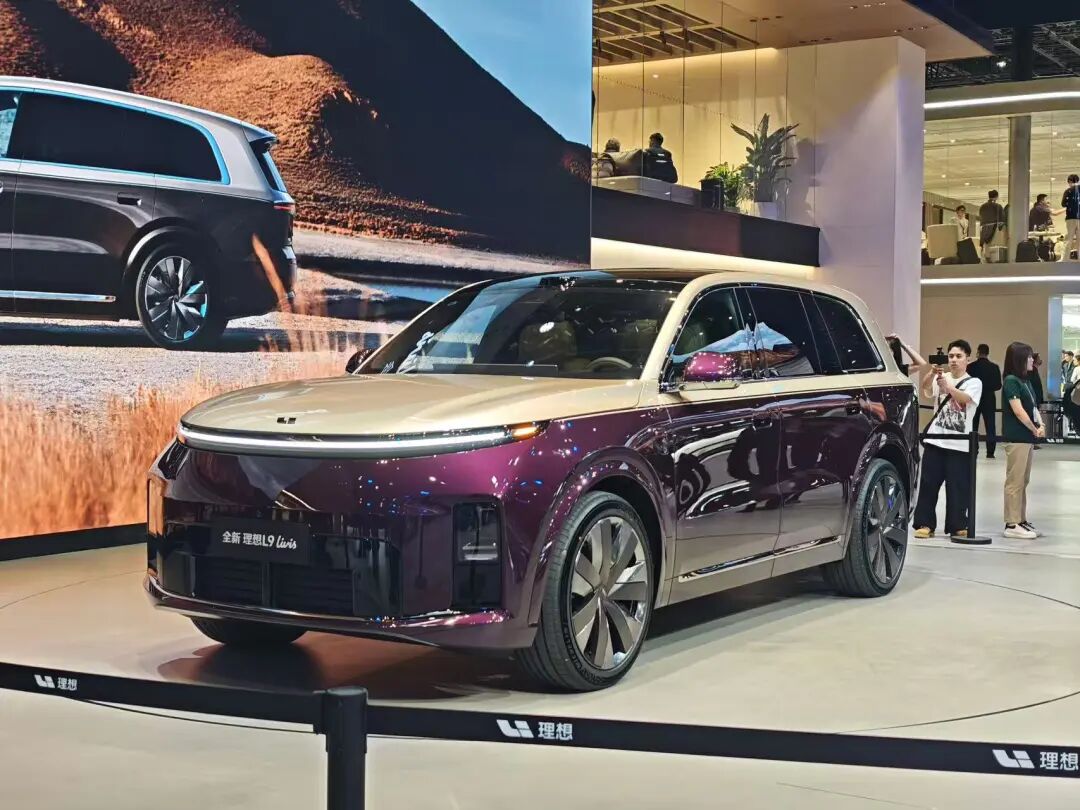
The Ideal L9 Livis of Li Auto, which is positioned as an "Embodied Intelligence Flagship SUV", had its world premiere at this auto show. The vehicle is equipped with two self - developed 5nm Mach 100 chips, and the total computing power reaches 2,560 TOPS. Li Xiang, CEO of Li Auto, enthusiastically talked about the design and details of the vehicle on stage. Almost everything was related to AI. When the atmosphere reached its peak, he demonstrated the anti - pinch function of the doors himself.
XPeng Group presented itself for the first time as a "physical AI technology company" at the auto show, with the theme "AI changes the world". The XPeng GX, which is positioned as an "AI New Luxury Six - Seater Flagship SUV", was introduced at this auto show. It is based on the XPeng SEPA 3.0 physical AI overall vehicle architecture and is called the first fully integrated and self - developed series robotaxi prototype in China. It is equipped with four Turing chips, and the computing power reaches 3,000 TOPS. In addition to the intelligent car business, XPeng Group also showed the new humanoid robot IRON and a "Land Cruiser" - a separate flying car.
Geely Automobile designed its exhibition hall in the form of a "half - sided pavilion" with the theme of "Geely Technology Ecosystem". There, its complete and systematic all - domain AI 2.0 technology concept was shown. For example, the first native robotaxi prototype "Eva Cab" was introduced. The vehicle was developed based on the Geely Quantum - AI - Electronics and Electrical - Architecture EEA 4.0 and integrates three chips: Nvidia SuperChip, Thor U, and Qualcomm Snapdragon 8797. The total computing power exceeds 3,000 TOPS. According to information, Geely will launch a customized version of Eva Cab for Cao Cao Mobility in 2027 to accelerate the large - scale commercial use of robotaxis.
SAIC Roewe has integrated a large AI model into its car for the first time and released the world's first AI - native automobile series "Jiayue". It has also cooperated with ByteDance Cloud Computing and integrated the Doubao - Large Model 2.0 series.
It's not only Chinese self - owned brands but also established joint - venture and luxury automobile manufacturers that are accelerating their preparations for a complete AI transformation. Oliver Blume, Chairman of the Board of Management of the Volkswagen Group, emphasized: "After the spread of electrification and advanced driver assistance functions, we are entering a new era in which AI agents will fully bring the car to life."
The Volkswagen Group has officially released the technology roadmap for "all - domain intelligent agent AI" and announced that starting from the second half of 2026, all new vehicles based on the CEA - Electronics and Electrical - Architecture will be equipped with a built - in AI agent. A locally trained Large Language Model (LLM) will be used as the core for natural language interaction to enable a more intelligent and safer cockpit experience. BMW has also actively participated in the local AI ecosystem by integrating the large models of Alibaba, DeepSeek, and the HarmonyOS ecosystem to deepen its intelligence strategy.
The automobile manufacturers' narratives about AI depend on the strength of the underlying supply chain.
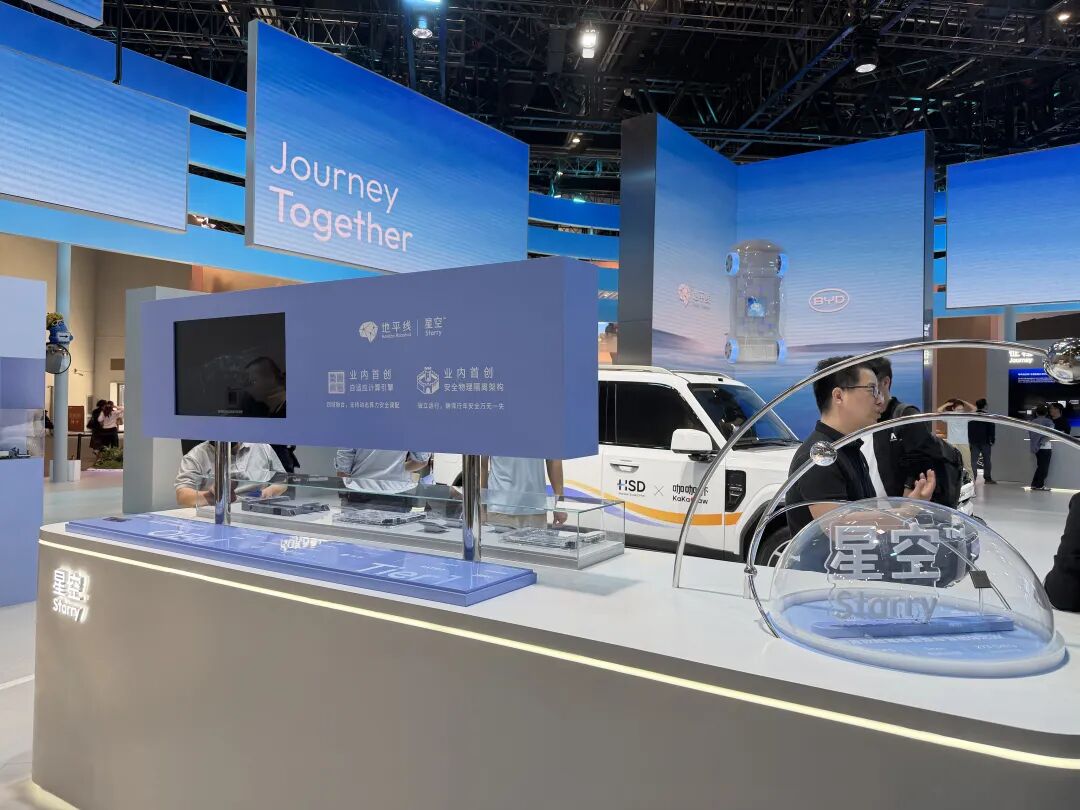
At previous auto shows, suppliers were separated from automobile manufacturers and had their own halls. At this Beijing Auto Show, core suppliers and technology companies have for the first time entered the main hall in large numbers and are facing the automobile manufacturers. Examples are Huawei Kunpeng, CATL, Horizon Robotics, Momenta, and others. CATL has its own 1,500 - square - meter exhibition hall at the entrance of Hall W4, where many luxury cars are exhibited, and it stands next to BMW and Porsche. In Hall B3, Horizon Robotics, WeRide, iFlytek are exhibited together with Toyota and Changan Automobile Group. Momenta has rented space in Hall B4 and is next to Hongmeng Zhixing, Leapmotor, and Volvo.
Zhao Chunzhang believes that the software and hardware of intelligent cars strongly depend on leading suppliers, such as the batteries from CATL and the driver assistance technology from Huawei Kunpeng. The technological strength of suppliers directly determines the product performance of the entire vehicles. This trend has not only changed consumers' purchasing habits but also brought suppliers from the background into the public eye, making them brands with an impact on end - consumers. Today, the brand status and influence of core suppliers are on the same level as those of automobile manufacturers and are a key force in the market.
It is noteworthy that Roborock Technology, since it announced in August 2025 that it would build cars, was represented for the first time as a "new automobile manufacturer" at the Beijing Auto Show. It had its own exhibition hall and showed two models there: the sports car Nebula NEXT 01 and the luxury SUV Nebula NEXT 01X. Each model was shown in two colors, a total of four vehicles. However, all the vehicles were surrounded by a telescopic barrier, so one could only view them from a distance and could not get closer.
02
Business leaders "visit each other" to gain technological attention
While press conferences jointly held by automobile manufacturers and suppliers have become the norm, the focus of the 2026 Beijing Auto Show was on the "T - shirt socializing" and "visiting other exhibitors" of CEOs.
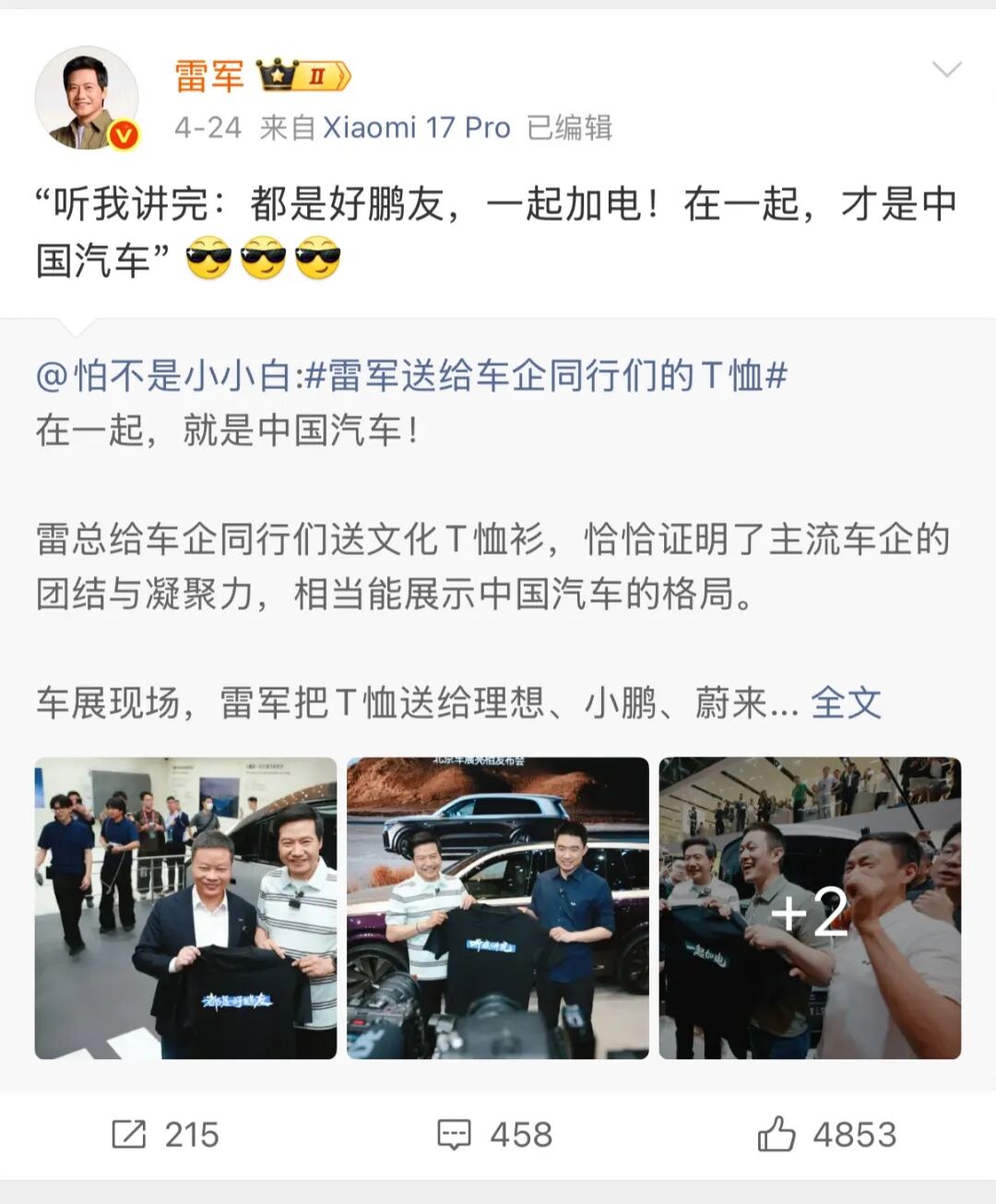
Lei Jun, the founder of Xiaomi, was like a "cheerleading squad". He gave four automobile business leaders individually designed T - shirts with special "memes": "Listen to me" to Li Xiang, CEO of Li Auto; "We are good friends" to He Xiaopeng, CEO of XPeng; "Let's charge together" to Li Bin, CEO of NIO; "Together we are the Chinese automotive industry" to Wang Chuanfu, Chairman of BYD. In addition, he gave Zhang Jianyong, Chairman of BAIC Group, a car model.
On the same evening, Lei Jun combined the four sentences in a Weibo post: "Listen to me: We are good friends, let's charge together! Together we are the Chinese automotive industry!"
▲ Image source: Lei Jun's Weibo
If the fun interactions of the CEOs add a human touch to this technological festival, the technological competition hidden behind the "visiting other exhibitors" outlines the three core forces of this auto show: "The rise of Chinese self - owned brands, the counter - attack of joint - ventures, and the rise of the supply industry".
Looking at the different camps, many of the "flagship" vehicles of Chinese brands have a very high technology content. Compared with previous times when they mainly increased the equipment in the cockpit, Chinese brands this time direct their "high - end" gaze towards the chassis. Without an electronic chassis or active chassis adjustment, one would almost be ashamed to be in the spotlight. These equipment items, which were previously only found in million - dollar sports cars, are now being offered by Chinese brands in vehicles in the price range of 400,000 to 500,000 yuan.
Chinese automobile manufacturers are coming on strong, and traditional luxury brands are not giving in. BMW has presented 16 vehicles from its three brands BMW, MINI, and BMW Motorrad. Four important models, such as the new BMW 7 - Series and i7, the new generation of the long - wheelbase BMW iX3, and the new generation of the long - wheelbase BMW i3, had their world premieres. The new generation of the long - wheelbase BMW iX3 was specially developed for the Chinese market and combines BMW's technology platform with a local Chinese intelligence solution to offer the Chinese market an "option that combines both worlds". The newly introduced worldwide Mercedes - Benz EQC and the newly introduced in China new S - Class sedan are both equipped with Momenta's driver assistance solution. Mercedes - Benz has also announced that it will equip most of its models with an AI cockpit and a driver assistance system in the next 9 to 15 months.
If traditional luxury brands are fixing their weaknesses in intelligence, Chinese manufacturers are only one small step away from starting the mass production of L3 self - driving vehicles. The Huawei Kunpeng ADS 5.0 system was officially introduced and will pave the way for the commercial use of L3 self - driving vehicles. Automobile manufacturers such as Li Auto, NIO, XPeng, and Voyah are already waiting with pre - installed hardware for the approval of L3 self - driving vehicles.
Lu Fang believes that high - quality driver assistance frees up the time of human drivers and thus also offers more room for imagination for business models in the intelligent cockpit. "Once one has free hands, the needs will be unlimitedly released, and one can do many things in the car." Lu Fang said to "Caixin Global".
While automobile manufacturers compete with each other, suppliers are also fighting fiercely.
With the increasing maturity of driver assistance technology, the concept of "cockpit - driver assistance integration" has become a hot topic at the auto show. "Cockpit - driver assistance integration" refers to the deep integration of the two systems of the intelligent cockpit and driver assistance to form a unified computing platform. As early as September 2022, Nvidia proposed the concept of "cockpit - driver assistance integration" and developed a chip named "Thor". Nvidia claims that the "Thor" chip can achieve a computing power of 2,000 TOPS and that a single controller based on this chip can simultaneously control multiple systems such as driver assistance and infotainment.
▲ Image source: "Caixin Global"
However, Nvidia was not the first to be able to implement the hardware and software of "cockpit - driver assistance integration" simultaneously. Instead, Chinese companies have taken a step ahead. This Beijing Auto Show was a concentration of Chinese "cockpit - driver assistance integration" solutions.
SenseTime has reached a strategic cooperation with T3 Mobility. The two sides will jointly promote the implementation of the intelligent driving solution for cockpit - driving integration and plan to start the trial operation of Robotaxis within 2026. Shortly before the Peking Auto Show, Black Sesame Intelligence also reached a cooperation with Dongfeng Motor. The Dongfeng Tianyuan Intelligent Cockpit Plus cockpit - driving integration mass - production platform will be equipped with the Wudang C1296 chip of Black Sesame Intelligence. The "cockpit - driving integration" solution will first be implemented in the Dongfeng Yipai 007 and will be extended to more models of Dongfeng within two years.
The exhibition stand of Horizon Robotics is almost filled