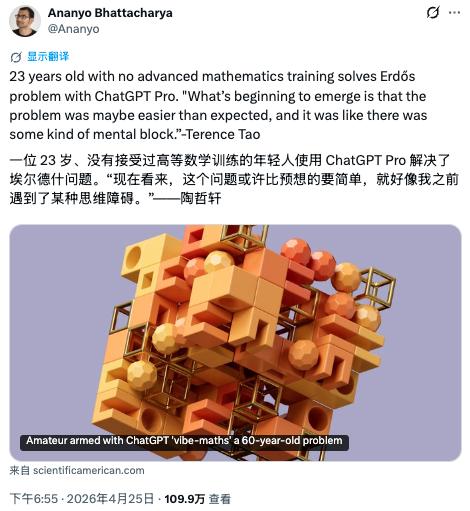
Just one hint: A 23-year-old amateur solved a 60-year-old math problem with ChatGPT. Terence Tao: All previous researchers went astray right from the first step.
A young man without systematic mathematical training advanced a classic problem that has puzzled the mathematical community for about 60 years with the help of ChatGPT.
This sounds like an exaggerated AI promotion story, but according to Scientific American, it really happened.
The protagonist is a 23-year-old young man named Liam Price. Without any advanced mathematical background, he entered a field long dominated by professional mathematicians with just a ChatGPT Pro account and a method called "vibe matching" (an exploratory approach that relies more on intuitive questioning and repeated trials).
What's even more surprising is that AI not only provided the direction of reasoning but also generated a proof path that had never been used by human mathematical researchers before.
This result later caught the attention and sparked discussions among scholars, including Fields Medalist Terence Tao.
The 60-Year-Old Unsolved Problem: Erdős' Primitive Set Conjecture
This breakthrough corresponds to a problem from the legendary mathematician Paul Erdős, and the core research object is the so-called "primitive set".
A primitive set refers to a set of integers where no number can be divided evenly by any other number in the set because they are related to prime numbers, which are also indivisible.
Previously, Stanford mathematician Jared Lichtman said, "A prime number has no other divisors. A primitive set is an extension of this definition from a single number to a set of numbers." Any set of prime numbers is naturally a primitive set because prime numbers have no factors other than 1 and themselves.
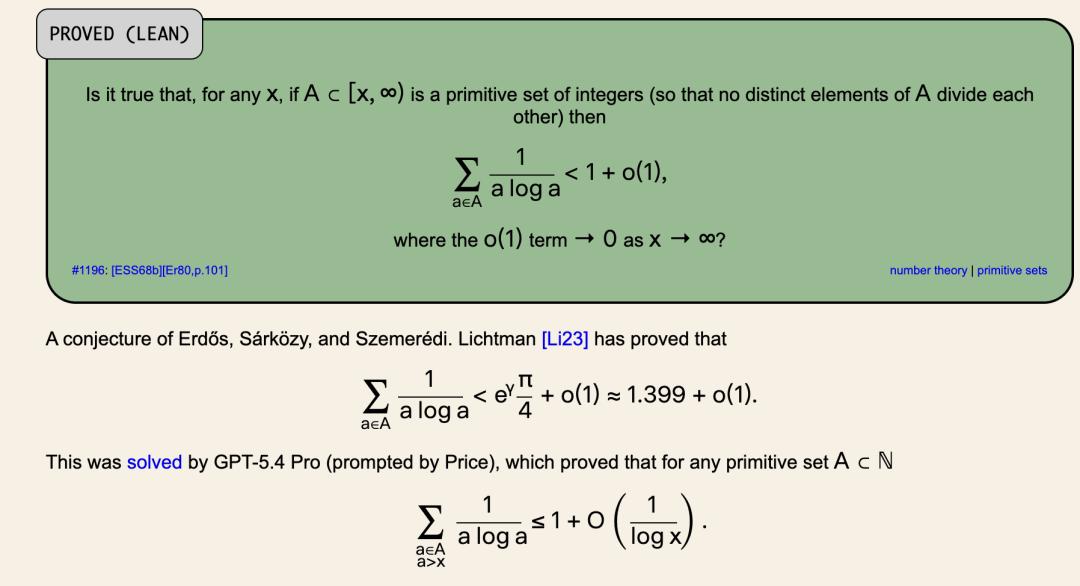
Erdős also proposed the "Erdős sum", which is a "score" that can be calculated for any primitive set. He proved that the maximum value of this sum is approximately 1.6 and conjectured that the infinite set of all prime numbers could also reach this value. In 2022, Lichtman proved Erdős' conjecture in his doctoral thesis.
Erdős also found that if the numbers in the set are large, the score will decrease - the larger the numbers, the lower the score. He guessed that the minimum value of this score is exactly 1, and when the numbers in the set approach infinity, the score will approach this limit infinitely.
Lichtman also tried to prove this but, like everyone before him, got stuck.
A Non-Mathematician Student Uses AI: From "Randomly Feeding Questions" to an Unexpected Breakthrough
Liam Price himself is not a professional mathematics researcher. His background is far from mathematical research, and this attempt is more like an experiment driven by interest.
On an ordinary Monday, he only gave one prompt to ChatGPT Pro. Without any preset ideas and without doing traditional literature preparation, he let the model conduct reasoning on its own.
Liam Price even said, "I don't even know what this problem is. I just occasionally work on Erdős' problems and throw them to the AI to see what results I can get. Then it gave a seemingly correct solution."
After getting the answer from ChatGPT, Liam Price sent it to Kevin Barreto, an undergraduate at the University of Cambridge who he had collaborated with before, and they verified the result together.
It's worth mentioning that at the end of last year, the two randomly selected unsolved problems from the Erdős problem website and tried to solve them with the free version of ChatGPT, thus starting a craze of "using AI to solve Erdős' problems". (Later, an AI researcher gave each of them a ChatGPT Pro subscription to encourage their "intuitive mathematics" approach.)
Finally, they confirmed that the overall logic of the answer given by ChatGPT was feasible and published the result on a research platform related to Erdős' problems, which caught the attention of the mathematical community.
AI Breaks Out of Human Fixed Thinking Patterns
Fields Medalist and UCLA professor Terence Tao commented that all previous researchers went astray from the very beginning and fell into a fixed thinking trap. However, GPT - 5.4 Pro completely broke out of the traditional framework and used a formula that is known in the mathematical field but has never been used for such problems.
Stanford mathematician Jared Lichtman added, "The original proof given by ChatGPT is actually very rough and needs to be sorted out by experts to really understand what it means."
Now, he and Terence Tao have streamlined the proof process and extracted the key insights of the AI. This idea is expected to be extended to other areas of number theory, rather than just solving a single problem.
Previously, although AI had solved many Erdős' problems, most of them were of limited difficulty and lacked innovation. This breakthrough is different:
The difficult problem has withstood the test of 60 years and has stumped many authoritative scholars;
AI provides a new methodology rather than optimizing existing solutions;
The result is transferable and provides a new perspective for the study of large numbers.
Terence Tao said, "We have discovered a new way of thinking about large numbers and their structures. This is a beautiful result, but its long - term significance remains to be seen."
The Threshold of Scientific Research Is Being Redefined
The real impact of this event is not just "AI helping people solve problems", but that the way of participating in scientific research is changing.
A person without systematic training entered a traditionally highly specialized research field through continuous interaction with AI and advanced the core problem to some extent.
This means that in the future, the key ability in scientific research may no longer be just "mastering knowledge", but whether one can effectively ask questions, guide the model, and adjust the direction in continuous feedback.
If this trend holds, the boundary of "who is doing mathematics" may become less clear.
Reference: https://www.scientificamerican.com/article/amateur-armed-with-chatgpt-vibe-maths-a-60-year-old-problem/
This article is from the WeChat official account "CSDN". Compiled by: Su Mi. Republished by 36Kr with permission.