Behind the blockbuster $200 million sales of a single curling iron, the new overseas expansion track of Chinese manufacturing.
In late April, the Information Office of Shenzhen Municipal People's Government released an article noting that Wavytalk, a local hair styling tool brand from Shenzhen, went global through TikTok Shop, posting a total cumulative revenue of over 200 million US dollars in the US market within three years. The related topic ranked third on the Shenzhen local trending list of Weibo.
The news, like a stone tossed into the cross-border e-commerce circle, has rippled widely in public view, reminding people once again of the vast overseas market and the potential wealth opportunities it holds.
In the fiercely competitive overseas beauty and personal care market, Wavytalk, as an emerging brand, has achieved its current revenue scale. This is not only supported by a solid supply chain foundation, but more importantly, it has accurately seized the dividends of the era when interest-driven e-commerce is booming in full swing.
The breakout success of Wavytalk is not an isolated case. The overall growth of the TikTok Shop platform has provided room for more similar merchants to develop.
Earlier, media reports revealed that the year-on-year growth rate of TikTok Shop's GMV (Gross Merchandise Value) in 2025 was close to 70%, making it the main driving force for ByteDance to increase its overseas revenue proportion. In the current global environment where traditional shelf e-commerce is generally facing peaking traffic and growth bottlenecks, this nearly 70% contrarian growth is particularly remarkable.
This traffic revolution driven by TikTok Shop is far more than the expansion of the platform's own business territory. It is subtly rewriting the global expansion genes of China's manufacturing industry, and providing a highly certain new channel for China's real economy to move towards the high value-added end of the global value chain.

01 Identity Transformation, Reshaping the Value Chain of Chinese Brands
Like the numerous factories scattered across the Pearl River Delta and Yangtze River Delta, many enterprises in the global expansion camp stayed at the bottom of the "smile curve" of international trade for a long time before their transformation: they have extremely mature manufacturing techniques and unparalleled supply chain efficiency, but could only earn meager processing profits in endless internal competition. The brand premium of products, channel profits, and even the most core pricing power are firmly controlled by overseas brand owners. For a long time, China's manufacturing industry has been "working for the benefit of others".
With the rise of early cross-border e-commerce, many factories tried to transform, but in the context of traditional shelf e-commerce, they soon hit an invisible ceiling that was hard to cross.
Hugh, Founder and CEO of Wavytalk, told 36Kr: "On traditional e-commerce platforms, we found that the biggest growth ceiling is that although we can sell products, it is difficult to build brand recognition and user loyalty at the same time."
This means that in the traditional global expansion model, products can only rely on price advantages, and it is difficult to precipitate into long-term brand assets.
It is at this industrial inflection point that the emergence of TikTok Shop reshapes the imagination space of going global.
In Hugh's view, TikTok is no longer a simple social media platform, and TikTok Shop does not belong to the traditional sense of shelf e-commerce. It is more like an ecosystem where content drives consumption. When users open TikTok, they usually do not have a clear purchase purpose. Instead, their interest is stimulated and emotions are aroused when browsing content, and they finally make consumption decisions.
"In content e-commerce, content is the shelf, and creators are shopping guides." In this process where content creation is deeply bound to consumption decisions, the brand value that was originally difficult to establish is accumulated imperceptibly.
With the help of the new model of interest-driven e-commerce represented by short videos and live streaming, countless Chinese enterprises trapped in homogenized competition have the opportunity to break through the limitations of traditional paths, successfully step from the huge and silent supply chain network behind the scenes to the front stage, bypass layers of distributors, and directly face hundreds of millions of consumers.
This leap not only means a substantial increase in profit margins, but also is the core process for enterprises to regain pricing power and build brand moats.
The rapid growth of TikTok Shop in overseas markets is turning into channel dividends driving the transformation and upgrading of China's industrial chain, empowering more real enterprises to climb to the high value-added end of the global value chain.
02 Interest-driven E-commerce Rewrites the Underlying Logic of Global Expansion
While marveling at the 200 million US dollars revenue of emerging merchants, we need to think more about: why new brands that are difficult to break through on traditional e-commerce platforms can achieve rapid growth in the short video ecosystem?
This is not accidental, but the restructuring of the traditional global expansion model by interest-driven e-commerce at the underlying business mechanism level.
First, it is the transformation brought by the "product finds user" model.
The underlying logic of traditional shelf e-commerce (such as Amazon, eBay) is "user finds product".
In the view of Jeremy, Head of Wavytalk TikTok Shop and Director of Social Media Operations, under this model "consumers usually enter the platform with clear purposes, and the conversion efficiency is very high, but it is difficult for brands to precipitate long-term assets."
If a new brand lacks popularity, or the product concept is too novel, consumers have no way to search for it, and the product will naturally face an extremely high cold start threshold.
While TikTok Shop launches the information flow recommendation mechanism of "product finds user".
For example, hair styling tools are naturally highly content-related. Selling points that are difficult to describe vividly in the graphic era, such as "straightens hair in one second" and "reduces hair frizz", can be displayed more intuitively in short videos. The visual effect of before-and-after comparison can instantly hit consumers' pain points, greatly shortening the decision-making link from "awareness" to "purchase".

TikTok creators share their experience of using Chinese hair styling tools
Secondly, it is the marketing leap from "selling goods" to "creating trends". TikTok has more than 1 billion active users around the world, most of whom are young people aged 18 to 35 with strong consumption power and passion for chasing trends. It is also the vane of global trends, with various topics on the platform gathering a large number of users to share and discuss. Chinese merchants can expand their influence and attract more users' attention by launching appropriate topic challenges and other forms.
In this ecosystem, brands no longer "promote" unilaterally, but build brand recognition through co-creation with users.
Wavytalk keenly captured the pain point of European and American women that "fine, soft and flat hair is difficult to manage", and took the initiative to launch the "#passyourwavytalk" bottle-passing check-in topic, which perfectly fits the globally popular social trend of "girls help girls".
In this relay, the product has turned into an emotional medium for conveying confidence and mutual assistance, successfully converting traffic into deep user resonance.
DTC (Direct-to-Consumer) data feedback that eliminates cross-border information gaps is another advantage of TikTok Shop.
A major pain point for Chinese enterprises to go global is that the design and production links are located in China, making it difficult to accurately grasp the real needs of overseas consumers. The interactive mechanism of TikTok Shop makes up for this information gap to a certain extent. Comments under short videos and interactions in live streaming rooms have become the "data brain" for factory micro-innovation.
Wavytalk's hit "curling comb" was iterated from the comment section. Hugh said that initially this curling comb was only an accessory in a set, but the team found that creators often focused on it when displaying products. "We judged that users had strong demand for this single product, so we quickly developed an independent version." Then, based on the real feedback from the comment section, they added multiple temperature settings and added negative ion technology to reduce frizz.
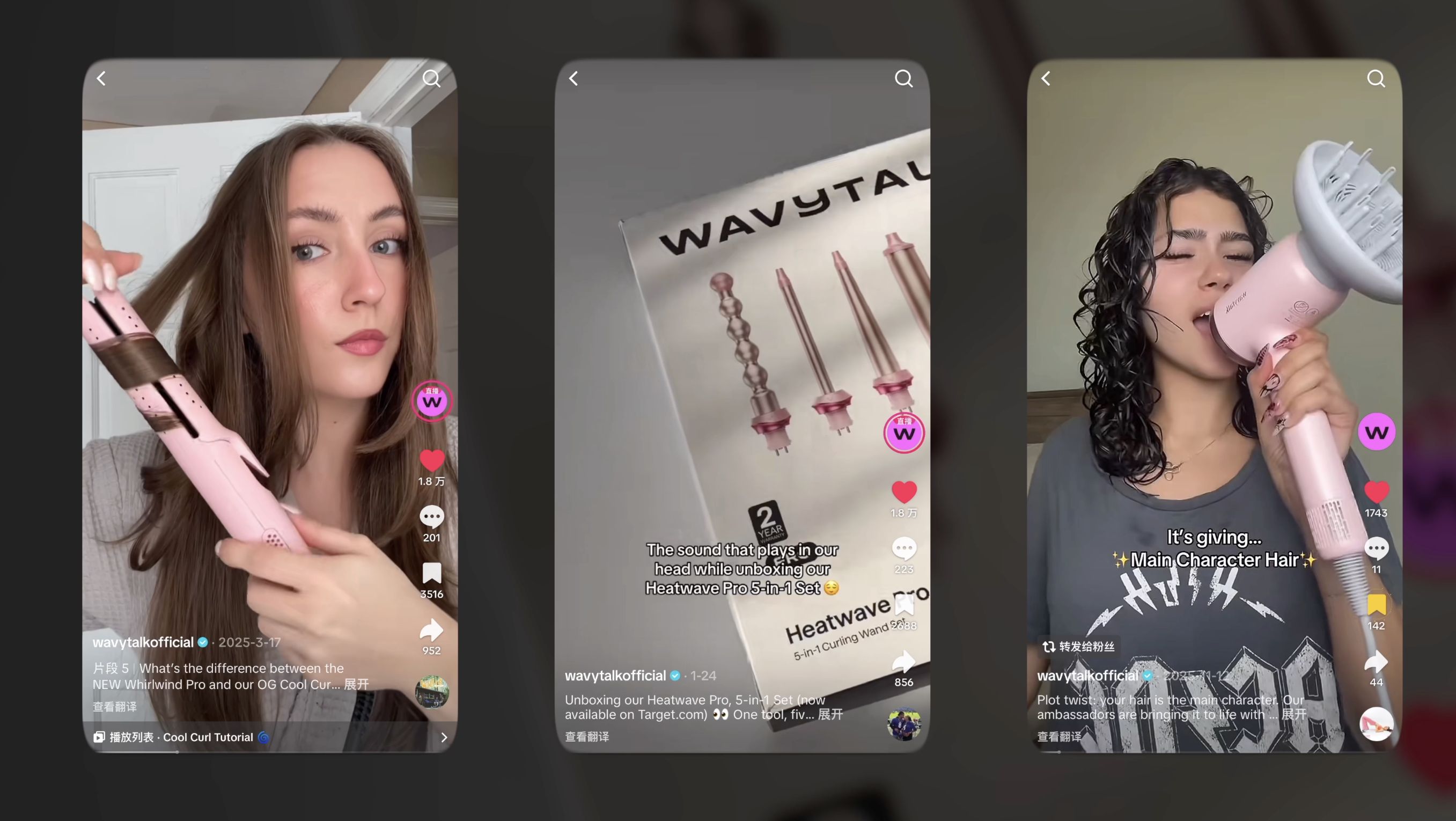
TikTok creators post videos to promote Chinese hair styling tool products
Good content is not only a sales tool, but also a product selection feedback channel. Gan Chuanwei and Zhang Chao, founders of the Dongguan-based marker pen merchant "Speed Sketch", noticed the daily feedback from the comment section that "left-handed people tend to smudge ink when writing". They worked with factory technicians to adjust the ink formula, and after two months of repeated testing, launched a "quick-drying pen" that directly targeted this pain point.
The success of this quick-drying product made Gan Chuanwei sigh: "In the past, when people talked about high-end marker pens, they recognized Japanese and German brands, but now Chinese merchants have taken the lead in innovation."
03 Collective Breakout of the New Globalization Array
For cross-border sellers, the brand awareness accumulated on TikTok Shop is not only limited to the platform, but also produces a "spillover effect" offline and on other platforms.
In the past, Chinese cross-border commodities were often labeled as "low-cost alternatives". Now, relying on the display dimension of content e-commerce, Chinese merchants have gradually established a brand image that combines innovation and quality after completing the initial incubation. The natural spillover of traffic has allowed many merchants to achieve growth on Amazon, independent sites, and even overseas offline supermarkets, expanding their global sales network.

In Yiwu, Zhejiang, Chen Kehan, founder of Youmei Technology Co., Ltd., set his sights on the personal care track, selling Hatteker hair removal devices. After operating on multiple platforms, the team finally focused heavily on TikTok Shop.
Chen Kehan calculated that most traditional platforms see slow "step-by-step" growth, while TikTok Shop brings a "pulsatile" surge. One of his women's hair removal devices saw its daily sales increase tenfold after a creator's video went viral. Li Chunlian, the business leader, concluded: "Traditional platforms adopt the model of stores facing users, while TikTok is communication between people, which is very authentic and has stronger user stickiness."
For Chen Kehan, behind the sales volume is the reshaping of brand dignity. He no longer wants Chinese factories to be pressed for bottomless low prices and lose their right to speak. "After the efforts of our generation of merchants, overseas purchasers also respect us very much. Now when I go abroad to attend small home appliance exhibitions, I am very confident, because I know that the stable channel of TikTok Shop online helps us sell products."
In Shenzhen, the capital of innovation, PetPivot, an automatic litter box merchant, has also achieved outstanding results.
Facing the unfamiliar overseas market, leaders Lena and Poppy did not blindly launch advertisements, but gave the autonomy of brand concept creation to creative creators on TikTok. Art creator kapgallery painted a starry sky pattern on the back of the litter box and painted the front as a spaceship, turning the practical tool into a home artwork. In just 7 months, the team made 200 million yuan, deeply implanting the warmth of Chinese design into the hearts of overseas pet owners.

In Dongguan, known as the "World Factory", plus-size women's clothing brand Finjani accurately insight into the pain points of the European and American markets.
Guo Hua and Li Hongsen, founders of Finjani, regard short videos as "invisible salespeople". A single hit plus-size dress has more than 1500 video materials, and its annual revenue exceeded 23 million yuan last year driven by live streaming.
Facing the severe challenges of overseas trade disputes and skyrocketing cross-border logistics costs, the "overseas warehouse" model launched by TikTok Shop provided timely help for them. By shipping goods to overseas warehouses in batches for distribution, the freight cost is greatly reduced, and the profit margin is successfully maintained.
Today, every piece of women's clothing shipped from China to Europe and the United States by Ruimin has its own brand LOGO, which is seen and truly remembered by more overseas people.
These business cases spanning different categories and regions jointly confirm a trend: as long as China's huge and high-quality industrial belts find the right channel to communicate with global consumers, they can burst out amazing energy.
The nearly 70% year-on-year ultra-high GMV growth rate of TikTok Shop means that there is still a vast blue ocean for interest-driven e-commerce. In this ecosystem, traffic is no longer an expensive consumable, but a lever that can be leveraged through creativity and content. This large-scale platform momentum not only greatly reduces the trial and error cost and cold start threshold of new brands, but also provides indispensable commercial infrastructure for the domestic industrial chain to move from simple "selling goods" to "building brands".
Back to the starting point of the story, Wavytalk making 200 million US dollars in three years with a single curling iron is by no means an accidental order explosion, but a microcosm of the era of China's manufacturing industry crossing the cycle with the help of new channels.
With the expansion of global expansion channels and the iteration of models, more and more Chinese real enterprises like Wavytalk are completely bidding farewell to the meager profit era of "working for the benefit of others". Riding the strong east wind of interest-driven e-commerce models such as TikTok Shop, driven by product innovation and content marketing, they are firmly moving towards high value-added global brands. This is not only the expansion of business territory, but also a true portrayal of China's manufacturing industry redefining its self-worth to the world and comprehensively climbing to the upper reaches of the industrial chain.