How to efficiently build your own knowledge system?
Who wakes up first from the great dream? I know myself throughout my life.
Currently, the economic anxiety lingers while the technological anxiety has emerged. Facing this era's proposition, how can we solve it? People have given the answer with their actions: efficient learning. No matter how technology develops, it only amplifies an individual's original abilities. The key lies in how to efficiently establish a unique knowledge system.
Is knowledge useless? No, it's that knowledge hasn't been put to use by you. Then, how can you create your own knowledge world? How can you integrate others' knowledge into your own system? How can you "be free from the cage and return to nature"? The answer is simple: learn from nature.
"What can I learn from you?" you ask nature.
Nature thought for a while and said, "Fractal."
What is a fractal?
In 1967, an article titled "How long is the coast of Britain?" in Science caught people's attention. People were puzzled: Why not just measure it? Why publish a paper on it? After a closer look, they found that the author, Benoît B. Mandelbrot, was exploring a far - more complex question.
Mandelbrot concluded in his paper that the length of the coastline is related to the length of the measuring ruler. The shorter the ruler used to measure the coastline, the longer the coastline. Even, when the ruler is infinitely short, the length of the coastline is infinite.
Infinite? How is that possible?! Of course, it's possible because the structure of the coastline is actually "self - similar."
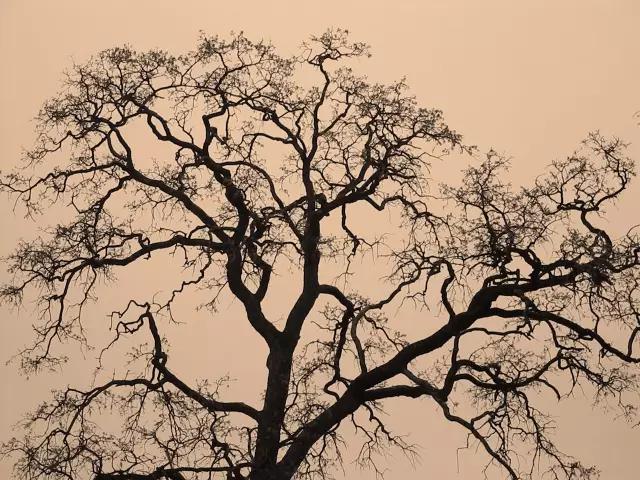
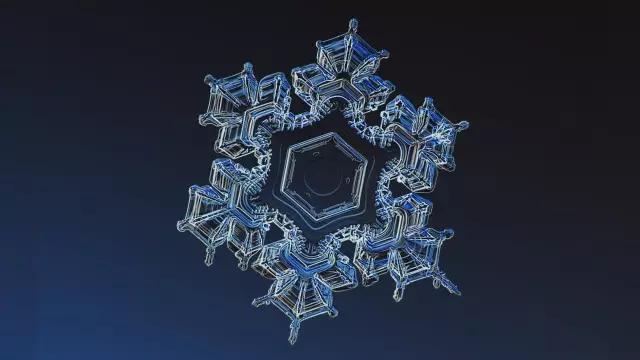
To understand the concept of "self - similarity," take a look at these two pictures. Observe if there are any similarities in their shapes?
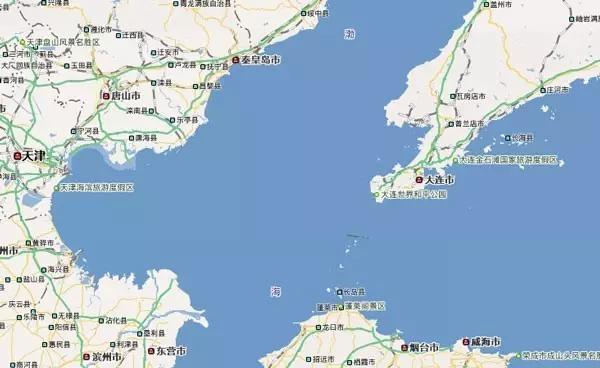

Do you see the similarities in their structures? Yes, they both have a cone - like structure. If we look at the coastline from a more macroscopic or microscopic perspective, we'll find that everywhere there is this "the structure of the local part is a miniature of the whole." This is "self - similarity."
It might be difficult to understand the real world at once. So, let's take a look at the ideal model constructed by the Swedish mathematician Koch based on this concept - the Koch curve.
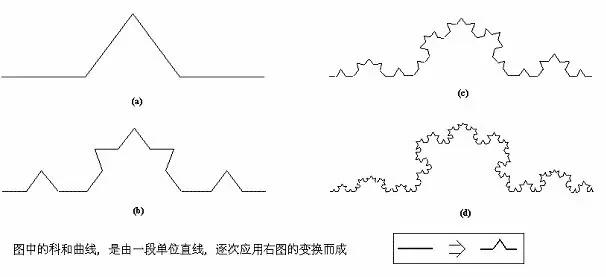
The Koch curve is obtained by continuously applying the following rules:
Start with a straight line;
Divide each line segment into three equal parts, and replace the middle part with two sides of a triangle, with each side being 1/3 of the original line segment;
Apply the Koch curve rules to the generated figure again and continue.
By continuously applying this rule, each time the Koch curve changes, its length becomes 4/3 of the original. Therefore, the length will become infinite. This is why the length of the coastline changes with the measuring ruler.
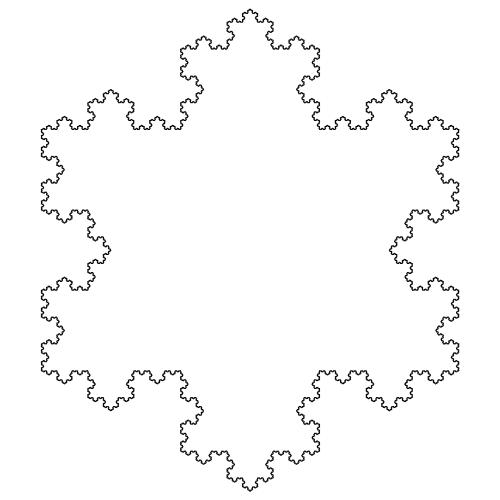
Such "a rough or fragmented geometric shape that can be divided into several parts, and each part is (at least approximately) a reduced version of the whole" is called a fractal.
Simply put, if a part of a figure, when magnified, is similar to the original figure, then it is a fractal.
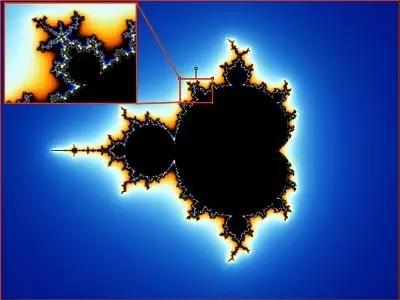
Applications of fractal theory
By now, you may have some questions. Fractals are beautiful, but what are they useful for? Why do we need to learn fractals from nature? As the saying goes, we can use the stones from other mountains to polish our jade. Before learning, let's first see how people in other fields use fractals.
When Mandelbrot published his paper in Science in 1967, he didn't propose the term "fractal." It wasn't until 1983, in his book "The Fractal Geometry of Nature," that he first fully proposed the term "fractal" and elaborated on it.
The book mentions that fractals exist in various structures in nature. For example, uneven mountains, ever - changing clouds, winding rivers, criss - crossing branches, and crystal - clear snowflakes... All are "self - similar" fractal geometric structures!
Before Mandelbrot proposed the fractal theory, people mostly used Euclidean geometry to describe the world, that is, well - known regular figures such as triangles, rectangles, and circles. But scientists found that Euclidean geometry can't describe the complex nature at all! How can you describe a small stone with a circle or a square? Is it enough to describe a mountain with just a triangle? The emergence of the fractal theory solved this problem.
This has greatly promoted computer simulation. For example, when generating natural environments such as leaves and mountains, using the fractal theory often produces more realistic results.
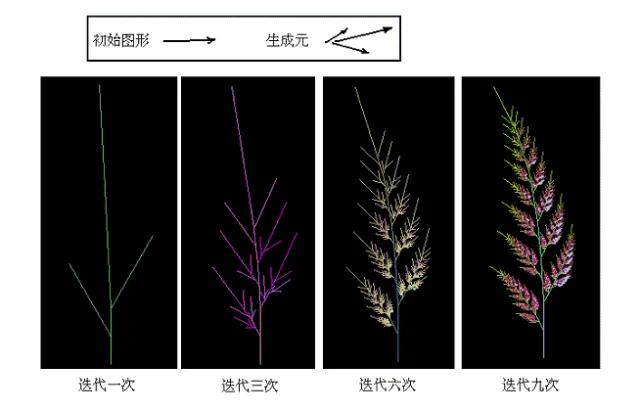
Just give an initial formula, and the computer will automatically generate trees. By simply modifying the parameters, different trees will be generated immediately.
Do you understand now? This determining an initial structure and then continuously generating "self - similar" structures at different scales is the law of knowledge world generation taught by nature to humans!
Fractals and the knowledge world
Currently, most of the knowledge people absorb is fragmented and scattered, rarely being complete and systematic. In this case, if you don't have a solid knowledge world to integrate these fragmented knowledge into your ecological cycle, no matter how much you learn, it will just pass by in your life.
How to create your own knowledge world? You need to first construct your own "initial structure" according to the specific situation. Here, let's take books as an example.
When you open the table of contents of a book, what will you see? You'll see this structure:
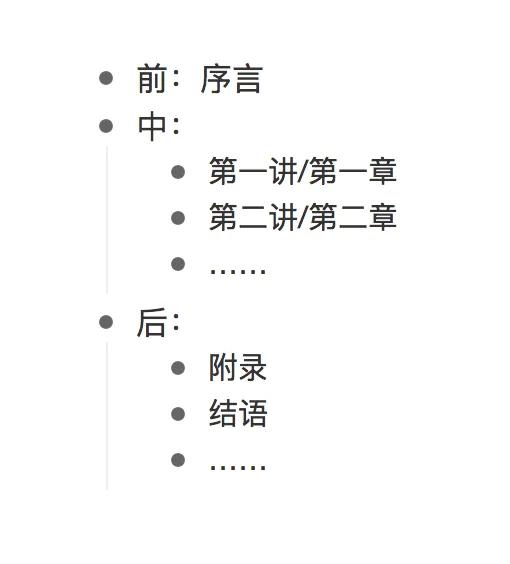
No matter how many chapters or pages there are in the middle of the book, the whole book is divided into three main parts: beginning + main body + end.
The beginning usually includes prefaces, recommendations, etc., aiming to introduce the book and provide some background and summary information for readers; the main body is the core part of the whole book, divided into different chapters, used to answer or explain the questions or purposes raised in the beginning; the end mainly includes conclusions, appendices, references, etc., used for some supplements or to provide some information support.
For example, the structure of the book "The Smart Reader" is roughly as follows:
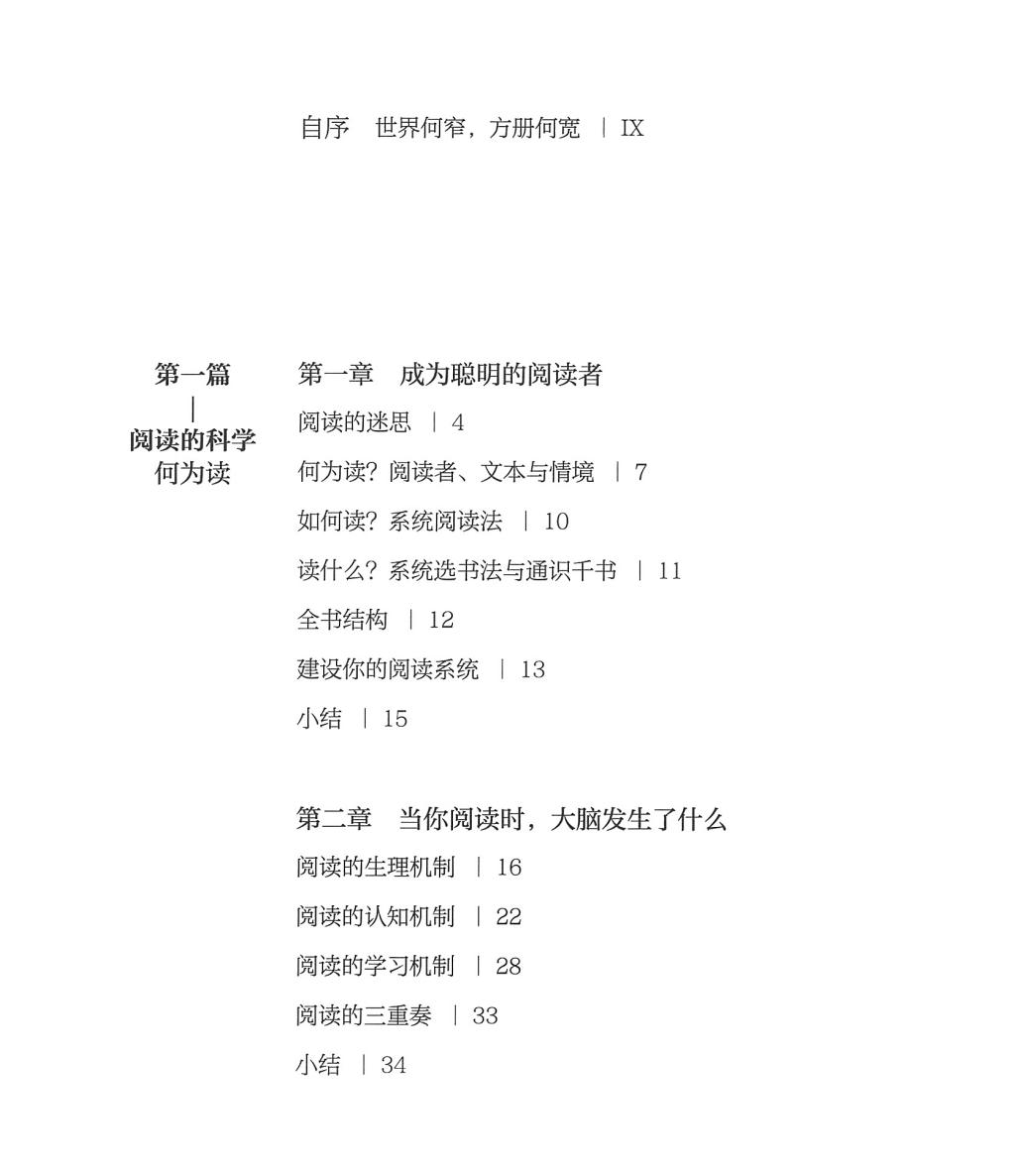
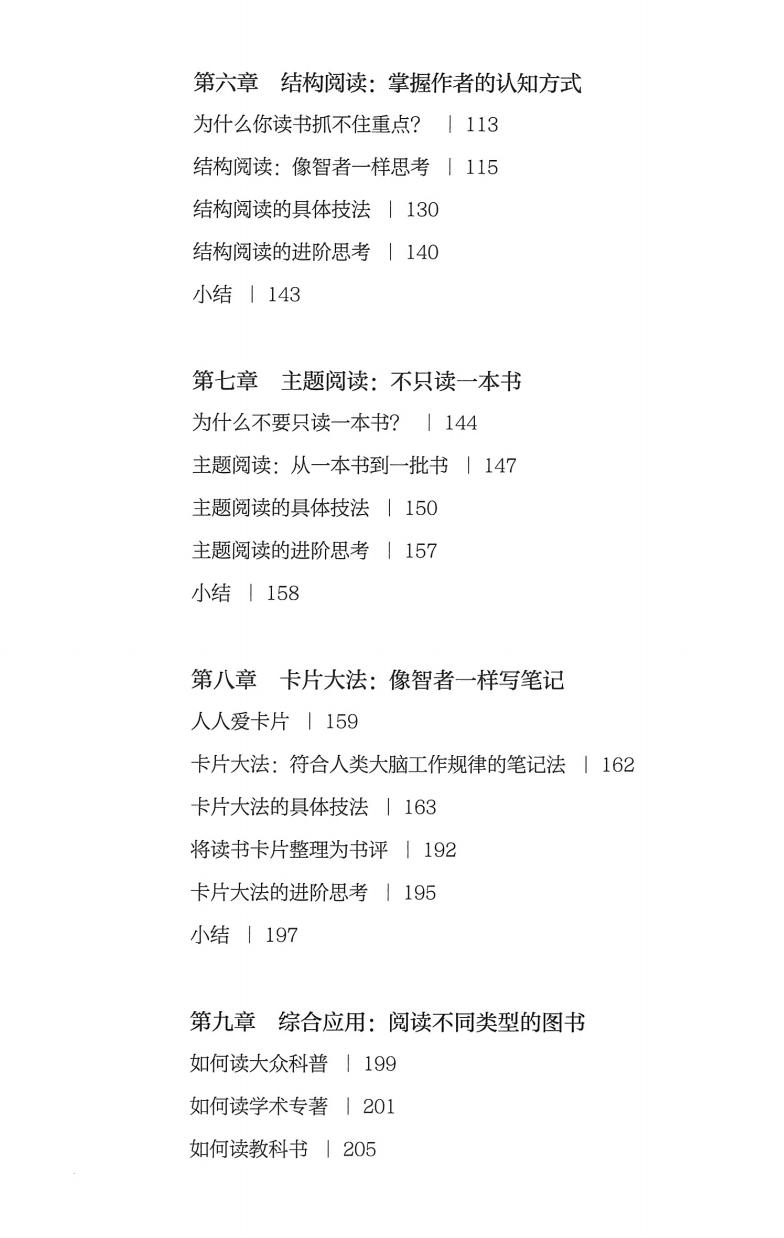
Beginning, main body, and end. This is the "initial structure" of a book. So, where does its "self - similarity" lie? For example, at the article level (such as this one), it also has a "self - similar" structure of beginning (explaining what the article is about), main body (detailed discussion and examples), and end (information supplement).
For academic books, a chapter also has a structure of beginning (theories, concepts), main body (arguments, applications), and end (exercises, thinking questions).
If it can be "self - similar" on a smaller scale, what about on a larger scale? Of course, it can. For example, when learning a certain subject, you need to read multiple books. At this time, you can still use this structure to organize materials:
1. Beginning: This part includes introductory books and popular science books on the subject, such as "Principles of Economics" in economics, aiming to understand what aspects the subject specifically studies;
2. Main body: This part includes various classic books on the subject. Taking economics as an example, you can put books on macroeconomics, microeconomics, etc. in this part, aiming to understand the subject in - depth from different perspectives;
3. End: This part includes the latest papers on the subject, some special applications, etc., aiming to supplement the textbooks.
In this way, by determining an "initial structure" and continuously forming "self - similar" structures at different levels, your knowledge world is formed.
Benefits of building a knowledge world
Steven Pinker wrote in "The Sense of Style":
Writing is to organize the network - like thoughts into linearly - presented text through the tree - like syntax.
Building your own knowledge world is to re - weave the linearly - presented text into your own network - like thoughts. There are many benefits to doing this, generally in three aspects:
1. Facilitate understanding and memory
Since it is your own thought, understanding will be thorough.
Different from the well - known view that "understanding can help remember knowledge," Zhang Wuchang believes that understanding is a substitute for memory.
Memorizing theories by rote is not only difficult to remember accurately; when it comes to application, rote - memorized theories are useless. Once you understand the basic concepts and meanings of the theories, you'll suddenly find that your memory is greatly enhanced. The reason is simple: you don't need to memorize what you understand.
However, there are different depths and accuracies in understanding theories. The deeper and more accurate the understanding, the clearer the memory, and the more proficient you'll be in application. So, when reading, you need to have a thorough understanding - understand the relationships between different key points in the theory; be thorough - be clear about the evolution of concepts or principles.
In this way, by creating your own knowledge world, with the help of understanding, the amount of knowledge you can remember will double.
2. Facilitate interdisciplinary learning
If nature can apply fractals to mountains, rivers, and trees, why can't you?
By creating your own knowledge world, you can apply it to different fields. Whether you're learning writing or programming, literature or physics, you can continue to be "self - similar" in different disciplines and conduct interdisciplinary learning.
The investor Munger is a master of interdisciplinary learning. He tells us that connecting the thinking models of different disciplines to form an integrated grid is the best decision - making model for investment. Thinking about the same investment problem with the thinking models of different disciplines, if the same conclusion can be drawn, such an investment decision is more correct.
Similarly, not only in investment, interdisciplinary learning can help you make judgments and decisions in more areas.
3. Facilitate continuous output
Since you've created a knowledge world, it should not only be used for learning but also for output.
During an interview, the greatest writer of the 20th century, Nabokov, was asked:
How do you write? What's your writing method?
Nabokov answered like this:
I don't start writing from the beginning and write chapter by chapter to the end. I just fill in the blanks on the picture, completing the jigsaw puzzle that is quite clear in my mind. I take out one piece here, another piece there, piece together a corner of the sky, then the scenery of mountains and rivers, and then - I don't know, maybe a drunken hunter.
Most people who are not good at writing have unclear thinking rather than being unable to express. Once you have a definite knowledge structure, all you need to do is fill in the information according to the established structure.
Conclusion
The sun and the moon seem to rise and set within it; the stars and the Milky Way seem to shine from it. After the knowledge world is built, whether the learning is fragmented or holistic no longer matters because you know it will operate according to the laws of the world.