Chinese cars are using the "era of price hikes" to counter the "sales slump".
"I've never been so looking forward to a Beijing Auto Show."
After a long moment of contemplation, a sales manager of an automobile brand uttered this sentence, which hides a dual - toned background: the bright color represents hope, as he anticipates that the Beijing/Shanghai Auto Show, currently the world's largest, can stimulate the market to recover; the dark color indicates that the sales volume of the Chinese auto market in March still hasn't picked up.
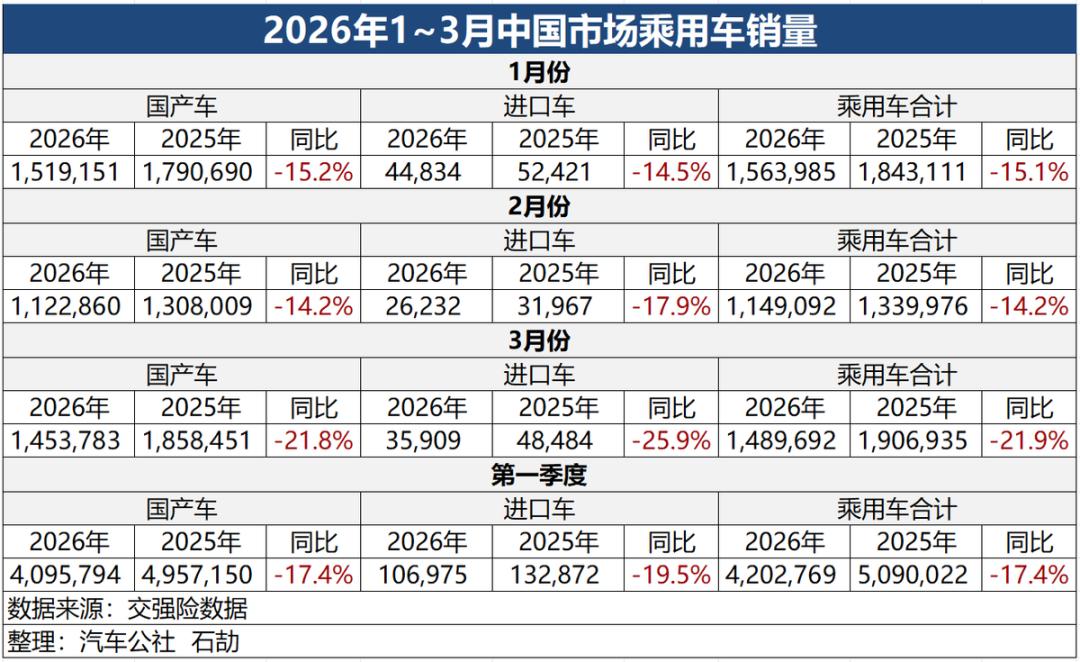
According to the insurance registration data compiled by Auto Commune, in the domestic passenger - car market last month, both domestic and imported cars saw a year - on - year decline of over 20%, with an overall year - on - year decline of 21.9%. In January and February, which many industry insiders complained about, the decline was around 14 - 15%.
In the third week of April, retail sales even plummeted by 33% year - on - year.
However, this is not just a description of the downturn in the auto market. If we lift our eyes from the fluctuations of monthly sales data, we will see a deeper contradiction: common sense tells us that "if sales are slow, lower the price", but the prices of new cars are quietly rising.
"The shrinkage of small - car sales is due to the phasing out of policies", but the structural change in the market is not the only reason. Terminal data shows that price discounts are indeed not as high as in the peak period of 2022. When the macro - economy hopes to adjust slightly from deflation to inflation, the automobile industry is no exception.
Price increases and decreases coexist, like ice and fire in the same furnace. This is not an industry scenario that can be understood with simple linear logic. Its essence is not a sudden price change, but an inevitable backlash and positive regression at a specific stage of industry development.
If we want to deeply deconstruct the seemingly abnormal consumer sentiment, we must delve into the uppermost reaches of the cost chain, the innermost part of the technical route, and the value logic quietly redefined on the auto - show stands.
In the past few years, price wars have shrouded the Chinese auto market. From the "involution - style price cuts" of new - energy vehicle manufacturers to the "inventory - clearing sales" of traditional fuel - powered vehicles, each round of price cuts has been accompanied by a contraction of automakers' profits and pressure on the industrial chain.
When the price of lithium carbonate rebounds strongly and the supply of automotive - grade chips is tight, when policies start to regulate the market order and pure - electric technology makes a qualitative breakthrough, this long - brewing price - increase wave has finally broken the deadlock of the price war and announced that the Chinese automobile industry has officially bid farewell to the "low - price - only theory" and entered a new development cycle centered on value.
Therefore, the 2026 Beijing Auto Show is not only a "lifeline" to boost market demand but also a turning point for the reconstruction of the logic of the Chinese automobile industry.
Seeing Price Increases Amidst Declines - Price Wars Can't Go on Indefinitely
The market sales are declining, while the prices of cars are rising.
"The price of the Performance version has indeed exceeded 400,000 yuan. We are a direct - sales store, and the price is set directly by the company." From the Juran Home North Fourth Ring store to the Laiguangying Tesla Center, in several Tesla stores I visited recently, the salespeople almost all told a similar story, with the core meaning being that "the price of the Model Y Performance version has increased."
A friend who accompanied me on the store visits said complacently, "It seems I was quite prescient in buying a new car last year."
Carefully considering the statement "The Chinese auto market has entered the era of price increases", it can be divided into three dimensions.
Firstly, there is the intuitive "structural increase in the price of individual vehicles".
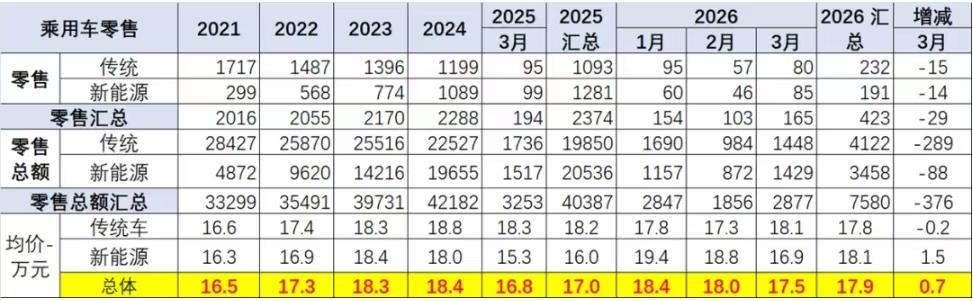
According to the statistics of the Passenger Car Association, the average retail price of passenger cars was 165,000 yuan in 2021, rising all the way to a peak of 184,000 yuan in 2024; it dropped to 170,000 yuan in 2025 but rebounded to 175,000 yuan in March 2026.
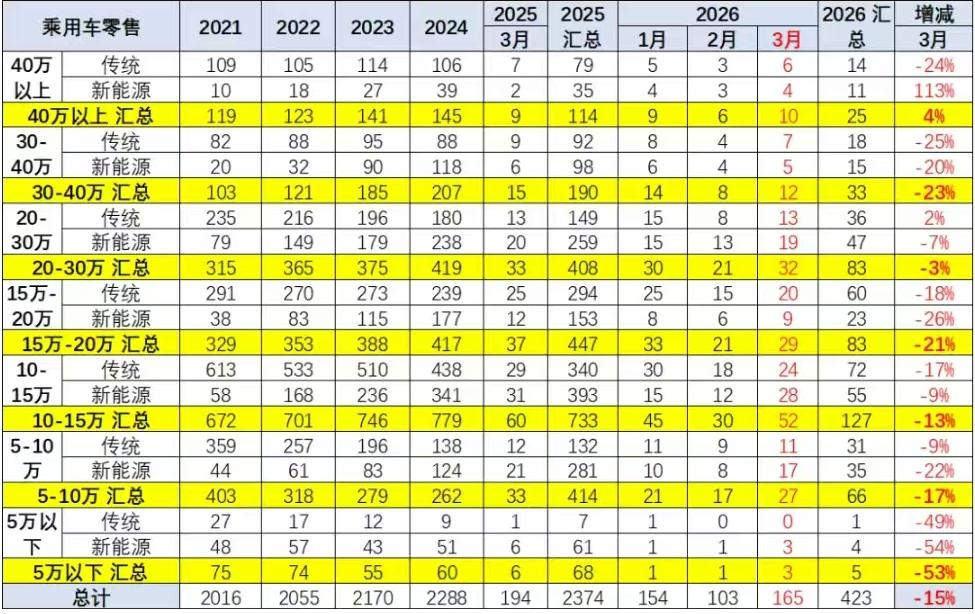
Many observers who pay a little attention to the auto market can blurt out without hesitation that "the average price has increased because the small - car market has been hit by the phasing out of policies". Indeed, the sales volume of low - price cars under 50,000 yuan plummeted by 53% year - on - year in the first quarter of this year.
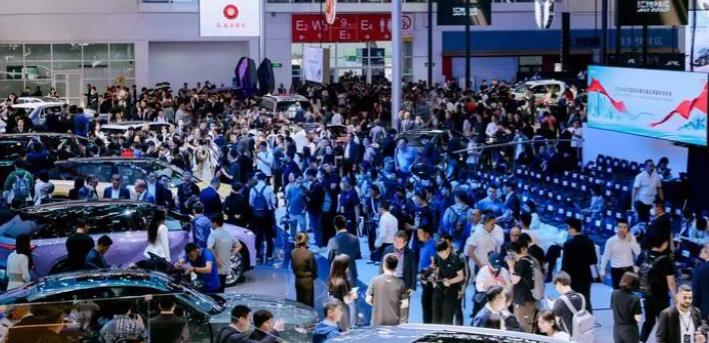
The new cars at the Beijing Auto Show are still led by large - sized vehicles.
The new Wenjie M9 is fully equipped with the latest intelligent driving system with 6 lidars and the Hongmeng cockpit 6; the NIO ES9 aims to replicate the success of the third - generation ES8, while the LeDao L90 simply inherits the Shenji 9031 and lidar; the new - generation Li L9 is equipped with an 800V magic - carpet suspension, claiming to have handling comparable to that of a Ferrari sports car; in addition to the new GLC, the most important model from Mercedes - Benz is the new S - Class, with a mid - cycle facelift comparable to a full - model change.
Some even have dual flagships: In addition to extreme charging capabilities, the BYD Sea Lion 08 realizes AI multi - modal interaction in its intelligent cabin, while the Datang focuses more on business and stability; Geely combines the Zeekr 8X and 9X to form a sports - flagship + luxury - flagship combination; Great Wall's Wei brand will launch the V8X after the V9X; behind the Leapmotor D19 is the D99.
The second dimension is the exploration of higher - end product categories.
As the sales leader of Huawei's Hongmeng Smart Mobility, the Seres Wenjie has finally broken through the 600,000 - yuan price ceiling with the M9 Ultimate, with a pre - sale price starting from 669,800 yuan.
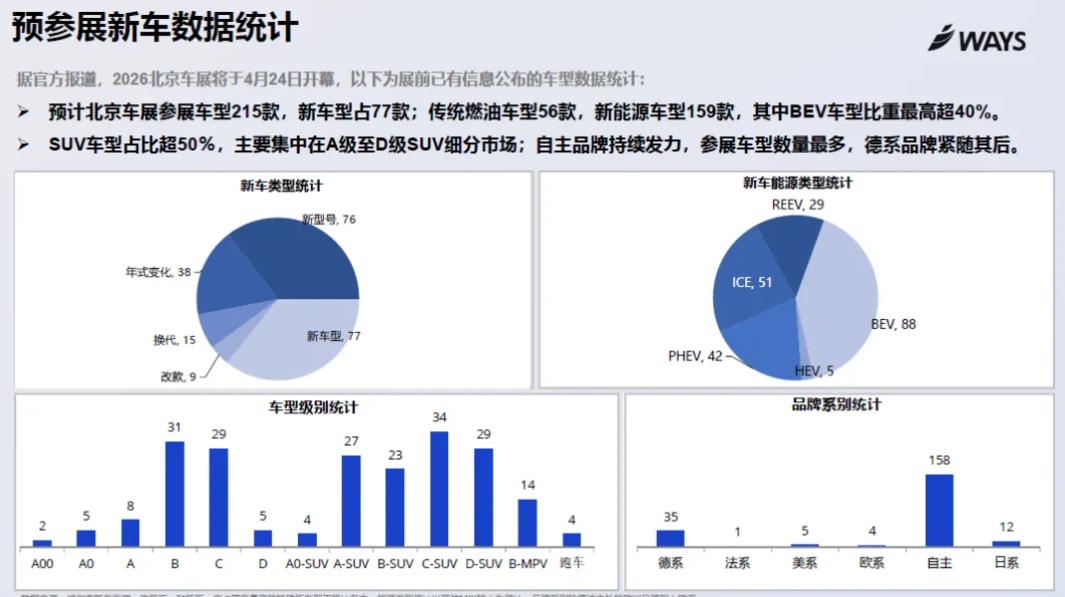
According to the statistics of Wilson, among the 215 exhibition models counted by the institution at this auto show, there are 29 C - class mid - to - large sedans, as many as 34 C - class mid - to - large SUVs, and even 29 D - class full - size SUVs.
But the third dimension is the real price increase.
After the Spring Festival this year, starting from the Xingtu ET5 and the Bestune Xiaoma Yueyi, 15 models once announced price increases.
Different from the previous "temporary promotional price cuts for cash - flow recovery", this price increase is a "genuine increase in the official guide price". The high - end version of the Xingtu ET5 has increased by 5,000 yuan, and the previously free intelligent - driving package is now priced separately; the Bestune Yueyi 03 has increased its mid - to - high - end prices by 2,000 to 5,000 yuan under the pretext of adding more features.
This is not an isolated incident. Tesla took the lead, raising the price of the Model Y Long - Range version from 357,900 yuan to 375,900 yuan and the Performance version from 397,900 yuan to 417,900 yuan, completing two price adjustments within a week.
Xiaomi followed suit, with the new - generation SU7 increasing the price of the whole series by 4,000 yuan compared with the old model. However, Lei Jun admitted that the material cost alone had increased by nearly 20,000 yuan, and this price increase was the result of cost - compression.
BYD followed on March 16, raising the prices of many best - selling models in the Dynasty and Ocean lineups by 3,000 to 6,000 yuan, covering popular models such as the Song PLUS, Han, and Seal. The Avatr 12 had the largest price adjustment, with the pre - sale price increasing from 269,900 yuan to 299,900 yuan, a direct increase of 30,000 yuan in the entry - level price.
If the first two dimensions can be attributed to structural adjustment and partial consumption upgrading, then the third dimension is a combination of "correction" and "helplessness".
Correction is, of course, the correction of past price wars. And helplessness is closely related to the soaring prices of upstream raw materials.
The average price of battery - grade lithium carbonate soared from 75,000 yuan per ton in July 2025 to about 170,000 yuan per ton in March 2026, an increase of more than 130%. This alone increased the battery cost of each vehicle by 3,000 to 5,000 yuan.
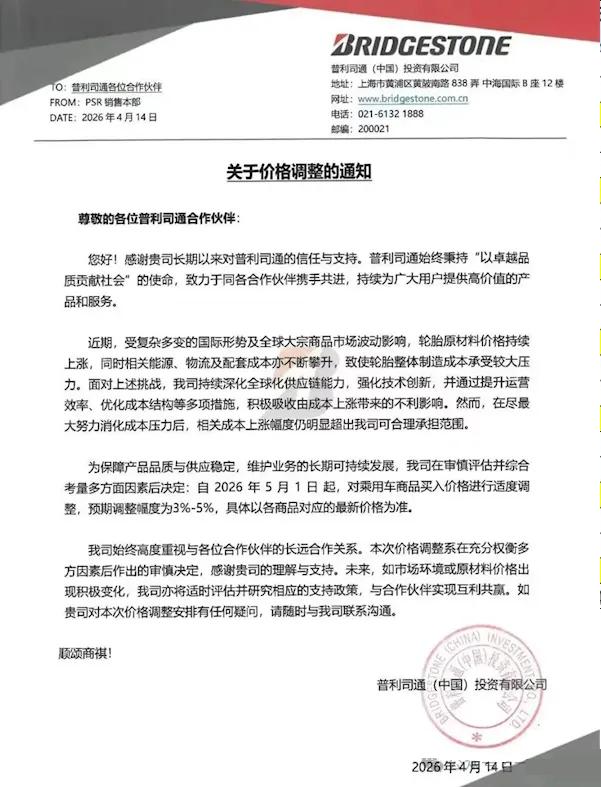
Since mid - April 2026, the Chinese tire industry has witnessed the second price - increase wave this year, with more than 70 tire companies issuing "price - increase notices". The price increase of passenger - car tires is generally between 2% and 5%. Drought in natural - rubber producing areas, the doubling of the prices of some synthetic - rubber varieties due to the soaring crude - oil prices, and a 13% monthly increase in carbon - black prices due to environmental - protection production restrictions... The production cost of all - steel tires in March soared by nearly 7% compared with January.
Meanwhile, the explosive growth of the AI industry has rapidly squeezed the production capacity of automotive - grade chips, and the price of memory chips has soared by nearly 300%. The chip cost per vehicle has increased from 700 yuan to 2,000 yuan.
Another pressure comes from policies. Since 2026, the purchase tax for new - energy vehicles has been adjusted from full exemption to half exemption, with the maximum exemption amount reduced to 15,000 yuan. The on - road price of a 200,000 - yuan car has directly increased by about 9,000 yuan.
The conclusion estimated by UBS is even more suffocating - with the superposition of several factors, the cost of an ordinary mid - sized intelligent electric vehicle will soar by 4,000 to 7,000 yuan.
Therefore, before and after the Beijing Auto Show, the "price increase" and "value increase" of cars have begun to show signs, and the meaning of correction and helplessness is self - evident.
The Era of Pure - Electric Vehicles is Also the Era of Price Increases
When the war in the Persian Gulf drives up oil prices, the Chinese auto market thousands of miles away is also affected.
"I'm worried about not being able to afford gas, so I choose a pure - electric vehicle." More than one friend expressed this when buying a car after March this year.
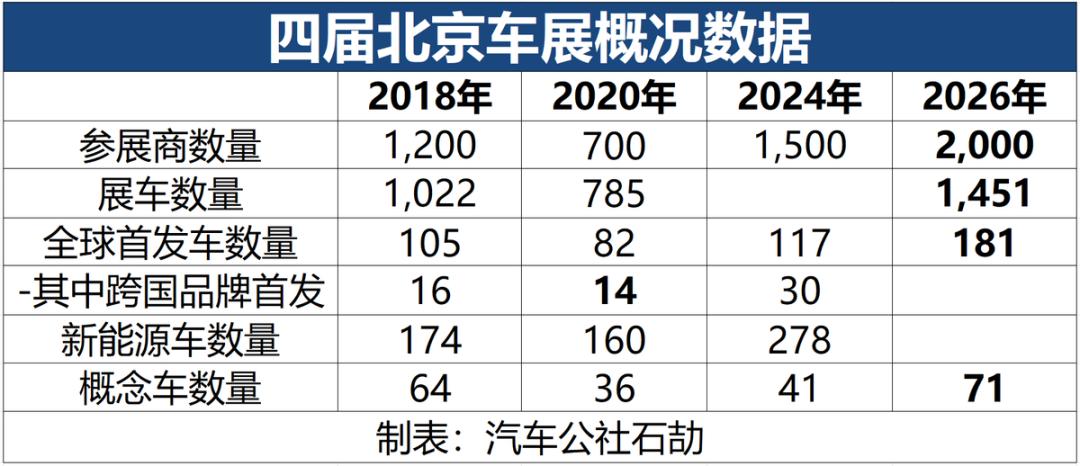
Two figures at the 2026 Beijing Auto Show are worth remembering: there are a total of 1,451 exhibition vehicles, and 181 are global premieres.
But the real signal that transcends time and space is hidden in the detailed statistics of Wilson: Among the 215 exhibition models, 159 are new - energy vehicles, accounting for more than 70%; and there are as many as 88 pure - electric vehicles, not only exceeding the 56 fuel - powered vehicles but also surpassing the sum of plug - in hybrid and extended - range vehicles.
This data forms a sharp contrast with the market trend of the "Year of Plug - in Hybrids" in the previous two years. The keywords in 2024 and 2025 were "both gasoline and electric available", and the extended - range version once became the "standard configuration" for a model to achieve monthly sales of over 10,000 units. However, judging from the overwhelming position of pure - electric vehicles at the 2026 Beijing Auto Show, the trend has completely reversed.
According to the domestic passenger - car retail - sales data for March 2026 provided by the Passenger Car Association, the sales of pure - electric vehicles decreased by 11.7% year - on - year to 644,000 units, plug - in hybrids dropped by 23.5% year - on - year to 204,000 units, and extended - range vehicles declined by 6.0% year - on - year to 76,000 units. In the first quarter, the year - on - year decline in the sales of new vehicles with these three power structures was 19.9%, 28.3%, and 6.4