Innovation Q&A | LI Qiang of Weican Medical: From Understanding Rules to Establishing Rules - Reinventing the Implantable Drug Delivery Path
What does an excellent enterprise look like, and what characteristics do successful entrepreneurs have? On their journey of struggle, what "pitfalls" need to be avoided, and what is the most important change?
Chuang·Wen poses questions to some outstanding Huachuang entrepreneurs, investors, and industry experts, and also hopes to share their ideas with you.
The protagonist of this issue is Li Qiang, the founder and chairman of Weican Medical. Weican Medical is currently the world's first innovative medical device company that covers all - scenario implantable drug delivery devices, including those for veins, arteries, spines, abdomens, dialysis, and intracranial areas, as well as intelligent implantable self - drug delivery devices. Relying on its self - developed team, the company has developed a variety of implantable drug delivery device series products, all of which are the first of their kind at home and abroad.
In 2023, Huachuang Capital made an exclusive seed - round investment in Weican Medical and continued to increase its investment in subsequent financing rounds.
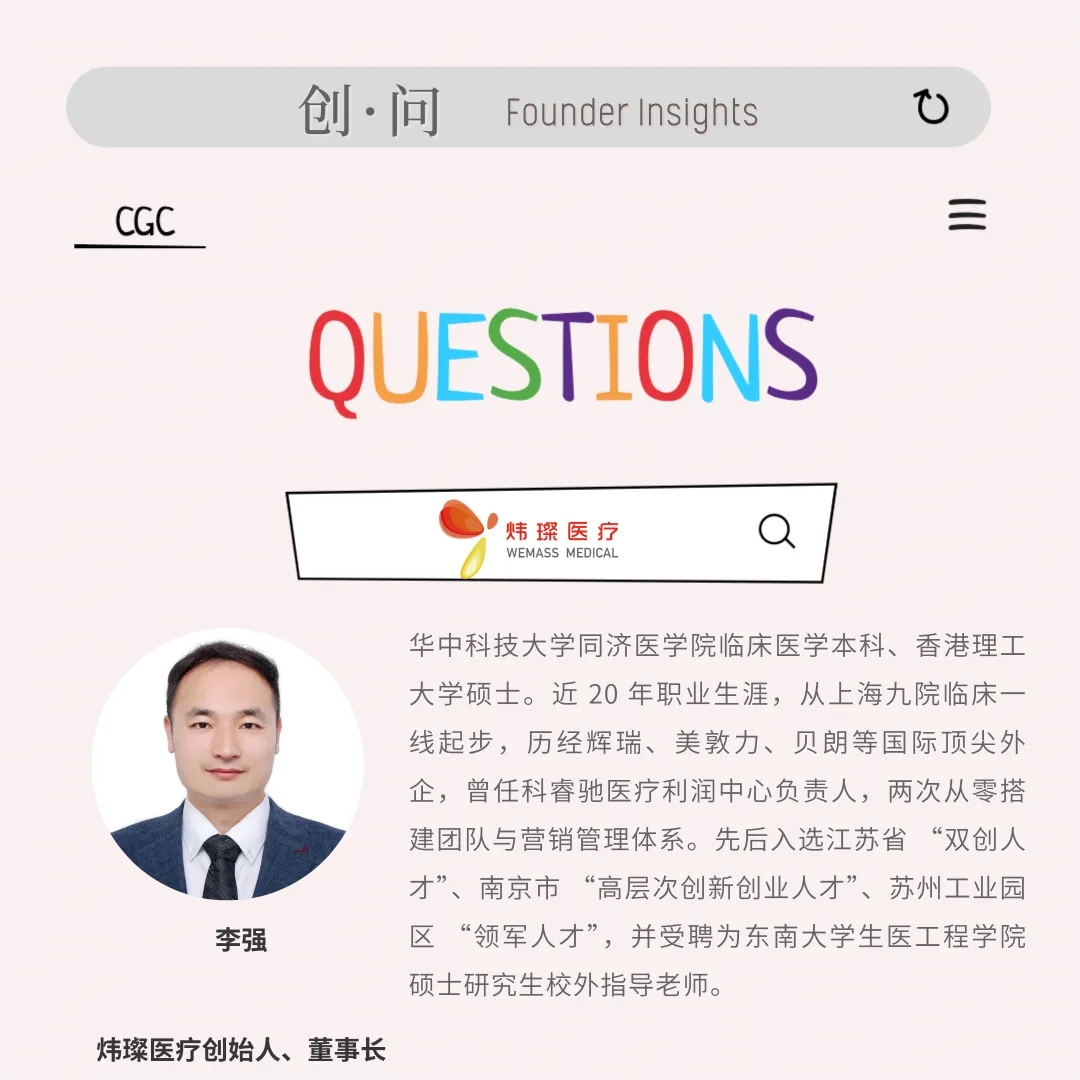
At the age of 30, Dr. Li Qiang resigned from Shanghai Ninth People's Hospital and became a pharmaceutical sales representative at Pfizer.
After getting his first order, all he felt was humiliation and collapse, as it was obtained at the cost of his dignity.
In the following three years, he repeatedly questioned his choice. It was not until he earned his first pot of gold that he gradually realized the value of this job - what drives the medical industry forward is not only doctors, but more importantly, enterprises.
Only by understanding how the rules of an industry are formulated can one possibly rewrite them.
After earning his first sum of money as a pharmaceutical sales representative, Li Qiang used it to pursue an MBA. For the first time, he learned to understand the logic of industry operation from a market perspective.
With hard work and the effective application of knowledge, in just three and a half years, Li Qiang became one of the top - tier salespeople at Pfizer and got the opportunity for promotion and a salary increase. However, in 2014, he predicted that the medical reform was really coming. "The crazy golden decade of the pharmaceutical industry is over, and what follows is the end - time twilight."
He decided to switch to the medical device industry so that his previous clinical professional skills could come in handy. He jumped to Medtronic, taking a demotion and a pay cut. His former superiors and colleagues thought he might be crazy.
Li Qiang also felt like a "fool" in his first year because the pharmaceutical and medical device industries are two completely different worlds with different rules of the game. As a pharmaceutical sales representative, one could work independently, but in the medical device industry, one has to manage agents. There are clear divisions of labor and role - playing, and one needs to drive the upward spiral of the triangle formed by distributors, manufacturers, and customers.
Li Qiang believed that he could only rely on technology. He started to follow surgeries crazily, following more than 400 surgeries in a year, and gained sufficient knowledge of interventional devices.
Later, in order to shift from sales to market management, Li Qiang went to 3M and B. Braun successively. Since the experience in foreign - owned enterprises seemed not in line with the local situation, he then joined private pharmaceutical and medical device companies, trying to understand the "rules of the game" of different players.
It was also during his time in a private enterprise that he discovered an entrepreneurial opportunity. He entered the market through the infusion port track and founded Weican Medical, establishing a brand - new implantable drug delivery solution.
From a doctor to a salesperson, and from foreign - owned enterprises to private enterprises, Li Qiang continuously entered new systems, learned the "rules of the game", understood it, and adapted to it.
Until this entrepreneurial venture, he decided to become the one who rewrites the rules.
The full - text sharing is as follows:
Q: Huachuang Capital
A: Li Qiang, founder and chairman of Weican Medical
I. "A Newly - Made Person"
Huachuang Capital: What was the biggest impact and change on you from the experience of transitioning from a doctor to a pharmaceutical sales representative?
Li Qiang: Looking back now, the hospital is actually a closed society, an ivory tower. When you really jump out, you find yourself facing a brand - new world.
Of course, this process was very painful. I resigned from the hospital at the age of 30. I used to be the client, but as a salesperson, I had to serve doctors who might have less professional ability than me. Just think about that gap. The first thing to solve when taking this step is the psychological problem. Can you put aside your pride? Can you humble yourself?
When getting my first order, I didn't know the director. I simply bent my knees and begged for help. And the sales job is not something that you can overcome the obstacles just by taking the first step. In the first three years, I felt like I was reshaping my values and testing my psychological bottom line every day. As my work experience increased, the challenges and pressure actually became greater. It was not until one day when I no longer doubted my choice that I really got on the right track.
Huachuang Capital: When did you start to realize that it is not only doctors but also enterprises that truly drive the medical industry?
Li Qiang: Since I'm a doctor in the rehabilitation department, we mainly use medical devices and auxiliary tools to treat patients. Without the products produced by these enterprises, we can hardly do anything.
In the past, domestic doctors often learned passively. The most innovative therapies, drugs, and devices were all brought by enterprises, and many industry guidelines and consensuses were also promoted by enterprises. Comparing my work as a doctor saving lives with developing innovative products in an enterprise, which has a greater impact?
There was a well - known senior professor in our hospital who also agreed with my view. She thought that her achievements were based on technological innovation. It was because a foreign - owned enterprise brought the detection method and treatment drugs for a certain disease to China that she was able to become a well - known expert in the treatment of this field in China. And she also encouraged me to start from front - line sales, as many big bosses also grew up in this way.
Huachuang Capital: From the initial discomfort to later becoming one of the top - tier salespeople, how did you understand the "rules of the sales game"?
Li Qiang: First of all, you need to learn to hide your edge. Sometimes, the company may not promote the most outstanding people because they always want to subvert the company's rules of the game. You need to be an excellent and stable person.
Secondly, you must choose the most difficult and arduous tasks. At that time, the most difficult area for Pfizer was Fengxian in the southernmost part of Shanghai, while I lived in Baoshan in the northernmost part. It took three or four hours for a one - way trip, but I voluntarily applied to be transferred there. According to the knowledge I learned in business school, I built my own marketing model from scratch. It took me more than a year to turn this area into a star area.
Huachuang Capital: Since you achieved good results at Pfizer, why did you choose to start anew at Medtronic?
Li Qiang: Pfizer conducts policy analysis every year. In 2014, there was no concept of "centralized procurement" yet, but I thought it was just a matter of time. Once the real medical reform comes, it's basically game over for the pharmaceutical industry.
The crazy golden decade is over, and what follows is the end - time twilight.
In this drastic adjustment, I thought about how to reflect my value. In the later stage of the pharmaceutical industry, it's more about emotional intelligence, while my strength lies in professionalism. And I found that every time I went to the hospital, pharmaceutical salespeople were queuing up to knock on the director's door, while medical device salespeople could just walk in. Because their values to doctors are different.
So I took a demotion and a pay cut to go to Medtronic and started from the most basic front - line sales again.
Huachuang Capital: What are the differences between the pharmaceutical and medical device systems?
Li Qiang: The pharmaceutical industry adopts a direct - sales model, while the high - value medical device consumables industry uses a channel - sales model. They are two completely different worlds with different rules of the game.
In the pharmaceutical industry, it's a single - point breakthrough. All resources are in my hands, and one person can work independently. But in the medical device industry, there are seven or eight agents below, and each agent has seven or eight representatives. There are clear role - positioning and division of labor. Power and resources need to be distributed, and one needs to drive the upward spiral of the triangle formed by distributors, manufacturers, and customers. This also involves the distribution and balance of interests.
I was in a complete mess in the first three months and couldn't find my way. My boss even doubted my ability. Later, I figured out that my role should be technical support, and my professional ability should support me in assisting doctors in surgeries.
So I started to follow surgeries crazily, following more than 400 surgeries in a year. Later, I also participated in the writing of some popular science books on interventional devices, which laid the foundation for my future entrepreneurship.
Huachuang Capital: Then why did you keep switching between foreign - owned and private enterprises later? What abilities were you trying to improve?
Li Qiang: When I left the hospital, I planned my career to be a salesperson for five years and then switch to the market. After working in the world's largest pharmaceutical and medical device companies, I went to 3M and B. Braun successively, learning how to manage the supply chain, product lines, how to set prices, and how to manage teams.
Especially before going to B. Braun, I really wanted to figure out why a family - owned enterprise that doesn't raise funds or go public can survive for 180 years. They have a very comprehensive product line with more than 40,000 products, and almost all pharmaceutical enterprises are their competitors. They believe that medical needs are constantly changing, so they keep launching products, but they never pursue being No. 1. As long as they follow the trend and rank third or fourth in each niche area, it's okay.
These world - class foreign - owned enterprises all have their own mature systems and brands, but entrepreneurship is about starting from scratch. So I went to a private enterprise, starting from zero. I promoted the company's participation in the centralized procurement of insulin and biopharmaceuticals, and also tried training, digital transformation, marketing, etc., and began to learn how to establish rules.
II. "A Road - Builder"
Huachuang Capital: Under what circumstances did you realize that there was an entrepreneurial opportunity in the infusion port field?
Li Qiang: An infusion port is a minimally invasive implantable drug delivery device (PORT), usually a professional infusion device implanted in the body to reduce the irritation of drugs to the patient's blood vessels.
During my time at Keruichi Medical, I found that the actual clinical application of perfusion was very large, but there was no suitable perfusion tool. Coupled with my experience in oral insulin, I thought that the biggest pain point of the oral method was low bioavailability and high cost. Why not deliver the drug directly to the liver? In this way, there is no need for peripheral injection, and PORT can meet these requirements.
At that time, the chips and sensors did not support the development of SmartPort. Later, when the conditions were mature, I also conducted market research, and then I started my business in 2023 and founded Weican Medical.
Huachuang Capital: In your opinion, why is the infusion port not just a small product but a field worth reinventing?
Li Qiang: The application scope of PORT is very wide. In 2022, there were 2.4 million newly diagnosed cancer chemotherapy patients in the country, and among them, as many as 1.2 million patients were suitable for PORT. In addition to chemotherapy, scenarios such as arterial perfusion for tumors, dialysis, and insulin delivery can all be covered. In the future, it can also be extended to elderly people living alone and pets.
For example, for cancer chemotherapy patients, the past infusion method was like "irrigation", which required a large amount or high - concentration of drugs. Although it was effective, it would also attack other parts of the body indiscriminately. The infusion port can place the catheter into the blood vessel that supplies blood to the tumor, accurately "drip - irrigating" the tumor cells and reducing the damage to other parts of the body.
Similarly, by changing the implantation position of the infusion port catheter, different diseases can be treated. For example, placing it in the spine to treat spondylitis, in the intestine to treat intestinal cancer, and behind the ear to treat nasopharyngeal cancer...
In this sense, the infusion port is no longer just a single product but can be applied in all scenarios that require long - term drug delivery.
Huachuang Capital: Why do you think the existing products have not met these needs?
Li Qiang: The infusion port product looks only as small as a fingernail, but for so many years, it still has to rely on imports, and there are many clinical pain points.
Firstly, it doesn't match the physique of the Chinese people because it is designed according to the size of foreigners. Secondly, the technology and process are backward. The products on the market still use the technology before 2005, while the domestic clinical needs have changed, but the products have not been updated. In addition, the maintenance cost and price are still very high.
Many enterprises only stay at the single - product level. They think that what foreign - owned enterprises have developed is the industry benchmark. Even if they make improvements, they don't touch the raw materials but only make simple optimizations and upgrades in details such as shape and function.
Huachuang Capital: What improvements and innovations have you made?
Li Qiang: Our idea is not to simply replace imported products with domestic ones. Instead, we conduct our own research and development from the raw materials, product processes, to the final product form. At the same time, we dare to explore new application fields, lead new treatment methods, and benefit more patients.
Since I have a clinical background and industrial experience, our enterprise can form a closed - loop from clinical need insight, product definition, to engineering implementation and business verification. We can truly achieve originality, not just imitation or minor innovation.
Weican has cooperated with an innovative new - material team and has developed raw materials that can replace imports. We also use 3D printing technology to refine the product shape to the greatest extent, and can make micro - holes, polish, and achieve integrated molding.
Currently, we have product layouts in six application fields: including traditional venous access, arterial perfusion, thoracic and abdominal perfusion, intracranial perfusion, spinal analgesia drug delivery, and animal drug delivery. There are multiple original products in each niche area.
Huachuang Capital: You said that what you are doing is "building a road". How should we understand this?
Li Qiang: What we are doing is actually not a traditional infusion port but a "gateway between silicon - based life and carbon - based life", which may be a bit hard to understand.
Firstly, we need to cover all scenarios that require long - term drug delivery. For example, implanting infusion ports in the intracranial, thoracic, abdominal, dialysis, venous, and arterial areas is equivalent to building the infrastructure.
Secondly, it's about informatization. We are developing implantable sensors ourselves, which can monitor indicators such as body temperature, blood pressure, blood oxygen, and cell count. When we have a medical examination in the hospital, the data shown in the report are all past - tense and point - like data, but there is not enough individual data to support the prediction of your future.
We are equivalent to implanting AI in your body. It is your "digital doctor" and "digital organ", monitoring the data changes at any time and providing early warnings and early drug delivery.
For example, in