Tesla made a net profit of $477 million in Q1. Elon Musk is complaining on one hand and telling stories on the other.
After the market closed on April 22 local time, Tesla released its financial report for the first quarter. It not only achieved a positive free cash flow of $1.44 billion but also exceeded market expectations in terms of profit. Subsequently, its stock price rose by more than 4% in after - hours trading.
Data shows that Tesla's total revenue in the first quarter was $22.39 billion, a 16% increase from $19.3 billion in the same period last year. However, it was slightly lower than the $22.64 billion generally expected by analysts surveyed by LSEG.
Tesla showed outstanding performance in terms of profitability in the first quarter.
Calculated according to the U.S. Generally Accepted Accounting Principles (GAAP), the net profit attributable to common shareholders reached $477 million, a 17% year - on - year increase. The adjusted net profit according to non - GAAP was as high as $1.453 billion, a 56% surge from $934 million in the same period last year. The adjusted earnings per share reached $0.41, exceeding the Wall Street expectation of $0.37.
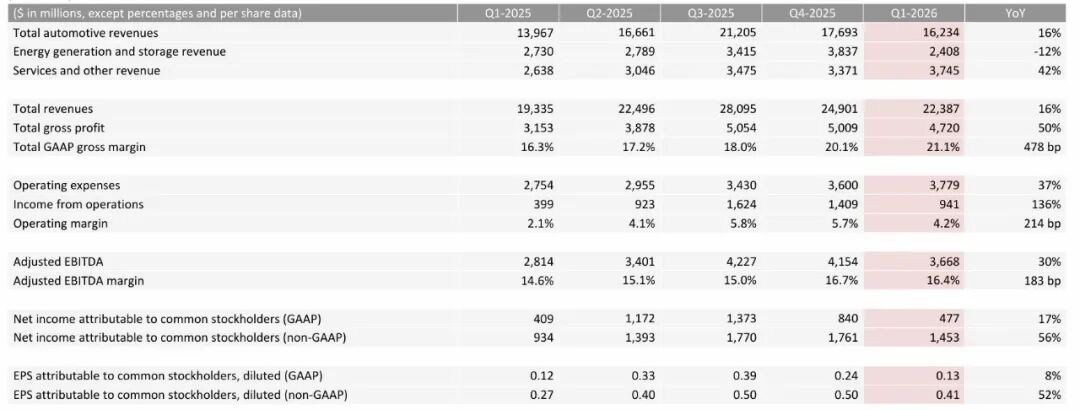
Tesla's financial performance in the first quarter of 2026
Behind these impressive financial data, Tesla is also brewing a transformation - from a manufacturing enterprise centered on car sales to a giant in the fields of artificial intelligence, autonomous driving, and humanoid robots. Its operating expenses soared by 37% year - on - year to $3.78 billion, and capital expenditures skyrocketed by 67% to $2.49 billion.
Andrew Rocco, an analyst at Zacks Investment Research, believes that this performance "confirms that although the traditional electric vehicle business is no longer growing rapidly, it is stable enough to fund Tesla's large - scale investments in robotics and autonomous driving technology."
01 Restart of the Profit Engine
Tesla's total gross profit margin in the quarter reached 21.1%, an increase of 478 basis points from 16.3% in the same period last year. More notably, the gross profit margin of the automotive business climbed to 19.2% excluding the sales of environmental regulatory credits, exceeding the level of any quarter last year.
The reasons for the significant improvement in the profit margin come from multiple dimensions.
Tesla clearly stated in its financial report that the higher average selling price and "the decrease in the average cost per vehicle due to the reduction in material costs" jointly contributed to the improvement of the profit margin. Meanwhile, the "one - time gains" related to tariffs and vehicle warranties also provided additional flexibility for the income statement.
The operating profit also showed a strong recovery momentum.
The operating profit in this quarter reached $941 million, a 136% increase from $399 million in the same period last year. The operating profit margin increased from 2.1% to 4.2%. The adjusted earnings before interest, taxes, depreciation, and amortization (EBITDA) reached $3.668 billion, with a profit margin of 16.4%, a year - on - year increase of 183 basis points.
Of course, the improvement in profitability is not without concerns. Operating expenses soared from $2.75 billion in the same period last year to $3.78 billion, an increase of 37%, clearly reflecting the company's rapidly expanding investment in artificial intelligence infrastructure, new product research and development, and capacity expansion.
02 Hidden Concerns Behind the Growth in Delivery Volume
In the first quarter, Tesla delivered 358,023 vehicles globally, a 6% year - on - year increase, which was lower than the Wall Street expectation of 370,000 vehicles. However, considering that Tesla lost several weeks of production capacity last year due to the upgrade of the Model Y production line, this result still deserves careful interpretation.
Dan Ives, an analyst at Wedbush Securities, called it a "disappointing start." However, from a longer - term perspective, the cumulative delivery volume has reached 9.2 million vehicles, a 21% year - on - year increase.
Looking at the breakdown of models, Model 3 and Model Y are still the absolute mainstays. The combined production of the two models in the first quarter was 394,611 vehicles, and the delivery volume was 341,893 vehicles, with year - on - year increases of 14% and 6% respectively.
Meanwhile, the production of "other models" including Cybertruck, Model S, and Model X decreased by 20% year - on - year to 13,775 vehicles, while the delivery volume increased by 25% year - on - year to 16,130 vehicles. This difference is mainly due to Tesla's announcement in January this year to discontinue the production of Model S and Model X. The production line in Fremont, California, will be transformed for the production of Optimus humanoid robots.
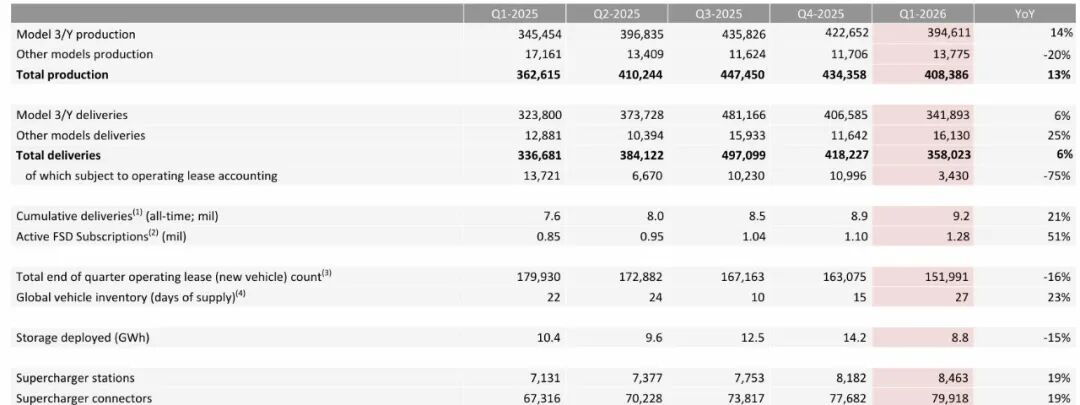
Tesla's vehicle production and delivery data in the first quarter of 2026
The situation of Cybertruck is more delicate. Although its annual production capacity exceeds 125,000 vehicles, the market response to this radically - designed electric pickup truck has been mediocre. Tesla seems to have found a unique solution: selling Cybertrucks to other companies under Elon Musk.
Tesla confirmed in its financial report that Cybercab and Tesla Semi are scheduled to enter mass production in 2026, and the first Cybercab was produced in February.
In terms of capacity layout, Tesla continues to optimize its global production network. The annual production capacity of Model 3 and Model Y at the Fremont factory in California exceeds 550,000 vehicles. The Shanghai Gigafactory leads with a capacity of over 950,000 vehicles. The Berlin factory has a capacity of over 375,000 vehicles, and the Texas factory is responsible for the production of Model Y and Cybertruck.
Tesla clearly stated that it will give priority to fully utilizing and optimizing the existing production capacity before building new factories and production lines.
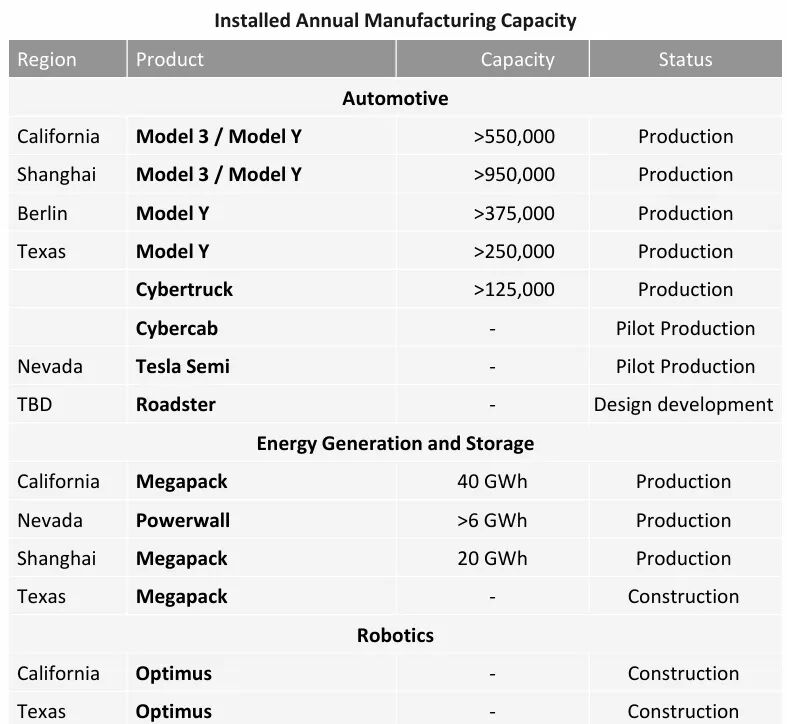
Tesla's capacity expansion of different products in the first quarter of 2026
A concerning signal comes from the inventory level.
At the end of the first quarter, the global vehicle inventory supply days reached 27 days, an increase from 22 days in the same period last year and a significant increase from 15 days in the previous quarter. This means that although the delivery volume has continued to grow, the gap between production and sales is widening. The production volume in the first quarter was 408,386 vehicles, while the delivery volume was only 358,023 vehicles, with a difference of more than 50,000 vehicles.
03 Cooling of the Energy Storage Business
The energy generation and storage business has always been the most stable highlight in Tesla's financial reports in recent years, but it experienced a rare decline in the first quarter. The revenue of this segment was $2.41 billion, a 12% decrease from $2.73 billion in the same period last year. The energy storage deployment volume was 8.8 gigawatt - hours, a 15% year - on - year decrease, and it dropped significantly compared with the historical peak of 14.2 gigawatt - hours in the previous quarter.
However, this short - term fluctuation has not shaken Tesla's long - term layout in the energy field.
The new Megafactory on the outskirts of Houston is progressing steadily. This factory will specialize in the production of Megapack 3 for Megablock and is scheduled to start production later this year. In Shanghai, the Megapack factory with an annual production capacity of 20 gigawatt - hours is still under construction.
In the solar energy field, Tesla has started to deploy its first self - designed solar panels produced at the Gigafactory in New York on a large scale to customers. This new product has 18 independent power zones, three times that of traditional residential solar panels, enabling it to generate more energy reliably even under shaded conditions. The improved aesthetic design and faster and easier installation process are the core selling points of this product.
Meanwhile, Tesla's Supercharger network continues to expand. In the first quarter, more than 2,200 new charging piles were added, and the number of Supercharger stations globally reached 8,463, with the number of charging piles reaching 79,918, both showing a 19% year - on - year increase.
04 Soaring FSD Subscription Volume
If we want to extract a data point from the first - quarter financial report that best reflects Tesla's strategic focus, it is undoubtedly the growth of the FSD subscription volume.
As of the end of the first quarter, the number of active FSD subscriptions reached 1.28 million, a 51% year - on - year surge. Compared with 1.1 million in the previous quarter, there was a net increase of 180,000, setting the highest single - quarter net increase record ever. The cumulative driving mileage of FSD has exceeded 17.7 billion kilometers, of which the versions V12 and later contributed approximately 14.5 billion kilometers.
The driving mileage of paid Robotaxi in the first quarter almost doubled compared with the previous quarter, and the cumulative mileage has exceeded 2.74 million kilometers. In April, Tesla further expanded its unsupervised operation area in Austin and officially launched unsupervised travel services in Dallas and Houston.
In the San Francisco Bay Area, the ride - hailing service with a safety driver is also operating simultaneously. Tesla is preparing to launch services in Phoenix, Miami, Orlando, Tampa, and Las Vegas. The Dutch Vehicle Authority approved the deployment of FSD in the Netherlands in April, clearing the way for potential approvals in other EU countries.
The Optimus humanoid robot is also the most imaginative part of Tesla's future.
Tesla announced that the preparation work for the first large - scale Optimus factory will start at the beginning of the second quarter. The first - generation production line is designed to produce one million robots annually and will directly replace the original Model S and Model X production lines at the Fremont factory. Meanwhile, the Gigafactory in Texas is preparing for the second - generation production line, which is designed to produce 10 million robots annually in the long term.
At the level of artificial intelligence infrastructure, the Cortex 2 training cluster has been officially launched and started running training tasks, and the on - site training computing power continues to climb. Tesla also confirmed that the design of the next - generation AI5 inference processor was finalized in April.
05 Chip Factory and Soaring Capital Expenditure
Tesla's capital expenditure in the first quarter reached $2.49 billion, a 67% surge from $1.49 billion in the same period last year. Although this figure has increased significantly, it is still only about half of the quarterly average required for the annual expenditure plan, which is also one of the key reasons why Tesla was able to achieve positive free cash flow this quarter.
Battery manufacturing is the top priority of capital investment. The lithium - iron - phosphate battery cell factory in Nevada, the cathode material factory, and the lithium refinery in Texas have all started to increase production. Specifically, the LFP production capacity in Nevada is 7 gigawatt - hours, the 4680 battery production capacity in Texas is 40 gigawatt - hours, the cathode material production capacity is 10 gigawatt - hours, and the lithium refining capacity is 30 gigawatt - hours. The latter three are all in the early stage of production increase.
The expansion of artificial intelligence training computing power has also consumed a large amount of capital. The Cortex 1 cluster in Texas has more than 100,000 H100 - equivalent GPUs, and Cortex 2 is equipped with more than 130,000 H100 - equivalent GPUs and is in the early stage of production increase. According to the training capacity improvement curve released by Tesla, the total existing and planned capacity has increased from close to zero to more than 300,000 H100 - equivalent GPUs. The development of the Dojo 3 custom chip is still ongoing, with the goal of reducing long - term training costs.
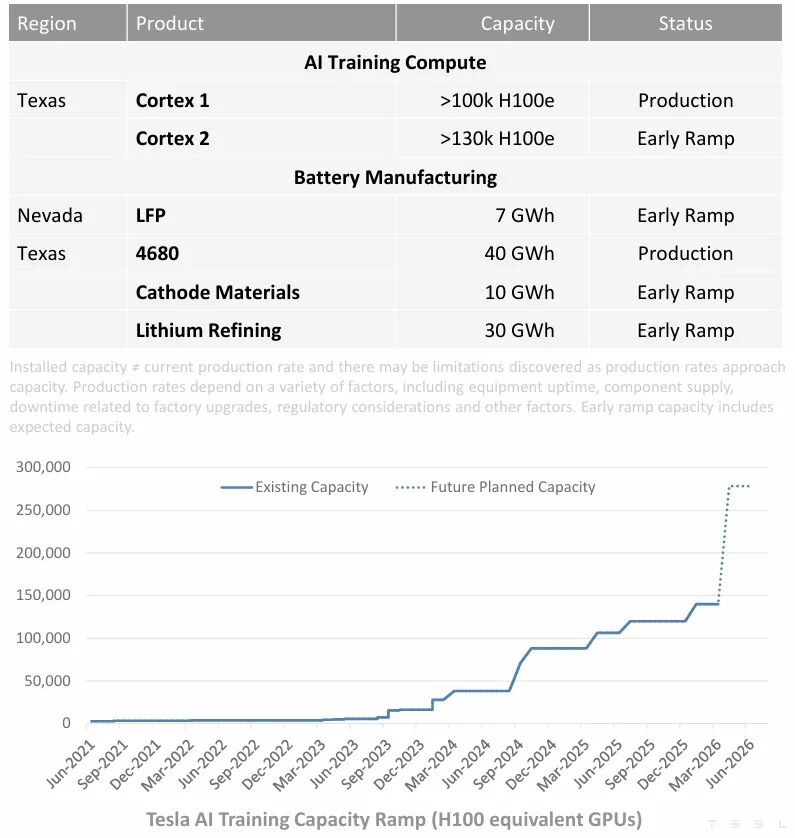
Tesla's computing power cluster expansion in the first quarter of 2026
The plan for the TeraFab chip factory is given special strategic significance.
Tesla describes this project as "the largest chip factory ever," aiming to vertically integrate logic, storage, and advanced packaging capabilities to enable rapid iteration when the chip demand exceeds the industry's production capacity. This is not only a measure to ensure the security of chip supply but may also open up a new business dimension for Tesla, with the goal of manufacturing chips for robots, artificial intelligence, and space data centers.
The path of "trading current profits for future stories" has an obvious cost of shrinking profit scale and a hidden cost of fluctuations in the core automotive business.
Although the delivery volume increased year - on - year this quarter, The Wall Street Journal pointed out that this is still the second - worst sales quarter for Tesla since 2022. Meanwhile, the market has over - valued the "future story." Bloomberg's analysis warns investors that Tesla, with a forward price - to - earnings ratio of 183 times, is the third - most expensive stock in the S&P 500 index, far higher than other technology giants in the "Magnificent Seven" of U.S. stocks.
The following is a condensed version of the analyst conference call for Tesla's first - quarter 2026 financial report:
Tesla CEO Elon Musk commented:
2026 will be very exciting. Tesla will significantly increase capital expenditure and comprehensively invest in batteries, AI training, chip design, and the supply chain.
The new products (Cybercab, Semi, Optimus) will all experience a stretched S - curve. The initial production increase will be very slow, but it will show exponential growth from the end of this year to next year. The demand for Megapack is strong, and the new factory near Houston will start production later this year.
In terms of FSD, V14.3 is a major architectural update, which is expected to enable unsupervised FSD to operate in legally compliant regions globally. V15 will be launched at the end of this year or early next year, with safety far exceeding that of humans. The autonomous taxis have expanded to Dallas and Houston. The only limitation on expansion is strict safety verification, and the team currently maintains a zero - accident record.
Optimus V3 is expected to be showcased around mid - year. We actually don't want to showcase it too early because competitors will copy it frame by frame. Internal production at the Fremont factory will start later this year, and the production volume will increase significantly next year. The second factory in Texas will start production next summer. Optimus will become the most important product in Tesla's and even the world's history.
Technically, AI5 has been taped out and is the most cost - effective edge AI inference chip. The development of AI