Yang Xiaolei: This is not an era of capital shortage, but an era of choice.
There is a piece of data that can well illustrate the real picture of the current venture capital market: The top - tier projects have indeed brought huge returns to investments. As long as investors can get in, they can basically recoup the costs of the current - period funds. However, the problem is that the stock of un - exited projects is also very high. Approximately 70% of the projects have not exited, and the power - law distribution is very obvious. This is not an era of capital shortage; instead, it is an era of extreme differentiation of opportunities.
When you step into the primary market, you will see two completely parallel worlds. In one world, there are consecutive financing rounds for AI, chips, and biotechnology, with valuations breaking through upwards. More and more top - tier entrepreneurs and star companies are attracting most of the capital in the market. In the other world, tens of thousands of existing enterprises are caught in a long - term financing drought.
At this year's annual summit of the China Investment Annual Conference, this phenomenon was summarized into a concise and powerful concept - the K - shaped curve: The downward and upward split trends occur simultaneously. There is strong consensus but huge differentiation. Opportunities are multiplying exponentially while risks are also intensifying.
Why does such a situation occur? The key lies in the tri - directional synergy of policies, technology, and capital. National policies clearly support hard technology and new - quality productivity. The secondary market maintains a consistently high valuation premium for AI and technological innovation. High - net - worth individuals and institutional capital are flowing back to the primary market. These forces all point in one direction: Future wealth and opportunities are gathering in those tracks that can drive industrial upgrading and participate in international competition. In contrast, traditional sectors that rely on frictional costs and are highly competitive are gradually losing their appeal.
Once capital starts to pour into a certain track, investors will face a difficult choice of "whether to follow". Yang Xiaolei, the CEO of ChinaVenture Group, used a vivid metaphor: The current market is like a game of Texas Hold'em. Just one card has been dealt, and everyone else at the table has gone all - in. Do you still want to follow?
Is there a bubble? Yes. But Yang Xiaolei believes that a market without a bubble is definitely not a good market. A market with a bubble is a vibrant market. In this era of K - shaped differentiation, see the reality clearly, accept it calmly, and decide whether to stand on the upward curve of the K - shape based on your own preferences and judgment of the future. This is everyone's own choice at the table.
The following is the on - site transcript, compiled and edited by ChinaVenture:
Respected Secretary Yue Li, dear leaders, guests, and friends, good morning! I'm Yang Xiaolei from ChinaVenture Group. I would like to express my sincere gratitude to all of you for your presence here. On behalf of the organizers, I'd like to thank all the guests!
Just like last year, we have once again held the 20th conference in Haidian, Beijing, the innovation high - ground of China. Haidian is a place of innovation, entrepreneurship, and venture capital. We are grateful for the support of the Haidian District Party Committee and the district government, as well as the trust of the Zhongguancun Science City Management Committee. We hope that through this conference, the participating guests can learn more about Haidian, promote more industry cooperation, and let capital take root in Haidian.
This is the 20th conference we have held, spanning 20 years full of ups and downs. Last year, we compiled the era imprints and industry snapshots we observed, witnessed, and discovered into a book - "The History of Chinese Venture Capital", which has been reprinted several times. We hope that those who have read it like it.
Now, let's get back to today's report. A book called "Homo Deus: A Brief History of Tomorrow" was published ten years ago. The author predicted that in the near future, humans would complete a cognitive revolution, transform from Homo sapiens to "god - like beings", delegate more decision - making and work to machines and algorithms, and a large number of people would become the "useless class".
Previously, a Polish - Irish female writer posted on X: "I hope that one day I can be engaged in art while AI does the laundry for me, instead of the current situation where it is engaged in art and creation while I'm here doing the laundry."
This is a topic that is often discussed recently: the relationship between humans and AGI in the AI era. From the end of last year to the beginning of this year, we spent four and a half months conducting an industry survey and assessment. Based on this, we set the theme of this year's conference - the "K - shaped curve".
The K - shaped Curve: An Era of Differentiation
In the past 20 years of Chinese venture capital, as well as the past 20 years of the Chinese economy, a fairly clear downward - upward split trend has emerged. We are experiencing a period with characteristics such as strong consensus, huge divergence, and fierce competition. In the same world, there are different dreams. Some people are trying to get out of trouble and considering how to solve current problems on the downward curve. Another group of highly motivated people are trying to change themselves, the world, and humanity at the forefront of the storm.

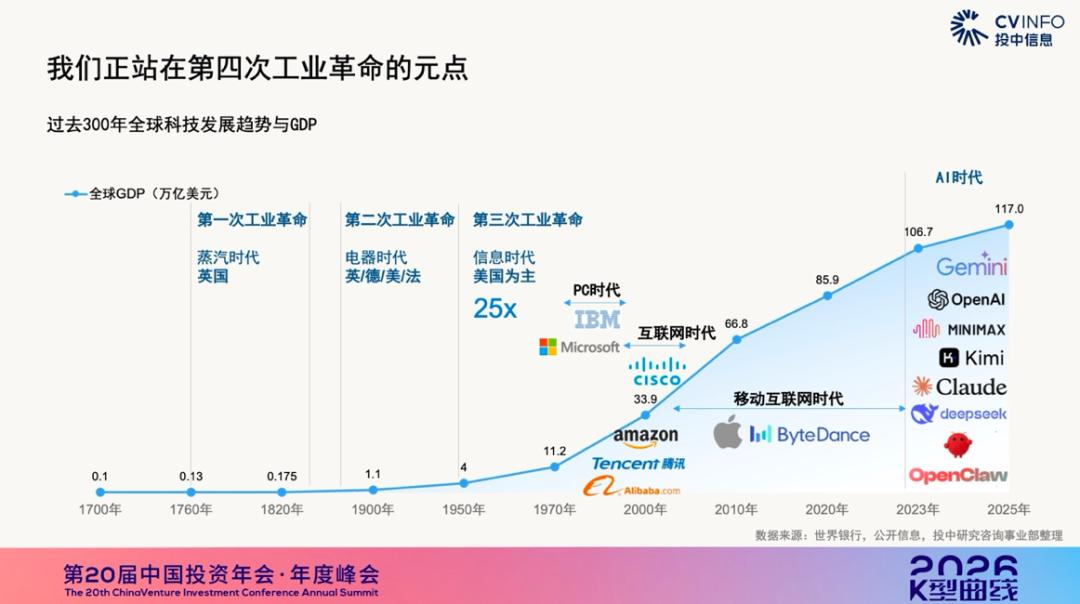
Looking back at the investment themes of the past 20 years, we have gone through the stages of Internet e - commerce, social media, mobile Internet, local life services, industrial Internet, and now hard technology. If the previous logic was more about technological innovation, we believe that we may have entered a cycle of disruptive innovation. Joel Mokyr, Philippe Aghion, and Peter Howitt, the winners of the 2024 Nobel Prize in Economics, proposed that this innovation is no longer a mild supplement to the existing stock but a strong replacement of many old productive forces. The disruptive force may impact or even overthrow some industries and create some opportunities, and the opportunities are multiplying exponentially.
Today's discussion still starts with policies: one turning point and three main lines. Before 2019, the old stable state mainly relied on investment and consumption. After 2019, due to the game between China and the United States, the pandemic, and confrontations, the "three - horse carriage" of investment, exports, and consumption has changed its position. Today, we can see that exports are still very strong, but the export items have changed. Today's exports include semiconductors, silicon wafers, photovoltaics, services, and even Token exports. This transformation has taken place.
There is a concept that has evolved from the decisive role of the market to "marketization" plus "coordinating development and security", with proactive policies actively intervening in key areas. This adjustment has a profound impact on every industry and also on the venture capital industry.
We routinely present this chart, and everyone can feel the conclusion. To a large extent, this is due to the "9.24" policy in 2024, which is well - felt by everyone. I guess there is another reason: The Federal Reserve has entered an interest - rate cut cycle, the US dollar is weak, geopolitical situations are volatile, and the world is de - risking from US dollar assets. As a result, Chinese assets have reached their current position and achieved a relatively good recovery.
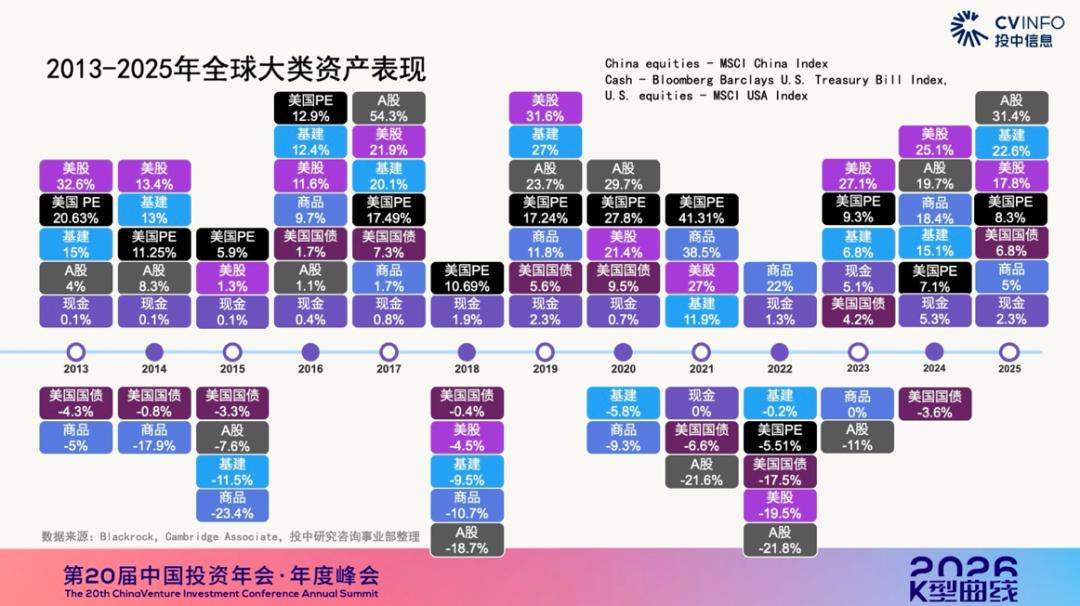
Except for the ongoing US - Iran war, which still has a slight impact on the A - share index, the A - share market has been quite strong since 2025. Foreign investment in Chinese securities has also fully recovered. Foreign investment in Chinese securities, which was in the negative and experienced capital outflows in 2024, has fully flowed back in 2025.
In terms of technology, there is a strong K - shaped differentiation in technology concepts. Not only does the secondary market strongly promote the AIGC concept, and the PE multiples and performance of related concept stocks significantly exceed those of established technology stocks, but the actions of leading unlisted companies in the primary market also constantly affect the valuations of listed technology companies.
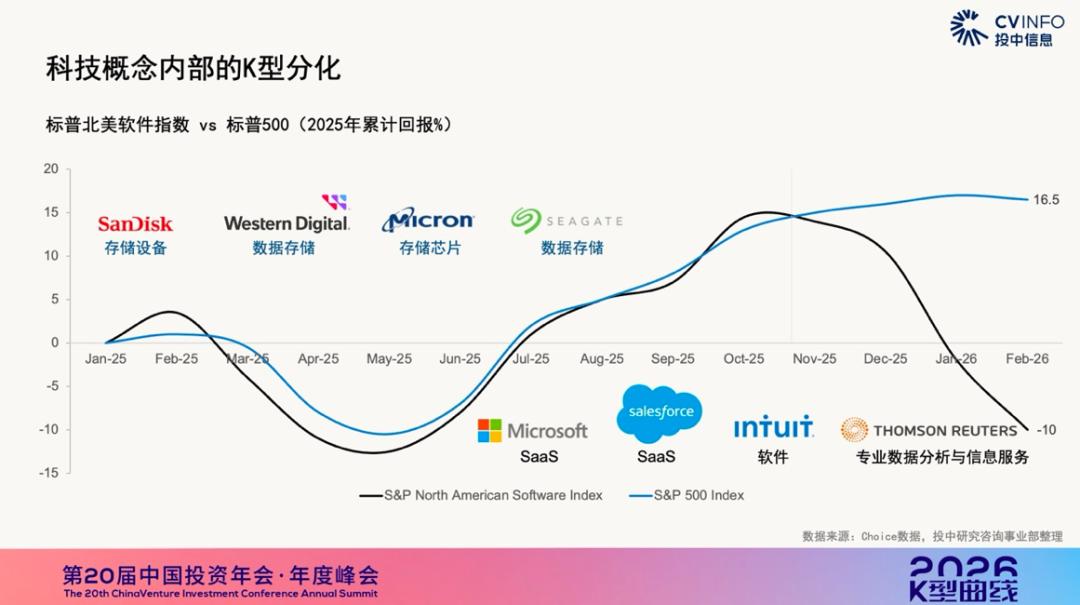
For example, last week, Anthropic released a plug - in for vertical business. This morning, I saw that GPT released a new image - generation model called Image 2, which has comprehensively affected the SaaS companies listed on the US stock market. Two weeks ago, there was a narrative that "the Hang Seng Tech Index is not tech - savvy". In the face of such a large technology wave today, these established stocks still face great challenges.
Behind this, for example, ByteDance, a Chinese company, has made some layouts in the five - layer structure described by Huang Renxun - energy, chips, AI infrastructure, models, and applications. Especially in the fields of chips, models, and applications, ByteDance has a deep business foundation, which exerts great pressure on the constituent stocks of the Hang Seng Tech Index, which are mostly former Internet and technology companies.
AI Reshapes the Pricing Logic
In the AI era, AI is reshaping the pricing logic of the secondary market, and the PE multiples of many industries will be re - priced. For example, HALO, a company with heavy assets and a low elimination rate, has become a good hedging asset. In addition, the proportion of core resource - related companies, involving non - renewable resources such as copper, iron, and tin, is also gradually increasing. As more people buy, the PE multiples go up.
In addition, regarding AIDC - related matters. The other day, I accidentally saw a passage on Xueqiu, which was very well - said and interesting. It generally means that in the future, what silicon - based life needs to consume to maintain its activities is as important as what carbon - based life needs to consume to maintain its activities. This means that the cabinets for maintaining AIDC and everything inside them are necessities for silicon - based life, and in the future, they will receive more capital support in terms of allocation.
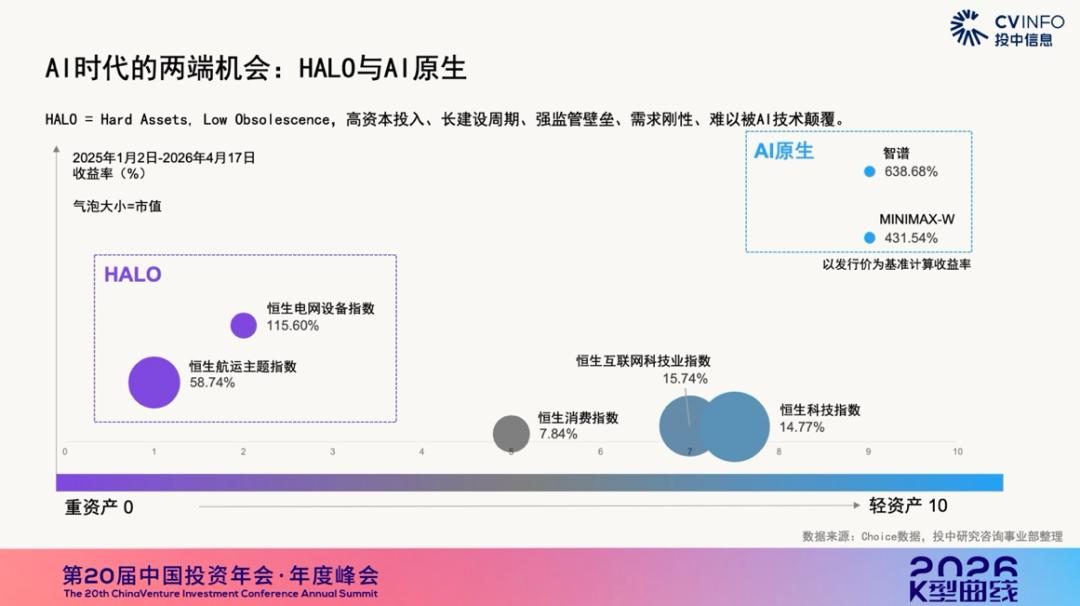
From the perspective of the public market, companies with higher technological content are indeed reflected in their valuations. We made a chart, and the stock price increase of growth - layer enterprises on the Science and Technology Innovation Board is still better than that of non - growth - layer stocks.
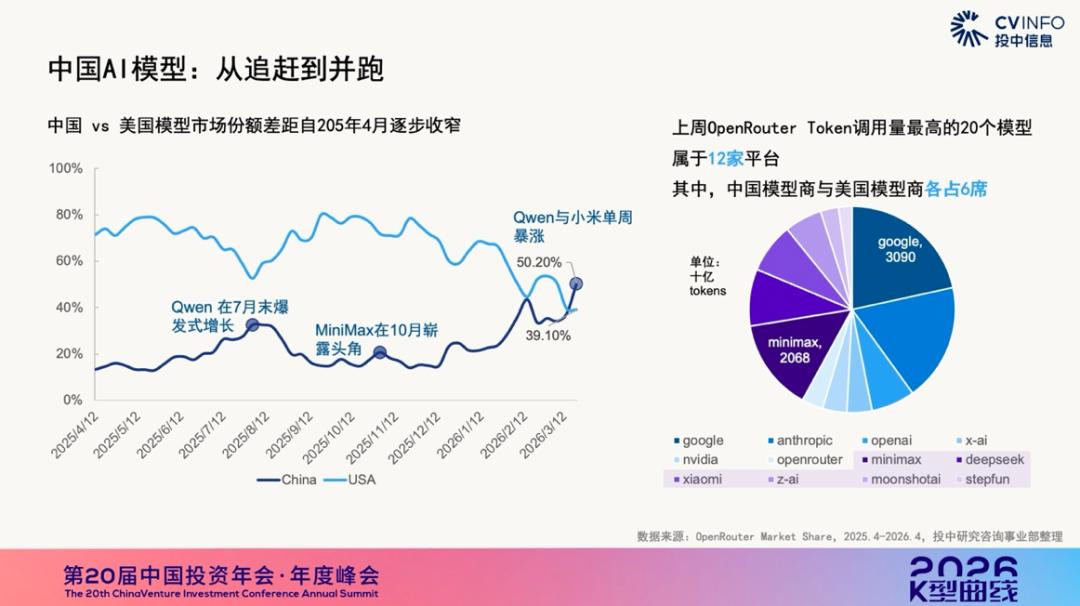
From an industrial perspective, people in different industries in the market should have completely different feelings today. On the K - shaped economic curve, for example, backward production capacity is definitely in a difficult situation today, as it is gradually being phased out and inventory is being reduced. However, on the upward curve, industries related to new - quality productivity such as AI and embodied intelligence are expanding rapidly. For example, in the AI industry, both Chinese and American model companies are moving forward at full speed, whether in terms of performance growth or valuation. This morning, I saw that SpaceX is going to spend $60 billion to buy the options of Cursor. I also saw that the price of Anthropic's shares in the private secondary market has been set at $1 trillion, while the last round of financing was only $380 billion. This shows people's optimistic expectations for its future.
Today, a large part of human activities is the service industry, and its business foundation and value - added space come from frictional costs. We need to reduce these frictional costs, which is why we have these service industries. In the foreseeable future, AI may play a role in a market worth trillions of dollars. People, both in China and the United States, are focusing on the softer part of AI. For example, in the fields of law, services, accounting, auditing, SaaS, etc., people are trying to use AI productivity tools to replace humans and eliminate these frictional and time costs. In the United States, people talk about "model as application", so capital is vigorously promoting these model companies, and their valuations are increasing rapidly, creating a winner - takes - all situation, and people are seizing the opportunity of value aggregation.
The situation in China may be slightly different. Since we have a manufacturing industry and a supply chain, our opportunities are relatively more dispersed. Conversely, in these aspects, China has more AI opportunities, and there are also more opportunities for entrepreneurs. This is our stronger aspect, where we are globally leading, and we will have more AI opportunities.
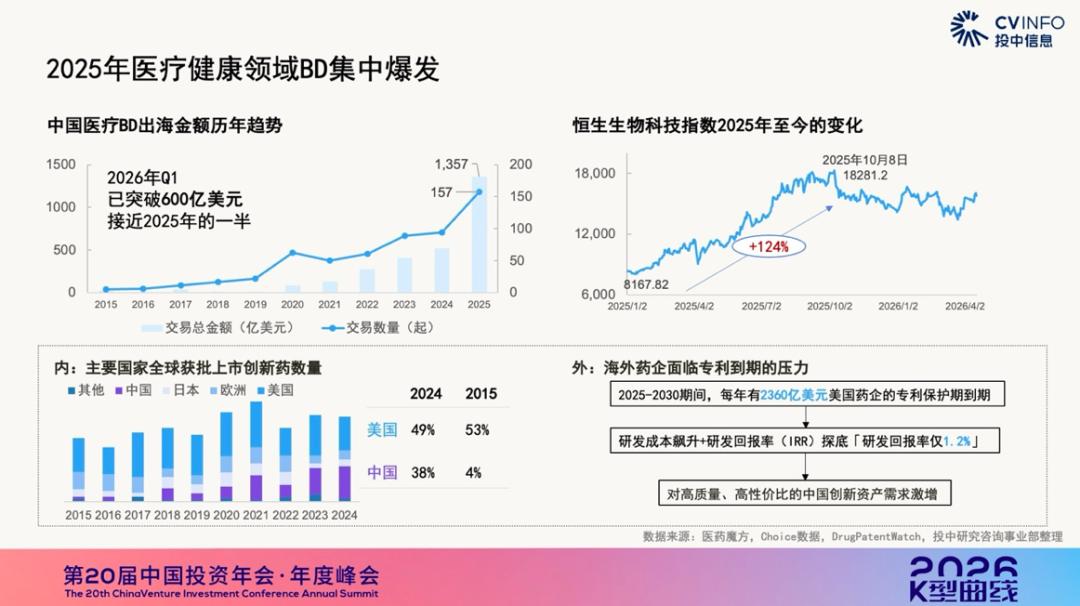
Looking at another part of the upward K - shaped curve, China's medical industry. Last year, China accounted for 32% of the global R & D pipeline for innovative drugs, while the United States accounted for about 37%. The improvement of internal R & D capabilities has led many multinational pharmaceutical companies to come to China to buy R & D pipelines. The data for the first quarter of this year will be even more remarkable.
At the same time, in synthetic biology, brain - computer interfaces targeting a larger audience, and high - end medical devices, we are not only seeing concepts on PPT but also real industrial explosions, which are all huge future investment and industrial development opportunities. In seemingly "virtual" tracks such as commercial space and embodied intelligence, we have vaguely touched the edge of commercialization. Although there is no clear end - game, we are moving forward in a state of "fuzzy correctness".
Significant Improvement in Private Equity Investment Data
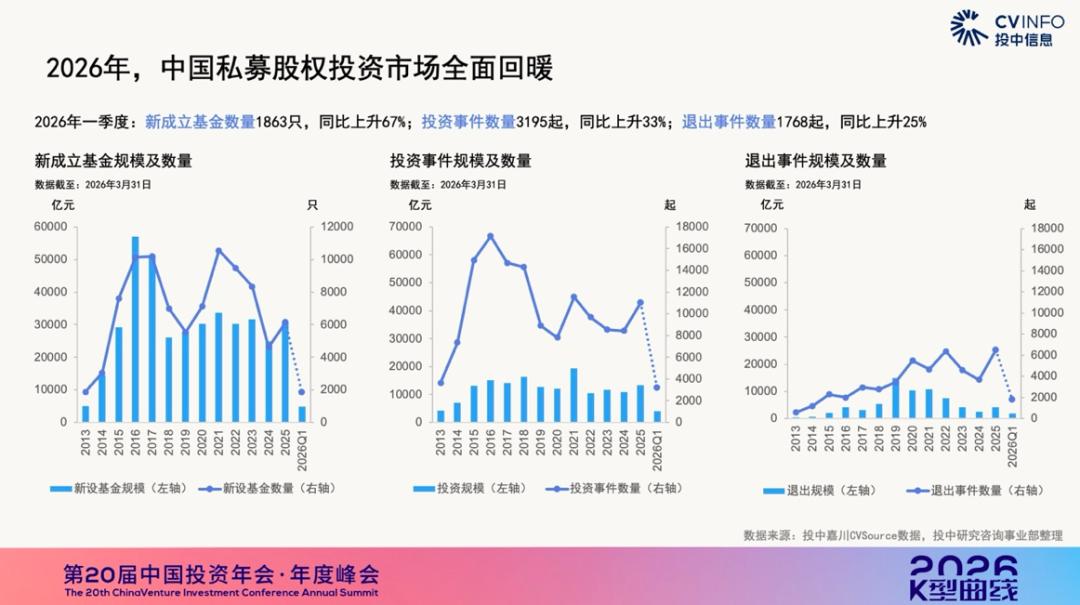
In 2026, from a statistical perspective, the data in the private equity investment field has significantly improved. In Q1, the number of newly established funds, investments, and exits has all increased significantly.
The biggest feeling in our industry today should be the bubble, or rather, the over - valuation. High valuation is a common problem that everyone faces today. We believe that there are two types of market bubbles: One is the bubble brought about by the development trend of industrial