Nokia, the "undying fallen giant", has a market value exceeding 400 billion.
Nokia: "Fallen but Not Dead"
In today's business world, numerous powerful players are emerging. There are established giants like Google, NVIDIA, Microsoft, Alibaba, and ByteDance, as well as new tech upstarts such as OpenAI and Anthropic. They are all competing in the field of AI technology, occasionally allowing people to catch a glimpse of the silhouette of a new world.
In contrast, Nokia seems to represent an old era that has long passed. Even when it is mentioned, it is often in the context of the "Nokia Moment" and has become a synonym for a company's sudden downfall.
Even after Nokia's mobile phones quietly exited the market in 2013, along with the statement "We didn't do anything wrong, but somehow, we lost," this company was considered "dead" in the eyes of many.
So, when news about Nokia reappeared these days, many people were quite surprised: Nokia's stock price reached a 16 - year high, and its market value has exceeded $60 billion (nearly 400 billion yuan in RMB), with a year - to - date increase of over 60%!
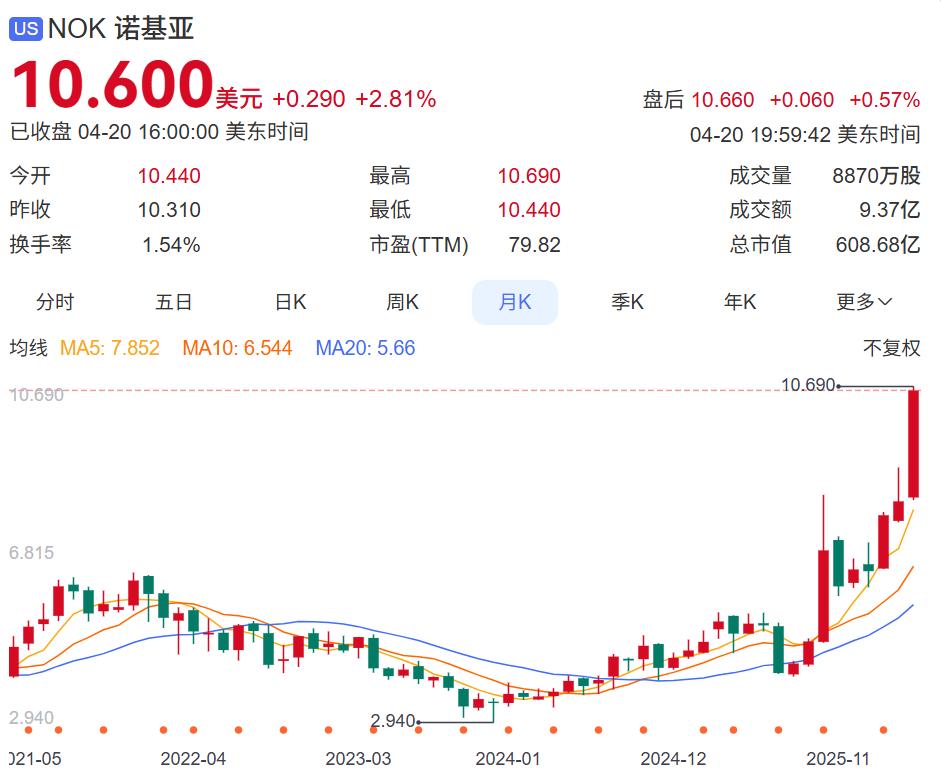
This market value is equivalent to 1.5 times that of Baidu. Although it cannot be compared with its peak level of nearly 2 trillion yuan in RMB, it is quite remarkable for a company that has "risen from the dead."
Why is the market re - evaluating this "ancient giant"?
People who know Nokia may be aware that after losing its most proud mobile phone business, it has transformed into a telecommunications equipment provider and has even become the world's second - largest telecommunications equipment manufacturer after Huawei. However, this is not the reason for the market's re - evaluation of Nokia.
The main reason is that it holds an important "ticket" to the AI era: optical communication.
As humanity moves towards the AI era, AI large - scale models, autonomous driving, and embodied intelligence all place higher demands on the speed, capacity, and stability of data transmission. The traditional method of transmitting data through electrical signals has reached its physical limit. The computing power of GPU clusters is like a large number of sports cars congested on a narrow path.
Optical communication uses optical signals to transmit information. It can not only achieve high - bandwidth and low - latency transmission but also reduce energy consumption in long - distance and large - capacity transmission. Naturally, it has become the "highway" for transporting AI computing power.
Looking at the optical communication industry chain, the upstream consists of optical chips, electrical chips, and structural components. American and Japanese companies have an advantage in high - end optical and electrical chips. Coherent, Lumentum, Mitsubishi Electric, and Sumitomo Electric occupy the high - end optical chip market, while Broadcom, Marvell, etc. almost monopolize the high - end electrical chip market.
In the middle reaches is the packaging of optical components and optical modules. Chinese companies have occupied half of the global optical module packaging market. The so - called "Yi Zhongtian" (Xinyisheng, Zhongji Xuchuang, Tianfu Communication), whose stock prices have skyrocketed in the past two years, are the leading manufacturers in optical component and optical module packaging.
There are two main directions in the downstream. One is optical communication equipment manufacturers such as Huawei, Nokia, and Ericsson. The equipment they produce is mainly sold to the communication market. The other is the data centers built by Internet giants such as Amazon, Google, Meta, Alibaba, and ByteDance.
In this industry chain, Nokia ranks second in the global market share of optical communication equipment, still second only to the "big boss" Huawei. The third is Ciena, which competes with Nokia in the North American market.
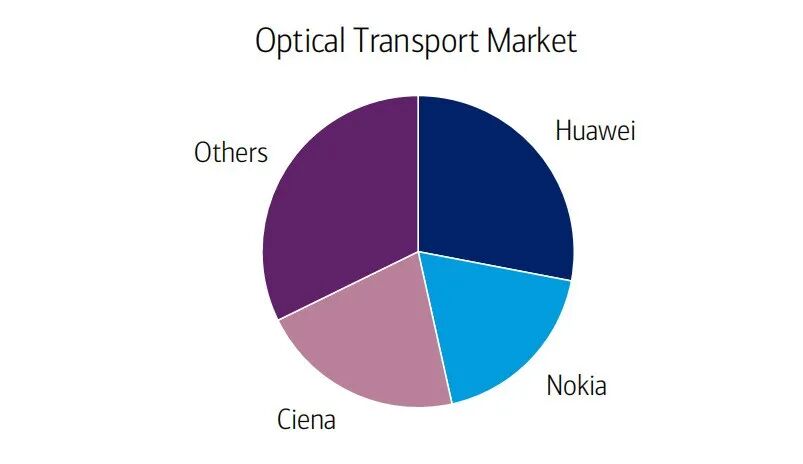
Source: Bank of America research report
Moreover, compared with other companies in the industry chain, Huawei and Nokia not only sell equipment or modules but also have R & D capabilities in chips and optical modules. They have stronger vertical integration capabilities in the entire system.
In addition, Nokia ranks first in the global market share of next - generation fiber - optic technology (XGS - PON) with 35%.
So, when Nokia's CEO said that nine out of the top ten cloud service providers in North America have switched to Nokia's technology, it's not an exaggeration.
Last year, Nokia's optical network business grew by 19% throughout the year, and AI and cloud customers accounted for 14% of the sales of the network infrastructure department.
After its "backbone" mobile phone business was broken, Nokia transformed into a telecommunications equipment provider. Now, it is quietly evolving into an "AI optical communication service provider."
Jensen Huang also added fuel to Nokia's rise. In October last year, NVIDIA announced an investment of $1 billion in Nokia. The two sides joined hands to promote AI - RAN innovation and 6G transformation. Jensen Huang defined the communication network industry as a "trillion - dollar industry."
Jensen Huang dug out this "living fossil" Nokia not out of nostalgia. As computing power increases, communication technology will become a bottleneck. High network latency will lead to idle computing power, and data packet loss will directly cause task interruption. Since communication is NVIDIA's weakness, it forces Jensen Huang and the entire AI field to re - evaluate the value of communication technology, which also leads to the re - evaluation of Nokia.
Some people commented that after 13 years, Nokia has gone from "just standing there" to "standing in the light."
But Nokia has never "just stood there." Looking at Nokia's 13 - year development, behind holding the optical communication card is the great belief of this company to piece together a "new Nokia" after experiencing a "cliff - like fall":
Buying out the communication equipment business, acquiring Alcatel - Lucent, taking over Bell Labs, and swallowing the optical network equipment manufacturer Infinera.
Even though Nokia's stock price has reached a 16 - year high, there are few media reports. Because there are too many powerful players in today's business world. There are many companies with a market value of over 500 billion or even 1 trillion yuan. New tech upstarts are also emerging one after another, and the spotlight is full of their figures.
In comparison, Nokia seems quite ordinary in terms of performance, market value, and status in the tech circle. Its re - evaluation has not staged an eye - catching "return of the king." It is just undergoing some unassuming but significant changes, that's all.
But I precisely think that Nokia, which has fallen but not died and is constantly evolving, deserves a headline.
Piecing Together a "New Nokia"
Back in 2013, after being continuously squeezed by Apple and Samsung, Nokia's market share in the mobile phone market dropped from over 40% at its peak to 3%. It had been in the red for the third year. On September 2nd of that year, Nokia sold its mobile phone business to Microsoft for $7.2 billion.
At that time, almost all global financial media used the headline "Nokia is dead." Most people believed that the death of Nokia, which had lost its core business, was just a matter of time.
But one month before selling its mobile phone business, Nokia also completed a transaction that received little attention: it bought the other half of the equity of Nokia Siemens Networks from Siemens.
What's going on here?
Previously, both Siemens and Nokia wanted to develop 3G and 4G wireless communication technologies. However, due to the huge investment, neither of them wanted to bear it alone. So, they took out their respective network business segments to form a joint - venture company, namely Nokia Siemens Networks.
However, Nokia Siemens Networks did not develop well later. First, although the joint - venture company seemed to be a combination of two strong players, in fact, it was not a "direct descendant" but a "distant relative" for both sides. It was easy to fall into a situation where neither side took full responsibility, and its operation was not good.
Second, the competition in the telecommunications business was extremely fierce. At that time, Ericsson was the global leader, and Huawei was growing the fastest. Nokia Siemens Networks had high costs and redundant personnel, and it had accumulated losses of billions of dollars in the past few years.
So, both Siemens and Nokia were fed up with this joint - venture company that kept "sucking blood." They just hadn't found the right price. So, they could only inject an additional 500 million euros each to carry out a large - scale restructuring of Nokia Siemens Networks -
Cutting costs; making the United States, Japan, and South Korea, which had higher profit margins, the core areas for R & D and operation; and betting on 5G and the cloud, which laid the foundation for Nokia to benefit from the 5G boom later.
After this round of restructuring, along with the increasing demand for bandwidth due to the rise of mobile Internet, which stimulated the market demand for a new generation of mobile broadband infrastructure, Nokia Siemens Networks began to turn a profit.
Siemens had lost interest in the communication business and planned to sell its shares. At that time, Nokia's CFO, Timo Ihamuotila, put forward a hypothesis:
"What would happen if we bought out Siemens' shares and kept Nokia Siemens Networks?"
This provided a new possibility for Nokia - to recreate a brand - new Nokia based on Nokia Siemens Networks.
However, this seemed a bit bold at that time because Nokia Siemens Networks could only provide solutions for the mobile network part of the entire network infrastructure and could not deliver end - to - end solutions.
Even so, Nokia's management and board of directors still believed that buying out Nokia Siemens Networks was a profitable deal. Because Siemens was eager to sell, the price was lower than the actual value of Nokia Siemens Networks. Even if they resold it later, they could still make a profit, and keeping it in hand offered another possibility.
Finally, Nokia acquired Nokia Siemens Networks for 1.7 billion euros. At this time, Nokia only had three businesses left: the network business of Nokia Siemens Networks, the HERE mapping business, and the R & D department responsible for patent licensing. Among them, the network business was the core, contributing about 80% of Nokia's total revenue.
The three businesses had different business models, different customer groups, and different marketing models. How to integrate them became a difficult problem.
After careful consideration, Risto Siilasmaa, the then - chairman of Nokia's board of directors, believed that Nokia had always been engaged in connection. The previous mobile phone business was about connecting people, while what Nokia Siemens Networks did was actually the interconnection between devices. In the future, whether it was the Internet of Things or the AI era, Nokia Siemens Networks could be the "digital nervous system" and serve as the central department of the new Nokia.
The HERE mapping business indicates the geographical location where things that the digital nervous system needs to know occur, and the high - end technology department has a large patent portfolio and can provide technical support.
At this time, a great opportunity emerged, giving Nokia a chance for a complete transformation - Alcatel - Lucent, the world's third - largest telecommunications equipment provider, was struggling on the profit - and - loss line and was seeking a merger partner.
This was just like "when God closes a door, he opens a window." As mentioned above, Nokia Siemens Networks only had mobile broadband technology and services, while Alcatel - Lucent had a complete communication infrastructure industry chain, and its mobile network business was actually a weakness. They were a "perfect match."
By the way, the optical transmission ability was brought to Nokia by Alcatel - Lucent.
More importantly, Alcatel - Lucent also had a "temple - level" research institution in the communication field: Bell Labs.
Bell Labs has invented many basic technologies that support the entire information and communication network and all digital devices and systems. These research achievements have won eight Nobel Prizes, two Turing Awards, three "Japan International Prizes," and a large number of national science and engineering awards.
For Alcatel - Lucent, Nokia was also the best merger partner. At that time, Ericsson was implementing strategic contraction, focusing on wireless communication, and was not interested in Alcatel - Lucent's fixed - line, IP routing, and optical communication. And Huawei was blocked by political barriers and had no possibility of acquiring this French company whose main market was in Europe and America.
In 2016, Nokia acquired Alcatel - Lucent through a share - swap method (each Alcatel - Lucent share was exchanged for 0.55 newly issued Nokia shares), with a transaction scale of 15.6 billion euros.
Before that, Nokia sold the HERE mapping business to a consortium jointly formed by BMW, Audi, and Daimler for 2.5 billion euros to prepare funds for the integration after the acquisition of Alcatel - Lucent.
As a result, Nokia became the world's second - largest telecommunications equipment provider and the only one in Europe and America that covers all elements of the 5G network, including radio, core network, cloud, management, automation, and other end - to - end product portfolios.
Nokia also has many 5G patents. According to data from the European Telecommunications Standards Institute, as of 2026, Nokia has 7,287 5G standard - essential patents, second only to Huawei, Qualcomm, and LG.
So, Nokia has benefited from 5G construction for many consecutive years. For example, at its peak in 2022, Nokia's revenue was 24.9 billion euros, and its net profit was 4.26 billion euros (about 31.4 billion yuan in RMB at that year's exchange rate).
It is worth mentioning that in addition to making money from the telecommunications business, Nokia also quietly collects patent fees from all over the world and is even called a "patent troll."
Over the past 30 years, Nokia has invested at least trillions of yuan in R & D and has accumulated a large number of patents in the 2G - 5G communication field. Coupled with the integration of Bell Labs, it is difficult for many technology companies to bypass Nokia's patents.
Nokia sued Apple in the early years and received an annual patent fee of 100 million euros; then it sued Samsung and received 200 million euros annually. OPPO, vivo, Lenovo, Asus, etc. have also been sued by Nokia.
Even car companies cannot escape Nokia's lawsuits. Because the more intelligent cars are, the more they are connected to the Internet, and the more they need communication technology, which brings them into contact with Nokia. In 2019, Nokia sued Mercedes - Benz, forcing it to pay a 4G patent license fee of $15 per car to Nokia; last year, Nokia also sued Geely, demanding a patent fee of 49 yuan per car.
From 2020 to 2025, Nokia can contribute 600 million to 1.2 billion euros in operating profit to the company every year just by patent fees, accounting for more than 30% of the group's comparable operating profit. It is the core cash - flow source to support Nokia's strategic transformation.
In recent years, the peak period of 5G construction has passed, and Nokia's performance has declined significantly. Last year, its revenue was 19.89 billion euros, and its net profit was 650 million euros (about 5.2 billion yuan in RMB).
Another important reason for Nokia's low net profit last year was the cost of restructuring Infinera - it acquired the optical communication equipment manufacturer Infinera for $2.3 billion in June 2024.
From this transaction, Nokia obtained the jigsaw pieces of core optical communication technologies such as indium phosphide integration and semiconductors, making it the world's second - largest optical network equipment supplier.
Summary
Among the companies moving towards the AI era, Nokia is not outstanding or eye - catching. It also faces considerable challenges - its original mobile communication business is shrinking, and the optical communication field is highly competitive with great uncertainty ahead.
However, such a "fallen but not dead" company is still constantly "struggling" and has obtained an entry ticket to the AI arena. This "power of evolution"