All the tricks have been used up, and there are no more new stories in the automotive circle.
What are the trends in the automotive industry this year? The answer is straightforward: it's all about quantity. In the Chinese automotive market in 2026, the number of new car press conferences has become overwhelming. A leading automotive media company reported that its entire team of over 100 people was dispatched to cover these events.
According to incomplete statistics, in March alone, there were nearly 80 new car - related events held in China, exceeding the daily update rhythm. On many days, four car companies held press conferences on the same day. In April, this wave of press conferences not only showed no sign of cooling down but intensified as the Beijing Auto Show on April 24 approached. It has become normal to have three or four press conferences per day.
According to incomplete statistics, in April, at least 40 new cars in the domestic auto market were launched, pre - sold, or announced. Car companies have chosen to launch new cars before the auto show to avoid the information flood during the show and lock in the communication volume in advance. April 22 was even more intense. According to preliminary statistics, more than 10 new cars will be launched or announced on that day.
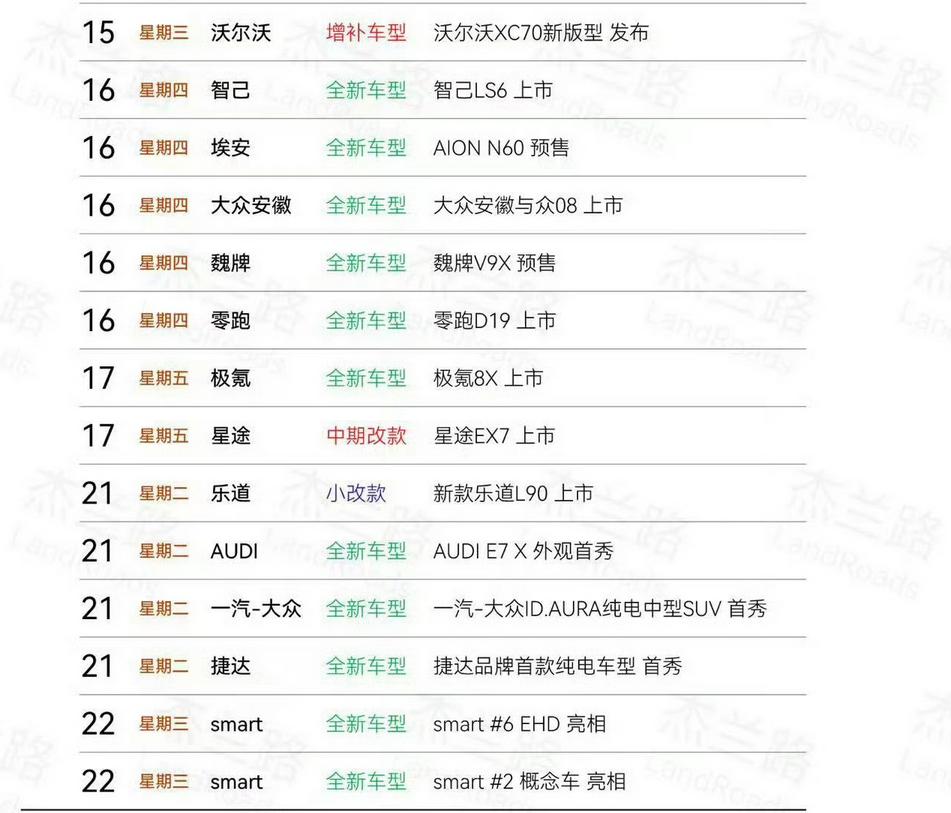
Notably, these new cars are highly similar in positioning and price range. Take April 16 as an example. Earlier, there were XPeng GX and Volvo XC70. On that day, IM LS8, Leapmotor D19, and FAW - Volkswagen ID.08 were pre - sold or launched. Later, ZEEKR 8X and Wei brand V9X were launched and pre - sold. These are all large SUVs, with prices concentrated in the range of 200,000 to 400,000 yuan, and the product homogenization is severe.
What's even more terrifying is the number of press conferences for a single new car. From the technical pre - heating to the final delivery, it often involves five or six or even more press conferences. For example, technology brand days, product premieres, static studio shoots, dynamic test drives, pre - sales, official launches, car disassembly or long - term test live broadcasts, etc., are like a continuous drama.
In the era of traditional fuel - powered cars, a new car usually only needed two to three press conferences. Now, it often starts with five or six. Car companies almost create new topic nodes every month. Some brands can shorten the time from pre - sale to delivery to one month, but some models start pre - heating a year in advance.
In the past, people said not to engage in the so - called "involution", but now it has taken a more absurd turn. It is a waste of resources and time, and the result is just like a stream of short - video information. Only a few cars are truly remembered by consumers. The madness during the Beijing Auto Show week is hard to describe the surging situation in the Chinese automotive industry. There are more and more cars, but they seem to be becoming more and more similar.
What has been the focus of the "involution" in recent years?
In the current Chinese auto market, car companies may say they don't engage in "involution" verbally, but their actions tell a different story. It's impossible not to be involved in the "involution".
The starting point of the "involution" was the chip computing power, or more specifically, it started with the intelligent cockpit chips. With the rapid increase in the penetration rate of automotive intelligence, whether a car is equipped with Qualcomm 8155, 8295, or chips with 6 - nanometer or 4 - nanometer processes once became the standard to judge whether the cockpit of a new energy vehicle was more intelligent, qualified, or high - end.
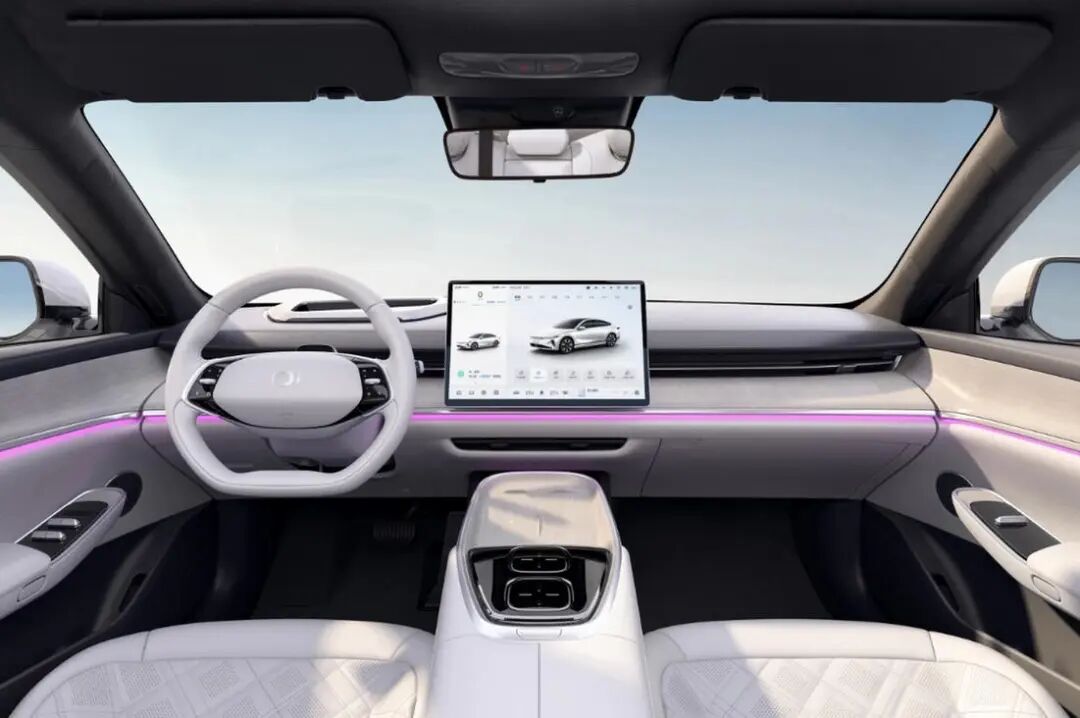
Meanwhile, in the field of intelligent driving, the focus shifted to computing power, including the number of lidars and the number of lidar lines. Initially, the NVIDIA Orin - X chip dominated the industry and was almost an unavoidable choice for car companies aiming for high - level intelligent driving. Later, Chinese car companies started to develop their own chips. NIO, XPeng, Li Auto, etc., are all testing the waters. Then there is Huawei's leading position and the rapid rise of Horizon Robotics.
When the computing power competition reached a bottleneck, the "involution" shifted to another dimension: refrigerators, large - screen TVs, and comfortable seats. Li Auto was the first to stand out with this product concept. However, what was once a unique selling point quickly became a standard feature across the industry. Now, even 100,000 - yuan family cars can be equipped with in - car refrigerators. For 150,000 - yuan SUVs, seats with massage functions are basic. For 200,000 - yuan cars, it's embarrassing not to have three large screens at a press conference.
As these selling points became standard, innovation fell into the trap of homogenization. Car companies can only keep adding features in this race. For example, Ford created a concept of "one living room, one bedroom, and one kitchen". IM added a tail - gate shower system to its flagship car. Leapmotor D19 even launched an in - car oxygen generation system to create a forest - like oxygen cabin.
If consumers are no longer interested in the configurations, then the "involution" moves on to promotions. Direct price cuts can easily damage the brand image and cause negative public opinion from existing customers. So, car companies have repackaged the price war into a low - interest financial war. At the beginning of 2026, Tesla was the first to offer a seven - year ultra - low - interest loan, with a monthly payment of only over a thousand yuan.
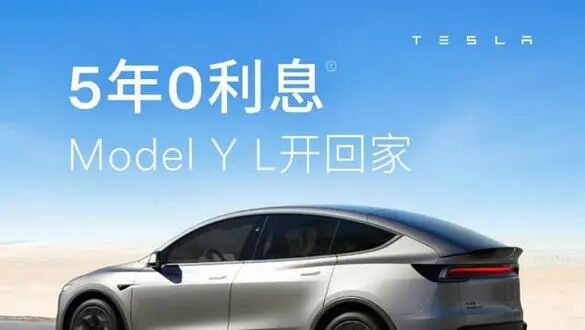
Subsequently, more than 20 car companies, including BYD, Xiaomi, Li Auto, and XPeng, followed suit. Dongfeng Nissan even extended the loan period to eight years. IM Motors launched a combination of a seven - year zero - down - payment loan and a 23,000 - yuan cash bonus. It's more like a price war in the guise of financial services than a real financial innovation.
Here, there is a new track that is not exactly "involution" but rather an industry - driven trend: the installation volume of intelligent driving assistance solutions. For example, Huawei's Qiankun Intelligent Driving, Momenta, DeepRoute.ai, Horizon Robotics, and Zhuoyue Technology form the first echelon of Chinese intelligent driving suppliers.
What if these strategies also fail? The "involution" fire spreads to the supply chain. Car companies start to show off their list of well - known suppliers to prove their superiority. On March 26, the Yijing brand held a supplier ecosystem cooperation conference, bringing together 75 key global industrial chain suppliers, including Shenzhen Yinwang and CATL, covering core vehicle sectors such as chassis, intelligent driving, cockpit, braking, and body lighting. It is a top - level matrix in the core areas of the entire vehicle manufacturing process.
The Leapmotor D19, launched on April 16, also adopted a similar strategy. During the pre - heating period, it released a series of posters of well - known suppliers, emphasizing on high - end components. At the press conference, it showed off a series of top - notch suppliers such as Konghui air suspension, Michelin low - noise tires, Fuyao double - layer sound - proof glass, semi - aniline leather interior, and 9200 - ton integrated aluminum die - cast floor.
Actually, if we recall, we can remember that at the Shanghai Auto Show last year, the scale of supplier booths quietly increased. In the 2025 Shanghai Auto Show, the number of supply - chain exhibition booths increased from 12 in 2023 to 23, and the exhibition area soared from 30,000 square meters to 100,000 square meters. This shows how important suppliers are in the new energy era.
Now, as we can see, the "involution" has entered the simplest and most straightforward stage: the number of press conferences. Information shows that during the two - day media days of the Shanghai Auto Show last year, 193 press conferences were held, setting a record. What about the upcoming Beijing Auto Show this year? It will be held in a new venue for the first time. Will the number of press conferences exceed that of the 2025 Shanghai Auto Show?
What are the costs of the "involution"?
When "involution" is inevitable, another unavoidable question emerges: who is paying the price for this "involution" frenzy?
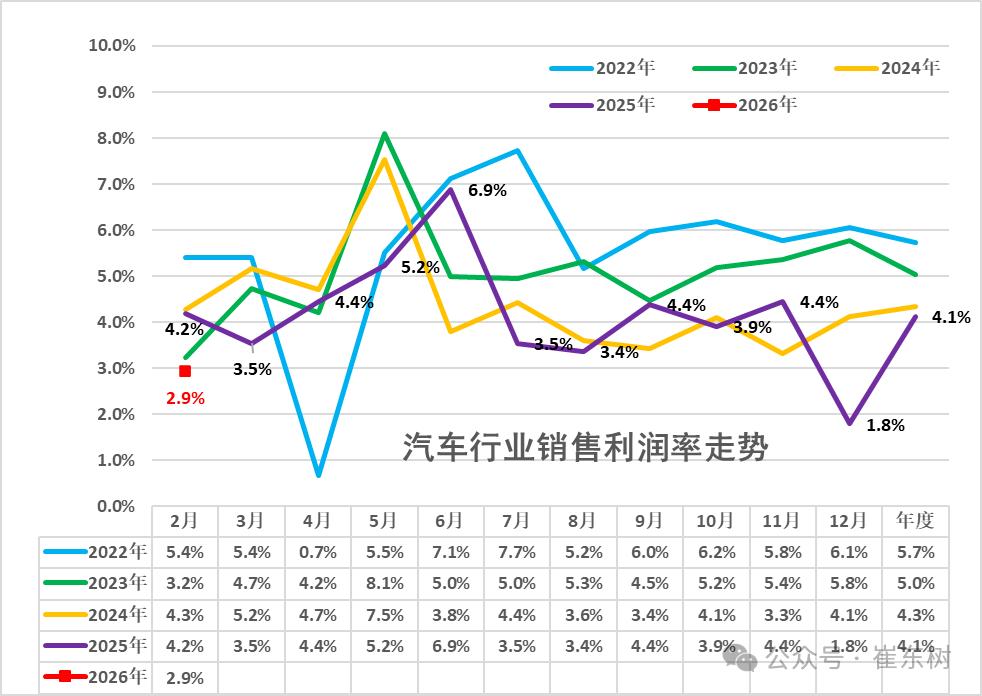
The most direct cost is the continuous decline of the industry's profit margin. According to data from the National Bureau of Statistics, in 2025, the profit margin of the Chinese automotive industry was 4.1%, a year - on - year decrease of 0.2 percentage points, reaching a record low. In December 2025 alone, the profit margin was only 1.8%, a year - on - year decrease of 2.3 percentage points.
In 2026, the situation did not improve. From January to February, the industry's profit margin further dropped to 2.9%, far lower than the average of 4.92% for industrial enterprises above the designated size nationwide. During the same period, the total profit of the automotive industry was only 43.5 billion yuan, a year - on - year decrease of 30%.
The financial reports of some mainstream car companies are also not looking good. In 2025, Li Auto's operating income was 112.313 billion yuan, a year - on - year decrease of 22.25%. Its net profit attributable to shareholders was 1.124 billion yuan, a year - on - year decrease of 86%. XPeng Motors had a net loss of 1.139 billion yuan for the whole year. Although it achieved a single - quarter profit for the first time in the fourth quarter, it was still in the red for the whole year. NIO had a net loss of 15.571 billion yuan for the whole year, although the loss was narrower than the previous year.
Li Bin, the founder of NIO, once calculated: "It's quite common for a car model to waste hundreds of millions of yuan. The manufacturers don't make money, the supply chain doesn't make money, and the users don't benefit either. Hundreds of millions of yuan are just wasted like this." According to his estimate, by standardizing battery cells and unifying chips to reduce industry waste, the industry can release over a hundred billion yuan in potential benefits every year.
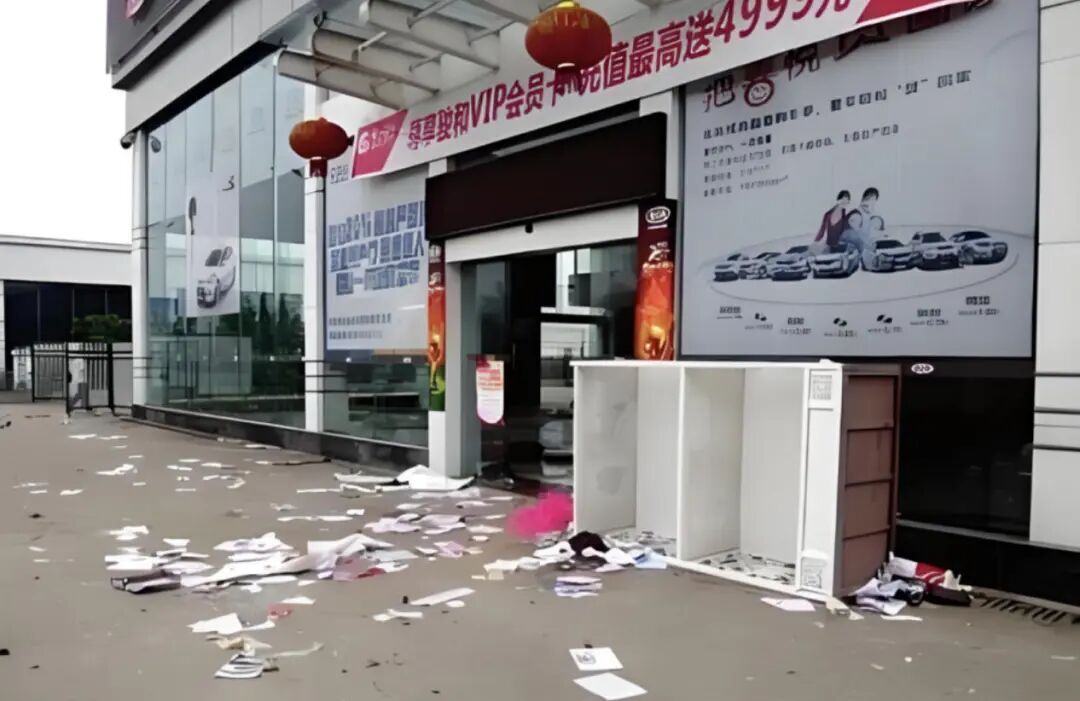
Car dealers are the invisible victims dragged into the abyss by the "involution". According to the calculation of Cui Dongshu, the secretary - general of the China Passenger Car Association, from January to September 2025, the gross profit per vehicle of car companies was only about 14,000 yuan, while in 2017, this figure was as high as 23,000 yuan. The profitability per vehicle has shrunk by nearly 40% in eight years.
In 2024, the average gross profit margin of car dealers nationwide was less than 3%, and more than 4,400 4S stores withdrew from the market. In the first half of 2025, more than 52.6% of dealers suffered losses, and 74.4% of dealers had price - inversion problems. The loss per vehicle for some slow - moving models exceeded 10,000 yuan. A dealer of a joint - venture brand said helplessly: "We lose thousands of yuan for each car sold. We rely on after - sales service and manufacturer rebates to make up for the losses."
The biggest victim of the "involution" may be the consumers. In the past, car model upgrades usually followed a pattern of a mid - cycle refresh every three years and a full - generation change every five years. Now, the iteration cycle of new cars has been compressed to a few months or even shorter, and existing car owners are often "stabbed in the back". Some car owners bought a car in March, and six months later, the official price dropped by 30,000 to 50,000 yuan. This depreciation rate makes many consumers feel that buying a car is like investing in stocks.
The decline in new car prices is most likely to lead to the collapse of the vehicle's residual value. The "2025 China Vehicle Residual Value Report" shows that the three - year residual value of plug - in hybrid vehicles is only 43.7%, and that of pure - electric vehicles has dropped to 42.0%. In the same period, the three - year residual value of traditional fuel - powered cars is generally above 50%, that of Japanese joint - venture brands is stable above 54%, and the three - year residual value of luxury brand Porsche is as high as 66.2%.
The number of consumer complaints has also soared. At the "3·15 Problem Auto Show" held in a certain place this year, the proportion of complaints about new energy vehicles exceeded 40% for the first time, becoming the hardest - hit area. According to data from the national 12315 platform, in the first quarter of 2026, there were 32,000 complaints related to automobile consumption, a year - on - year increase of 18.6%. Among them, false range claims, exaggerated intelligent driving promotions, and three - electric system failures are the core pain points.
From the decline in car companies' profits, to the crisis of car dealers, and then to the damage of consumers' interests, the "involution" is a game with no winners. Especially when consumers lose their judgment and interest in learning about new cars in the overwhelming marketing information, the cars that can truly meet consumers' needs will be overshadowed.
This article is from the WeChat official account "Automobile Commune" (ID: iAUTO2010), written by Yang Jing, and is published by 36Kr with authorization.