36Kr Exclusive Interview | After Receiving Investments from DJI and Meituan, SmartPie Catches Up with Toolwiz to Turn the Tables as the Runner-up
Author | Zhang Ziyi
Editor | Yuan Silai
Chen Bo, the co-founder and deputy general manager of Smart School, has changed.
Three years ago, if you met him, you'd think he was so flamboyant as to be arrogant. Chen Bo was absolutely confident in Smart School's products and capabilities. As for competitors, he thought, "They're nothing special."
Three years later, he told us: He'll try his best on some things. If he can't achieve the desired results in a few years, he'll let more capable people take over the business - or even introduce professional managers.
In the venture capital circle where "founder worship" prevails, this is a shocking decision, but there are traces to follow.
36Kr exclusively learned that Smart School has completed a Series B+ financing of hundreds of millions of yuan. Jointly invested by Meituan Longzhu, Meituan, Shenzhen Capital Group, Hillhouse Capital, Intime Group, Guoce Investment, Minghui Zhiyuan, GaoXin Investment, etc. This round of financing is less than half a year after the previous round in which DJI participated.
In the past decade or so, people have been infatuated with and chased after genius founders, regarding them as some kind of religious leaders. They don't necessarily have good eloquence or need to be likable, but they must have extremely strong personalities and talents in one aspect. Even if their styles are high - pressured, dictatorial, and unfeeling, they will still be worshiped by countless people.
From Silicon Valley to China, from Steve Jobs and Elon Musk to Sam Altman, this trend has never faded. And these dreamers have indeed created a number of star companies worthy of being recorded in history.
Smart School obviously doesn't belong to this group. They started their business in Huaqiangbei and are common grass - roots "bosses" in Shenzhen. The headquarters of Smart School is in Longhua, an area full of factories. They like "doing business" rather than being obsessed with changing the world - Chen Bo never romanticizes entrepreneurship.
In the founding team of Smart School, you can see the entrepreneurial spirit flowing in the blood of many Cantonese people: like water, they adapt to the changes of the times, the market, regions, and even cultures. They are flexible, practical, and down - to - earth. When they find they can't achieve their goals, they can admit their own deficiencies and quickly switch paths.
From the matter of introducing investment, you can see the change in Smart School's actions. For a long time, the three founders of Smart School didn't accept external investment or media interviews. "Making money quietly" has always been the characteristic of Chaoshan bosses.
During those years, they invested a lot of money and manpower in R & D and even abandoned a product, but they found that the gap between their products and their competitors was still getting bigger. "At that moment, I realized that our efforts couldn't keep up with the intensity of the market," Chen Bo recalled.
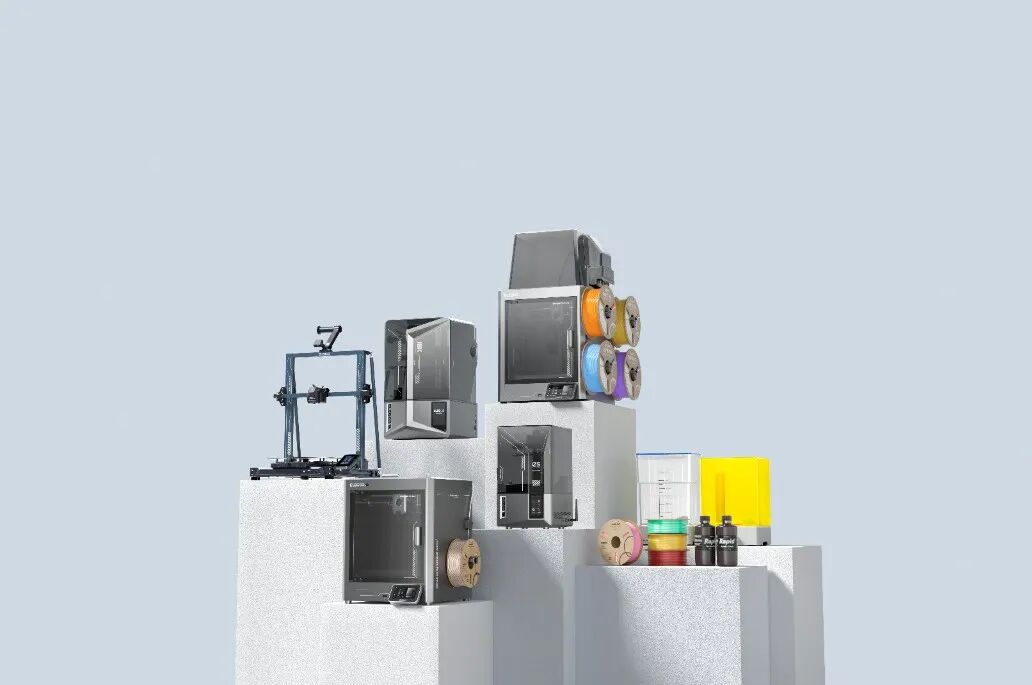
(Image source/Enterprise)
And the solution is clear: "If the three of us can't do it well, it means there's a problem with our own abilities. If we can't do it well, let more suitable people do it."
They actively looked for intermediaries to contact DJI and reached an agreement on financing in three months. Chen Bo, who didn't even want to make his personal photos public before, also began to force himself to contact the media.
As "bosses", Hong Yingsheng and Chen Bo of course have ambitions. They believe that the 3D printing market still has several times of growth potential, and the market is far from reaching the end. Smart School must stay at the table to take advantage of the dividends and even become the first. For this purpose, they're willing to cut off the inherent sense of control, pride, and emotions of the founding team. As Chen Bo said: "Doing business isn't playing house."
We talked with Chen Bo for nearly three hours, exchanging experiences of the past three years and plans for the future.
People are easily attracted by founders with a savior - like temperament. Smart School isn't good at telling fascinating stories, but there's no doubt that these grass - roots "bosses" are also formidable opponents.
"Be water, My friend."
01 "Revolutionize Yourself"
36Kr: Actually, you didn't want to show up and speak before.
Chen Bo: Actually, the cultural style of a company is set by its founders. Why didn't we often come out to talk before? Our founders aren't of the overly lively type. Even two years ago, we didn't want to be known by the media, not even a single word.
This is related to the style of Chaoshan people. He's from Chaoshan, and I'm from Hakka. In fact, our personalities are the same. We believe that it's best to be like Ma Huateng, just make money quietly.
36Kr: Why choose to speak out at this stage?
Chen Bo: Essentially, it's a need for development. What I've observed now is that the world has entered a new cycle. Before, we called it "cross - border e - commerce going global", and now it's called "brands going global". This is a stage where Chinese brands are directly challenging old - world brands (such as Sony and Apple). Who can become a global brand in the future? Besides those top - notch hardcore companies, there are also variables for medium - and small - sized companies like ours in the process. So we can't be "narrow - minded" and be trapped in our own circle anymore.
36Kr: What do you think is the biggest shortcoming of Smart School now?
Chen Bo: Actually, our current shortcoming is in software. We need to be clear that the software here isn't the kind of software in the Internet field that focuses on mass customer acquisition, large - scale effects, and closed - loop business models. Instead, it needs to be strongly integrated with hardware. It includes two levels: one is the firmware and slicing software of the machine itself, which is used to drive the hardware to work; the other is the ecological software that matches the machine, such as the model library and mobile phone apps.
So although we only mention "software", ultimately it refers to your ability to integrate and close - loop the entire 3D printing software - hardware ecosystem. At present, only a few of us have such an ability. Undoubtedly, Tuozhu is doing the best, and we still haven't done well enough.
36Kr: People used to think that 3D printing was about competing in hardware parameters. After Tuozhu entered the market, where exactly does its software advantage lie? Is it in printing efficiency or simple completion rate?
Chen Bo: Tuozhu's entry has raised the standard to the current level. Actually, from the perspective of industry breakdown, its hardware isn't the best, but its software is indeed a moat. At present, it's difficult for other companies, including us, to catch up in a short time.
The core problem that software solves is actually "stability". Before Tuozhu emerged, the software of most companies was basically at the level of "just usable" and played a supporting role, while hardware was the main focus of innovation. But looking at the subsequent development, with ordinary hardware, as long as the software is well - tuned, the user experience can also be very smooth.
36Kr: What's the most intuitive difference in this "stability" at the user end?
Chen Bo: The most crucial point lies in the success rate, both for single - print and continuous - print success rates.
Let me put it in an intuitive way. If a household user buys and uses a brand in the second - tier of 3D printing (T2), this machine may need to be reset and self - leveled every half - month before it can continue to be used. There wasn't much of a problem with this in the past because users didn't need to adjust it manually. But Tuozhu can maintain continuous and stable operation for more than a month.
This is the difference in consistency. It's not a hardware problem because the hardware can restore its accuracy after resetting, but it's about software control. After each print, can the algorithm remember the accuracy deviation caused by the hardware? Can it be restored every time? This requires the accumulation of algorithms, and we're still working hard to catch up.
36Kr: So that's why you're using DJI's methodology now?
Chen Bo: We're indeed learning DJI's methodology for product development. Their software and algorithms are what we need, and there's also the methodology for firmware development in combination with hardware. It's not about looking at what kind of firmware they've developed, but about the entire system. This situation occurs in the entire industry, including Tuozhu: the hardware products are well - made, but the software tuning can't keep up. If we adopt this methodology, it can correct the process of constantly making mistakes in the past.
36Kr: Did you think about doing it on your own before?
Chen Bo: We used to try to form our own team to do it. In the past few years, we also recruited a group of people to break through. Did we achieve any results? Definitely, but it was all about trial - and - error, and the efficiency was extremely low. We found that hardware can be gradually accumulated and iterated, and people have mastered the rules, but software is a binary relationship of 0 and 1. Our previous team lacked software thinking. When you form a team, it takes time for it to grow, and your competitors are also making progress. So now we've changed our approach to improve the situation.
36Kr: If, after introducing this system, we still can't produce good products after verification, will you make more radical adjustments?
We've made our stance very clear, which is to "revolutionize ourselves". If the products in 2024 and 2025 still can't meet the market's expectations or reach the level of competing with rivals, it means that our management ability has indeed reached its ceiling.
Our attitude is open: if we can't do it well, let more suitable people do it. We'll even consider introducing professional managers. To be honest, if the three of us can't do it well, it means there's a problem with our own abilities. I have the same attitude towards my management department. If they can't lead the company forward, I'll step down and let more capable people take over.
36Kr: Then, in such in - depth cooperation or even takeover, how can you ensure your control?
Chen Bo: It's still the same logic: if you terminate the cooperation, do you have any other ways out? No. Although your profit margin may decrease, in terms of total profit, if you used to earn 100 million yuan and will earn three to five billion yuan in the future, what's wrong with that? Doing business isn't playing house.
We started in Huaqiangbei, which is a very grass - roots startup in Shenzhen. Later, we transformed from a cross - border e - commerce model to product development. At that time, there was just such an opportunity, and the industry had a high ceiling, so we could pursue it. But if we still can't succeed after our efforts, we definitely need to make adjustments.

Saturn+4+Ultra (Image source/Enterprise)
Let me give you an example. If I give you 200,000 yuan, you can buy a very good car and drive it right away. But if you use this 200,000 yuan to develop a car on your own, you may not even be able to make a wheel in the end. So which is more cost - effective? When you can't do it on your own, you need to be decisive. As long as you can stay at the table, it's better than being kicked out.
36Kr: When exactly did this change occur? I remember you seemed very high - spirited when I met you in 2023.
Chen Bo: The change occurred from the end of 2024 to the beginning of 2025. Theoretically, we should have launched a product at the end of 2024 to capture the incremental market. At that time, some of our competitors hadn't launched new products for two years, and we needed to beat them to it.
However, the product developed by the team we formed in 2023 was constantly delayed. At that moment, I realized that our efforts couldn't keep up with the intensity of the market. It was extremely painful at that time because you were already in an all - in state. All resources were allocated to the R & D of this product, but the result couldn't catch up with the products already launched by our competitors.
36Kr: Haven't you experienced such a setback before? Will you doubt yourself?
Chen Bo: We had a relatively smooth journey before. There's no self - doubt. We've been in business for ten years.
We immediately looked for a way out. Looking back to analyze the success patterns of these "top students", we found an interesting phenomenon: in the field of hardware innovation going global, leading brands like Tuozhu, Insta360, and EcoFlow, their core teams largely originated from DJI. This shows that DJI not only outputs products but also a system - level hardware engineering ability that has been repeatedly verified by the market.
This common genetic feature made us realize that DJI is the technological mother - body that can help us break through the bottleneck. Since we've identified the optimal solution right in front of us, we just went directly to DJI. This is the way out we've been looking for.
At that time, with the introduction of a familiar intermediary, the speed from the first communication to the confirmation of cooperation between the two sides was extremely fast.
36Kr: What was the main reason for the delay of that generation of products at that time?
Chen Bo: It was still the ability of engineering mass - production. You've pre - researched a lot of technologies, but when you put them all together in one machine, single - point bugs will affect the whole. At that time, the multi - color printing efficiency didn't meet the standard, so we were forced to only release a single - color version of the machine overseas. And I didn't even sell this generation of products in the domestic market. You can imagine how painful I was.
02 It's Meaningless to Be Second
36Kr: Actually, I remember that some of your products have achieved good crowdfunding results over the years.
Chen Bo: Regarding the later - model machine, we shipped more than 200,000 units overseas last year. From an industry perspective, more than 200,000 units is already a hit product. However, in front of the first - place brand, you're nothing. Even if your single - model product ranks second, if the first - place brand sells one million units, a sales volume of 200,000 units means a five - fold gap.
So, in the face of such a gap, what's the meaning of being second? Is there any difference between being second, third, or fourth? Is there any difference between being fifth or tenth? No. It's meaningless to alternate rankings.
So, although you've indeed achieved something, when the outside world observes you, you're just not significant enough.
36Kr: In 2023, your scale reached one billion yuan, and last year it was 2.3 billion yuan. Although it's been