I quit my job without a new one lined up to run a "one-person company," and I regret it.
At this time last year, an Israeli programmer was traveling in Southeast Asia. He casually turned an idea that had been brewing in his mind for a long time into a product, a platform that allows anyone to "describe" the software they want in natural language, and then the AI directly creates it for you. The database, login system, and data storage are all automatically configured, without writing a single line of code. He named it Base44.
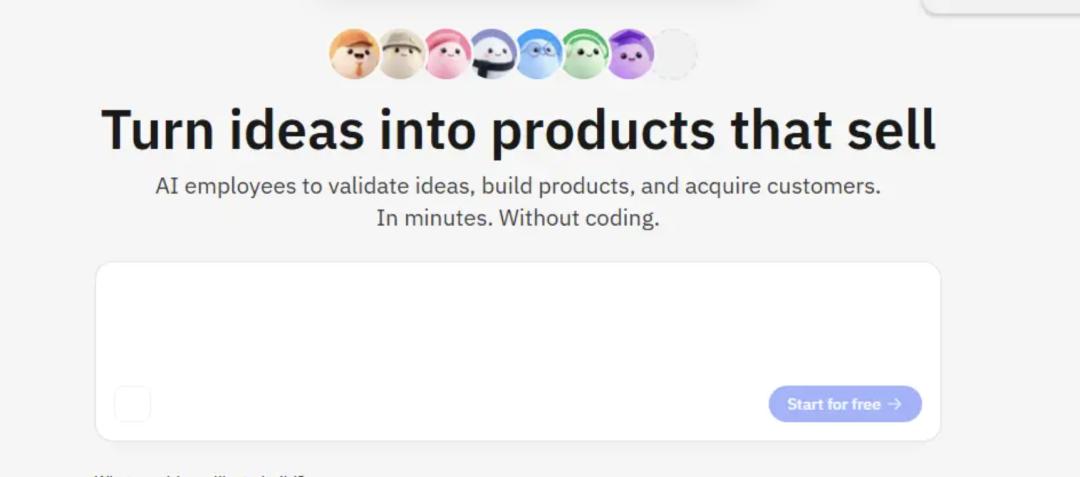
Base44 | Screenshot from the official website
Four months later, this platform had 250,000 users, and its monthly profit was close to $200,000. Six months later, Wix, a giant in website building, bought it for $80 million in cash.
Later, this story went viral on domestic social media. The version that was repeatedly forwarded usually only had one sentence: One person, six months, $80 million.
Almost at the same time, AI guru Andrej Karpathy posted that tweet on X that was later quoted by countless people, defining a new term: vibe coding.
He said that there is a new way of programming where you fully immerse yourself, forget about the existence of code itself, just tell the AI what you want, and then wait for the result.
"Vibe coding" was included in the Merriam - Webster Dictionary as an annual buzzword in March and was selected as the word of the year 2025 by the Collins Dictionary at the end of the year.
Immediately afterwards, what Sam Altman said a few years ago, "The era of one - person unicorns has arrived," was dug out again. A wave of entrepreneurial enthusiasm hotter than the Internet bubble in 2000 came. Vibe coding tools emerged one after another, such as Cursor, Lovable, and Claude Code; on Xiaohongshu, the post "Liberal arts students are the real beneficiaries of AI" started to flood the screen.
A bunch of people, inspired by the topic "Quit job and start an AI business to restart life," gritted their teeth, quit their jobs, turned on their computers, and started making products. But after a few months, they only learned a painful lesson: Writing code is actually the easiest part of the entire entrepreneurial process...
Liberal arts students obsessed with programming
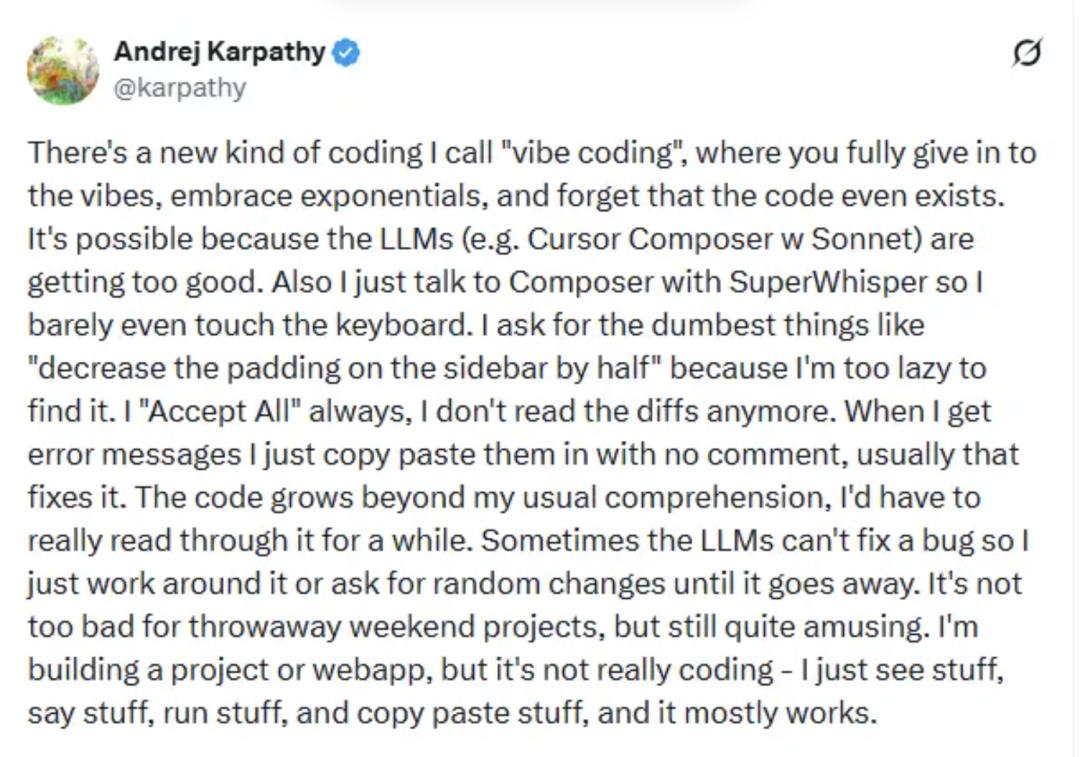
Karpathy's X screenshot
"Rely on feelings, enter the flow state, and then forget the existence of code. This is vibe coding (fully give in to the vibes, embrace exponentials, forget that the code even exists)."
To be honest, in the Chinese context, there isn't a translation for "vibe coding" that can fully convey its meaning. Many people literally translate it as "atmospheric programming," but these four characters are really obscure.
In my opinion, vibe coding can be called "observant" AI programming.
Like text and pictures, sometimes writing code also requires a certain "feeling". What vibe coding can do is that as long as you describe the final result you want, the AI can code for you.
Vibe coding instantly became a hot term of the era. YC then released a podcast specifically talking about why vibe coding would become the main theme. Their partner said in the podcast that among the projects YC invested in that quarter, a quarter of the companies had a vibe coding ratio of 95% or even higher, and the founders of these companies were all computer majors, because they knew more precisely how to describe their requirements and modify code, and they were more willing to use vibe coding to improve efficiency.
As a top "hello world" player in Python and a complete tech - novice, I immediately thought I could do it when I heard this term and immediately opened ChatGPT eager to try. However, the reality was very harsh. GPT gave me a string of code. As a complete beginner with no programming foundation, I stared at the screen, completely at a loss as to where to put these things. So, this idea was shelved.
I wanted to try vibe coding again some time ago when Claude's Agent ability started to shine. In the past, vibe coding required a bit of patience. You had to know where to put the code generated by the AI, and when there was a problem, you could only stare blankly at the screen. After the Agent came out, it was different. The AI started to be able to do a series of things on its own, create files, find problems, and debug...
I decided to try again, this time using Claude. I opened the dialog box, and my first sentence was: "I'm a complete beginner with no programming experience. Now I want to make a tool. What should I do?"
Claude directly asked me what my requirements were. I directly told Claude my requirements in plain language, saying that I wanted to make a web page, a tool that could read the content in video and article links and convert it into the text style I wanted. Claude directly made a complete web page design for me, and then I made modifications on this basis. For example, in the initial version, it gave me several options for the word count, 400, 600, 1000 words. I changed it to manually inputting the word count.
However, when it came to connecting to the backend of this web page and accessing the API, which involved fees, I didn't want to spend money on it, so this attempt ended here. Although the process was not complete, it still let me experience vibe coding.
Many people like me who are not from a computer background have already made products using vibe coding.
Serious (pseudonym) is doing a PaaS startup in Silicon Valley. During the startup process, he needs to track a large amount of Silicon Valley information, such as a16z's podcasts, YC's batch progress, and various financing dynamics, which are scattered across dozens of different channels. Manually checking these every day is time - consuming, labor - intensive, and error - prone. He used vibe coding to make a summary website that regularly crawls and aggregates these sources. He only needs to open it and take a look every morning.

Provided by Serious (pseudonym) | Screenshot of the information collection website
Yan Wen (pseudonym) graduated from the Department of Architecture at Tsinghua University and worked in a large company for several years. Vibe coding made her see the opportunity to start her own product - based business. She made an AI resume - modification tool that polishes resumes through multiple rounds of conversations with users and in combination with the requirements of the applied positions.
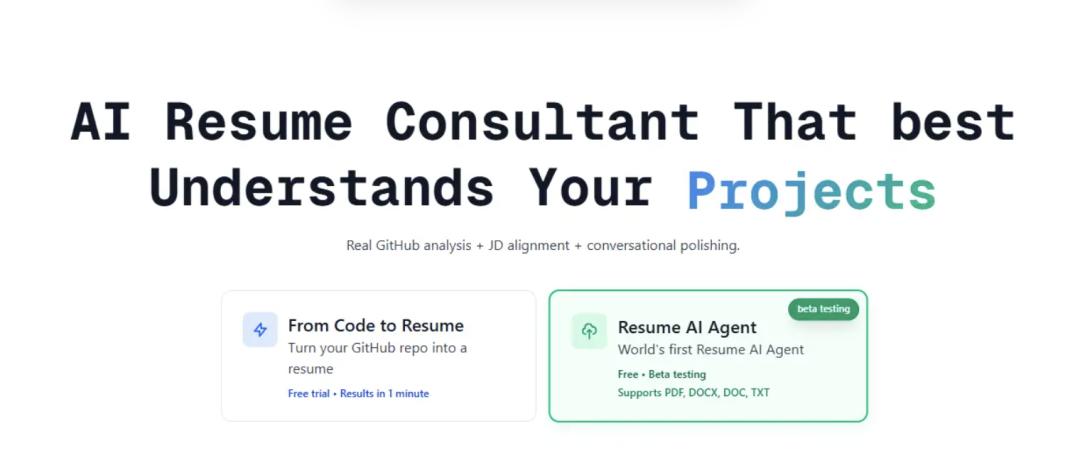
Provided by Yan Wen (pseudonym) | Resume modification website
Lin Yu (pseudonym) and his all - business - major team also used vibe coding to create a product, which I describe as an AI version of "Zhu Bajie". Users can build their own websites through natural - language conversations and selections, which is suitable for individual companies or small teams for market promotion. Previously, such requirements had to be outsourced to programmers, but now their product can achieve all of this.
After chatting with these people, I found that they have one thing in common: Their starting point for taking action is not "vibe coding looks cool", but "I have a specific problem that hasn't been solved". Serious wants to solve his own information management problem, Yan Wen is productizing her years of judgment on resumes, and Lin Yu and his team are filling a real market gap.
First have a need, then use the tool. This is how the first group of people who successfully used vibe coding did it.
Some job - quitting is just self - indulgence
The progress of vibe coding has greatly lowered the threshold for making products, which gives many people the illusion that they can do it too.
As a result, on Xiaohongshu and in Moments, there are a large number of posts like "Quit job and restart life", "I am a one - person company", "I launched my first product in three days of vibe coding". Various entrepreneurs' alliances and coffee chats have also emerged everywhere.
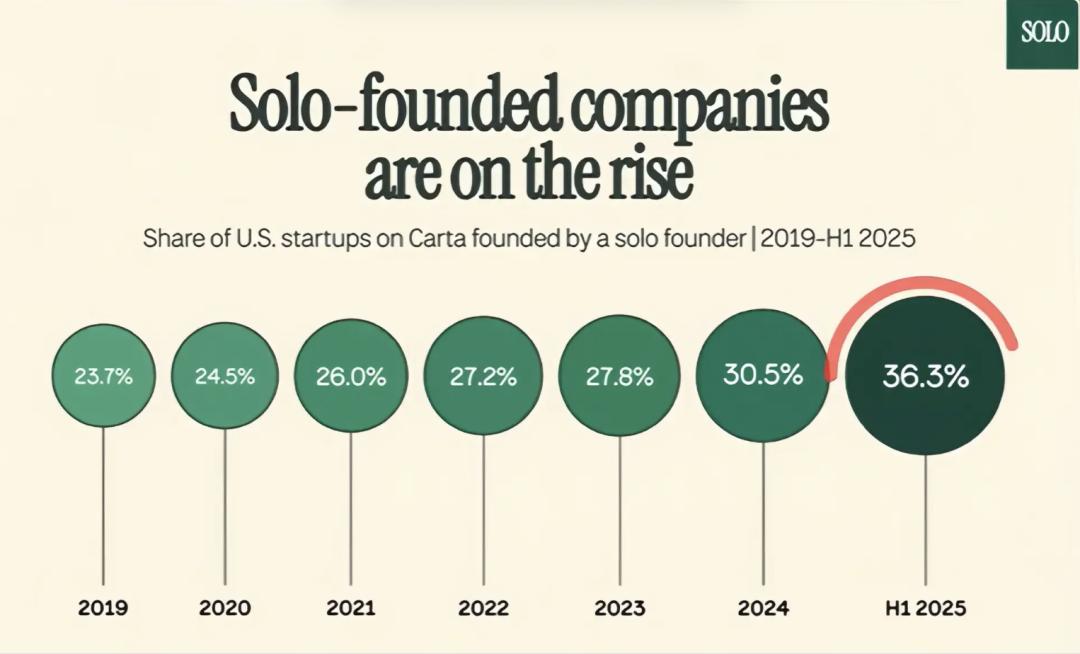
Data of one - person companies | Information screenshot from youtube: silicon valley girl
Liang Lu (pseudonym), who is thirty years old this year, heard this kind of voice when she was struggling with quitting her job and anxious about her career planning. She made up her mind and quit her job without a backup plan.
"I thought that the biggest obstacle to my entrepreneurial success was making products. Now that vibe coding has removed this obstacle." Liang Lu had a very good plan before quitting her job. After quitting, she was also very active in trying to make various products. She checked Google's hot keywords every day. It was precisely because vibe coding had infinitely lowered the threshold for making products that she could try more product paths. She tried making AI - based metaphysics, AI - designed dynamic enterprise logos, and AI - based K12 teaching tools.
However, when making products was no longer a problem, Liang Lu suddenly found that the real problem was not the product at all.
It was the demand.
"I can't reach users, nor can I reach investors. I have absolutely no idea what the market needs and what investors like. After the programming cost has decreased, I've actually wasted a lot of time on making products themselves because this has become the thing that can bring me the most positive feedback. To put it bluntly, starting a business just makes me feel good about myself."
After deeply reflecting on the problem of her self - indulgent entrepreneurship, Liang Lu started to try to expand her social circle. She had to know the real market situation.
Liang Lu joined several entrepreneurs' alliances, some were online communities, some were offline coffee chat activities, and some were online roadshows. As a result, she found that the actual functionality of these communities was very limited. "Either they charge you to join the group, or they are FAs trying to connect you with resources. Or, like me, they haven't thought things through clearly, just think that AI is a hot trend but haven't found out exactly where the opportunity lies..."
After a year of exploration, Liang Lu learned a truth: When the threshold of a thing is lowered, it also means that the competitiveness of this thing itself will be infinitely reduced.

If Liang Lu is a negative example of trying vibe coding, then the next person I'm going to talk about is a typical positive example.
Jin Can (pseudonym), a serial entrepreneur from Northeast China, earned his first pot of gold by doing outsourcing programming projects through self - study in college. After an internship at a large company, his thought was: "I'll never work for others. I have to start my own business."
So he started his entrepreneurial journey. After various bankruptcies and failures, he finally established a foothold in the SaaS industry. When he was approaching his tenth year in business, AI came along.
Jin Can immediately realized that the logic of the SaaS industry was going to change completely. Because his company was small and easy to adjust, he immediately integrated AI and started making an AI voice customer service. During this period, he found an excellent scenario: debt collection.
He found a very counter - intuitive thing. In fact, people are more likely to disclose their real financial situation to an AI because they think that since an AI is not a human, they won't feel embarrassed as they would when facing a real person. The AI can make basic judgments about regions and ages based on the recorded ID information and then formulate different debt - collection strategies for different age groups. The commercialization model also changed from the annual fee in the SaaS model to taking a commission from debt collection.
Next, he found a very similar scenario where he could transform the entire project from the SaaS model to the RaaS (Result as a Service) model. Last year, he had a fifteen - minute conversation with a top investor and got funded. Now he's busy meeting investors again.
Actually, Liang Lu and Jin Can completely represent the difference between those who can make money and those who can't in this wave of vibe coding: Those who can make money must know exactly where the demand is. These people may have been deeply involved in an industry for a long time and have the know - how. For them, AI is really a tailwind. The logic of those who can't make money is the opposite. They don't see the market demand but first see that the difficulty of doing things is low, but they forget that the easy path is also the most crowded one.
What can ordinary people actually do with vibe coding?
The other day, I saw a survey by Anthropic of more than 80,000 AI users. One of the findings was that the appeal of East Asian users for AI is self - improvement and financial freedom. I instantly sighed: East Asians really pursue "financial freedom" all their lives.

So when we talk about vibe coding, we are always naturally more interested in "one - person companies", "one - person unicorns", and "how to let AI help me make money".
However, I want to say that the spirit of exploration and curiosity are also very important.
Many people's first expectation of vibe coding is "help me achieve a specific function", and they have an incorrect expectation: Since it is an AI tool, the implementation efficiency must be very high.
Actually, vibe coding itself is a learning process. While writing this article, I was also frequently exploring things like raising lobsters and building skills. When I visited skills on GitHub, I often saw some "useless" skills, such as feeding the AI with PUA words from large companies, imitating the tone of