Ich bereue es, dass ich mein Job ohne neuen Arbeitsplatz aufgegeben habe und eine Einzelunternehmung gegründet habe.
At this time last year, an Israeli programmer traveled to Southeast Asia. He spontaneously created a product from an idea that had been swirling in his head for a long time. A platform that allows anyone to "say" in natural language which software they want, and then the AI implements it directly for them. The database, registration system, and data storage are automatically set up without having to write a single line of code. He called it Base44.
Base44 | Website screenshot
After four months, this platform had 250,000 users and a monthly profit of nearly $200,000. Six months later, the website-building giant Wix bought it for $80 million in cash.
Later, this story spread like wildfire on domestic social media. The frequently shared version usually consisted of just one sentence: One person, six months, $80 million.
Around the same time, AI genius Andrej Karpathy posted a tweet on X that was later quoted by countless people and coined a new term: Vibe coding.
He said there is a new way of programming where you immerse yourself completely, forget about the existence of code, and simply tell the AI what you want, then wait for the result.
"Vibe coding" was included as the word of the year by the Merriam - Webster dictionary in March and was chosen as the word of the year 2025 by Collins at the end of the year.
Then, what Sam Altman said a few years ago, "The era of one - person unicorns has begun," was brought up again. A startup craze even hotter than during the 2000 internet bubble emerged. Vibe coding tools popped up like mushrooms, such as Cursor, Lovable, Claude Code; On Xiaohongshu (Little Red Book), posts like "Humanities scholars are the real beneficiaries of AI" started to flood.
Many people picked up the catchphrase "Quit your job and start a startup with AI to start a new life", bravely took action, quit their jobs, opened their computers, and started developing products. But after a few months, they only learned a painful lesson: Programming is probably the easiest step in the entire startup process...
Humanities scholars fall in love with programming
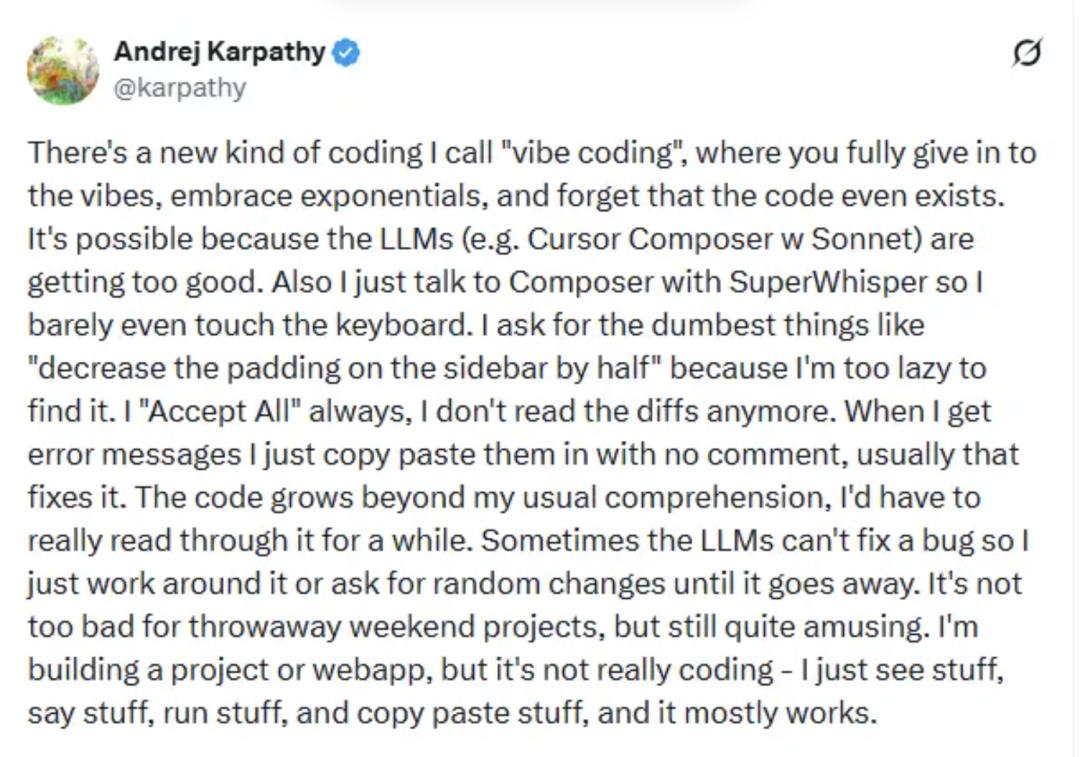
Karpathy X Screenshot
"Rely on your feelings, get into the flow, and then forget about the existence of code. That's vibe coding (completely surrender to your feelings, embrace exponentiality, and forget that code even exists)."
To be honest, there is no Chinese translation for "vibe coding" that fully conveys its meaning. Many translate it literally as "Mood programming", but these four characters are just too hard to understand.
In my opinion, "vibe coding" can be called AI programming with a "gut feeling".
Just like when writing texts or creating images, sometimes programming also depends on a certain "feeling". What "vibe coding" can do is that you just need to describe the desired end - result, and the AI will do the programming for you.
"Vibe coding" suddenly became a trendy term. YC then released a podcast episode specifically discussing why "vibe coding" would become the main trend. Their partner said in the show that in a quarter of the projects YC invested in this quarter, the proportion of "vibe coding" was 95% or even more. And the founders of these companies were themselves computer scientists because they knew better how to describe their requirements and change the code. They were more inclined to use "vibe coding" to improve efficiency.
As an absolute beginner in Python programming, a real electronics idiot, when I heard this term, I suddenly thought that I could also do it. I immediately opened ChatGPT and was eager to try it out. But the reality was harsh. GPT gave me a line of code. As someone with absolutely no programming basics, I stared at the screen and had absolutely no idea what to do with these things next. This concept was then put on hold.
I wanted to try "vibe coding" again recently when Claude's agent ability gained momentum. In the past, "vibe coding" still required some patience. You had to know where to insert the code generated by the AI, and when there were problems, you could only stare helplessly at the screen. Since the emergence of the agent, it's different. The AI can now do a series of things on its own, create files, find problems, and debug itself...
I decided to try it again with Claude. I opened the dialog box and my first sentence was: "I'm an absolute beginner in programming. Now I want to create a tool. What should I do?"
Claude directly asked me about my requirements. I simply told Claude in plain words that I wanted to create a website, a tool that can read the content of video and article links and convert it into my desired text style. Claude directly created a complete website design. Then I made changes based on it. For example, in the first version, there were some options for the number of words, 400, 600, 1000 words. I switched to manual input of the word count.
But when it came to integrating the API on the website's backend and it was associated with costs, I thought it wasn't worth spending money on. This attempt ended here. Although the process was not complete, I was able to experience "vibe coding" once.
Many people like me, who don't come from the field of computer science, have already developed products with "vibe coding".
Yan Su (pseudonym) founded a PaaS startup in Silicon Valley. During the startup process, he had to track a lot of information about Silicon Valley, such as the podcasts of a16z, the progress of YC batches, and various financing dynamics. This information was distributed across dozens of different channels. It was time - consuming and laborious to manually update this information daily, and it was also easy to miss something. He created a collection website himself with "vibe coding" that regularly collects and aggregates this information. Now he only needs to look at the page once in the morning.

Provided by Yan Su (pseudonym) | Screenshot of the information collection website
Yan Wen (pseudonym) graduated from the School of Architecture at Tsinghua University. After working in a large company for a few years, thanks to "vibe coding", she saw the opportunity to develop her own products and build her own business. She developed an AI tool for resume optimization that improves the resume through multiple dialogues with users and considering the requirements of the applied position.
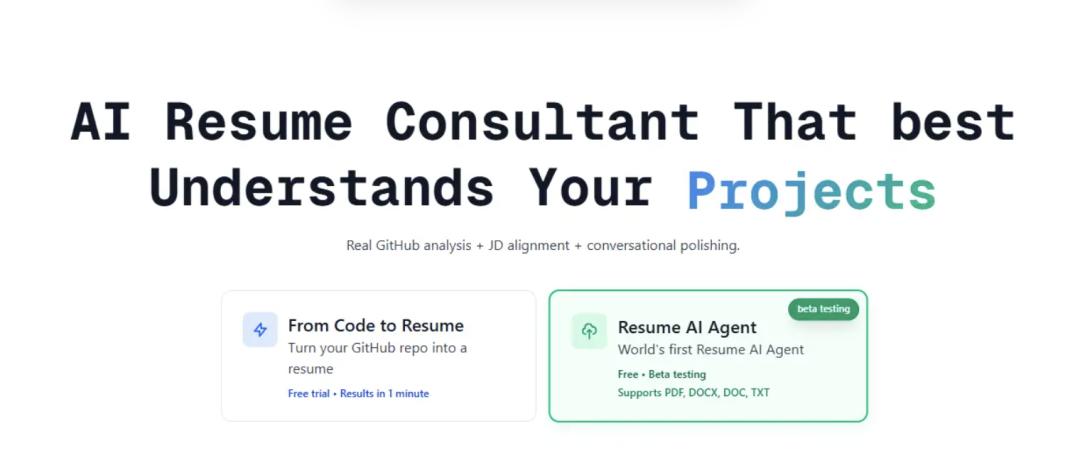
Provided by Yan Wen (pseudonym) | Resume optimization website
Lin Yu (pseudonym) and his team of business graduates also developed a product with "vibe coding". I describe it as the AI version of "Zhu Bajie". Users can create their own websites through natural language dialogues and selections. This is suitable for individuals or small teams for brand promotion. In the past, such requirements had to be outsourced to programmers. Now their product can do everything on its own.
After talking with these people, I found that they have a common point: The starting point of their actions was not "Vibe coding looks cool", but "I have a specific problem that hasn't been solved yet". Yan Su wanted to improve his information management, Yan Wen wanted to turn her years - long resume evaluation skills into a product, and Lin Yu and his group wanted to fill a real gap in the market.
First identify the needs, then use the tool. That's how the first successful "vibe coders" did it.
Some job quits are pure self - deception
The progress of "vibe coding" has greatly lowered the threshold for product development, giving many people the impression: I can do it too.
Therefore, on Xiaohongshu and in friend circles, mass posts started to appear: "Quit your job and start a new life", "I'm a one - person company", "Three days of 'vibe coding' and I've launched my first product online". Various founder alliances and "Coffee Chats" popped up like mushrooms.
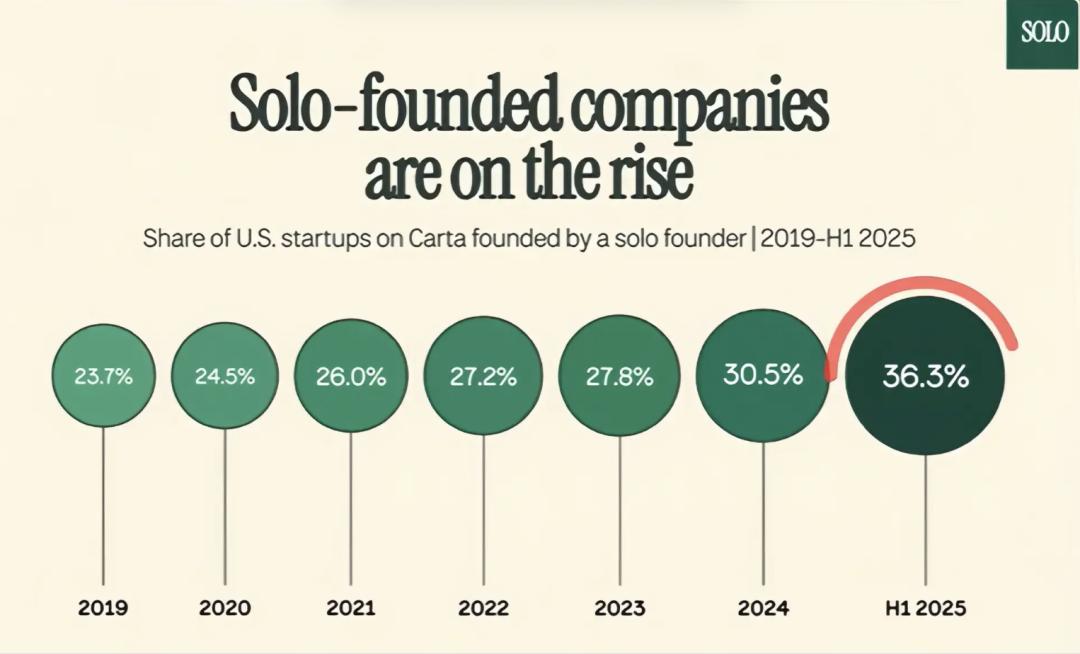
Data on one - person companies | YouTube: Silicon Valley Girl - Information screenshot
Liang Lu (pseudonym), who is 30 years old, heard these voices when she was torn between quitting her job and career planning. She bravely took action and quit her job.
"I thought the biggest obstacle to my unsuccessful startup was product development. Now 'vibe coding' has removed this obstacle." Liang Lu had very good plans before quitting her job. After quitting, she was also very active and tried to develop various products. She looked at Google hotwords every day. Precisely because "vibe coding" has lowered the threshold for product development so much, she could try more product paths. She tried to develop AI parapsychology, AI - supported dynamic corporate logos, and AI - supported school teaching materials.
But when product development was no longer a problem, Liang Lu suddenly realized that the real problem was not the product at all.
It was the demand.
"I have no contact with users and no contact with investors. I have absolutely no idea what the market needs and what investors like. After the programming costs have decreased, I've instead wasted a lot of time on pure product development because this was the only thing that gave me positive feedback. In essence, entrepreneurship just made me feel good about myself."
After a profound self - reflection on her self - deceptive startup behavior, Liang Lu began to expand her social circle. She had to understand the real market situation.
Liang Lu joined several founder alliances. Some were online communities, others were offline "Coffee Chats" or online pitch events. However, she found that these communities had practically no functions. "Either they ask you to pay for access to the community, or they are financial intermediaries trying to offer you resources, or they are people like me who have no idea what they want to do but just think that AI is a great opportunity but don't know which way the wind is blowing..."
Liang Lu experimented for a year and learned in this year that when the threshold for something decreases, the competitiveness of that thing also decreases.

If Liang Lu is a negative example of the "vibe coding" experiment, then the next person I'll mention is a typical positive example.
Jin Can (pseudonym), a serial entrepreneur from northern China, earned his first capital during his studies by teaching himself programming and completing outsourcing projects. After graduating from a large company, he thought: Be an employee? No way. I have to continue being an entrepreneur.
So he started his business. After various bankruptcies and failures, he finally established himself in the SaaS industry. Just before he had been in the industry for ten years, AI came along.
Jin Can immediately recognized that the logic of the SaaS industry would completely change. Since his company was small and could quickly reorient itself, he immediately integrated AI and started developing an AI voice - activated device for...