Chinese mathematicians achieve legendary status. WANG Hong and TANG Yunqing win the "Oscar" of the mathematical world.
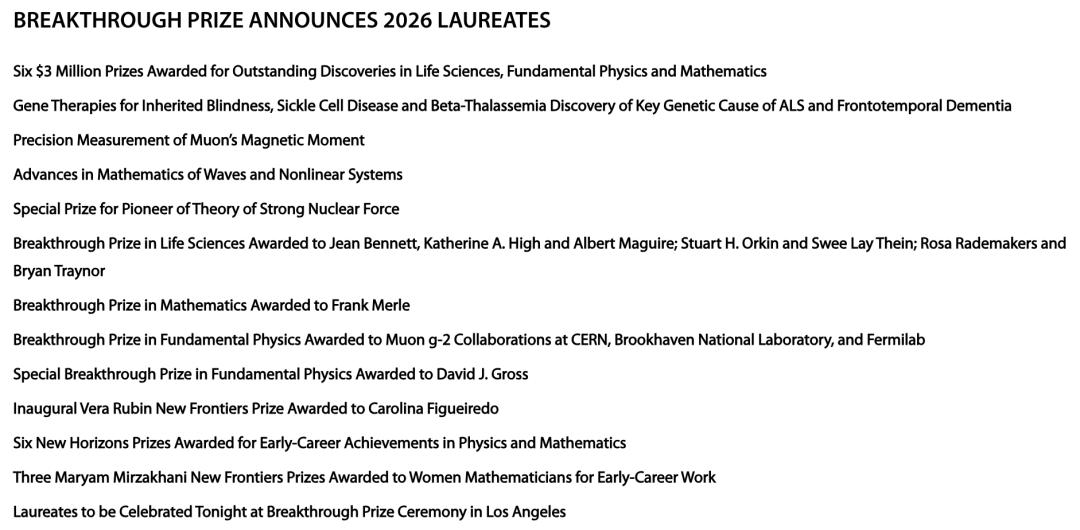
Today, the 2026 Breakthrough Prize, known as the "Oscars of the mathematical world," has been announced!
In this year's list, the New Horizons in Mathematics Prize has been particularly eye - catching.
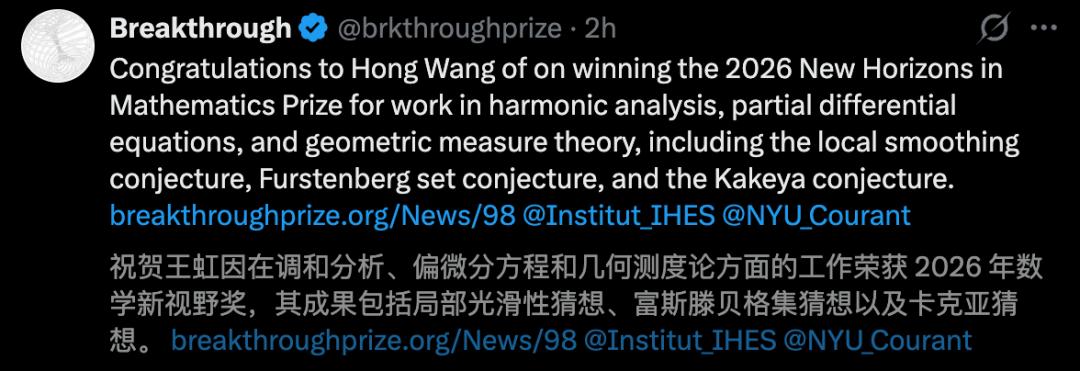
Four top young scholars have shared this honor, and half of the seats are occupied by Chinese - American female mathematicians. They are:
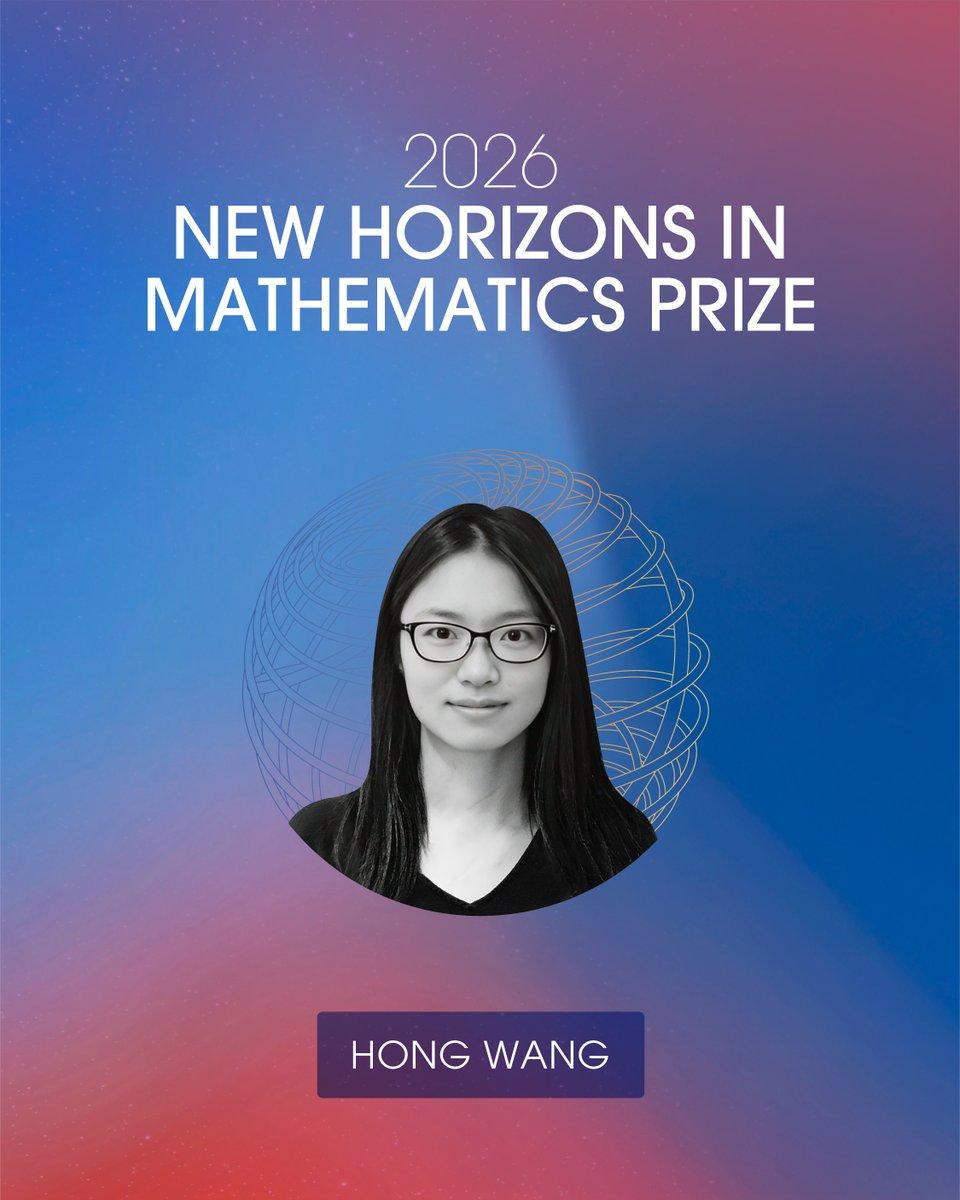
Hong Wang from New York University and Yunqing Tang from UC Berkeley.
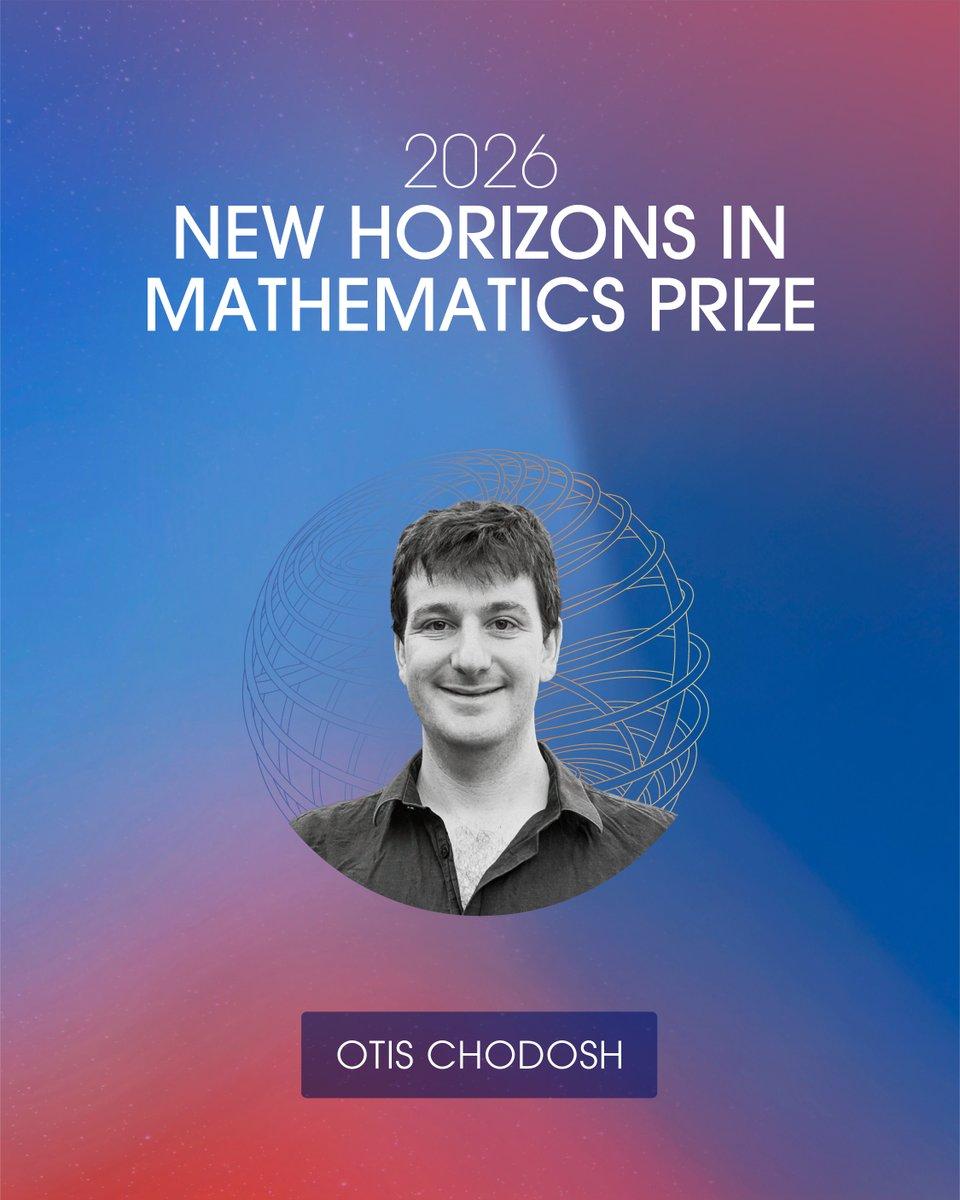
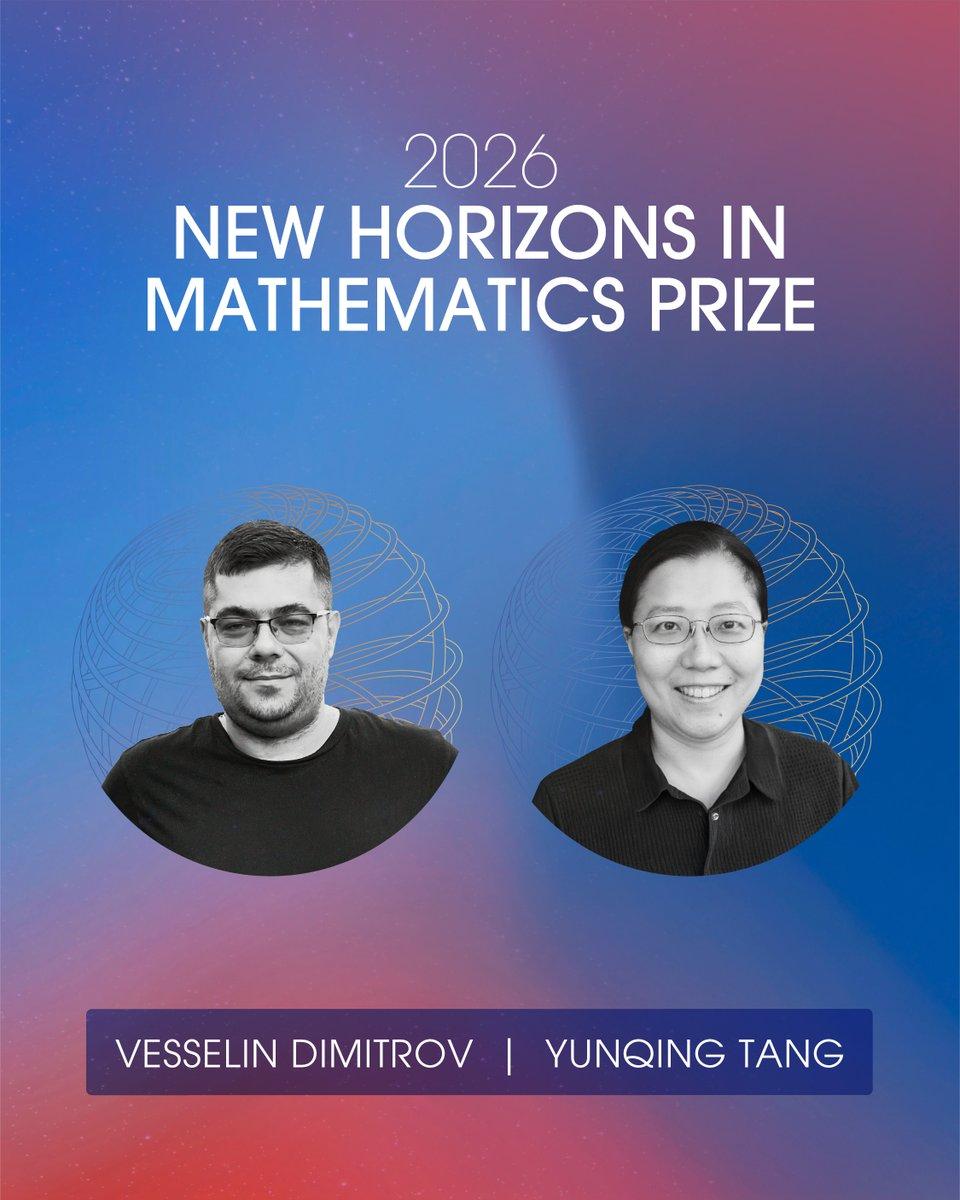
The other two top minds are Otis Chodosh from Stanford University and Vesselin Dimitrov, Yunqing Tang's research partner.
For what contributions did these mathematicians win the awards?
A 90s postgraduate from Peking University who proved the "Kakeya Conjecture"
Let's start with the most remarkable one - Hong Wang.
If you follow the mathematical circle, you must be familiar with this name.
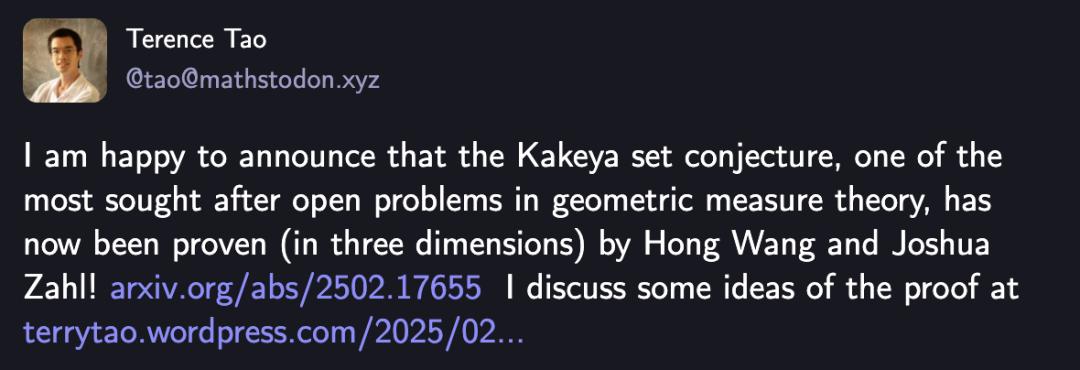
In February 2025, she and her collaborator Joshua Zahl, with a 127 - page paper, officially announced the settlement of the "Kakeya Conjecture," which had puzzled mathematicians for over a century, in three - dimensional space.
Tao Zhexuan, a Fields Medalist, excitedly posted that this was "the most remarkable breakthrough in geometric measure theory."
It has to be said that Hong Wang's life story itself is a legend.
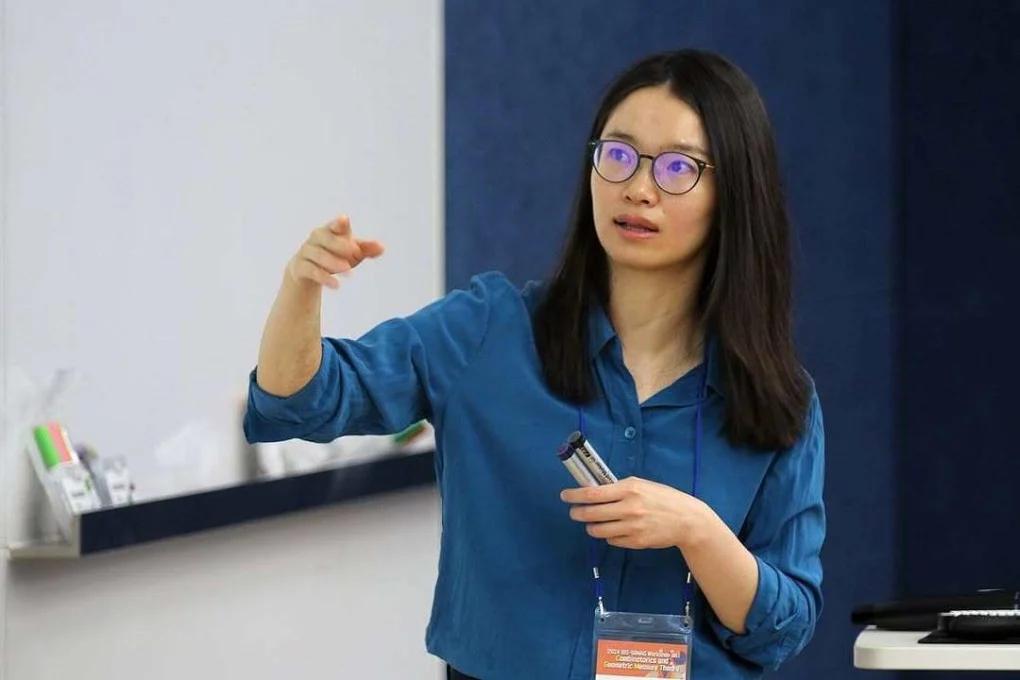
In 1991, she was born in Shazi Town, Pingle County, Guilin, Guangxi. She skipped grades in primary school and was admitted to Peking University with a high score of 653 at the age of 16.
But initially, she entered the School of Earth and Space Sciences - yes, not the Department of Mathematics.
One year later, out of her love for mathematics, she resolutely transferred to the School of Mathematical Sciences at Peking University.
So, what happened?
After graduating from undergraduate studies, she first went to the École Polytechnique in France, then obtained a master's degree from the University of Paris - Sud, and later completed her doctoral degree at MIT under the supervision of Larry Guth.
After that, she was a post - doctor at the Institute for Advanced Study in Princeton and an assistant professor at UCLA. Currently, she is a professor at the Courant Institute of Mathematical Sciences at New York University and also a tenured professor of mathematics at the Institute des Hautes Études Scientifiques (IHÉS) in France.
In short, her academic resume is simply outstanding.
A century - long battle triggered by a needle
So, what exactly did Hong Wang prove?
The Kakeya Conjecture originated from a question raised by Japanese mathematician Soichi Kakeya in 1917:
When a needle rotates a full circle in space to cover all directions, what is the minimum amount of space it needs to occupy?
It sounds simple? But this question has tormented mathematicians for more than a hundred years.
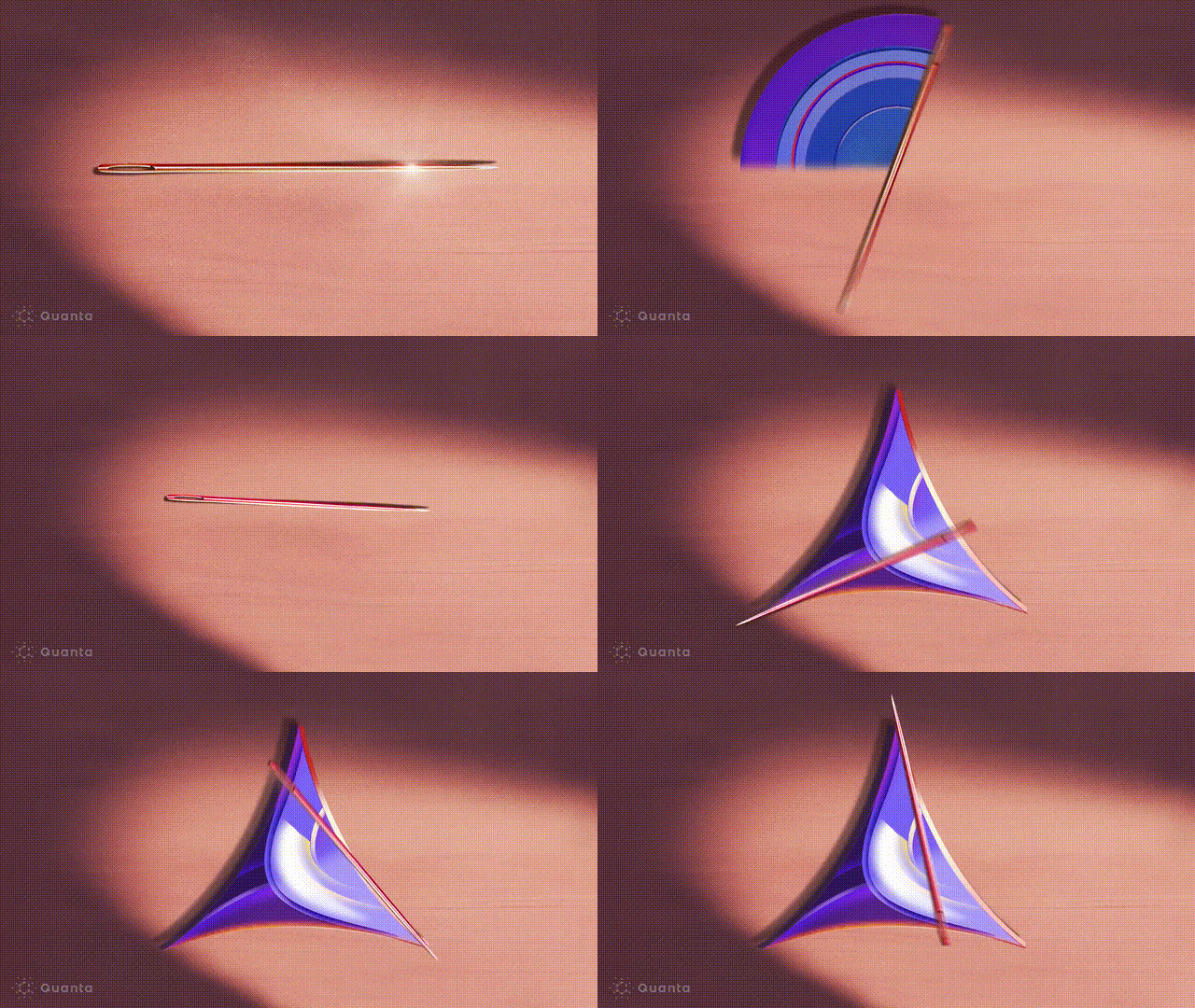
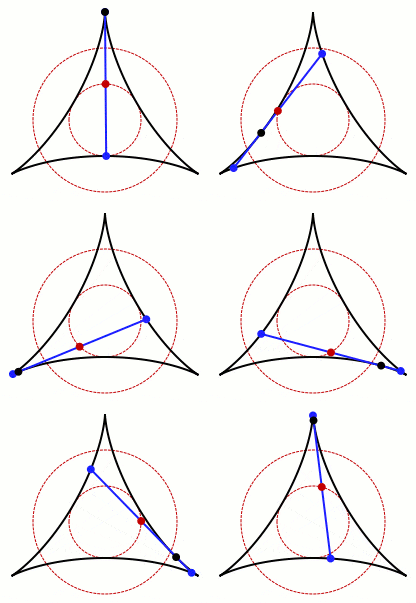
In two - dimensional space, it has been proven that the answer is that the area can approach zero infinitely. It's very counter - intuitive.
However, the situation in three - dimensional space is completely different. The Kakeya Conjecture predicts that in three - dimensional space, such a set cannot be "too small" - its dimension must be 3.
Previously, numerous mathematicians have tried, including top experts such as Fields Medalist Jean Bourgain and Larry Guth from MIT, but they could only make partial progress.
In February 2025, Hong Wang and Joshua Zahl directly provided the ultimate answer - the three - dimensional Kakeya Conjecture has been proven.
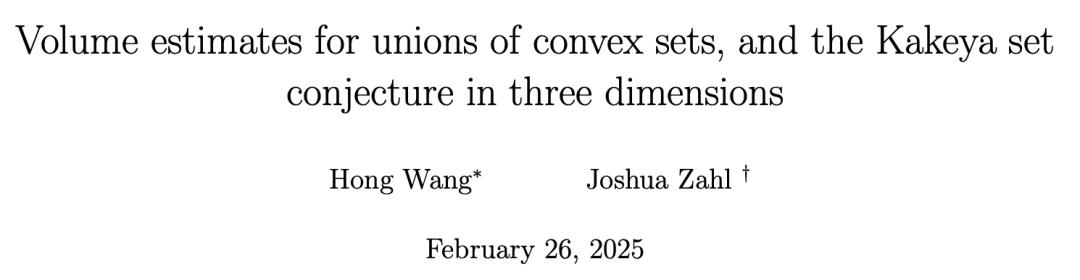
Paper address: https://arxiv.org/pdf/2502.17655
Eyal Lubetzky, the director of the Courant Institute at New York University, only had one comment: "This is one of the top mathematical achievements of the 21st century."
And the citation for this Breakthrough Prize clearly states her contributions - in recognition of her outstanding work in harmonic analysis, partial differential equations, and geometric measure theory, including the local smoothing conjecture, the Furstenberg set conjecture, and the Kakeya Conjecture.
Each of these three conjectures is a "tough nut" in the mathematical world.
Hong Wang didn't solve just one, but a series of them.
The "blasting expert" in the field of number theory
Now, let's look at another group of winners - Vesselin Dimitrov and Yunqing Tang.
Their battlefield is number theory - one of the oldest and most profound branches of mathematics.
Together with their collaborator Frank Calegari, they have accomplished two major things:
First, they proved the "unbounded denominators conjecture" about modular forms. Modular forms are extremely fundamental and important objects in mathematics, and this conjecture has puzzled number theorists for decades.
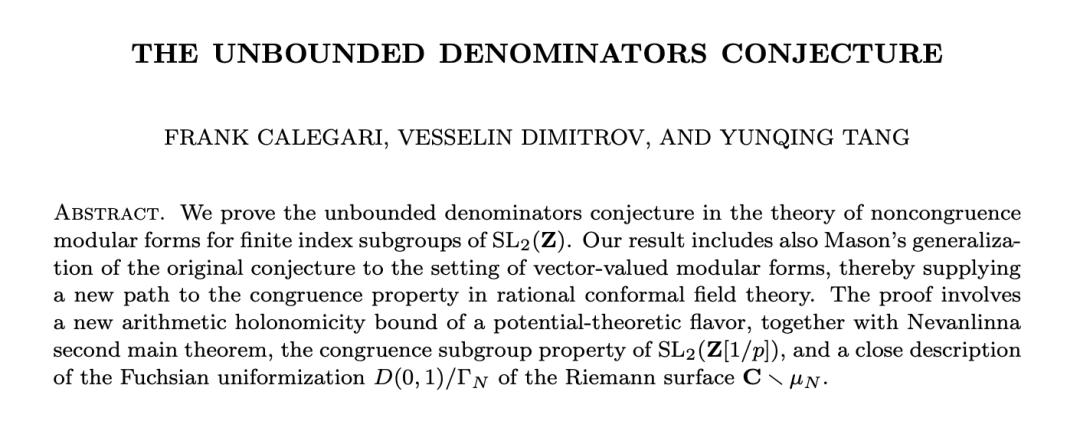
What's even more remarkable is that the method they used shocked experts in the field and was completely unexpected.
Second, they proved the irrationality of a constant related to a basic infinite series.
How important is this result? This is the first such breakthrough in this field since the famous proof by Apéry 45 years ago.
For 45 years, no one could make any progress. Dimitrov and Yunqing Tang directly broke the deadlock.
The "terminator" of differential geometry
The third winner is Otis Chodosh from Stanford University.
He has solved several core problems in the field of differential geometry that have remained unsolved since the 1970s and 1980s.
He collaborated with Chinese - American mathematician Chao Li to prove the core conjecture about "non - spherical manifolds" - a type of generalized high - dimensional space that has long been regarded as the core battlefield of differential geometry.
In addition, he collaborated with Christos Mantoulidis to solve a key problem in the geometric analysis of minimal surfaces.
Minimal surfaces, like soap bubble films, are surfaces with the smallest local area. Solving such problems has directly promoted the development of the entire field of calculus of variations.
$18.75 million, a scientific feast
In addition to the New Horizons in Mathematics Prize, this year's Breakthrough Prize lineup is also star - studded -
The Breakthrough Prize in Mathematics ($3 million) was awarded to French mathematician Frank Merle in recognition of his pioneering contributions in the field of nonlinear evolution equations.
He proved that some equations that were long considered to "behave well" would actually "explode" in a finite time - this discovery completely overturned the basic assumptions in this field.
The Breakthrough Prize in Physics ($3 million) was awarded to three "muon g - 2" experimental collaboration groups (CERN, Brookhaven National Laboratory, and Fermi National Accelerator Laboratory) over a span of six decades, with a precision of one in 127 billion - 30,000 times more precise than the first experiment in 1965.
The Breakthrough Prizes in Life Sciences (three awards, $3 million each) recognized breakthroughs in gene therapy for congenital blindness, sickle - cell disease, and β - thalassemia, as well as the discovery of the most common genetic causes of ALS and frontotemporal dementia.
This year's total prize pool is as high as $18.75 million, bringing the cumulative total of prizes awarded by the Breakthrough Prize over the past 15 years to more than $340 million.
Next stop: the Fields Medal?
Let's get back to the most concerning topic - how far is Hong Wang from the Fields Medal?
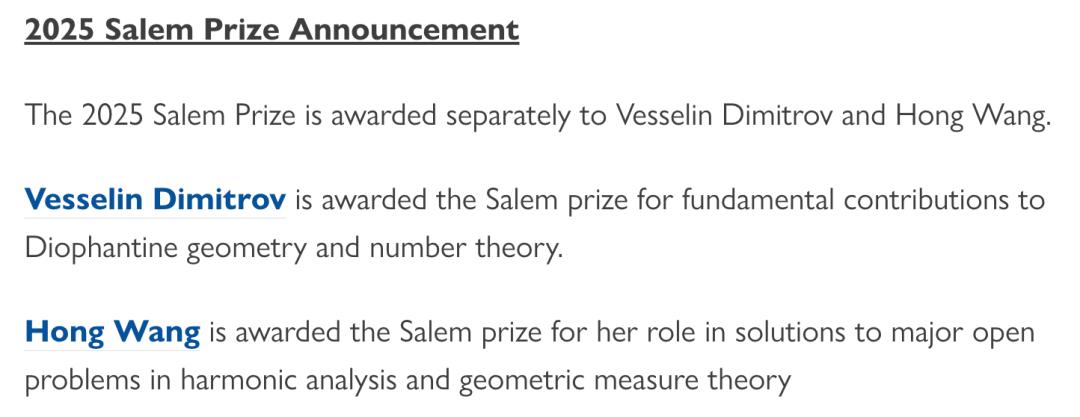
She already has the Salem Prize and the Gold Medal of the ICCM Mathematics Award (known as the "Chinese Fields Medal"), and now she has won the New Horizons in Mathematics Prize of the Breakthrough Prize.
In 2025, she gave a three - day lecture at Peking University, and Wei Dongyi sat in the front row throughout.
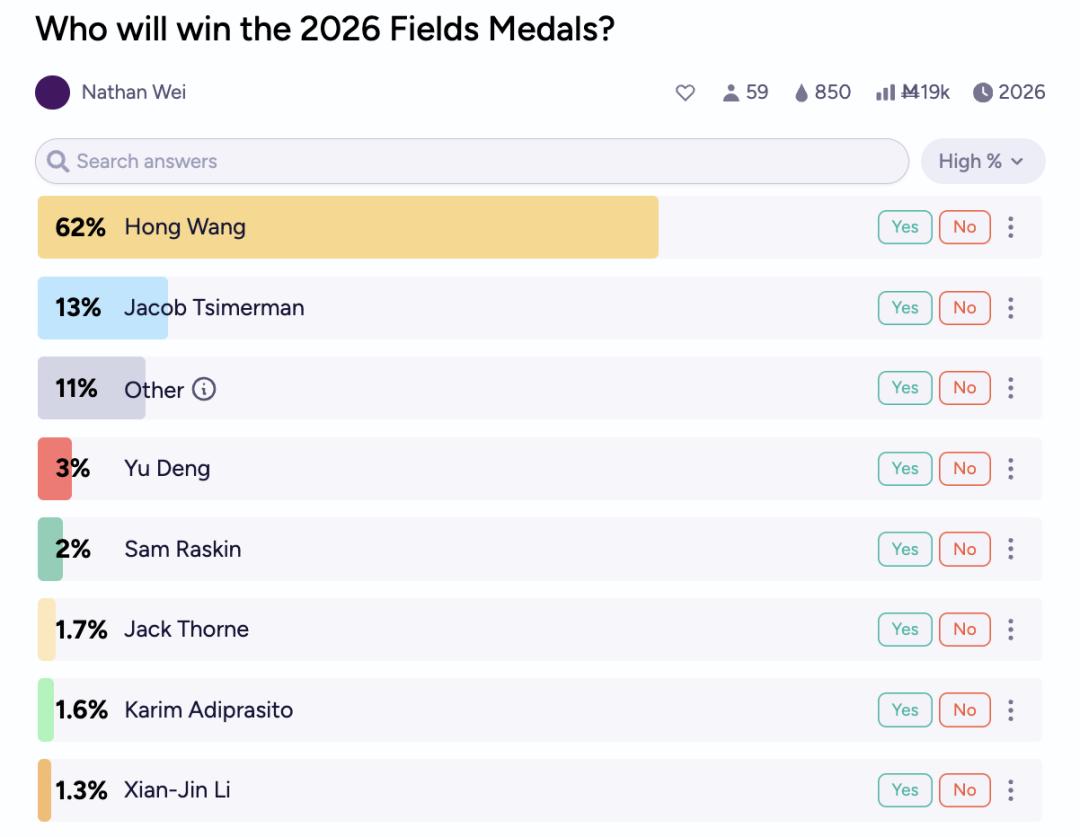
Previously, Hong Wang once topped the odds list for the 2026 Fields Medal.
She was born in 1991 and is only 35 years old this year. The Fields Medal has an age limit of under 40. Time is on her side.
Reference materials:
https://x.com/brkthroughprize/status/2045643285901767158?s=20
https://breakthroughprize.org/News/98
Editor: Taozi
This article is from the WeChat official account "New Intelligence Yuan", author: New Intelligence Yuan, published by 36Kr with authorization.