36Kr Exclusive | Former Huawei Engineers Start a Business to Realize the Recycling of Temporary Bonding Carrier Boards, and Leading Customers Have Verified It
Author: Ou Xue
Editor: Yuan Silai
Yingke learned that Huanjingxin Technology has recently completed an angel - round financing of tens of millions of yuan. This round was led by Qifu Capital, with Shengshi Investment, Haiyi Investment, and Hunan Provincial College Students' Entrepreneurship Investment Fund participating. The funds will be mainly used for the construction of the company's first mass - production line in Wuxi, R & D investment, and replenishment of working capital.
Huanjingxin Technology was established in May 2025. It is the first domestic company to propose a non - destructive recycling and reuse solution for temporary bonding carriers. Zhang Jieyuan, the founder of the company, has research backgrounds from the Chinese Academy of Sciences, the University of Science and Technology of China, and Harbin Institute of Technology, as well as work experience at Huawei. He studied under the first person in China to break the monopoly of temporary bonding adhesives and has a profound understanding of the characteristics of such materials.
Yingke learned that in advanced packaging, to process ultra - thin wafers or devices, they need to be fixed on a hard carrier through temporary bonding adhesives. After the processing is completed, the wafer is separated from the carrier. However, the temporary bonding adhesives used for bonding have extremely strong acid - resistant, alkali - resistant, and high - temperature - resistant properties, making it extremely difficult to remove the residual adhesive on the surface of the carrier.
Currently, in the field of carrier recycling and processing, there is no mature and scalable unified solution in the industry. Only a few manufacturers use the polishing process to treat the surface of the carrier, which brings a series of problems such as uneven carrier thickness, reduced rigidity, and increased complexity of production line management. Most packaging factories usually discard or hoard the carriers after one - time use, resulting in a huge waste of costs.
The core technology of Huanjingxin Technology can achieve non - destructive recycling and reuse of temporary bonding carriers, reducing the cost of advanced packaging auxiliary materials. The entire processing process does not damage the carrier material, and in theory, infinite recycling and reuse can be achieved.
The key indicators such as surface cleanliness and flatness of the glass carriers processed by Huanjingxin Technology are the same as those of brand - new glass carriers. At present, the company's solution has passed the technical verification of the leading domestic packaging company, and its recycling service can help customers significantly reduce the cost of related materials.
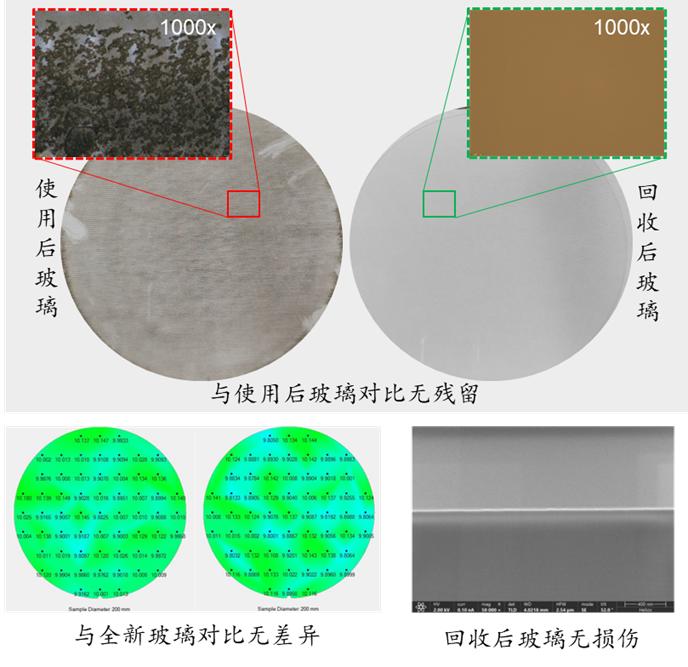
Comparison of recycling effects (Source: the enterprise)
With the explosion of the demand for thin and light products in AI computing chips, high - performance computing (HPC), and consumer electronics, the penetration rate of advanced packaging technologies such as 2.5D/3D packaging and wafer - level chip - scale packaging (WLCSP) continues to increase, and these processes can hardly avoid the temporary bonding technology.
Zhang Jieyuan told Yingke: "Whether it is high - computing - power GPUs, CPUs, or high - performance computing chips for AI, advanced packaging is indispensable. In the future, from urban data centers to home computing centers, the market demand for computing chips is very considerable, which will directly drive the demand for our technology."
Currently, the company has completed discussions with several domestic and international leading packaging and testing manufacturers. The company's first - phase production line is located in Wuxi, with a designed monthly production capacity of 25,000 pieces. It is expected to complete the construction within this month, and then start the process of customer factory inspection and introduction.
The following is an excerpt from the dialogue between Yingke and Zhang Jieyuan:
Yingke: There are no other domestic companies doing non - destructive recycling of glass carriers. Where is the technical barrier?
Zhang Jieyuan: People have been trying this technology since the industry emerged. Temporary bonding adhesives are designed to withstand strict semiconductor manufacturing processes, being acid - resistant, alkali - resistant, high - temperature - resistant, and resistant to ion impact. The recycling solutions of soaking in strong acids and alkalis or CMP grinding have obvious defects.
We can achieve non - destructive recycling. On the one hand, it is because we have developed a unique treatment solution; on the other hand, my master's supervisor is the first person in China to achieve mass production of this adhesive material and break the international monopoly, and currently has a market share of over 50% in China. I have followed him for many years and have a deep understanding of the material characteristics, which is our most core underlying advantage.
Yingke: The cycle for customers to enter the semiconductor supply chain is very long. How does the company solve the problem of early - stage market development?
Zhang Jieyuan: It usually takes more than half a year for packaging factories from technical verification to formal orders. We have several strategies: First, we conduct demonstration applications through cooperative units with good relationships; second, we actively communicate with end - customers to promote the coordinated development of the industrial chain; third, as the number of domestic advanced packaging factories increases from a few to more than a dozen, the competition intensifies, and cost reduction has become the core requirement, which will greatly reduce our market entry cost.
Yingke: What are the company's future technical path and commercialization plan?
Zhang Jieyuan: In the short term, our goal is to complete customer verification and introduce orders in 2026. Subsequently, we plan to build multiple production lines to serve the local packaging industry nearby and expand overseas business in the future.
In the long run, we position ourselves as a comprehensive service provider in the semiconductor industry. Based on our in - depth understanding of the temporary bonding field, we are about to launch a carbon - free laser debonding equipment, which has higher processing efficiency and the technical advantage of improving production yield. We are also conducting some R & D work on domestic substitution in cooperation with Harbin Institute of Technology. In the future, we will form a business matrix of "material R & D + equipment supply + process service", planning to take the domestic market of temporary bonding carrier recycling in the Chinese mainland as the foundation and gradually expand to Taiwan, Southeast Asia, Japan, and South Korea.
Views of the investors:
Haiyi Investment believes: Temporary bonding glass carriers have long been monopolized by overseas manufacturers and are typical "choke - point" consumables in advanced packaging. The cost per piece is high and the proportion is large, so the logic of domestic substitution is very strong. The company does not follow the simple self - developed material route, but directly reconstructs the cost structure through cleaning and reuse, which not only bypasses the long - term R & D investment in the material end but also can quickly realize cost - effectiveness, and the implementation speed far exceeds that of traditional material substitution.
This reuse model is essentially a combination of service and consumables, combined with high customer stickiness. Once the window period is seized, it will form a strong first - mover barrier. At the same time, extending to the upstream materials is equivalent to shifting from a "service provider" to a "material provider", with extremely strong growth potential.