Losing 2.5 billion, an 89-year-old guy from Hangzhou goes for IPO: Competitors earned 10.7 billion
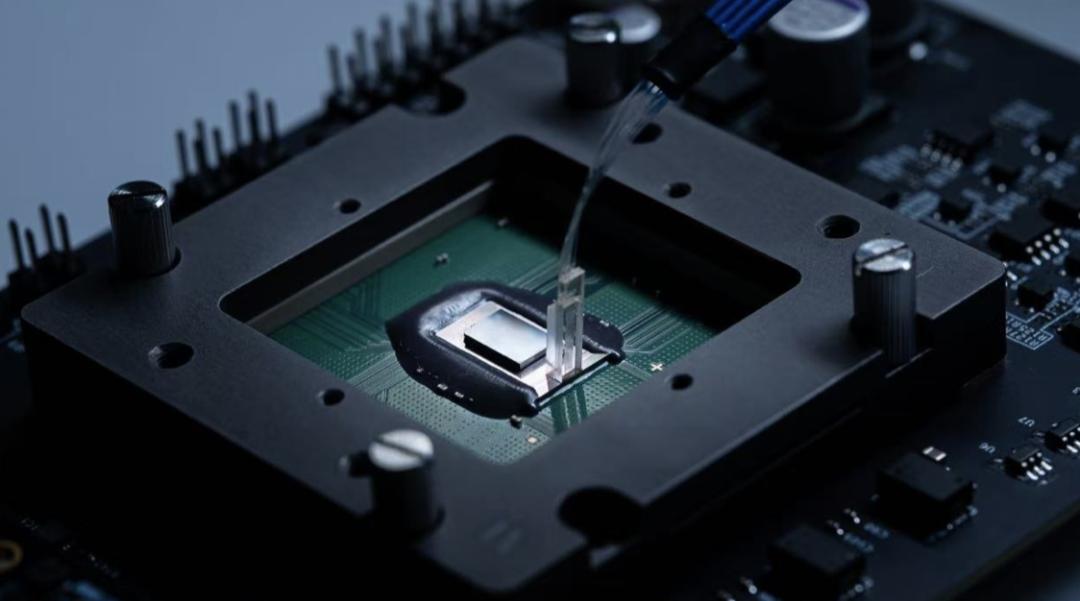
To what extent is AI's hunger for computing power exaggerated? It doubles every 3.5 months!
Under such consumption, traditional electronic chips are approaching their physical limits.
What to do? Some people consider using light to perform calculations to increase the computing power of chips.
Recently, Lightelligence, a company that "uses light for computing", passed the listing hearing of the Hong Kong Stock Exchange and is about to go public.
AI computing power is moving from the era of electricity to the era of light. What new opportunities lie behind this?
- 01 -
Turning a Thesis into a Unicorn
Yichen Shen, the founder of Lightelligence, was born in Hangzhou, Zhejiang in 1989. His father is an electrical engineer.
Yichen Shen studied at Nanyang Technological University in Singapore and Johns Hopkins University in the United States.
In 2011, Yichen Shen entered the Massachusetts Institute of Technology to pursue a doctorate in physics. His supervisor is John Joannopoulos, a leading figure in the field of photonic crystals, who enabled humans to "design light like designing circuits" for the first time.
Yichen Shen was deeply influenced by him and first verified the feasibility of using photons for deep learning calculations through a top - tier journal paper. Simply put, using light for calculations is faster and more energy - efficient than using electricity. In the future, there will be no need to rely solely on electronic chips to increase computing power.
This research result also became the technological starting point of Lightelligence. In 2017, Yichen Shen returned to Shanghai to found Lightelligence.
After starting his business, he caught three waves of dividends:
The first wave is the "academic dividend".
As the first author, he published a cover paper in Nature Photonics, verifying for the first time the possibility of using photons for calculations. At that time, the number of teams working on this globally could be counted on one hand, with extremely high barriers and almost no competitors. While others were still using electricity, he had already started "chasing light".
The second wave is the "capital dividend".
Optical computing hits the intersection of cutting - edge technology and industrialization and is favored by capital. From ZhenFund and Baidu Ventures making early bets, to Matrix Partners and CICC getting involved, and then to industrial capitals such as Tencent, China Mobile, and Shanghai State - owned Assets Investment Group entering the scene collectively - Lightelligence has raised more than 2.3 billion yuan in 9 years, almost covering the entire spectrum of "VC + industry + national team".
In September 2025, it raised more than 1.5 billion yuan in Series C financing, with a post - investment valuation of 7.8 billion yuan. Half of the investment circle is on the list of shareholders.
The third wave is the "AI dividend".
After 2019, large models exploded, and the demand for computing power increased exponentially. The hunger for high - performance computing power happens to align with Lightelligence's strength - optical interconnection, which reduces the transmission delay between GPUs by more than 90%.
Looking at the product path, this company almost "follows the industry rhythm":
In 2019: Made the world's first photonic computing prototype card, verifying that "light can also perform calculations".
In 2021: Released the optical computing processor PACE, which is hundreds of times faster than high - end GPUs at that time for specific algorithms.
In 2023: Launched the optical interconnection accelerator card, starting to solve the problem of "inability to transmit".
In 2025: Released PACE 2, which was first adapted to complex business models; in the same year, launched the "LightLeap" super - node, and jointly with BiRen Technology and ZTE, created the first domestic optical interconnection GPU cluster.
In 2026: The 128 - card commercial version was launched, thousands of cards were deployed, and it was adapted to mainstream large models such as DeepSeek and Kimi.
Based on the revenue in 2025, Lightelligence ranks first in the Chinese optical interconnection market, with a market share of 88.3%; the cumulative shipment volume of optical computing chips has ranked first globally for two consecutive years. After its official listing, it will become the "world's first stock in AI optical computing power".
- 02 -
Why has "optical computing power" suddenly become popular?
Since the release of ChatGPT at the end of 2022, AI products such as large language models and agents have been "consuming" more and more computing power.
The stronger the AI and the larger the model, the higher the demand for computing power; however, it is becoming more and more difficult to make chips, with higher power consumption and higher costs. This contradiction has reached a critical point.
Take a specific example: The annual electricity cost of a thousand - card - level GPU cluster can reach millions or even tens of millions. Moreover, the more troublesome thing is that it's not that there isn't enough computing power, but that the data can't be transmitted. The speed of data exchange between GPUs has become the biggest bottleneck.
Optical computing power solves these two problems: reducing power consumption and improving transmission efficiency.
The optical interconnection market is expected to grow from 5.7 billion yuan in 2025 to 180.5 billion yuan in 2030, with a compound annual growth rate of nearly 100%; the optical computing market will grow from more than 60 million yuan to 1.46 billion yuan, with a growth rate of about 87%. In other words, this is a market that "hasn't fully grown but has already exploded".
More importantly, it has started to make money.
Lightelligence currently serves 44 customers, mainly concentrated in three categories:
The first category is Internet companies, which use it to accelerate large - model training, such as ByteDance and Baidu. After using optical computing power, the GPU utilization rate has increased by 50%, and the delay has decreased by 90%.
The second category is intelligent computing centers. The deployment cost of a thousand - card cluster has been reduced by 40%, and it is becoming one of the infrastructures for the "Eastern Data and Western Computing" project.
The third category is financial institutions, which use it for high - frequency trading and risk control. The delay has been reduced to 0.3 milliseconds, and the efficiency has been increased by 3 times.
Looking at the competitive landscape, it is a typical "China - US confrontation".
In the United States, there are Lightmatter and Ayar Labs, which focus on data centers and lead in cutting - edge technologies; in China, Lightelligence integrates optical computing and optical interconnection, while Zhongji Innolight and New Fiber Optic Technology dominate the optical module market, accounting for more than 70% of the global market share.
Generally speaking, the United States leads in cutting - edge technologies, while China excels in engineering implementation. Both sides have their own advantages, but they are all moving in the same direction - to prevent computing power from being restricted by "electricity".
- 03 -
Who is making money from optical computing power?
The question now is not whether there is money to be made in optical computing power, but rather - who can make the most money.
Let's start with the most profitable layer: upstream components.
The characteristics of this part are simple: high technical barriers and high gross profit margins. Zhongji Innolight had a revenue of 38.2 billion yuan and a net profit of 10.7 billion yuan in 2025, with a gross profit margin of nearly 40%. The profit of TaiChenLight increased by 118% year - on - year, and the gross profit margin increased to 42%. Lightelligence had an overall gross profit margin of 39% in 2025.
These companies are essentially selling "core components", which are indispensable for everyone.
The middle layer consists of solution providers.
Lightelligence itself actually plays a larger role as a "system integrator" - packaging optical computing and optical interconnection into an overall solution and selling it to customers.
The logic of this layer is: lose money in the early stage and make money through scale in the later stage.
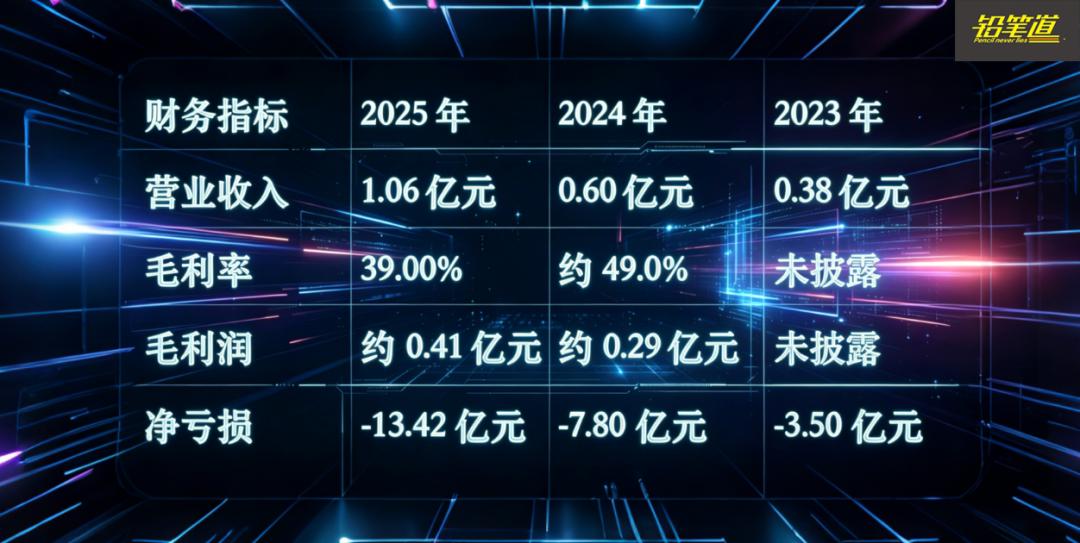
Lightelligence's financial data
The prospectus shows that Lightelligence had a revenue of 106 million yuan in 2025, a year - on - year increase of more than 70%, but still had a net loss of 1.342 billion yuan. Why such a large loss? On the one hand, the R & D investment is huge; on the other hand, the improvement of product integration has pushed up the testing and outsourcing processing costs, resulting in the gross profit margin dropping from about 49% in the previous year to 39%.
However, once customers are connected, the replacement cost is extremely high, and the stickiness is very strong. From 2023 to 2025, the number of new customers of Lightelligence was 11, 10, and 22 respectively, and the customer pool is continuously expanding.
The last layer is the application side - who is using these technologies to make money?
After using the optical interconnection solution, intelligent computing centers have significantly reduced power consumption and can save millions of yuan in electricity costs per year. Internet companies doing AI inference have reduced costs by 55% and can save millions of yuan in computing power expenses per day.
So, can others still make money in this field? Yes, but the threshold is rising. Technological iteration is accelerating, from 800G to 1.6T to 3.2T. Each upgrade is a reshuffle. Those who can keep up with the rhythm will make more money; those who can't will be squeezed out.
This is also why this field has suddenly become popular - because it's not just "potentially useful in the future", but "can save money right now".
Of course, this industry is not without risks.
The technological routes are still splitting. It's still undetermined whether silicon photonics or thin - film lithium niobate will become the mainstream.
Tech giants have entered the scene. NVIDIA and Google are both investing heavily in their own optical interconnection solutions. NVIDIA has NVLink, and Google's TPU cluster has also introduced optical switching technology.
Most companies are still in the red. Lightelligence has accumulated a loss of nearly 2.5 billion yuan in three years. The large - scale commercialization of optical computing still takes time.
But if we look at the long - term: The end of AI is computing power, the end of computing power is energy consumption, and the end of energy consumption is the physical limit.
And light is one of the answers closest to this limit at present.
This article does not constitute any investment advice.
This article is from the WeChat official account "Pencil News" (ID: pencilnews), author: Song Ge. It is published by 36Kr with authorization.