In the second half of the AI PC era, Honor aims to enable everyone to use consumer-grade "lobsters" first.
Text | Wang Xinyi
Editor | Su Jianxun
The lobster craze continues.
On April 16th, Honor held its shortest - ever press conference and officially launched the previously hyped "Lobster - raising Laptop" - the Honor MagicBook series of lightweight laptops.
Even though OpenClaw has been all over the place for more than two months, it's not as easy as expected for ordinary users to raise an original lobster.
Many software and cloud service providers have caught on to the trend and launched one - click deployed lobsters. However, Honor is the first terminal manufacturer to enter the field of making lobsters and "Lobster - raising Laptops".
It is reported that the Honor MagicBook digital series is Honor's first "Lobster - raising Laptop". It comes pre - configured with Honor's self - developed lobster, YOYO CLAW. The starting price of the Honor MagicBook 14 | 16 2026 models is 5,949.15 yuan.
As a terminal manufacturer, Honor has been making arrangements in the field of AI PCs.
At the beginning of 2026, OpenClaw emerged suddenly. On March 10th, following Xiaomi Claw and Huawei HarmonyOS Xiaoyi Claw, Honor announced that it would launch the "Lobster Universe", supporting functions such as one - click lobster - raising on PCs, tablets, and mobile phones. On March 27th, Honor's Agent assistant, YOYO Claw, started closed - beta testing.
On April 13th, at the Honor PC Technology Exchange and Sharing Conference, Honor mentioned the concept of the Lobster Universe again, proposed the hardware category of "Lobster PC" for the first time, and demonstrated the functions of YOYO Claw on the PC side.
The lobster in the "Lobster - raising Laptop" is not a reuse of the previously launched YOYO Claw on the computer side. Instead, it is an AI assistant completely rewritten for the PC side.
Out - of - the - box usability means that users can have their own lobster assistant without any operation after getting the "Lobster - raising Laptop".
After scanning the QR code to log in, users can directly call the Agent tool using WeChat, Feishu and other tools. YOYO Claw has 5 main lobsters and 23 sub - lobsters preset, and has the ability of self - evolution. It can become "more user - friendly with more use" by understanding the user's memory.
Besides the problem of "difficulty in getting started", burning Tokens is another reason that makes users shy away from lobsters.
It is worth mentioning that YOYO Claw adopts an end - cloud collaborative solution, which can intelligently determine where the task should be executed and achieve high - quality Token consumption. According to the information released by Honor, in the process of task execution, compared with OpenClaw, YOYO Claw can save an average of 50% of Token consumption.
In addition, in order to achieve safe lobster - raising, Honor has also created an "Independent Security Lobster", which is specifically used for security protection on the user's device. It can monitor the operations of the Agent throughout the process and block high - risk actions such as formatting the hard drive and reinstalling the system.
At the sharing conference, Zhu Chencai, the general manager of Honor's PC products, mentioned that in the Agent era, a PC is not only a Personal Computer but also a Partner Creator.

△ The scene of the Honor PC Technology Exchange and Sharing Conference. Image source: Shot by Intelligent Emergence
See the last mile of Claw's application among ordinary people
Behind the "lobster craze" is the reality that it's difficult for ordinary people to raise lobsters.
In the future, the capabilities of large models will surely become stronger and stronger, but there are still some basic tasks such as model - controlled computers and execution demonstrations. Ordinary users don't need an application with all functions fully configured. Instead, they value efficiency, economy, and stability.
Honor's core user groups are basic office workers and college students. Office scenarios and paper - related needs are high - frequency applications. Therefore, in the preset Skills of YOYO CLAW, Honor targets five major scenarios: education, office work, academics, content creation, and intelligent assistance, and extends 23 Skills.
In terms of specific functions, YOYO Claw can transform into an office lobster, an education lobster, a learning lobster, a health - care lobster. It can be an assistant for college students' theses and also an expert in financial stock trading.
Taking the specific scenario of a college student writing a graduation thesis as an example, users only need to input prompt words, and the lobster can complete the whole process from literature download and analysis to thesis writing and chart generation, and finally to thesis typesetting and PPT generation, realizing one - stop application.
Starting from vertical lobsters is to connect the basic tool chain.
In addition to the Skills presets for the five vertical scenarios, YOYO Claw also supports users to install other Skills in the OpenClaw ecosystem to supplement scenarios that are not covered.
Looking at YOYO Claw's development strategy, it is compatible with the open Skills of OpenClaw, and also has the strict security and self - developed system mechanism of Hermes Agent.
It adopts the solution of "end - cloud model collaboration, with the end - side prioritized". During use, the local end - side model can handle semantic search, reducing the number of cloud inferences.
For simple, high - frequency tasks involving local operations, YOYO Claw will actively choose to complete them 100% on the end - side. It will only call the cloud model when cloud computing power is needed. It also amplifies the efficiency of cloud calls through context optimization, memory matching, etc.
On average, compared with OpenClaw, YOYO Claw can save 50% of Token consumption, and in extreme cases, it can save more than 90%.
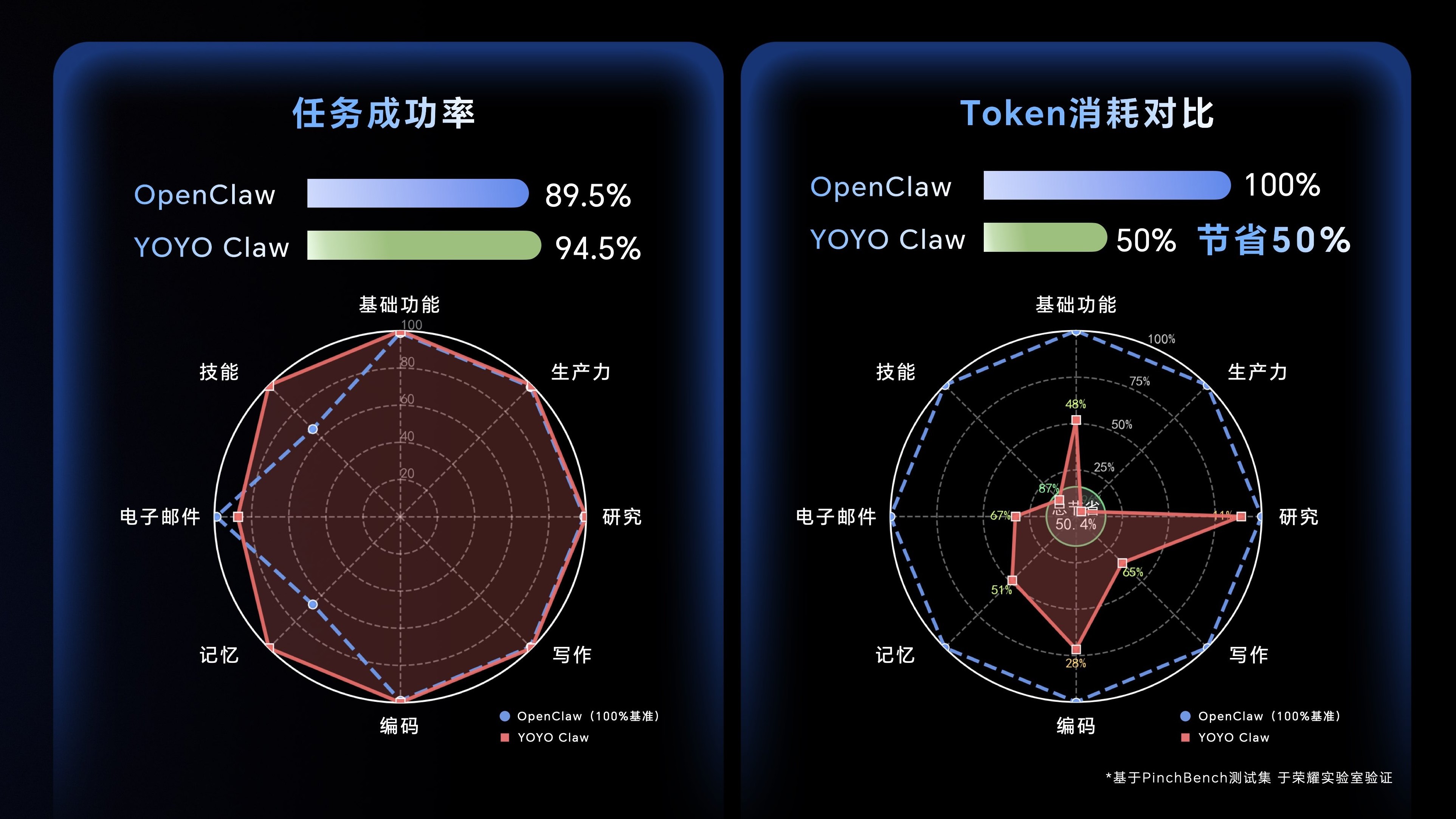
△ Comparison between Honor YOYO Claw and OpenClaw. Image source: Official
In addition