From a county town boss to losing all assets: Why do people always line up to fall into the franchise traps?
“Why do people still fall into the traps of franchise opportunities even though they know they exist?”
Mr. Hua, who has been in the food and beverage investment promotion field for 13 years, is often asked this question. His answer is straightforward: “Everyone wants to get rich overnight and thinks that fortune will fall from the sky.”
At 3 a.m., a shoe and clothing store owner from Fujian was still scrolling through Douyin. The screen was playing franchise advertisements claiming “recoup the investment in three months, full - scale management by the headquarters, and earn one million a year.” He had just closed his shoe and clothing store and was holding hundreds of thousands of savings in his hand. He was thinking: Since physical business is difficult, it's better to join a popular brand and be a hands - off boss.
This was the last time he saw such an advertisement. Three months later, the barbecue restaurant he opened in the mall lost hundreds of thousands of yuan and finally closed down.
This case comes from “the most regrettable friend last year” in Mr. Hua's words. And such stories are staged every day in the food and beverage franchise circle.
According to the “2026 China Chinese Cuisine White Paper”, the store - closing rate of the Chinese food and beverage industry reached 49% in 2025, and franchise stores accounted for more than 70% of the closed stores. The failure rate of franchise entrepreneurship in third - and fourth - tier cities is as high as 74%, and more than 80% of the losses are concentrated in the “four bankruptcy packages” of milk tea, hamburgers, coffee, and baking.
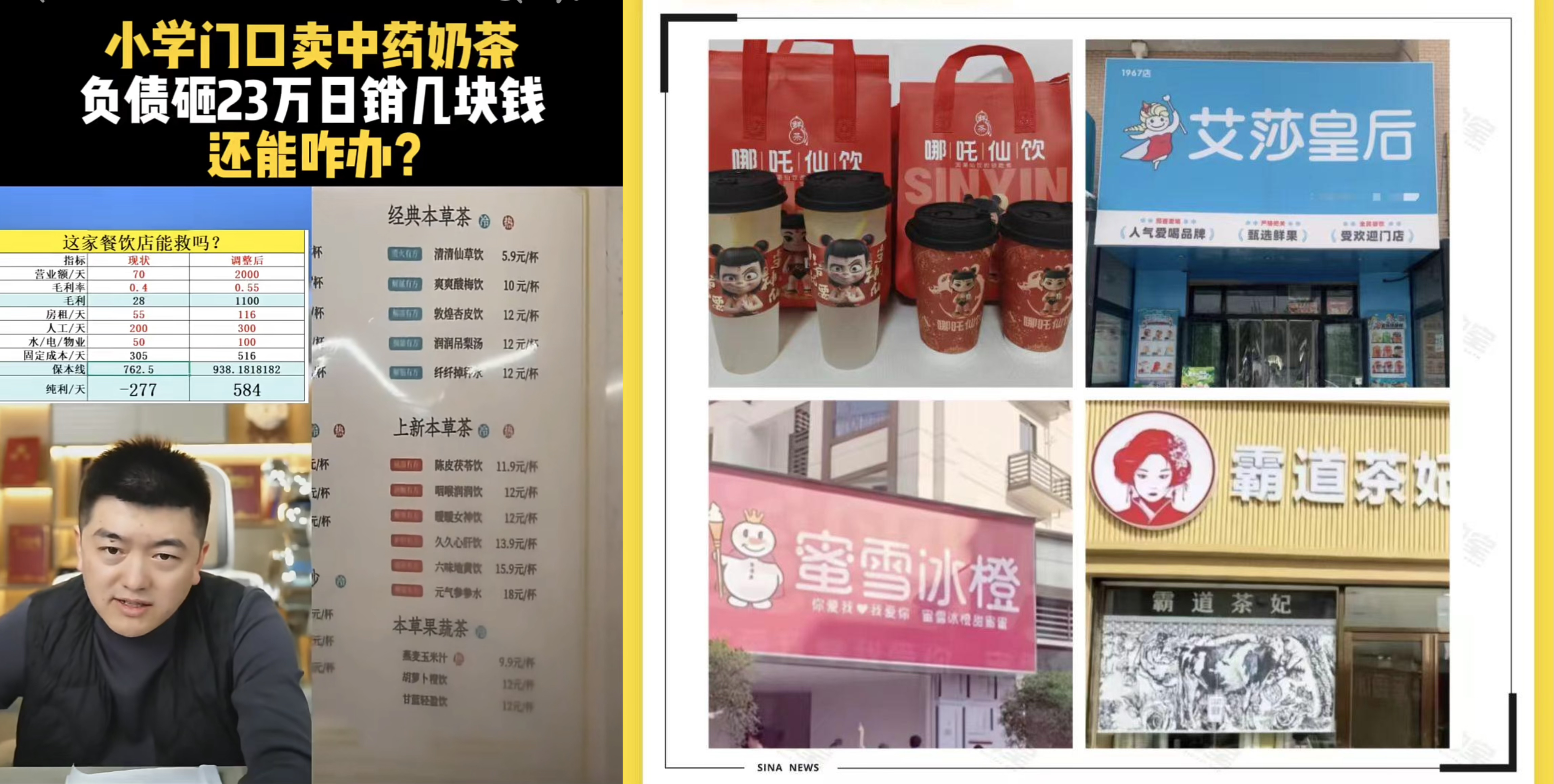
From entrepreneurs who cried and broke down in Yongge's food and beverage live - stream room to the closed “four bankruptcy packages” all over the streets of small towns - the stories of falling into franchise traps are never the same.
If a business is guaranteed to make money, why doesn't the brand do it itself? Why, in today's era when there are countless guides to avoiding franchise traps, do people still flock to become victims? Is it because the fast - recruitment companies' tricks are too deep, or is it because entrepreneurs are too obsessed with getting rich overnight? In 2026, is it still possible to engage in food and beverage franchising? How can one survive?
01 Dreaming of getting rich but becoming the prey of fast - recruitment companies
When deeply analyzing the business logic of fast - recruitment franchise scams, we must face the weaknesses deep in human nature. This is the result of the combination of the psychological loopholes of entrepreneurs themselves and the carefully designed hunting strategies of external fast - recruitment companies.
From the perspective of entrepreneurs themselves, they often play three roles. First, they are dreamers with the fantasy of getting rich overnight. Many people, when exposed to franchise opportunities, are ignited by the exaggerated publicity of “investing tens of thousands and easily earning one million a year”. They regard franchising as a shortcut to quickly achieve financial freedom and class leap, but ignore that business is essentially a painstaking practice that requires meticulous efforts and even hard work.

Netizens listed classic connection cases in Yongge's food and beverage live - stream room. Source: Xiaohongshu
Second, they are escapers who long to be hands - off bosses. They are tired of the constraints of working for others and yearn to have their own businesses. However, at the same time, they are extremely afraid of the hardships of traditional entrepreneurship, such as working non - stop throughout the year and being involved in every detail. The promises of “full - scale management by the headquarters” and “becoming a boss with just a bag” from fast - recruitment companies precisely target this contradictory mentality of wanting to be a boss but not wanting to endure hardships. Mr. Hua pointed out in an interview that the probability of a store losing money and closing down is more than 90% if the boss doesn't personally oversee the store in the early stage, and this is precisely the beginning of most people's nightmares.
Finally, they are anxious people seeking survival in desperate situations. A large number of entrepreneurs come from declining traditional industries (such as those in the transformation of physical retail and education and training), or are facing middle - age career crises, or are full - time “stay - at - home moms” who have been out of the workforce for a long time and are out of touch with society. They regard their only savings as the last chip to change their fates. Research shows that the long pay - back period is the most concerned issue for franchisees, and their anxious mentality of fighting a desperate battle and eager to turn the tables greatly reduces their risk judgment ability, making them more likely to be captured by the words of “low threshold and quick pay - back” and even willing to borrow money to invest.
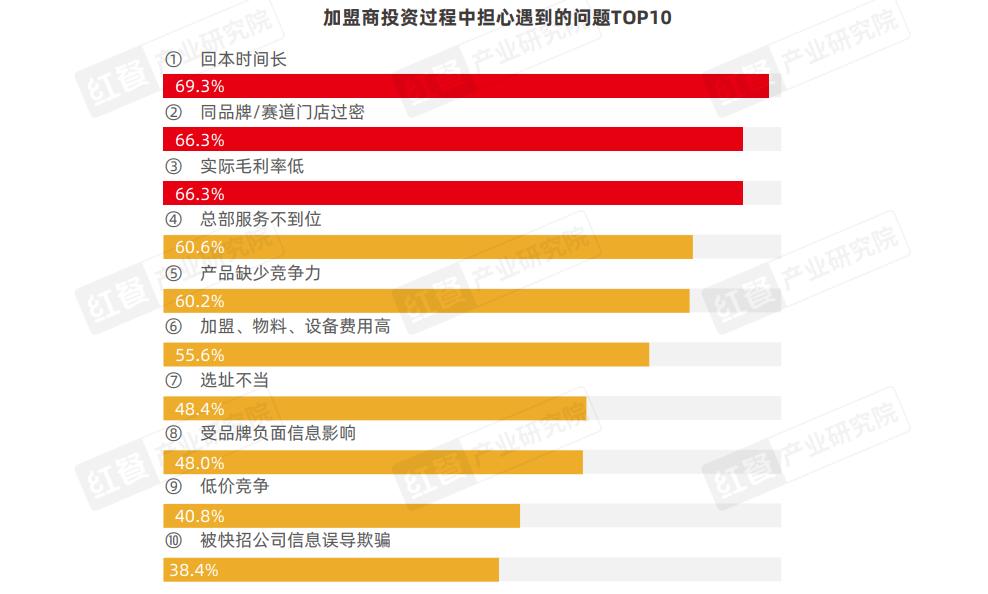
Source: “2026 China Chain Franchise Business Development White Paper”
However, it is unfair to completely blame entrepreneurs. There is a structural promoter in the market: The high threshold of regular franchise brands objectively discourages a large number of entrepreneurs, while fast - recruitment companies use a “pig - raising” tactic to capture them all.
The franchise system of regular leading brands is essentially a rigorous risk and qualification screening mechanism. They do not accept everyone. They not only set clear financial and personal investment thresholds but also conduct franchise reviews with great caution.
Taking some brands as an example, their review process is closely linked. From the preliminary review of materials, online courses, video interviews, to on - site visits to the headquarters and the evaluation of the location plan by the regional manager... Any deficiency in any link may lead to all previous efforts being wasted. Some brands have strict requirements for the store location. They do not consider storefronts outside the core shopping malls or prime pedestrian streets, which directly drives up the rent and operating costs, and the overall investment in a single store often reaches millions of yuan.
Even so, the franchise opportunities of leading brands are still very popular. It is not uncommon for hundreds of thousands of people to compete for one quota. Even in some gray channels, the franchise qualification of a popular tea brand has been speculated to hundreds of thousands of yuan.
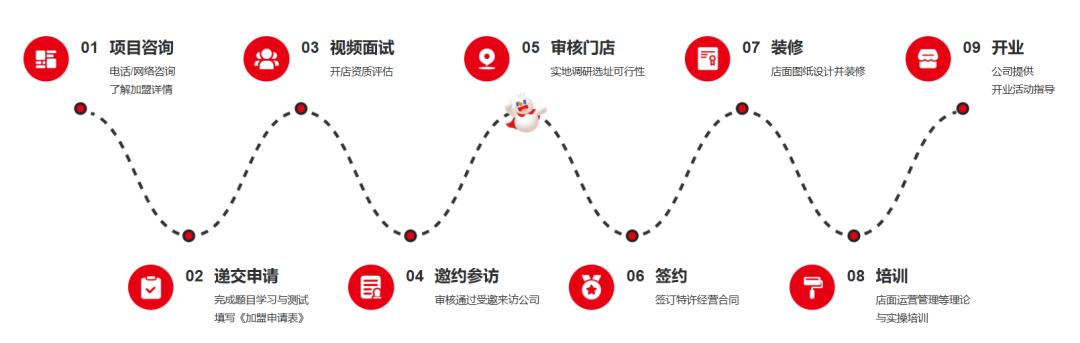
The franchise process of a leading tea brand. Source: Brand official website
Even if one successfully crosses the franchise threshold, the brand's refined management and strict assessment are just beginning. Taking a well - known tea brand as an example, it has almost strict requirements for product standardization. From the number of times of stirring drinks, the operation time of the milkshake machine, to the material ratio and cleaning process, there are clear quantitative regulations down to seconds and circles. Once a violation occurs, the store will first receive a yellow card warning and a fine of 3,000 yuan. If it accumulates three yellow cards, it will be converted into a red card. The store needs to be shut down for rectification and will be fined between 5,000 and 10,000 yuan.
If a franchisee chooses to close the store voluntarily, they have to face the reality of a significant discount on assets. The recycling price of catering equipment in the second - hand market is often only 30% - 40% of the original purchase price, or even lower. Moreover, some brands, in order to maintain the closed - loop of the supply chain and equipment system, will clearly prohibit stores from using second - hand equipment or require them to be processed through the brand - designated recycler. They may also track the flow of equipment through methods such as scanning the machine code, further reducing the bargaining power and choice of franchisees when exiting.
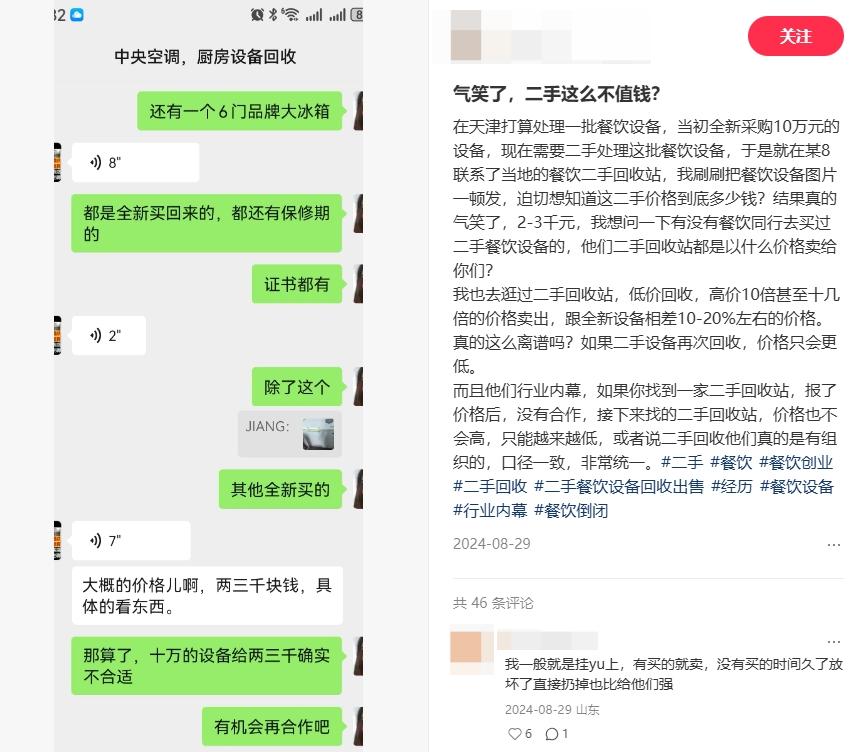
Equipment purchased for 100,000 yuan has a second - hand recycling price of 2,000 - 3,000 yuan. Source: Xiaohongshu
The rigorous attitude of these brands, although responsible for the long - term interests of both the brand and franchisees, keeps those entrepreneurs with limited funds or less experience out of the door. Therefore, those entrepreneurs who are rejected or scared away by regular brands become the “lambs to be slaughtered” wandering on the edge of the market, and fast - recruitment companies have already set up a net.
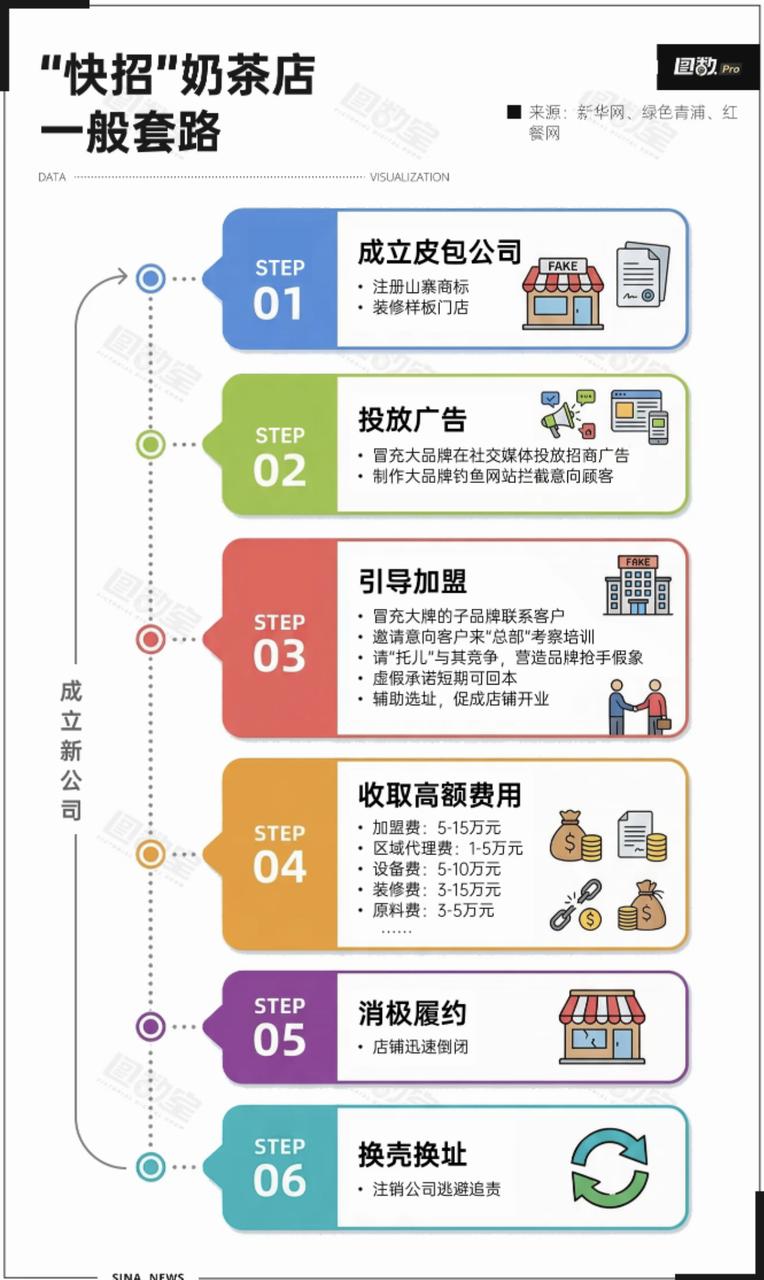
What is fast - recruitment? Simply put, this business model is called “rapid investment promotion”, and its main feature is speed - rapid franchise, rapid harvesting, and rapid closure.
Mr. Hua dissected the typical fast - recruitment traps: They buy keywords on search engines (such as “How much does it cost to join XX brand”), and also fully penetrate content platforms. Through carefully edited “successful” case videos, live - streaming as brand co - founders or strategic partners, and even directly placing information flow advertisements, they package themselves as low - threshold cooperation versions of well - known brands or newly launched sub - brands.

Source: Xinmin Video
Once they obtain the contact information, the salespeople of fast - recruitment companies will launch a dense emotional offensive. They make multiple calls every day, from caring about personal life and family to imagining the future blueprint, providing emotional value far beyond normal business consultations. This continuous emotional investment aims to establish a trust or even dependent relationship with customers, making entrepreneurs gradually lower their defenses emotionally. To dispel doubts, they will even offer an invitation for an inspection with reimbursement of travel expenses and accommodation arrangements, greatly reducing the decision - making cost of potential victims.
“Even a fast - recruitment friend told me that there are more victims than you think.” Mr. Hua said frankly that the means of fast - recruitment are constantly evolving: Now they also open one or two sample stores and then conduct large - scale investment promotion.
When inviting inspections, they will carefully decorate the sample stores or create the illusion of long queues. At the company headquarters, they forge a bustling signing scene, display a fictional list of successful franchisees, and even, as some cases have revealed, illegally purchase others' ID card information to fabricate a large number of false materials of local franchisees. All this is to create a sense of urgency of “the project is hot, the opportunity is scarce, and it's too late if you don't join now”.
But their common characteristics are clear: The brand has been established for a very short time, maybe just a few months. The founder is not the legal representative, and there is no real direct - operated store experience.
Source: Xiaohongshu “Tushushi”
Finally, an ordinary person full of wealth anxiety and wanting to avoid hardships turns around when facing the high wall of regular brands but falls into the “pig - raising” trap laid by fast - recruitment companies with low thresholds, high - care, and full of falsehoods.
However, this seemingly easy entrance actually leads to a doomed difficult situation. Most franchisees who join fast - recruitment companies, even if they try their best, still cannot escape the fate of store closure.
02 Why do they face closure no matter how hard they try?
The most fundamental reason is the incompatibility of the products with the local market. In Yongge's food and beverage live - stream room, the hardest - hit areas for entrepreneurial failure are milk tea, hamburgers, coffee, and baking, the “four bankruptcy packages”, which are also the favorite tracks of fast - recruitment companies to package and tell stories. From “Ne Zha's Fairy Drink” to “The Fourth - Generation Hamburger”, they thought they were joining the next big brand, but in fact, they only bought a bunch of high - priced equipment and unsellable raw materials.

Many entrepreneurs are impressed by the glamorous internet - celebrity logic of first - tier cities used by fast - recruitment companies and directly copy those categories such as traditional Chinese medicine milk tea and high - end baking, which rely on emotional value and impulse for check - ins, to county - level markets with a relatively stable consumption structure, an aging population, and a greater emphasis on rigid demand and cost - effectiveness.
This mismatch in logic sows the seeds of failure from the very beginning. The business ecosystem in small towns emphasizes repeat customers and word - of - mouth. The popularity of internet - celebrity categories comes and goes quickly. Once the novelty fades, those internet - celebrity products with extremely low repurchase rates will soon be exposed in the market.
“Who will you sell internet - celebrity baking and traditional Chinese medicine milk tea to in a small town?” Mr. Hua asked rhetorically. “Who will eat desserts every day? Without a high repurchase rate, you can only rely on attracting new customers. But the population in small towns is limited. There are more people during holidays, but most people go out to work on normal days, and the remaining are the elderly taking care of children. Can they afford a 35 - yuan cup of traditional Chinese medicine milk tea?”
Mr. Hua summarized a catchphrase for product selection in different scenarios:
Sell snacks near primary schools, and sell snacks near middle schools.
Sell staple foods near universities, and sell fruits and