CATL earns 200 million yuan a day. For whom are car companies working?
On April 15, CATL released its financial report for the first quarter of 2026: revenue reached 129.1 billion yuan, a year-on-year increase of 52%; net profit attributable to the parent company was 20.7 billion yuan, a year-on-year increase of 48%, with an average daily net profit of 230 million yuan.
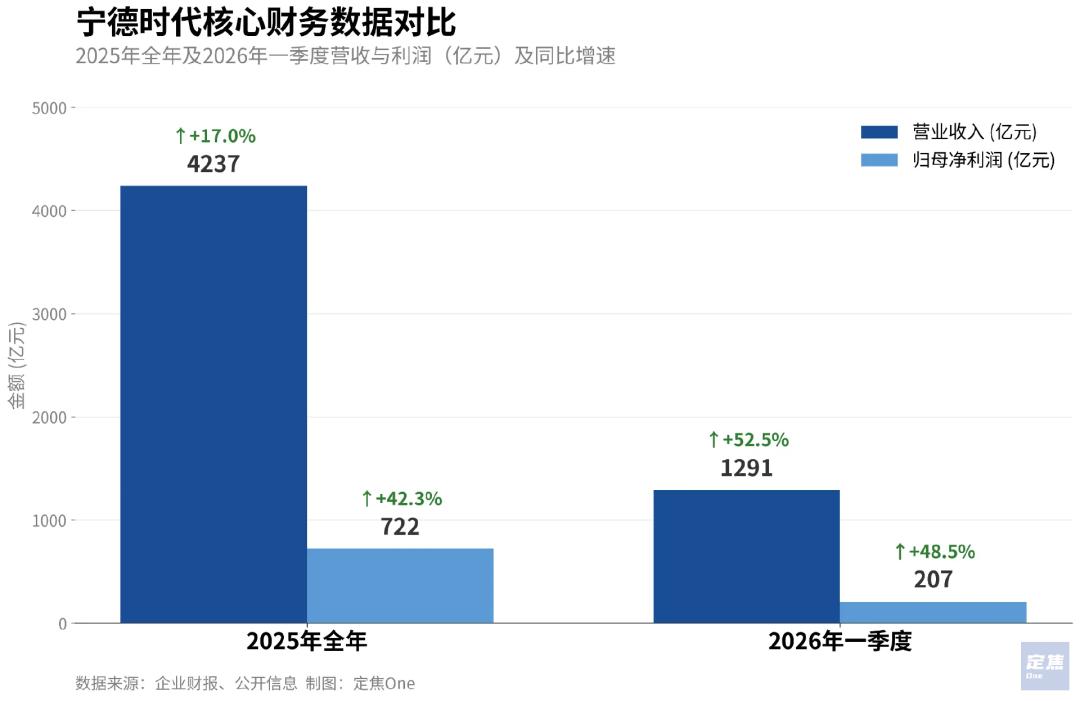
Looking at the whole year of 2025, CATL's net profit was as high as 72.2 billion yuan. During the same period, the total net profit of five automakers, BYD, Geely, SAIC, Great Wall, and Changan, was 73.5 billion yuan. A single battery supplier tied with five complete vehicle manufacturers.
Compared with CATL's huge profits, the downstream automakers are having a tough time. Cui Dongshu, the secretary-general of the China Passenger Car Association, revealed at the beginning of the year that the overall sales profit margin of the automotive industry in 2025 was only 4.1%, and in some months, it even fell below 2%, far lower than the average level of 5.9% in the manufacturing industry; in December 2025, this figure was only 1.8%.
Zhao Fei, the general manager of Changan Automobile in China, even publicly stated, "If a company only relies on selling cars, it can no longer make a profit."
There is also a set of data in the financial report that reflects CATL's position in the industrial chain. By the end of 2025, the advance payments made by customers to CATL were 49.2 billion yuan, a year-on-year increase of 77%, and it still remained at 45.5 billion yuan by the end of the first quarter of this year; during the same period (the first quarter of 2026), the total accounts payable and notes payable owed by CATL to upstream suppliers were about 300 billion yuan.
With downstream customers making advance payments and the payment period for upstream suppliers being continuously extended, the argument that "automakers are working for CATL" was brought up again in the industry with the release of the new quarterly financial report. This article aims to discuss whether this argument is true. How did this profit distribution pattern come into being? Will it continue?
01. A Battery Factory Outearns Five Complete Vehicle Manufacturers
To discuss whether the "working-for" theory holds, we need to first look at the accounts of the upstream and downstream of the industrial chain to see where the profits are flowing.
Let's start with CATL. The 2025 financial report shows that the gross profit margin of its power battery system was 23.8%, and the net profit margin attributable to the parent company was about 17%. In the first quarter of 2026, its revenue and net profit increased by 52% and 48% year-on-year respectively, and the profit momentum continued.
The situation is different for complete vehicle manufacturers. In terms of gross profit margin, the gross profit margin of BYD's automotive business was about 20%, the lowest in three years; Changan's was about 15.5%; the gross profit margin of SAIC's complete vehicle business was only 4.3%; and the gross profit margin of GAC's complete vehicle business became negative.
The gap is even greater in terms of net profit margin. In 2025, even for BYD, which had a leading sales volume, with a revenue of 803.9 billion yuan, its net profit attributable to the parent company decreased by 19% year-on-year to 32.6 billion yuan, and the net profit margin was about 4.1%. This is already the strongest profitability among domestic automakers.
For leading companies such as Geely, SAIC, and Great Wall, the net profit margin is generally between 1.5% and 4.5%, and most of them have experienced the situation of "revenue growth but profit decline". Changan Automobile's net profit decreased by 44% year-on-year, and the net profit margin dropped to about 2.5%. GAC (-8.8 billion yuan) and BAIC New Energy (-4.5 billion yuan) suffered direct losses.
In comparison, the net profit margin of mainstream complete vehicle manufacturers is generally between 2% and 4%, while the net profit margin of battery suppliers is more than four times that of their customer base.
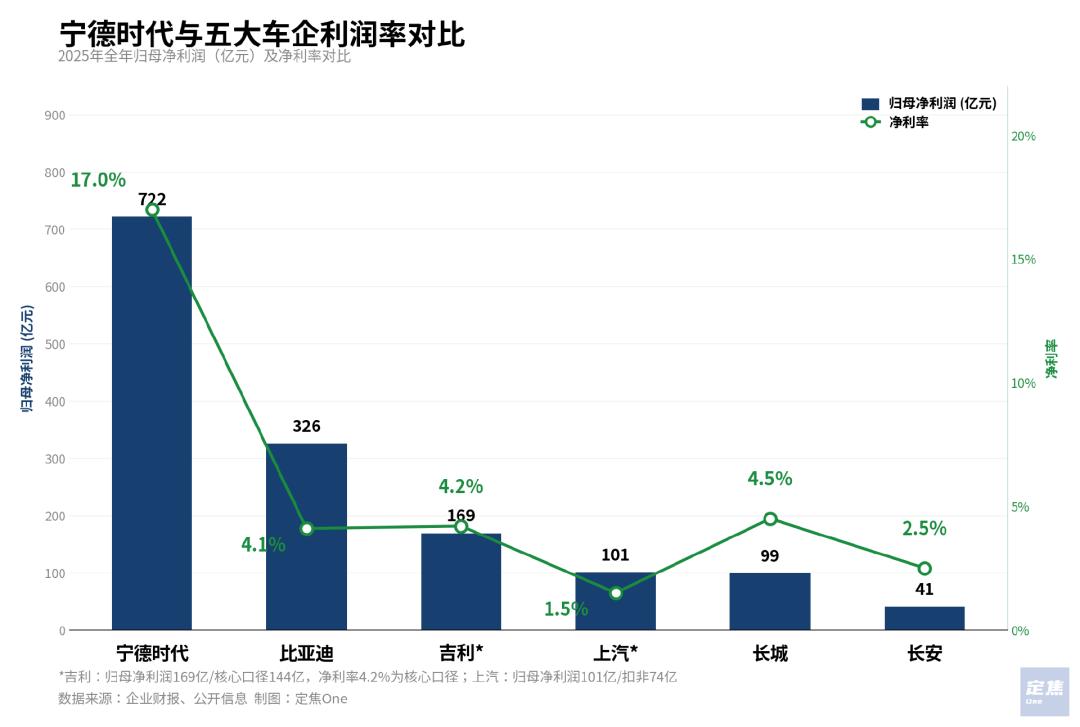
What lies behind this reflects the cost weight and pricing power of batteries in complete vehicles.
In 2022, Zeng Qinghong, the former chairman of GAC Group, said a widely circulated statement at a public event: "Batteries account for 60% of the cost of my vehicle. Am I not working for CATL?"
Three years have passed. In the BOM (Bill of Materials) cost of new energy vehicles, although the proportion of power batteries has decreased with technological progress, it still accounts for about 30% to 40%. The core component with the highest proportion, wherever it is concentrated, is where the profits flow.
This pricing power is also directly reflected in CATL's balance sheet.
By the end of 2025, the advance payments (contract liabilities) made by customers to CATL were as high as 49.2 billion yuan, a year-on-year increase of 77%; by the end of the first quarter of 2026, it still remained at 45.5 billion yuan. In order to obtain CATL's battery production capacity, downstream automakers need to lock in and make payments in advance.
Meanwhile, the accounts payable owed by CATL to upstream suppliers increased from 160.3 billion yuan at the end of 2025 to 180.6 billion yuan at the end of the first quarter of 2026. Adding the notes payable of 119.8 billion yuan, the total is 300 billion yuan, and the payment period continues to be extended.
In the manufacturing industry, it is rare for a company to receive advance payments from downstream and extend the payment period for upstream at the same time. In terms of receiving payments from downstream, CATL's logic is similar to that of TSMC, and its strength lies in getting customers to pay quickly.
However, TSMC pays its upstream suppliers quickly, with an accounts payable turnover days of about 20 days. CATL is different. While receiving advance payments from downstream, it also extends the payment period for upstream. This is more similar to Amazon's financial structure, relying on a large procurement scale to shorten the suppliers' payment period.
Arthur, an investor who focuses on new energy vehicles, mentioned that there is a financial indicator called the "Cash Conversion Cycle" (CCC). The lower the value and the closer it is to a negative value, the more a company can use others' money to operate its business.
According to CATL's 2025 financial report, its accounts receivable turnover days are about 66 days, and the payment period corresponding to the total accounts payable and notes payable is about 308 days. The cash conversion cycle is about -11 days. In other words, it receives payments from customers about 240 days faster than it pays suppliers, and the pressure on using its own working capital is relatively small.
CATL is not completely unaffected by the late payments from automakers, but from the data, the pressure is limited. By the first quarter of 2026, with the rapid expansion of its revenue scale, its accounts receivable turnover days have shortened to about 54 days. In the same industrial chain, the actual payment collection cycle of small and medium-sized parts manufacturers is usually between 90 and 120 days, and that of some interior material suppliers exceeds 300 days.
In comparison, CATL has the right to speak at both ends of the industrial chain. It is the creditor of downstream automakers and the debtor of upstream suppliers.
Judging from the financial report for the first quarter of 2026, there is no sign of weakening of this right to speak. As a battery supplier in the industrial chain, its revenue growth rate and net profit growth rate are still increasing at a rate of 50%, which is probably still higher than that of the complete vehicle industry during the same period.
In the traditional automotive supply chain, complete vehicle manufacturers usually have a strong position, and parts suppliers often need to advance funds for production and accept long payment periods. But in front of CATL, this relationship is reversed.
02. Why Can CATL Earn So Much?
Advance payments and long payment periods are just the results. The real reason why downstream customers are willing to make advance payments in line is that in many models and platforms, automakers cannot find a completely equivalent alternative in the short term. To understand why, we need to start more than a decade ago.
Around 2015, new energy vehicles began to experience explosive growth driven by policies. At that time, the choice facing complete vehicle manufacturers was: to produce batteries by themselves or to source them externally?
BYD has always insisted on self - research and self - production of batteries. Most other automakers, including joint ventures in China such as Volkswagen, BMW, and General Motors, as well as new forces such as NIO, XPeng, and Li Auto later, mostly chose to source externally at that time, with partial participation in integration or joint ventures.
Because self - research of batteries requires huge capital investment, a long R & D cycle, and extremely complex manufacturing processes. While external sourcing has lower costs and faster volume growth.
This is actually the supply chain logic in the era of fuel vehicles: the engine and transmission are the core, and other parts can change suppliers.
But in new energy vehicles, the battery is not an ordinary part, and the switching cost is extremely high. For example, if an automaker spends three years developing a model with CATL's batteries, once it wants to change the supplier, the BMS (Battery Management System) needs to be recalibrated, the thermal management needs to be re - verified, and the software interface needs to be re - connected. In fact, it is almost equivalent to re - developing this model.
Such a high switching cost has locked in the cooperation relationship between a large number of automakers and CATL.
This binding relationship was not obvious at first. But with the price war and technological iteration in recent years and the continuous reshuffle of the industry, the pattern has gradually become clear: by 2025, the total market share of the top ten domestic power battery loading enterprises has exceeded 90%, and CATL and BYD together account for 65%. Especially CATL, which has enjoyed the benefits of increased concentration. In 2025, its capacity utilization rate reached 96.9%. While the capacity utilization rate of many second - and third - tier enterprises is struggling below 50%, and some even dropped to 30%, relying on price wars and project subsidies to survive.
The high cost of changing suppliers and the inability of alternatives to enter the market. The more concentrated the supply side is, the less bargaining power automakers have at the negotiation table. But these are not enough to explain one point: Why can CATL's profits keep increasing while the downstream price war is intensifying?
This needs to be discussed in terms of the price mechanism. CATL has long implemented a raw material price linkage mechanism, and the battery pricing is directly linked to the prices of bulk commodities such as lithium carbonate. In 2022, the price of lithium carbonate soared from about 300,000 yuan per ton at the beginning of the year to nearly 600,000 yuan per ton at the end of the year. CATL passed on part of the price increase pressure to downstream automakers.
However, the price of lithium carbonate dropped from its peak in 2023 back to about 120,000 yuan per ton in 2025. Although CATL's battery price also decreased, from the financial report, the overall gross profit margin of power batteries increased.
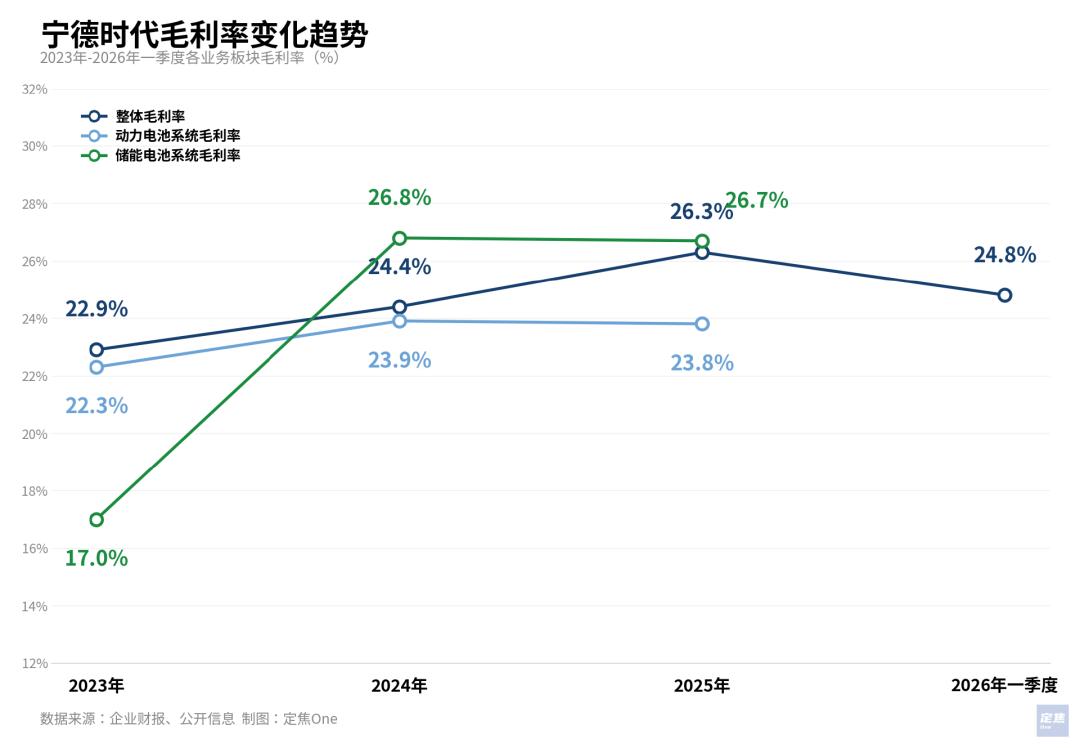
When the raw material price increases, the cost pressure is shared with automakers; when the raw material price decreases, the cost - reduction space is not fully passed on to downstream. The reason for this is on the one hand, the linkage mechanism, and on the other hand, the scale.
For most automakers, CATL has become one of the "must - cooperate" suppliers. In 2025, its market share in domestic power battery loading reached about 43.4%, and its global power battery installation market share was about 39.2%, ranking first in the world for many years. In the European market, CATL's market share has also increased from more than 30% in 2024 to about 40%. Mainstream automakers such as BMW, Mercedes - Benz, and Volkswagen are all its customers.
In such a pattern, while many second - and third - tier manufacturers are still worried about the payment collection and cash flow of individual projects, CATL is already using its money to layout technologies and resources for the next few years.
In 2025, CATL's net operating cash flow was as high as 133.2 billion yuan, and the cash and cash equivalents at the end of the period were 333.5 billion yuan. This money enables it to expand production against the trend during the industry trough, continuously increase R & D investment, and also make early arrangements in the upstream lithium ore resource end to hedge against raw material price fluctuations.
Therefore, the background of the "working - for" theory is the decision of automakers to prioritize efficiency back then. CATL has transformed this dependence into a profit advantage through the price linkage mechanism, and then used these profits to further widen the gap in technology and scale. This cycle is difficult to be interrupted in the short term.
03. Is it Reasonable for Automakers to Work for "King Ning"?
From the perspective of pure business competition, in the early and rapid growth stages of an industry, it is not an exception for the link that controls core technologies and bottleneck resources to obtain most of the profits. CATL made an early bet on the cell system and system integration, dared to invest heavily, and established an advantageous position in the power battery field, so it deserves corresponding commercial returns.
However, from the macro perspective of the long - term healthy development of the industry, this overly concentrated profit distribution method has potential risks.
If complete vehicle manufacturers are in a state of meager profit or even loss for a long time, it will be difficult for them to support the development of new platforms, the upgrade of intelligent systems, and the establishment of global channels and brands. This pressure will eventually be transmitted along the industrial chain to small and medium - sized parts suppliers, consumers, and also to CATL itself.
In other words, in the short term, CATL has obtained most of the profits in the core industrial chain of new energy vehicles (battery and complete vehicle segments); in the long term, if the complete vehicle end cannot operate healthily and continuously, it will affect the quality of its future customers.
This imbalance in upstream and downstream profits has been further magnified in the price war. Data shows that from January to November 2025, more than 170 models participated in official price cuts, and the average selling price of new energy vehicles decreased by about 12%. Complete vehicle manufacturers passed on the price concessions to consumers, and this part of the loss was mainly absorbed by automakers.

Image source / pexels
In contrast, the situation of BYD is completely different. In