Real estate in first-tier cities has taken the lead in showing signs of stabilization.
How about the quality of this round of the "mini spring" in the real estate market?
Data released by the National Bureau of Statistics on April 16 showed that in March, the sales prices of newly-built commercial residential buildings in first-tier cities increased by 0.2% month-on-month, turning from flat in the previous month. Among them, except for Beijing where the prices remained flat month-on-month, the prices of new homes in Shanghai, Guangzhou and Shenzhen all increased month-on-month.
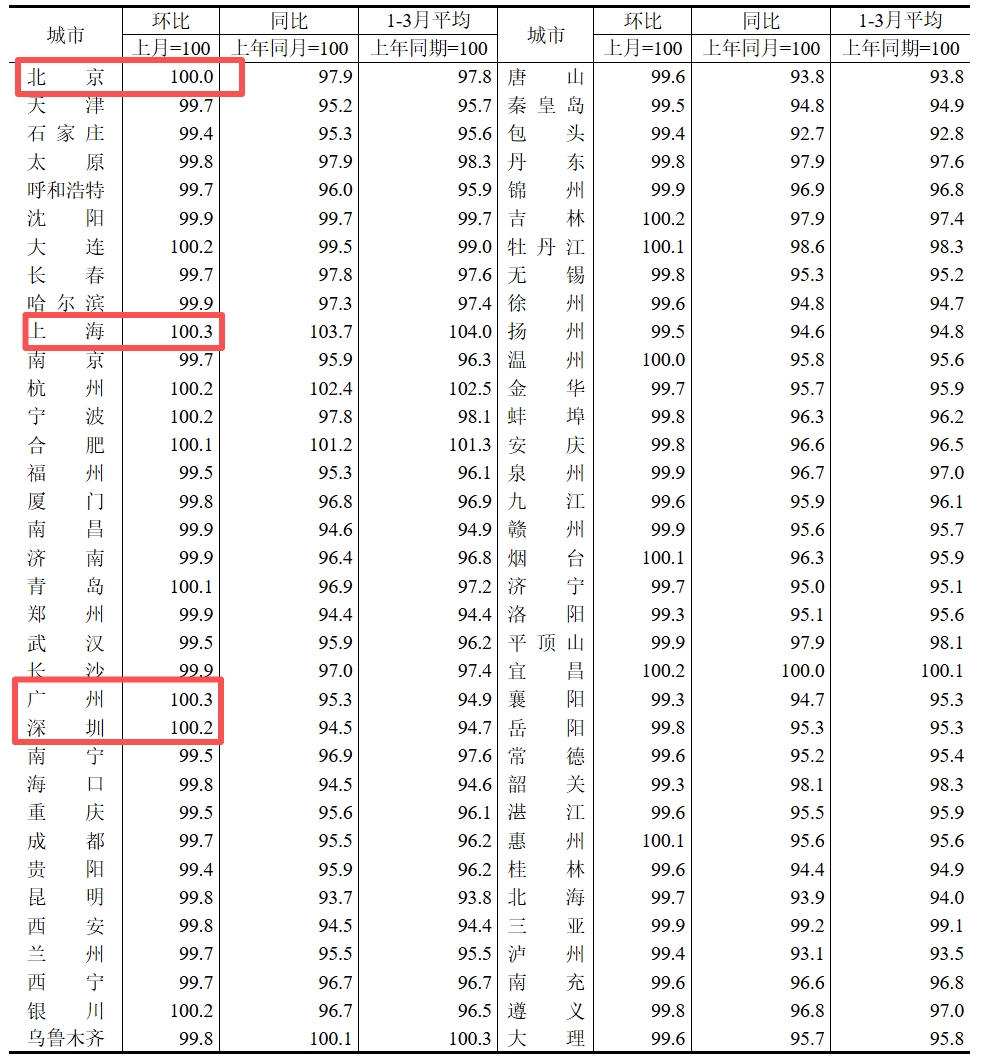
Price indices of newly-built commercial residential buildings in 70 large and medium-sized cities in March 2026, Source: National Bureau of Statistics
In the second-hand housing market, in March, the sales prices of second-hand residential buildings in first-tier cities increased by 0.4% month-on-month, turning from a 0.1% decline in the previous month. The prices of second-hand houses in Beijing, Shanghai, Guangzhou and Shenzhen all increased month-on-month, with the increases of 0.6%, 0.4%, 0.2% and 0.4% respectively.
This means that first-tier cities have taken the lead in stabilizing in this round of the "mini spring" in the real estate market.
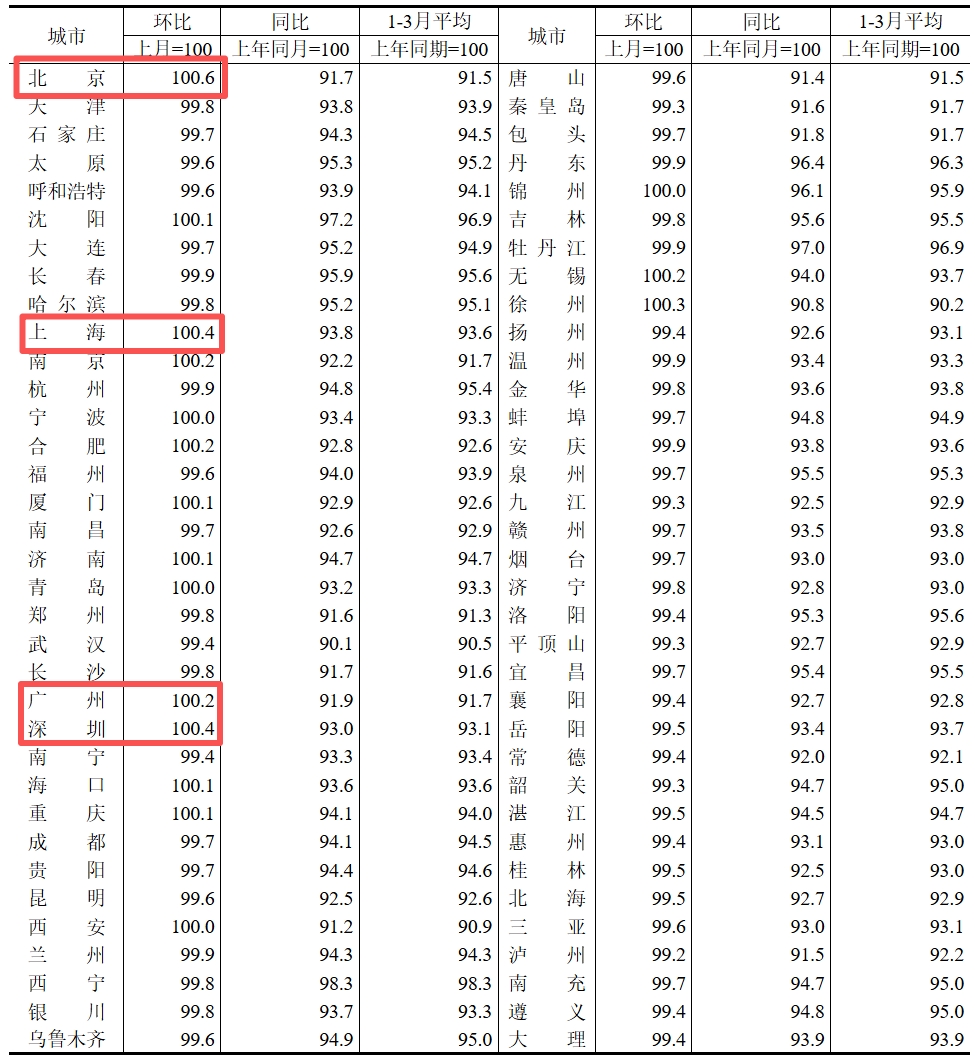
Price indices of second-hand residential buildings in 70 large and medium-sized cities in March 2026, Source: National Bureau of Statistics
The real estate markets in second and third-tier cities are still in a downward trend, but the price decline has also narrowed. According to the data from the National Bureau of Statistics, in March, the sales prices of newly-built commercial residential buildings in second and third-tier cities decreased by 0.2% and 0.3% month-on-month respectively, with the same decline as in the previous month. The number of cities with month-on-month price increases increased to 14. In the second-hand housing market, the sales prices decreased by 0.2% and 0.4% month-on-month respectively, with the decline narrowing by 0.2 and 0.1 percentage points respectively. The number of cities with month-on-month price increases increased by 11 compared with the previous month.
Zhang Bo, the dean of the 58 Anjuke Research Institute, analyzed that the full recovery of Beijing, Shanghai, Guangzhou and Shenzhen at this stage is a strong signal for the stabilization of the national market. Although the prices of second-hand houses are still hovering at the bottom, the signs of price stabilization have been further strengthened. According to the online data of Anjuke, the proportion of second-hand housing searches has risen for 9 consecutive months to 74.8%, reaching a new high in the past year. The diversion intensity to new homes has reached 34.1%, and the trend of rigid demand concentrating on second-hand houses is clear. The second-hand housing market has taken the lead in achieving recovery in core cities. The confidence of landlords has steadily recovered, the number of listed properties has increased, and the trading rhythm has accelerated. The market is transitioning from "trading at a lower price for higher volume" to "stable prices and increasing volume".
Driven by the market recovery in first-tier cities and cities such as Qingdao and Ningbo, the national data on the de-stocking of commercial housing has also shown signs of bottoming out and rebounding. According to the data from the National Bureau of Statistics, from January to March, the year-on-year decline in the sales area and sales volume of newly-built commercial housing nationwide both narrowed. Among them, the sales area of newly-built commercial housing was 195.25 million square meters, a year-on-year decrease of 10.4%, with the decline narrowing by 3.1 percentage points compared with January - February; the sales volume of newly-built commercial housing was 1,726.2 billion yuan, a decrease of 16.7%, with the decline narrowing by 3.5 percentage points.
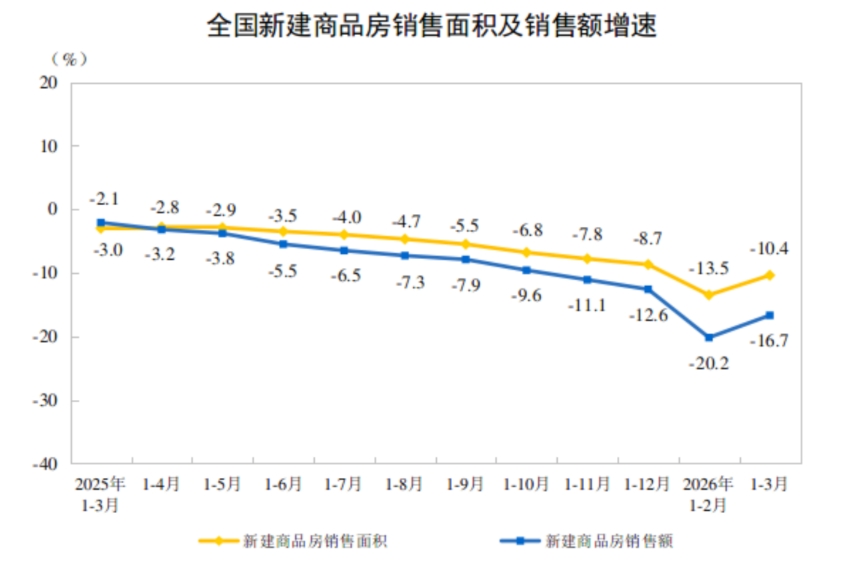
Source: National Bureau of Statistics
Judging from the data, the second-hand housing market in first-tier cities is recovering faster and more sustainably. Among them, the transaction prices of second-hand houses in Beijing have increased for two consecutive months month-on-month, and in March, it ranked first among first-tier cities with a 0.6% increase.
According to the monitoring data of Beijing Lianjia, in the first two months of this year, the average total price per set of second-hand housing in Beijing increased by nearly 100,000 yuan, a increase of nearly 2.4%. After excluding the impact of the transaction structure, the price index of second-hand houses also increased by nearly 2%.
The reason for the increase in the average price is driven by the enlarged trading volume in the "mini spring". The prices in areas with high market activity have taken the lead in rebounding.
The new housing market is limited by both the market trading activity and the cash flow pressure of development enterprises. According to the data released by the National Bureau of Statistics, from January to March this year, the funds in place for real estate development enterprises were 2,052.4 billion yuan, a year-on-year decrease of 17.3%. Among them, domestic loans were 341.9 billion yuan, a decrease of 23.7%; self-raised funds were 776.2 billion yuan, a decrease of 5.3%; deposits and advance receipts were 585.8 billion yuan, a decrease of 20.1%; personal mortgage loans were 220.4 billion yuan, a decrease of 34.6%. At present, the capital pressure of development enterprises is still relatively large, and "trading at a lower price for higher volume" to maintain stable cash flow is still the mainstream trend.
Zhang Bo said that the pattern of core cities leading the stabilization, second-tier cities recovering, and third and fourth-tier cities bottoming out will be more obvious. As the decline of the leading market index narrows and the landlord price adjustment index becomes more optimistic, this round of the "mini spring" is expected to last until May.
According to the online signing data of the Beijing Municipal Commission of Housing and Urban - Rural Development, as of the 15th, a total of 8,041 second-hand houses were signed online in Beijing in April, and the trading volume this month is expected to remain stable above 15,000 units.