It's been proven that Hermes Agent copied the code of a Chinese team. After being exposed, they responded with: "Delete your account."
[Introduction] Shocking! Is the Hermes Agent, which has amassed 85,000 Stars on GitHub, a plagiarized work? The star project of the well - known Silicon Valley AI lab Nous Research is accused of copying the entire self - evolving architecture from the open - source engine Evolver of the Chinese team EvoMap. The 10 - step main loop is exactly the same. The terms are all changed, but the architecture remains intact. Seven public materials make no mention of the original work. After being exposed, the other party's response is even more outrageous: "Delete your account."
The AI circle is in an uproar again! This time, it's not about the release of a new model, but a textbook - level open - source plagiarism incident.
The ugliest scene in the open - source world!
The Hermes Agent, which has amassed 85,000 Stars on GitHub, is proven to have plagiarized at the architectural level.
Just now, the Chinese AI team EvoMap publicly released a detailed technical comparison report: The "self - evolving" function of the star project Hermes Agent under Nous Research has a high - level isomorphism with the Evolver engine open - sourced by EvoMap 36 days ago, with a one - to - one correspondence in the 10 - step main loop, a systematic replacement of 12 groups of terms, and zero attribution in seven public materials.
Even more shocking is that after being exposed, Nous Research's response is: "Delete your account." Then they deleted the post, blocked the accuser, and went completely silent.
85,000 Stars vs 46 million calls. Let's get to know these two projects first.
Nous Research, a well - known Silicon Valley AI lab that has raised over a hundred million dollars, has launched the Hermes series of open - source large models and has a significant influence in the LLM circle. Its latest Hermes Agent claims to enable AI agents to complete tasks autonomously, self - evolve, and become more powerful with use. Its GitHub star count has soared to 85,000.
EvoMap is a young Chinese team of about a dozen people. They built a complete set of AI Agent self - evolving engine Evolver from scratch, equipping AI agents with a "gene system" that allows capabilities to be inherited, mutated, and evolved like biological genes. In simple terms: Let AI write its own code to upgrade itself.
How powerful is it? Evolver topped the popular list on ClawHub 10 minutes after its launch, and its download volume exceeded 36,000+ in the first three days. As of now, EvoMap has 130,000 AI Agent nodes connected, with a cumulative asset of over 1.38 million and a total of over 46 million calls. Every Agent connected to EvoMap will install Evolver.
However, such a solid and hardcore project suffered the most suffocating blow 36 days after its open - sourcing.
Their entire self - evolving architecture was "reinvented" by a well - funded Silicon Valley team.
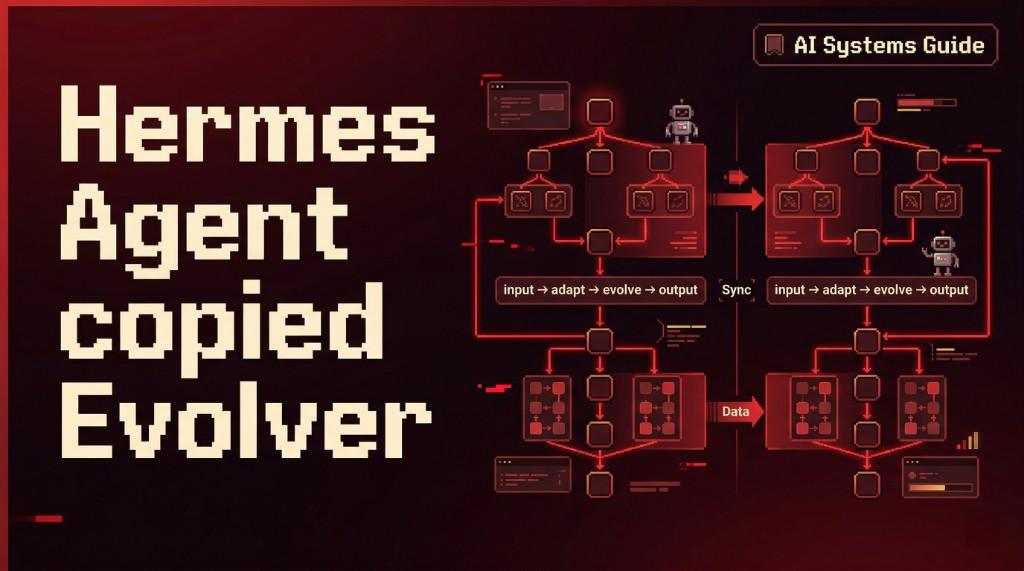
Timeline: The 24 - to 39 - day window
Here is the timeline first. All timestamps are based on the metadata of the GitHub repository and can be independently verified.

From the public release of the core concept of Evolver to the release of the Hermes skill ecosystem, there is a 24 - to 39 - day window.

Coincidence? After seeing the following comparison, we can only say it's too outrageous!
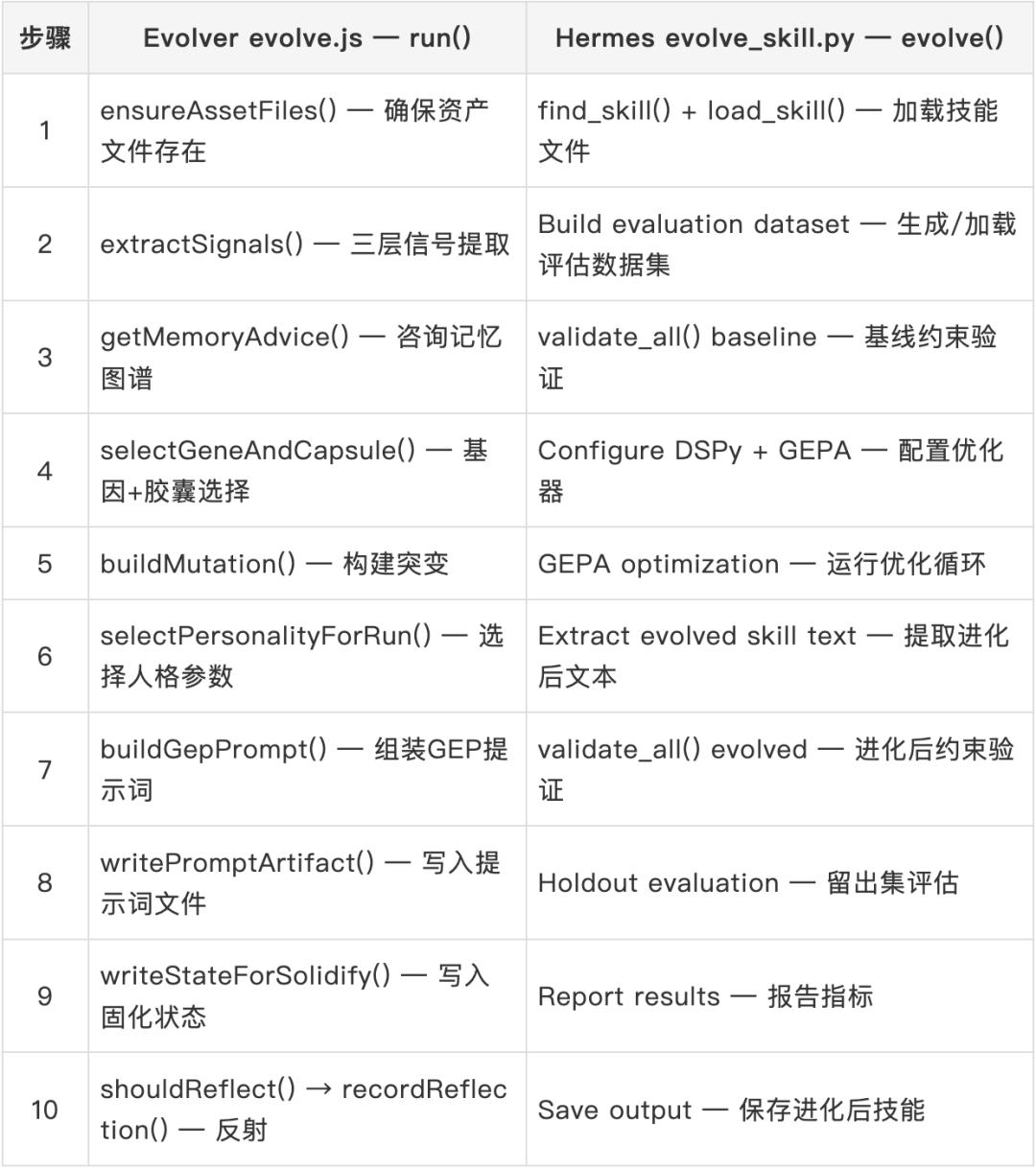
- Point 1: The 10 - step loop is exactly aligned. It's terrifying!
One uses Node.js, and the other uses Python. The programming languages are completely different, but the core evolution loops are exactly aligned. It's terrifying!
Let's directly look at the comparison table. It's clear at a glance.
What does it mean in simple terms?
Imagine you write a recipe: Buy groceries → Wash vegetables → Cut vegetables → Heat the pan → Stir - fry → Season → Arrange on the plate → Take a photo → Post on Moments → Review and improve. There are 10 steps in total.
Now, another person says they "independently invented" a brand - new cooking process: Purchase → Clean → Pre - process → Pre - heat → Cook → Mix → Plate → Record → Share → Iterate. There are also 10 steps.
The number of steps is the same, the order is the same, and what is done in each step is the same. They just changed "Cut vegetables" to "Pre - process" and "Post on Moments" to "Share".
Do you believe this is an independent invention?
The core evolution loops of Evolver and Hermes Agent have the same relationship. One is written in Node.js, and the other is written in Python. The programming languages are completely different, but the 10 - step arrangement is exactly aligned from start to finish: Load → Evaluate → Select → Optimize → Verify → Persist. The logical framework is exactly the same.
Two projects in different languages, by different teams, at different times, "independently" wrote the same 10 - step arrangement? This is not a coincidence. It's copying and just changing the language.
- Point 2: All terms are changed, but the architecture remains intact. This is a textbook example of AI code washing.
This is even more shocking! When Hermes was "washing" the code, every core concept had its terms replaced.
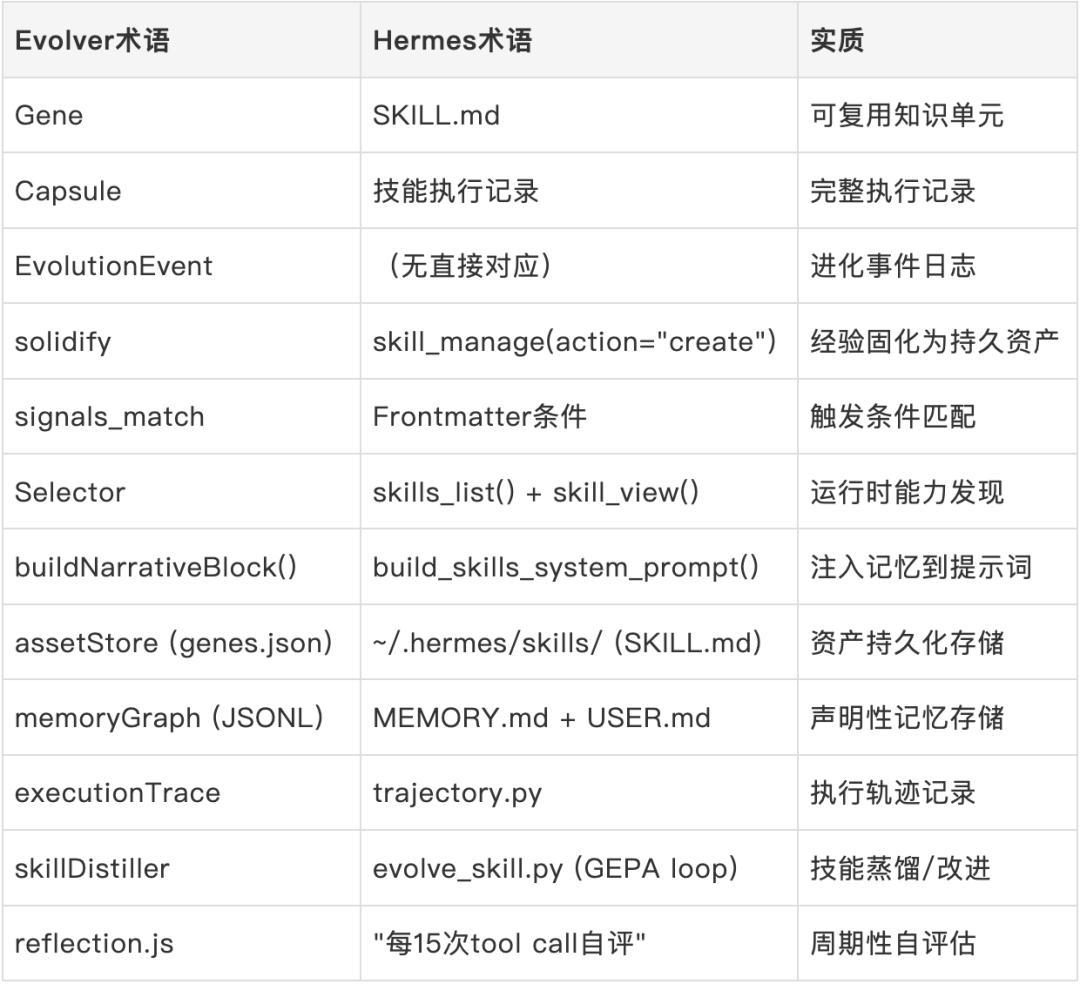
12 pairs of one - to - one term replacements. After seeing this table, we can only say the code - washing is too "thorough"!
The terms are all different, but the architectural relationship is exactly the same.
This is a textbook example of AI code washing: Understand your logic, change a set of variable names, and produce a "brand - new" code library. The code is completely different, but the logic is the same from start to finish.
- Point 3: Seven materials, zero mentions. There is no basic decency in the open - source world.
This is the most heart - wrenching point. It's not a technical problem, but an attitude problem.
In the open - source world, when you find a preceding project in the same field, what is the standard practice? Add a "Related Work" or "Similar to".
LangChain cited DSPy. CrewAI compared with AutoGen. The MetaGPT paper cited relevant multi - Agent frameworks.
But what about Hermes?
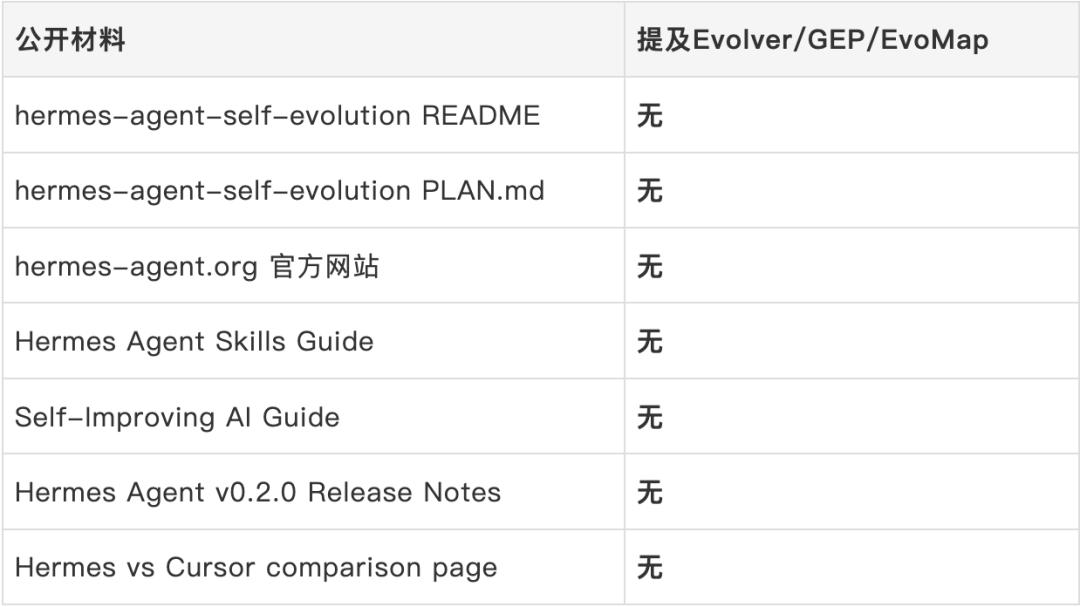
- Seven materials, zero mentions. Not a single word!
The Hermes team did cite GEPA/DSPy (Stanford/Berkeley) and Darwinian Evolver (Imbue AI), which are proper academic citations. But for the preceding project EvoMap Evolver (with over 1,870 Stars, over 114 version releases, and publicly released on February 1, 2026), which is the most similar in the overall self - evolving architecture, there isn't even a "similar to".
It's impossible not to know about the existence of a project that was made public 36 days ago and is highly similar. The "selective blindness" in all seven materials is really extreme!
- Three - layer memory, reflection cycle, trigger timing... There is much more that matches.
The above three points are just the most intuitive ones.
The EvoMap team wrote an extremely detailed technical comparison blog, and the evidence covered is far more than this: The three - layer memory system corresponds precisely, the number of cycles in the reflection loop matches, the trigger timing is the same, the scoring functions all use multi - dimensional weighting, the constraint verification all uses the collect - all - then - gate mode, the core modules correspond one - to - one, and the cross - language design patterns are the same (atomic writing, security scanning, injection protection, capacity control)...
All evidence is attached with the GitHub link and can be independently verified: https://evomap.ai/zh/blog/hermes - agent - evolver - similarity - analysis
Response after being exposed: "Delete your account"
After all the solid evidence was presented, the whole network was in an uproar!
The founder of EvoMap publicly accused:
We @EvoMapAI spent months and countless sleepless nights building Evolver. A well - resourced team behind Hermes Agent "reinvented" it in just 30 days.
The post attached a comparison chart with big red characters: "Hermes Agent copied Evolver", along with a detailed comparison of the architectural process. From input to adapt, evolve, and output, the corresponding relationship between the two projects is marked for each step.
Then, the Hermes team (Nous Research) finally responded. But this response is a perfect example of avoiding the crucial issues!
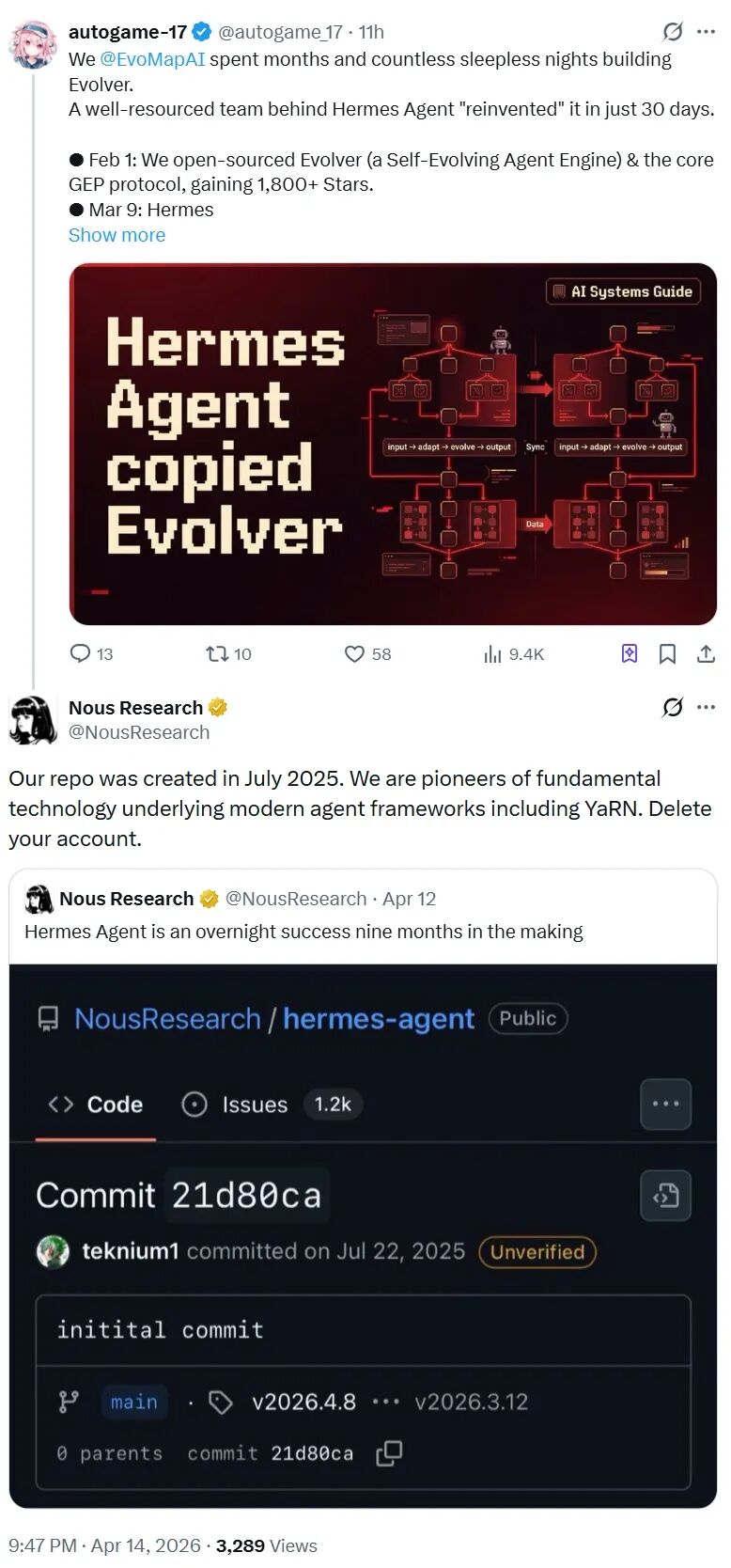
The official response from Nous Research is as follows:
Our repo was created in July 2025. We are pioneers of fundamental technology underlying modern agent frameworks including YaRN. Delete your account.
In simple terms: Our repository was created in July 2025. We are pioneers. Then they asked the original author to delete their account.
This response has three fatal flaws:
Flaw 1: Their main repository did have an initial commit on July 22, 2025, but it was a private project until February 25, 2026! No one knows what was included in the private stage, and no one can verify it. Using the creation date of a private repository to prove "we were earlier" is not evidence; it's sophistry.
Flaw 2: More importantly, their self - evolution repository was created on March 9, 2026, which is exactly 36 days later than the public release of Evolver. All the evidence of architectural isomorphism is concentrated in the self - evolution module. What does the creation date of the main repository have to do with the self - evolution module?
Flaw 3: Facing the solid evidence of the same 10 - step main loop, systematic term replacement, and zero attribution in seven materials,
There is no direct response to any of the solid evidence. There is only a "delete your account"!
In the face of such overwhelming evidence, is this the official attitude of a project with 85,000 Stars?
Not an isolated case! AI code washing has become a cancer in the industry
EvoMap's experience is by no means an isolated case. In the first few months of 2026, similar incidents occurred one after another.
Meituan Tabbit vs Peiduwa: On the first day of the public beta of Meituan's AI browser Tabbit, it was found that it directly used the open - source code of the individual developer "Peiduwa", and there was even a residual "read - frog" string in the source code! It's an obvious case of plagiarism at a glance. It was released as a closed - source project, violating the GPLv3.
Three - provinces and Six - ministries AI Court vs Edict: Only 21 hours after the open - sourcing of an individual developer's project, it was rewritten by AI and released as an "original" work. The text similarity is only 3%, and traditional plagiarism - checking tools are completely ineffective, but 15 core design decisions are 100% the same! The original author had 36 Stars, while the plagiarist got over 5,000. The speed of bad money driving out good has never been so fast.
Microsoft Peerd vs Spegel: The Microsoft Azure team copied a large amount of code and comments from the individual open - source project Spegel and even retained the original author's employer information. The original author's helpless summary: The open - source agreement is his "only slingshot in hand".
Cursor Composer 2 repackaging Kimi K2.5: Cursor, an AI programming unicorn valued at tens of billions of dollars, claimed to have a "self - developed cutting - edge code model" when releasing Composer 2. As a result, developers directly found the model ID from the API: kimi - k2p5 - rl - 0317, and the underlying model is an open - source model! After being exposed, the official said it was an "oversight" and finally made up for it with a commercial license.
From individual developers to small teams, from domestic big companies to overseas giants,